HEAT ENERGYHEAT ENERGY
What is HEAT?
 Form of energy and measured in
JOULES
 Particles move about more and take up
more room if heated – this is why things
expand if heated
 It is also why substances change from:
solids liquids gases
when heated
Visit www.worldofteaching.com for more free powerpoints
Heat and TemperatureHeat and Temperature
The temperature of an object tells us how
HOT it is
Measured in degrees Celsius - °C
It is NOT the same as heat energy although
the two quantities are related.
e.g. a beaker of water at 60 °C is hotter
than a bath of water at 40 °C BUT the
bath contains more joules of heat energy
Heating and CoolingHeating and Cooling
If an object has become hotter,
it means that it has gained heat energy.
If an object cools down, it means it has
lost energy
Heating and Cooling cont…Heating and Cooling cont…
 Heat energy always moves from:
HOT object COOLER object
e.g.Cup of water at 20 °C in a room at 30°C -
gains heat energy and heats up – its temperature
rises
Cup of water at 20 °C in a room at 10°C
loses heat energy and cools down – its
temperature will fall.
TemperatureTemperature
Measured with thermometers
Most materials expand when
heated.
e.g. hot air balloon
Temperature ScalesTemperature Scales
Three different ones get used
Fahrenheit- the one we use
Celsius- metric standard
Kelvin- starts at absolute zero but
same degree size as Celsius
HistoryHistory
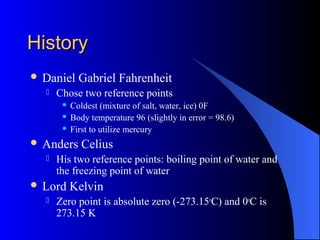
 Daniel Gabriel Fahrenheit
 Chose two reference points
 Coldest (mixture of salt, water, ice) 0F
 Body temperature 96 (slightly in error = 98.6)
 First to utilize mercury
 Anders Celius
 His two reference points: boiling point of water and
the freezing point of water
 Lord Kelvin
 Zero point is absolute zero (-273.15o
C) and 0o
C is
273.15 K
Converting TemperatureConverting Temperature
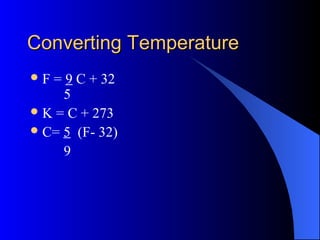
F = 9 C + 32
5
K = C + 273
C= 5 (F- 32)
9
Sample ProblemsSample Problems
1.Water freezes at 32°F, what is this in
Celsius?
2. Water boils at 100°C. What is this in
Fahrenheit? In Kelvin?
3. Methanol boils at 75°C, what is this in
Fahrenheit?, in Kelvin?
HEAT ENERGYHEAT ENERGY
Energy transfer
Conduction
Convection
Radiation
ConductionConduction
Heat is transferred through a material by
being passed from one particle to the next
Particles at the warm end move faster and
this then causes the next particles to move
faster and so on.
In this way heat in an object travels from:
the HOT end the cold end
Conduction cont…Conduction cont…
Occurs by the particles hitting each other
and so energy is transferred.
Can happen in solids, liquids and gases,
Happens best in solids-particles very close
together
Conduction does not occur very quickly in
liquids or gases
ConductorsConductors
Materials that conduct heat quickly are
called conductors
All metals are good conductors of heat
Copper is a very good conductor of heat
Pans for cooking are usually made with a
copper or aluminium bottom and plastic
handles
Insulators/poor conductorsInsulators/poor conductors
 Materials that conduct heat slowly or poorly are
called insulators
 Glass, wood, plastic and rubber are poor
conductors (good insulators)
 Nearly all liquids including water are poor
conductors (good insulators)
 Gases, including air are poor conductors,e.g., wool
feels warm because it traps a lot of air
 A fridge has insulation material round it to keep it
cold – reduces amount of heat conducted to inside
from the warmer room
ConvectionConvection
Takes place in material where particles can
move around inside the material, i.e. liquid or
gas
The heat is carried by the particles themselves
moving Convection
currents
Occur because an area with warm particles
expands and becomes less dense than the
cooler areas nearby. The warm area rises.
Cooler particles fall into the space left by the
warm particles and convection current is set up
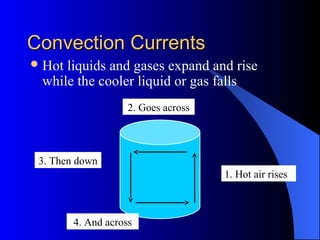
Convection CurrentsConvection Currents
Hot liquids and gases expand and rise
while the cooler liquid or gas falls
1. Hot air rises
2. Goes across
3. Then down
4. And across
Convection cont…Convection cont…
The sun can cause large convection
currents - WINDS
During daytime the land warms up more
than the sea. The warm air rises over the
land and cool air falls over the sea. So we
feel a sea breeze.
Rising convection currents can be uses by
glider pilots to keep their planes in the air
and by birds to stay aloft.
RadiationRadiation
Transfer of heat directly form the source to the
object by a wave, travelling as rays.
Heat radiation is also known as
All objects that are hotter than their surroundings
give out heat as infra-red radiation
Heat transfer by radiation does not need particles
to occur and is the only way energy can be
transferred across empty space
INFRA-RED
RADIATION
EmittersEmitters
Hotter objects emit (give out) heat
Different surfaces emit heat at different speeds
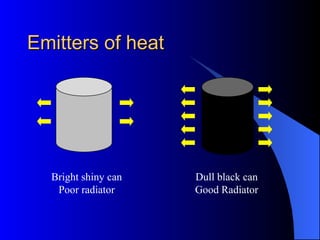
A dull black surfaces loses energy more
quickly – it is a good radiator
A bright shiny or white surface is a poor
radiator
Marathon runners need to keep warm at the end
of races, covering in shiny blankets reduces
radiation and therefore heat loss.
Emitters of heatEmitters of heat
Bright shiny can
Poor radiator
Dull black can
Good Radiator
AbsorbersAbsorbers
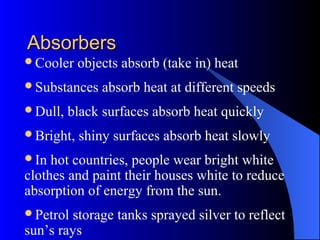
Cooler objects absorb (take in) heat
Substances absorb heat at different speeds
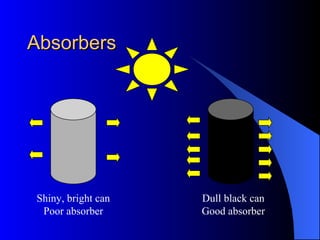
Dull, black surfaces absorb heat quickly
Bright, shiny surfaces absorb heat slowly
In hot countries, people wear bright white
clothes and paint their houses white to reduce
absorption of energy from the sun.
Petrol storage tanks sprayed silver to reflect
sun’s rays
AbsorbersAbsorbers
Shiny, bright can
Poor absorber
Dull black can
Good absorber
Key WordsKey Words
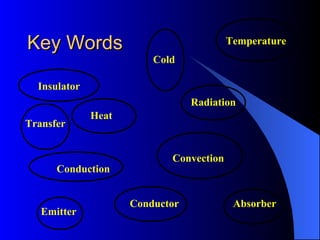
Heat
Radiation
Convection
Conduction
Cold
Insulator
Conductor
Temperature
Emitter
Absorber
Transfer

Heat energy

  • 1.
    HEAT ENERGYHEAT ENERGY Whatis HEAT?  Form of energy and measured in JOULES  Particles move about more and take up more room if heated – this is why things expand if heated  It is also why substances change from: solids liquids gases when heated Visit www.worldofteaching.com for more free powerpoints
  • 2.
    Heat and TemperatureHeatand Temperature The temperature of an object tells us how HOT it is Measured in degrees Celsius - °C It is NOT the same as heat energy although the two quantities are related. e.g. a beaker of water at 60 °C is hotter than a bath of water at 40 °C BUT the bath contains more joules of heat energy
  • 3.
    Heating and CoolingHeatingand Cooling If an object has become hotter, it means that it has gained heat energy. If an object cools down, it means it has lost energy
  • 4.
    Heating and Coolingcont…Heating and Cooling cont…  Heat energy always moves from: HOT object COOLER object e.g.Cup of water at 20 °C in a room at 30°C - gains heat energy and heats up – its temperature rises Cup of water at 20 °C in a room at 10°C loses heat energy and cools down – its temperature will fall.
  • 5.
    TemperatureTemperature Measured with thermometers Mostmaterials expand when heated. e.g. hot air balloon
  • 6.
    Temperature ScalesTemperature Scales Threedifferent ones get used Fahrenheit- the one we use Celsius- metric standard Kelvin- starts at absolute zero but same degree size as Celsius
  • 7.
    HistoryHistory  Daniel GabrielFahrenheit  Chose two reference points  Coldest (mixture of salt, water, ice) 0F  Body temperature 96 (slightly in error = 98.6)  First to utilize mercury  Anders Celius  His two reference points: boiling point of water and the freezing point of water  Lord Kelvin  Zero point is absolute zero (-273.15o C) and 0o C is 273.15 K
  • 8.
    Converting TemperatureConverting Temperature F= 9 C + 32 5 K = C + 273 C= 5 (F- 32) 9
  • 9.
    Sample ProblemsSample Problems 1.Waterfreezes at 32°F, what is this in Celsius? 2. Water boils at 100°C. What is this in Fahrenheit? In Kelvin? 3. Methanol boils at 75°C, what is this in Fahrenheit?, in Kelvin?
  • 10.
    HEAT ENERGYHEAT ENERGY Energytransfer Conduction Convection Radiation
  • 11.
    ConductionConduction Heat is transferredthrough a material by being passed from one particle to the next Particles at the warm end move faster and this then causes the next particles to move faster and so on. In this way heat in an object travels from: the HOT end the cold end
  • 12.
    Conduction cont…Conduction cont… Occursby the particles hitting each other and so energy is transferred. Can happen in solids, liquids and gases, Happens best in solids-particles very close together Conduction does not occur very quickly in liquids or gases
  • 13.
    ConductorsConductors Materials that conductheat quickly are called conductors All metals are good conductors of heat Copper is a very good conductor of heat Pans for cooking are usually made with a copper or aluminium bottom and plastic handles
  • 14.
    Insulators/poor conductorsInsulators/poor conductors Materials that conduct heat slowly or poorly are called insulators  Glass, wood, plastic and rubber are poor conductors (good insulators)  Nearly all liquids including water are poor conductors (good insulators)  Gases, including air are poor conductors,e.g., wool feels warm because it traps a lot of air  A fridge has insulation material round it to keep it cold – reduces amount of heat conducted to inside from the warmer room
  • 15.
    ConvectionConvection Takes place inmaterial where particles can move around inside the material, i.e. liquid or gas The heat is carried by the particles themselves moving Convection currents Occur because an area with warm particles expands and becomes less dense than the cooler areas nearby. The warm area rises. Cooler particles fall into the space left by the warm particles and convection current is set up
  • 16.
    Convection CurrentsConvection Currents Hotliquids and gases expand and rise while the cooler liquid or gas falls 1. Hot air rises 2. Goes across 3. Then down 4. And across
  • 17.
    Convection cont…Convection cont… Thesun can cause large convection currents - WINDS During daytime the land warms up more than the sea. The warm air rises over the land and cool air falls over the sea. So we feel a sea breeze. Rising convection currents can be uses by glider pilots to keep their planes in the air and by birds to stay aloft.
  • 18.
    RadiationRadiation Transfer of heatdirectly form the source to the object by a wave, travelling as rays. Heat radiation is also known as All objects that are hotter than their surroundings give out heat as infra-red radiation Heat transfer by radiation does not need particles to occur and is the only way energy can be transferred across empty space INFRA-RED RADIATION
  • 19.
    EmittersEmitters Hotter objects emit(give out) heat Different surfaces emit heat at different speeds A dull black surfaces loses energy more quickly – it is a good radiator A bright shiny or white surface is a poor radiator Marathon runners need to keep warm at the end of races, covering in shiny blankets reduces radiation and therefore heat loss.
  • 20.
    Emitters of heatEmittersof heat Bright shiny can Poor radiator Dull black can Good Radiator
  • 21.
    AbsorbersAbsorbers Cooler objects absorb(take in) heat Substances absorb heat at different speeds Dull, black surfaces absorb heat quickly Bright, shiny surfaces absorb heat slowly In hot countries, people wear bright white clothes and paint their houses white to reduce absorption of energy from the sun. Petrol storage tanks sprayed silver to reflect sun’s rays
  • 22.
    AbsorbersAbsorbers Shiny, bright can Poorabsorber Dull black can Good absorber
  • 23.