Copyright © 2008 Pearson Education, Inc.,
publishing as Pearson Benjamin Cummings
PowerPoint®
Lecture Slide Presentation
prepared by
Michael Hall
Chapter 15
Cardiovascular
Disease:
Reducing Your Risk
Copyright © 2008 Pearson Education, Inc., publishing as Pearson Benjamin Cummings
Objectives
 Discuss the incidence, prevalence, and outcomes of
cardiovascular disease.
 Describe the anatomy and physiology of the heart and
circulatory system and the importance of healthy heart
function.
 Review major types of heart disease, factors that contribute to
their development, diagnostic and treatment options and the
importance of fundamental lifestyle modifications aimed at
prevention.
 Discuss controllable and uncontrollable risk factors for
cardiovascular disease; your own risk profile, and determine
the risk factors you can and cannot control.
 Discuss methods of diagnosing and treating cardiovascular
disease.
Copyright © 2008 Pearson Education, Inc., publishing as Pearson Benjamin Cummings
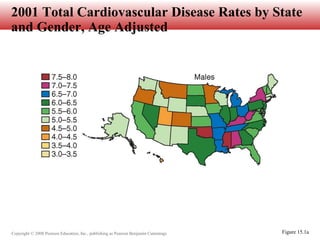
2001 Total Cardiovascular Disease Rates by State
and Gender, Age Adjusted
Figure 15.1a
Copyright © 2008 Pearson Education, Inc., publishing as Pearson Benjamin Cummings
2001 Total Cardiovascular Disease Rates by State
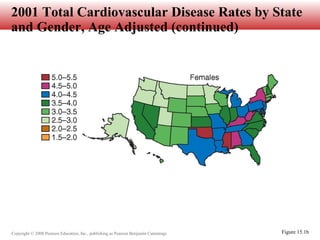
and Gender, Age Adjusted (continued)
Figure 15.1b
Copyright © 2008 Pearson Education, Inc., publishing as Pearson Benjamin Cummings
An Epidemiological Overview
 Cardiovascular disease (CVD) is the leading cause of
death in the U.S.
 In 2005 CVD accounted for approximately 38 percent
of all deaths
 CVD has been the number one killer in the U.S. since
1900 except for 1918 (influenza)
 More that 2,500 Americans die from CVD each day
 Among women, 1 in 2.6 deaths from CVD
Copyright © 2008 Pearson Education, Inc., publishing as Pearson Benjamin Cummings
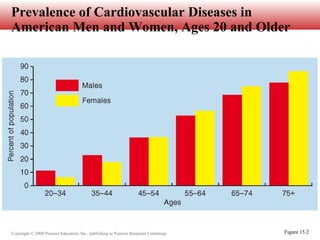
Prevalence of Cardiovascular Diseases in
American Men and Women, Ages 20 and Older
Figure 15.2
Copyright © 2008 Pearson Education, Inc., publishing as Pearson Benjamin Cummings
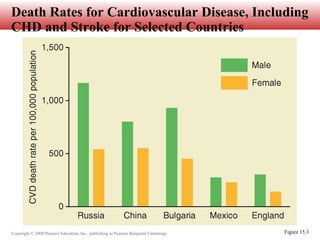
Death Rates for Cardiovascular Disease, Including
CHD and Stroke for Selected Countries
Figure 15.3
Copyright © 2008 Pearson Education, Inc., publishing as Pearson Benjamin Cummings
ABC News: Cardiovascular Disease
Play
Video
Play
Video
| Cardiovascular Disease
Copyright © 2008 Pearson Education, Inc., publishing as Pearson Benjamin Cummings
ABC News: Cardiovascular Disease
Discussion Questions:
 How does inflammation account for nearly 85% of all
heart attacks?
 What test measures inflammation and how expensive
is it?
 Why have physicians been hesitate to order tests to
measure inflammation?
 What dietary changes are recommended to lower
inflammation?
Copyright © 2008 Pearson Education, Inc., publishing as Pearson Benjamin Cummings
Understanding The Cardiovascular System
 Cardiovascular system includes: the heart, arteries,
arterioles, capillaries, venules, and veins
 The heart
• Muscular, four chambered pump
• Contracts 100,000 times per day
• Two upper chambers: atria
• Two lower chambers: ventricles
• Tricuspid, pulmonary, mitral, and aortic valves
Copyright © 2008 Pearson Education, Inc., publishing as Pearson Benjamin Cummings
Heart Function
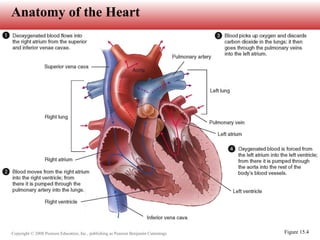
 Deoxygenated blood enters the right atrium
 From the right atrium blood moves to the right
ventricle, pumped through the pulmonary artery to the
lungs
 Oxygen blood enters the left atrium
 Blood from the left atrium is forced into the left
ventricle
 The left ventricle pumps blood through the aorta to
various parts of the body
Copyright © 2008 Pearson Education, Inc., publishing as Pearson Benjamin Cummings
Anatomy of the Heart
Figure 15.4
Copyright © 2008 Pearson Education, Inc., publishing as Pearson Benjamin Cummings
Types Of Cardiovascular Disease
 Atherosclerosis
 Coronary heart disease (CHD)
 Chest pain (angina pectoris)
 Irregular heartbeat (arrhythmia)
 Congestive heart failure (CHF)
 Congenital and rheumatic heart disease
 Stroke
Copyright © 2008 Pearson Education, Inc., publishing as Pearson Benjamin Cummings
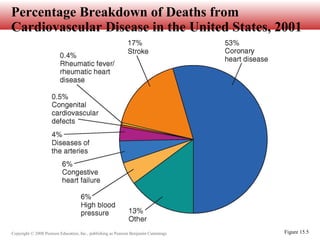
Percentage Breakdown of Deaths from
Cardiovascular Disease in the United States, 2001
Figure 15.5
Copyright © 2008 Pearson Education, Inc., publishing as Pearson Benjamin Cummings
Artherosclerosis
 Characterized by deposits of fatty substances,
cholesterol, cellular waste products, calcium, and
fibrin in the inner lining of the artery
 Hyperlipidemia – abnormally high blood lipid level
 Plaque – the buildup of deposits in the arteries
Copyright © 2008 Pearson Education, Inc., publishing as Pearson Benjamin Cummings
Coronary Heart Disease
 Myocardial infarction (MI) or heart attack – blood
supplying the heart is disrupted
 Coronary thrombosis – blood clot in the artery
 Embolus – when the blood clot is dislodged and
moves through the circulatory system
 Collateral circulation - if blockage to the heart is
minor, an alternative blood flow is selected
Copyright © 2008 Pearson Education, Inc., publishing as Pearson Benjamin Cummings
Angina Pectoris
 Ischemia – reduction of the heart’s blood and oxygen
supply
 The more serious the oxygen deprivation the more
severe the pain
 Nitroglycerin – drug used to relax (dilate) the veins
 Beta blockers control potential overactivity of the
heart muscle
Copyright © 2008 Pearson Education, Inc., publishing as Pearson Benjamin Cummings
Arrythmias
 An irregularity in heart rhythm
 Tachycardia – racing heart in the absence of exercise
or anxiety
 Bradycardia – abnormally slow heartbeat
 Fibrillation – heart beat is sporadic, quivering pattern
Copyright © 2008 Pearson Education, Inc., publishing as Pearson Benjamin Cummings
Congestive Heart Failure (CHF)
 Damaged or overworked heart muscle is unable to
keep blood circulating normally
 Affects over 5 million Americans
 Damage to heart muscle may result from: rheumatic
fever, pneumonia, heart attack, or other
cardiovascular problem
 Lack of proper circulation may allow blood to
accumulate in the vessels of the legs, ankles, or lungs
 Diuretics relieve fluid accumulation
Copyright © 2008 Pearson Education, Inc., publishing as Pearson Benjamin Cummings
Congenital And Rheumatic Heart Disease
 Congenital heart disease affects 1 out of 125 children
born
 May be due to hereditary factors, maternal diseases,
or chemical intake (alcohol) during fetal development
 Rheumatic heart disease results from rheumatic fever
which affects connective tissue
Copyright © 2008 Pearson Education, Inc., publishing as Pearson Benjamin Cummings
Stroke
 Occurs when the blood supply to the brain is
interrupted
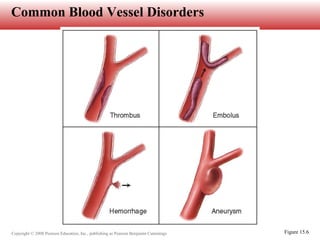
 Thrombus – blood clot
 Embolus – free flowing clot
 Aneurysm – bulging or burst blood vessel
 Transient ischemic attack (TIA) – brief interruptions
that cause temporary impairment
Copyright © 2008 Pearson Education, Inc., publishing as Pearson Benjamin Cummings
Common Blood Vessel Disorders
Figure 15.6
Copyright © 2008 Pearson Education, Inc., publishing as Pearson Benjamin Cummings
Reducing Your Risk For Cardiovascular Diseases
 Risks you can control
• Avoid tobacco
• Cut back on saturated fat and cholesterol
• Maintain a healthy weight
• Modify dietary habits
• Exercise regularly
• Control diabetes
• Control blood pressure
• Systolic – upper number
• Diastolic – lower number
• Manage stress
Copyright © 2008 Pearson Education, Inc., publishing as Pearson Benjamin Cummings
Reducing Your Risk For Cardiovascular Diseases
 Risks you cannot control
• Heredity
• Age
• Gender
• Race
Copyright © 2008 Pearson Education, Inc., publishing as Pearson Benjamin Cummings
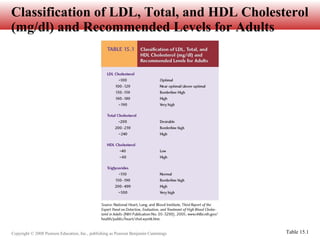
Classification of LDL, Total, and HDL Cholesterol
(mg/dl) and Recommended Levels for Adults
Table 15.1
Copyright © 2008 Pearson Education, Inc., publishing as Pearson Benjamin Cummings
Women And Cardiovascular Disease
 2003, CVD deaths
• 426,800 men
• 483,800 women
 Estrogen
• Once estrogen production stops, risk for CVD death increases
 Diagnostic and therapeutic differences
• Delay in diagnosing possible heart attack
• Complexity in interpreting chest pain in women
• Less aggressive treatment of female heart attack victims
• Smaller coronary arteries in women
 Gender bias in CVD research – typically CVD research has been
conducted on male subjects
Copyright © 2008 Pearson Education, Inc., publishing as Pearson Benjamin Cummings
New Weapons Against Heart Disease
 Techniques for diagnosing heart disease
• Electrocardiogram (ECG)
• Angiography
• Positron emission tomography (PET)
• Single positron emission color tomography
(SPECT)
• Radionuclide imaging
• Magnetic resonance imaging (MRI)
• Ultrafast CT
• Digital cardiac angiography (DSA)
Copyright © 2008 Pearson Education, Inc., publishing as Pearson Benjamin Cummings
Angioplasty Versus Bypass Surgery
 Angioplasty – a thin catheter is threaded through the
blocked arteries. The catheter has a balloon on the tip
which is inflated to flatten the fatty deposits against
the wall of the artery
 Coronary bypass surgery – a blood vessel is taken
from another site and implanted to bypass blocked
arteries and transport blood
Copyright © 2008 Pearson Education, Inc., publishing as Pearson Benjamin Cummings
Aspirin For Heart Disease?
 Research shows that 80 milligrams of aspirin every
other day is beneficial to heart patients due to its
blood thinning properties
 Some side effects of aspirin: gastrointestinal
intolerance and a tendency for difficulty with blood
clotting
 Should only be taken under the advice of your
physician
Copyright © 2008 Pearson Education, Inc., publishing as Pearson Benjamin Cummings
Thrombolysis
 If victim reaches an emergency room and is diagnosed
quickly, thrombolysis can be performed
 Thrombolysis involves injecting an agent such as
tissue plasminogen activator (TPA) to dissolve the
clot and restore some blood flow
Copyright © 2008 Pearson Education, Inc., publishing as Pearson Benjamin Cummings
Cardiac Rehabilitation
 Every year, 1 million people survive heart attacks
 Cardiac rehabilitation exercise training increases
stamina and strength, and promotes recovery
Copyright © 2008 Pearson Education, Inc., publishing as Pearson Benjamin Cummings
Personal Advocacy And Heart-Smart Behaviors
 Know your rights as a patient
 Find out about informed consent procedures, living
wills, durable power of attorney, organ donation, and
other legal issues BEFORE you become sick
 Ask about alternative procedures
 Remain with your loved one as a personal advocate
 Monitor the actions of health care providers
 Be considerate of your care provider
 Be patient with the patient

Ch15 lecture

  • 1.
    Copyright © 2008Pearson Education, Inc., publishing as Pearson Benjamin Cummings PowerPoint® Lecture Slide Presentation prepared by Michael Hall Chapter 15 Cardiovascular Disease: Reducing Your Risk
  • 2.
    Copyright © 2008Pearson Education, Inc., publishing as Pearson Benjamin Cummings Objectives  Discuss the incidence, prevalence, and outcomes of cardiovascular disease.  Describe the anatomy and physiology of the heart and circulatory system and the importance of healthy heart function.  Review major types of heart disease, factors that contribute to their development, diagnostic and treatment options and the importance of fundamental lifestyle modifications aimed at prevention.  Discuss controllable and uncontrollable risk factors for cardiovascular disease; your own risk profile, and determine the risk factors you can and cannot control.  Discuss methods of diagnosing and treating cardiovascular disease.
  • 3.
    Copyright © 2008Pearson Education, Inc., publishing as Pearson Benjamin Cummings 2001 Total Cardiovascular Disease Rates by State and Gender, Age Adjusted Figure 15.1a
  • 4.
    Copyright © 2008Pearson Education, Inc., publishing as Pearson Benjamin Cummings 2001 Total Cardiovascular Disease Rates by State and Gender, Age Adjusted (continued) Figure 15.1b
  • 5.
    Copyright © 2008Pearson Education, Inc., publishing as Pearson Benjamin Cummings An Epidemiological Overview  Cardiovascular disease (CVD) is the leading cause of death in the U.S.  In 2005 CVD accounted for approximately 38 percent of all deaths  CVD has been the number one killer in the U.S. since 1900 except for 1918 (influenza)  More that 2,500 Americans die from CVD each day  Among women, 1 in 2.6 deaths from CVD
  • 6.
    Copyright © 2008Pearson Education, Inc., publishing as Pearson Benjamin Cummings Prevalence of Cardiovascular Diseases in American Men and Women, Ages 20 and Older Figure 15.2
  • 7.
    Copyright © 2008Pearson Education, Inc., publishing as Pearson Benjamin Cummings Death Rates for Cardiovascular Disease, Including CHD and Stroke for Selected Countries Figure 15.3
  • 8.
    Copyright © 2008Pearson Education, Inc., publishing as Pearson Benjamin Cummings ABC News: Cardiovascular Disease Play Video Play Video | Cardiovascular Disease
  • 9.
    Copyright © 2008Pearson Education, Inc., publishing as Pearson Benjamin Cummings ABC News: Cardiovascular Disease Discussion Questions:  How does inflammation account for nearly 85% of all heart attacks?  What test measures inflammation and how expensive is it?  Why have physicians been hesitate to order tests to measure inflammation?  What dietary changes are recommended to lower inflammation?
  • 10.
    Copyright © 2008Pearson Education, Inc., publishing as Pearson Benjamin Cummings Understanding The Cardiovascular System  Cardiovascular system includes: the heart, arteries, arterioles, capillaries, venules, and veins  The heart • Muscular, four chambered pump • Contracts 100,000 times per day • Two upper chambers: atria • Two lower chambers: ventricles • Tricuspid, pulmonary, mitral, and aortic valves
  • 11.
    Copyright © 2008Pearson Education, Inc., publishing as Pearson Benjamin Cummings Heart Function  Deoxygenated blood enters the right atrium  From the right atrium blood moves to the right ventricle, pumped through the pulmonary artery to the lungs  Oxygen blood enters the left atrium  Blood from the left atrium is forced into the left ventricle  The left ventricle pumps blood through the aorta to various parts of the body
  • 12.
    Copyright © 2008Pearson Education, Inc., publishing as Pearson Benjamin Cummings Anatomy of the Heart Figure 15.4
  • 13.
    Copyright © 2008Pearson Education, Inc., publishing as Pearson Benjamin Cummings Types Of Cardiovascular Disease  Atherosclerosis  Coronary heart disease (CHD)  Chest pain (angina pectoris)  Irregular heartbeat (arrhythmia)  Congestive heart failure (CHF)  Congenital and rheumatic heart disease  Stroke
  • 14.
    Copyright © 2008Pearson Education, Inc., publishing as Pearson Benjamin Cummings Percentage Breakdown of Deaths from Cardiovascular Disease in the United States, 2001 Figure 15.5
  • 15.
    Copyright © 2008Pearson Education, Inc., publishing as Pearson Benjamin Cummings Artherosclerosis  Characterized by deposits of fatty substances, cholesterol, cellular waste products, calcium, and fibrin in the inner lining of the artery  Hyperlipidemia – abnormally high blood lipid level  Plaque – the buildup of deposits in the arteries
  • 16.
    Copyright © 2008Pearson Education, Inc., publishing as Pearson Benjamin Cummings Coronary Heart Disease  Myocardial infarction (MI) or heart attack – blood supplying the heart is disrupted  Coronary thrombosis – blood clot in the artery  Embolus – when the blood clot is dislodged and moves through the circulatory system  Collateral circulation - if blockage to the heart is minor, an alternative blood flow is selected
  • 17.
    Copyright © 2008Pearson Education, Inc., publishing as Pearson Benjamin Cummings Angina Pectoris  Ischemia – reduction of the heart’s blood and oxygen supply  The more serious the oxygen deprivation the more severe the pain  Nitroglycerin – drug used to relax (dilate) the veins  Beta blockers control potential overactivity of the heart muscle
  • 18.
    Copyright © 2008Pearson Education, Inc., publishing as Pearson Benjamin Cummings Arrythmias  An irregularity in heart rhythm  Tachycardia – racing heart in the absence of exercise or anxiety  Bradycardia – abnormally slow heartbeat  Fibrillation – heart beat is sporadic, quivering pattern
  • 19.
    Copyright © 2008Pearson Education, Inc., publishing as Pearson Benjamin Cummings Congestive Heart Failure (CHF)  Damaged or overworked heart muscle is unable to keep blood circulating normally  Affects over 5 million Americans  Damage to heart muscle may result from: rheumatic fever, pneumonia, heart attack, or other cardiovascular problem  Lack of proper circulation may allow blood to accumulate in the vessels of the legs, ankles, or lungs  Diuretics relieve fluid accumulation
  • 20.
    Copyright © 2008Pearson Education, Inc., publishing as Pearson Benjamin Cummings Congenital And Rheumatic Heart Disease  Congenital heart disease affects 1 out of 125 children born  May be due to hereditary factors, maternal diseases, or chemical intake (alcohol) during fetal development  Rheumatic heart disease results from rheumatic fever which affects connective tissue
  • 21.
    Copyright © 2008Pearson Education, Inc., publishing as Pearson Benjamin Cummings Stroke  Occurs when the blood supply to the brain is interrupted  Thrombus – blood clot  Embolus – free flowing clot  Aneurysm – bulging or burst blood vessel  Transient ischemic attack (TIA) – brief interruptions that cause temporary impairment
  • 22.
    Copyright © 2008Pearson Education, Inc., publishing as Pearson Benjamin Cummings Common Blood Vessel Disorders Figure 15.6
  • 23.
    Copyright © 2008Pearson Education, Inc., publishing as Pearson Benjamin Cummings Reducing Your Risk For Cardiovascular Diseases  Risks you can control • Avoid tobacco • Cut back on saturated fat and cholesterol • Maintain a healthy weight • Modify dietary habits • Exercise regularly • Control diabetes • Control blood pressure • Systolic – upper number • Diastolic – lower number • Manage stress
  • 24.
    Copyright © 2008Pearson Education, Inc., publishing as Pearson Benjamin Cummings Reducing Your Risk For Cardiovascular Diseases  Risks you cannot control • Heredity • Age • Gender • Race
  • 25.
    Copyright © 2008Pearson Education, Inc., publishing as Pearson Benjamin Cummings Classification of LDL, Total, and HDL Cholesterol (mg/dl) and Recommended Levels for Adults Table 15.1
  • 26.
    Copyright © 2008Pearson Education, Inc., publishing as Pearson Benjamin Cummings Women And Cardiovascular Disease  2003, CVD deaths • 426,800 men • 483,800 women  Estrogen • Once estrogen production stops, risk for CVD death increases  Diagnostic and therapeutic differences • Delay in diagnosing possible heart attack • Complexity in interpreting chest pain in women • Less aggressive treatment of female heart attack victims • Smaller coronary arteries in women  Gender bias in CVD research – typically CVD research has been conducted on male subjects
  • 27.
    Copyright © 2008Pearson Education, Inc., publishing as Pearson Benjamin Cummings New Weapons Against Heart Disease  Techniques for diagnosing heart disease • Electrocardiogram (ECG) • Angiography • Positron emission tomography (PET) • Single positron emission color tomography (SPECT) • Radionuclide imaging • Magnetic resonance imaging (MRI) • Ultrafast CT • Digital cardiac angiography (DSA)
  • 28.
    Copyright © 2008Pearson Education, Inc., publishing as Pearson Benjamin Cummings Angioplasty Versus Bypass Surgery  Angioplasty – a thin catheter is threaded through the blocked arteries. The catheter has a balloon on the tip which is inflated to flatten the fatty deposits against the wall of the artery  Coronary bypass surgery – a blood vessel is taken from another site and implanted to bypass blocked arteries and transport blood
  • 29.
    Copyright © 2008Pearson Education, Inc., publishing as Pearson Benjamin Cummings Aspirin For Heart Disease?  Research shows that 80 milligrams of aspirin every other day is beneficial to heart patients due to its blood thinning properties  Some side effects of aspirin: gastrointestinal intolerance and a tendency for difficulty with blood clotting  Should only be taken under the advice of your physician
  • 30.
    Copyright © 2008Pearson Education, Inc., publishing as Pearson Benjamin Cummings Thrombolysis  If victim reaches an emergency room and is diagnosed quickly, thrombolysis can be performed  Thrombolysis involves injecting an agent such as tissue plasminogen activator (TPA) to dissolve the clot and restore some blood flow
  • 31.
    Copyright © 2008Pearson Education, Inc., publishing as Pearson Benjamin Cummings Cardiac Rehabilitation  Every year, 1 million people survive heart attacks  Cardiac rehabilitation exercise training increases stamina and strength, and promotes recovery
  • 32.
    Copyright © 2008Pearson Education, Inc., publishing as Pearson Benjamin Cummings Personal Advocacy And Heart-Smart Behaviors  Know your rights as a patient  Find out about informed consent procedures, living wills, durable power of attorney, organ donation, and other legal issues BEFORE you become sick  Ask about alternative procedures  Remain with your loved one as a personal advocate  Monitor the actions of health care providers  Be considerate of your care provider  Be patient with the patient