NIKHIL VAISHNAV
M.Sc.(Nursing)
Date
PERIPHERAL ARTERY
DISEASE
CONTENT
Your Footer Here 2Date
• Introduction
• Definition
• Incidence
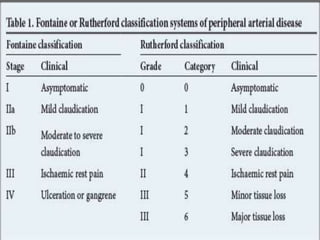
• Classification
• Etiology
• Risk factors
• Clinical menifestations
• Complications
• Assessment & Diagnostic
evaluation
• Medical & surgical
management
• Nursing management
INTRODUCTION
Peripheral artery disease (PAD) is an
abnormal narrowing of arteries other than
those that supply the heart or brain.
PAD is a common circulatory problem in
which narrowed arteries reduce blood
flow to limbs.
Your Footer Here 3Date
DEFINITION
• PAD is the thickening of the artery walls that
results in a progressive narrowing of the
arteries of the upper and lower extremities.
• Peripheral artery disease most commonly
affects the legs, but other arteries may also
be involved.
• PAD is a marker of advanced systemic
atheroslcerosis.
Your Footer Here 4Date
• This condition may be reducing blood
flow to the heart and brain as well.
• PAD can be treated with exercise, with
a healthy diet, quitting smoking.
• Early diagnosis & treatment is
important in the treatment to stop the
heart disease and stroke.
Your Footer Here 5Date
INCIDENCE
In 2010, 202 million people around the world
were living with PAD.
The majority of individuals with PAD (70 percent)
live in low/middle income regions of the world,
including 55 million individuals in southeast Asia
and 46 million in the Western Pacific Region.
Your Footer Here 6Date
Date Your Footer Here 7
Date Your Footer Here 8
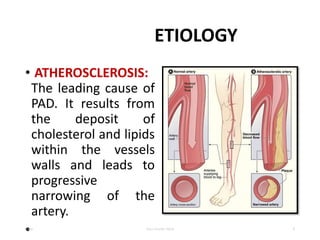
ETIOLOGY
• ATHEROSCLEROSIS:
The leading cause of
PAD. It results from
the deposit of
cholesterol and lipids
within the vessels
walls and leads to
progressive
narrowing of the
artery.
•Date Your Footer Here 9
• Less commonly PAD is also caused by blood
vessels inflammation , injury to limbs,
unusual anatomy of ligaments or muscles, or
radiation exposure.
Your Footer Here 10Date
IMPORTANT RISK
FACTORS
• Smoking: single greatest risk factor of peripheral
artery disease. Greater than 80%-90% of patients
with lower extremity peripheral arterial disease are
current or former smokers.
• Diabetes: DM does this by causing endothelial and
smooth-muscle cell dysfunction in peripheral
arteries.
• Chronic kidney disease
• Hypertension
• Hypercholesterolemia
Your Footer Here 11Date
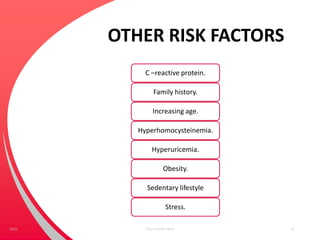
OTHER RISK FACTORS
C –reactive protein.
Family history.
Increasing age.
Hyperhomocysteinemia.
Hyperuricemia.
Obesity.
Sedentary lifestyle
Stress.
Your Footer Here 12Date
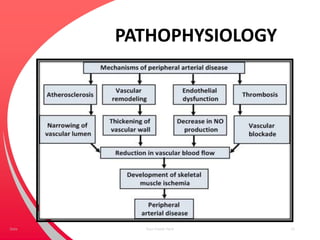
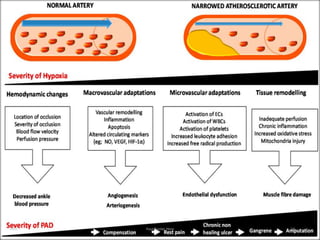
PATHOPHYSIOLOGY
Your Footer Here 13Date
Your Footer Here 14Date
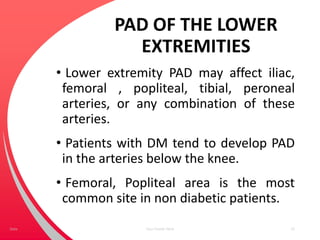
PAD OF THE LOWER
EXTREMITIES
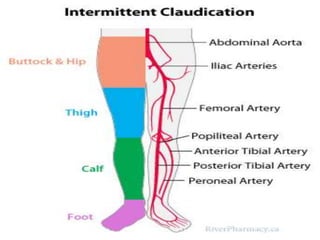
• Lower extremity PAD may affect iliac,
femoral , popliteal, tibial, peroneal
arteries, or any combination of these
arteries.
• Patients with DM tend to develop PAD
in the arteries below the knee.
• Femoral, Popliteal area is the most
common site in non diabetic patients.
Your Footer Here 15Date
Your Footer Here 16Date
Date Your Footer Here 17
INTERMITTENT
CLAUDICATION
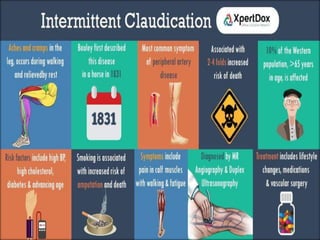
•Classic symptom of
lower extremity PAD.
This ischemic pain is
caused by exercise,
resolves within 10
minutes or less with
rest.
Date Your Footer Here 18
Date Your Footer Here 19
Date Your Footer Here 20
Date Your Footer Here 21
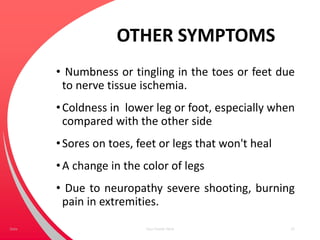
OTHER SYMPTOMS
• Numbness or tingling in the toes or feet due
to nerve tissue ischemia.
•Coldness in lower leg or foot, especially when
compared with the other side
•Sores on toes, feet or legs that won't heal
•A change in the color of legs
• Due to neuropathy severe shooting, burning
pain in extremities.
Your Footer Here 22Date
• Hair loss or slower hair growth on feet and
legs.
• Gradually loss of pressure and deep pain
sensations.
•Slower growth of toenails
•Shiny skin on legs
•No pulse or a weak pulse in legs or feet
•Erectile dysfunction in men
Your Footer Here 23
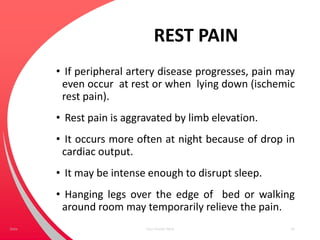
REST PAIN
• If peripheral artery disease progresses, pain may
even occur at rest or when lying down (ischemic
rest pain).
• Rest pain is aggravated by limb elevation.
• It occurs more often at night because of drop in
cardiac output.
• It may be intense enough to disrupt sleep.
• Hanging legs over the edge of bed or walking
around room may temporarily relieve the pain.
Your Footer Here 24Date
Your Footer Here 25Date
Your Footer Here 26Date
CRITICAL LIMB
ISCHEMIA
• It is a condition characterized by
chronic ischemic rest pain lasting more
than 2 weeks, arterial leg ulcers or
gangrene of the legs due to PAD.
• Patients with PAD who have diabetes,
heart failure, stroke history are at
increased risk for critical limb ischemia.
Your Footer Here 27Date
Date Your Footer Here 28
COMPLICATIONS
Your Footer Here 29Date
Your Footer Here 30Date
HISTORY COLLECTION
 Ask about risk factors.
 Diet history.
 Medication history.
 Family history of heart & blood vessels
disorders.
Your Footer Here 31Date
PHYSICAL
EXAMINATION
• Look for the signs of PAD.
• Check blood flows in legs/feet to see weak/
absent pulses.
• With stethoscope hear bruit sound in leg
arteries. A bruit may be a warning sign of a
narrowed or blocked artery.
• Segmental blood pressure: to measure
actual limb blood pressures to look at arterial
occlusion. In the leg pressures are measured at
the ankle, below the knee, above the knee and
mid-thigh.
Your Footer Here 32Date
DIAGNOSTIC TESTS
 Doppler Ultrasound.
 Ankle- brachial index.
 Treadmill test.
 Magnetic Resonance Angiogram.
 Arteriogram
 Blood tests.
 Duplex imaging.
Your Footer Here 33Date
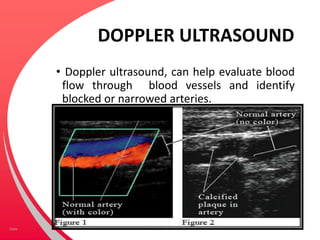
DOPPLER ULTRASOUND
• Doppler ultrasound, can help evaluate blood
flow through blood vessels and identify
blocked or narrowed arteries.
Your Footer Here 34Date
ANKLE- BRACHIAL
INDEX
Common test used to diagnose PAD.
 It is determined by using a handheld
Doppler.
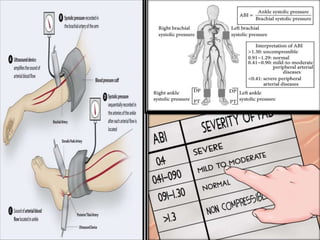
 It compares the blood pressure in ankle
with the blood pressure in arm.
 A normal ABI is 0.91 to 1.30 .
 Patients who have PAD with DM shows false
elevated ABI due to calcified and non
compressive arteries.
Your Footer Here 35Date
Date Your Footer Here 36
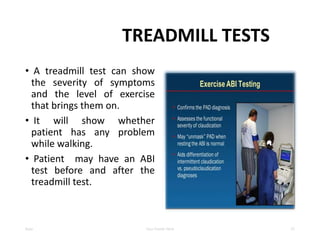
TREADMILL TESTS
• A treadmill test can show
the severity of symptoms
and the level of exercise
that brings them on.
• It will show whether
patient has any problem
while walking.
• Patient may have an ABI
test before and after the
treadmill test.
Date Your Footer Here 37
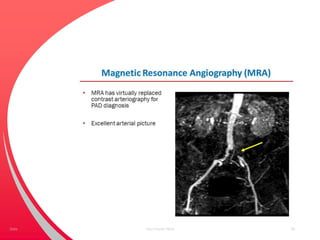
MAGNETIC RESONANCE
ANGIOGRAM
• A magnetic resonance angiogram (MRA) uses
magnetic and radio wave energy to take
pictures of blood vessels.
• An MRA can show the location and severity
of a blocked blood vessel.
Your Footer Here 38Date
Your Footer Here 39Date
ARTERIOGRAM
• It is used to further delineate the location
and extent of the disease process.
• It is useful when an intervention is indicated.
Your Footer Here 40Date
BLOOD TESTS
• blood tests can help diagnose conditions
such as diabetes and high blood cholesterol.
Your Footer Here 41Date
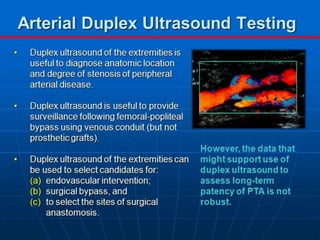
DUPLEX IMAGING
• It uses color Doppler system to map blood
flow throughout the entire region of an
artery.
• Provides anatomic and physiologic
information about blood vessels.
Your Footer Here 42Date
Date Your Footer Here 43
MANAGEMENT
 Risk factor modification.
 Drug therapy.
 Exercise therapy.
 Nutritional therapy.
 Care of leg with CLI.
 Minimally invasive procedures.
 Surgical therapy.
Your Footer Here 44Date
RISK FACTOR
MODIFICATION
• Tobacco cessation is essential to reduce the
risk of CVD events, PAD progression.
• Patients with diabetes should maintain a
Glycosylated hemoglobin(A1C) below 7%.
• For lipid management both dietary
interventions and drug therapy are needed.
Statins(simvastatin) and a fibric acid
(gemfibrozil) may be used.
Your Footer Here 45Date
•ACE inhibitors ( ramipril) are used for
symptomatic patients with PAD to control
hypertension. DASH diet and lifestyle changes
are recommended.
•
Your Footer Here 46Date
DRUG THERAPY
• Oral antipletlet therapy should include 75 to
325 mg/day of aspirin.
• To treat intermittent Claudication: Cilo-stazol
& Pentoxifylline.
• Cilostazol a Phosphodiesterase inhibitors,
inhibit platelet aggregation.
• Pentoxifylline a xanthine derivative ,
decreases fibrinogen concentration.
Your Footer Here 47Date
NUTRITIONAL THERAPY
• Teach patients with PAD to maintain a body
mass index less than 25 kg/m2.
• Recommend a diet reduced in calories and
salt for obese or overweight individuals with
PAD.
Your Footer Here 48Date
CARE OF LEG WITH CLI
Peripheral artery bypass surgery using an
autogenous vein.
Percutaneous transluminal angioplasty(PTA) is
recommended when bypass is not feasible.
I.V. Prostanoids( Ilioprost) who are not suitable for
PTA or bypass .It may decrease rest pain and
improve ulcer healing.
Your Footer Here 49Date
Continue optimal drug therapy( statin, antipletlet, ACE
inhibitor, Beta blocker ) to reduce the risk of CVD event.
Protect the extremity from trauma, control infection,
improve perfusion.
Cover any ulcer with a dry, sterile dressing to maintain
cleanliness.
Systemic antibiotics are used in patients with CLI, skin
infections and limb infection.
Your Footer Here 50Date
Encourage the patient to select soft, roomy and
protective footwear and avoid extremes of heat an
cold.
Trendelenburg position may control pain and
increase perfusion to the lower extremities.
Spinal cord stimulation may be helpful in managing
pain and preventing amputation in patients with
CLI.
Your Footer Here 51Date
MINIMALLY INVASIVE
PROCEDURES.
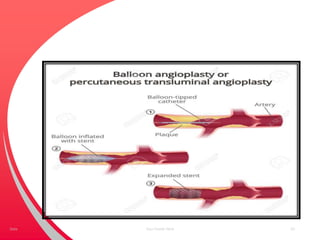
Percutaneous transluminal angioplasty(PTA)
procedure a catheter that contains a
balloon at the tip. The end of the catheter is
moved to the stenotic area of the artery.
Stents are placed within the artery
immediately after the balloon angioplasty is
done.
Your Footer Here 52Date
Your Footer Here 53Date
• Atherectomy is the removal of the
obstructing plaque.
• Cryoplasty combines two procedures: PTA
and cold therapy.
Your Footer Here 54Date
Your Footer Here 55Date
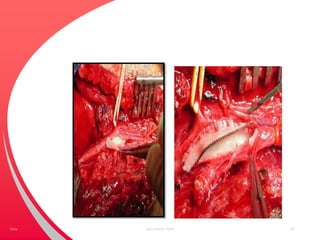
PERIPHERAL ARTERY BYPASS
SURGERY
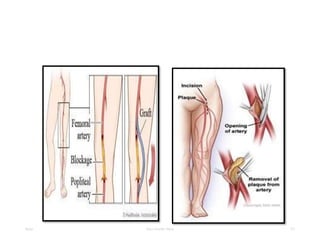
Peripheral artery bypass surgery should be done
with an autogenous vein to bypass the lesion.
Synthetic grafts are used for long bypasses such
as axillary –femoral bypass.
PTA with stenting may also be used in
combination with bypass surgery.
Your Footer Here 56Date
Date Your Footer Here 57
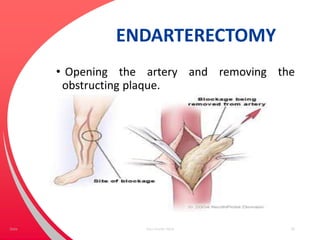
ENDARTERECTOMY
• Opening the artery and removing the
obstructing plaque.
Your Footer Here 58Date
PATCH GRAFT
ANGIOPLASTY
• Opening the artery , removing plaque, and
sewing a patch to the opening to widen the
lumen.
Your Footer Here 59Date
Your Footer Here 60Date
AMPUTATION
• Amputation may be required if tissue
necrosis is extensive , gangrene or
Osteomyelitis develops, or all major arteries
in the limbs are blocked .
Your Footer Here 61Date
Your Footer Here 62Date
NURSING ASSESSMENT
• Auscultate abdomen and listen for presence
of bruits.
• Observe lower extremities for color ,
sensation and temperature . Compare
bilaterally for differences.
• Palpate pulses and record.
• Inspect nails for thickening and opacity:
inspect skin for shiny , atrophic, hairless, and
dry appearance
Your Footer Here 63Date
• Assess for pain: Severe abdominal pain after
eating, Pain in the legs with exercise and pain
in feet at rest.
• Assess for ulcers of toes and feet.
Your Footer Here 64Date
NURSING DIAGNOSES
• Ineffective peripheral tissue perfusion related
to deficient knowledge of contributing
factors.
• Activity intolerance related to imbalance
between O2 supply and demand.
• Chronic pain related to ischemia,
inflammation, and swelling.
• Ineffective health management related to
lack of knowledge of disease and self-care
measures.
Your Footer Here 65Date
Your Footer Here 66Date
PROMOTING TISSUE
PERFUSION
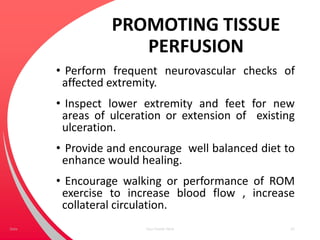
• Perform frequent neurovascular checks of
affected extremity.
• Inspect lower extremity and feet for new
areas of ulceration or extension of existing
ulceration.
• Provide and encourage well balanced diet to
enhance would healing.
• Encourage walking or performance of ROM
exercise to increase blood flow , increase
collateral circulation.
Your Footer Here 67Date
PROTECTING LOWER
EXTREMITIES
• Encourage patient to wear protective
footwear such as rubber soled slippers or
shoes with closed .
• Instruct patient and family to keep hallways
and walkways free of clutter to avoid injury.
• Avoid tight fitting socks and shoes.
• Perform and teach foot care , including
washing and carefully drying and inspecting
feet daily.
Your Footer Here 68Date
PREVENTING
INFCETION
• Applying moisturizing lotion to intact skin of
lower extremities to prevent drying and cracking
of the skin.
• Encourage patient to wear clean hose or socks
daily : woolen socks for winter and cotton for
summer.
• Instruct patient to check with physician before
using any OTC or topical lotions or creams on
wound.
• Administer antibiotics postoperatively to prevent
infection around prosthetic graft material.
Your Footer Here 69Date
Date Your Footer Here 70

Peripheral artery disease nikku

  • 1.
  • 2.
    CONTENT Your Footer Here2Date • Introduction • Definition • Incidence • Classification • Etiology • Risk factors • Clinical menifestations • Complications • Assessment & Diagnostic evaluation • Medical & surgical management • Nursing management
  • 3.
    INTRODUCTION Peripheral artery disease(PAD) is an abnormal narrowing of arteries other than those that supply the heart or brain. PAD is a common circulatory problem in which narrowed arteries reduce blood flow to limbs. Your Footer Here 3Date
  • 4.
    DEFINITION • PAD isthe thickening of the artery walls that results in a progressive narrowing of the arteries of the upper and lower extremities. • Peripheral artery disease most commonly affects the legs, but other arteries may also be involved. • PAD is a marker of advanced systemic atheroslcerosis. Your Footer Here 4Date
  • 5.
    • This conditionmay be reducing blood flow to the heart and brain as well. • PAD can be treated with exercise, with a healthy diet, quitting smoking. • Early diagnosis & treatment is important in the treatment to stop the heart disease and stroke. Your Footer Here 5Date
  • 6.
    INCIDENCE In 2010, 202million people around the world were living with PAD. The majority of individuals with PAD (70 percent) live in low/middle income regions of the world, including 55 million individuals in southeast Asia and 46 million in the Western Pacific Region. Your Footer Here 6Date
  • 7.
  • 8.
  • 9.
    ETIOLOGY • ATHEROSCLEROSIS: The leadingcause of PAD. It results from the deposit of cholesterol and lipids within the vessels walls and leads to progressive narrowing of the artery. •Date Your Footer Here 9
  • 10.
    • Less commonlyPAD is also caused by blood vessels inflammation , injury to limbs, unusual anatomy of ligaments or muscles, or radiation exposure. Your Footer Here 10Date
  • 11.
    IMPORTANT RISK FACTORS • Smoking:single greatest risk factor of peripheral artery disease. Greater than 80%-90% of patients with lower extremity peripheral arterial disease are current or former smokers. • Diabetes: DM does this by causing endothelial and smooth-muscle cell dysfunction in peripheral arteries. • Chronic kidney disease • Hypertension • Hypercholesterolemia Your Footer Here 11Date
  • 12.
    OTHER RISK FACTORS C–reactive protein. Family history. Increasing age. Hyperhomocysteinemia. Hyperuricemia. Obesity. Sedentary lifestyle Stress. Your Footer Here 12Date
  • 13.
  • 14.
  • 15.
    PAD OF THELOWER EXTREMITIES • Lower extremity PAD may affect iliac, femoral , popliteal, tibial, peroneal arteries, or any combination of these arteries. • Patients with DM tend to develop PAD in the arteries below the knee. • Femoral, Popliteal area is the most common site in non diabetic patients. Your Footer Here 15Date
  • 16.
  • 17.
  • 18.
    INTERMITTENT CLAUDICATION •Classic symptom of lowerextremity PAD. This ischemic pain is caused by exercise, resolves within 10 minutes or less with rest. Date Your Footer Here 18
  • 19.
  • 20.
  • 21.
  • 22.
    OTHER SYMPTOMS • Numbnessor tingling in the toes or feet due to nerve tissue ischemia. •Coldness in lower leg or foot, especially when compared with the other side •Sores on toes, feet or legs that won't heal •A change in the color of legs • Due to neuropathy severe shooting, burning pain in extremities. Your Footer Here 22Date
  • 23.
    • Hair lossor slower hair growth on feet and legs. • Gradually loss of pressure and deep pain sensations. •Slower growth of toenails •Shiny skin on legs •No pulse or a weak pulse in legs or feet •Erectile dysfunction in men Your Footer Here 23
  • 24.
    REST PAIN • Ifperipheral artery disease progresses, pain may even occur at rest or when lying down (ischemic rest pain). • Rest pain is aggravated by limb elevation. • It occurs more often at night because of drop in cardiac output. • It may be intense enough to disrupt sleep. • Hanging legs over the edge of bed or walking around room may temporarily relieve the pain. Your Footer Here 24Date
  • 25.
  • 26.
  • 27.
    CRITICAL LIMB ISCHEMIA • Itis a condition characterized by chronic ischemic rest pain lasting more than 2 weeks, arterial leg ulcers or gangrene of the legs due to PAD. • Patients with PAD who have diabetes, heart failure, stroke history are at increased risk for critical limb ischemia. Your Footer Here 27Date
  • 28.
  • 29.
  • 30.
  • 31.
    HISTORY COLLECTION  Askabout risk factors.  Diet history.  Medication history.  Family history of heart & blood vessels disorders. Your Footer Here 31Date
  • 32.
    PHYSICAL EXAMINATION • Look forthe signs of PAD. • Check blood flows in legs/feet to see weak/ absent pulses. • With stethoscope hear bruit sound in leg arteries. A bruit may be a warning sign of a narrowed or blocked artery. • Segmental blood pressure: to measure actual limb blood pressures to look at arterial occlusion. In the leg pressures are measured at the ankle, below the knee, above the knee and mid-thigh. Your Footer Here 32Date
  • 33.
    DIAGNOSTIC TESTS  DopplerUltrasound.  Ankle- brachial index.  Treadmill test.  Magnetic Resonance Angiogram.  Arteriogram  Blood tests.  Duplex imaging. Your Footer Here 33Date
  • 34.
    DOPPLER ULTRASOUND • Dopplerultrasound, can help evaluate blood flow through blood vessels and identify blocked or narrowed arteries. Your Footer Here 34Date
  • 35.
    ANKLE- BRACHIAL INDEX Common testused to diagnose PAD.  It is determined by using a handheld Doppler.  It compares the blood pressure in ankle with the blood pressure in arm.  A normal ABI is 0.91 to 1.30 .  Patients who have PAD with DM shows false elevated ABI due to calcified and non compressive arteries. Your Footer Here 35Date
  • 36.
  • 37.
    TREADMILL TESTS • Atreadmill test can show the severity of symptoms and the level of exercise that brings them on. • It will show whether patient has any problem while walking. • Patient may have an ABI test before and after the treadmill test. Date Your Footer Here 37
  • 38.
    MAGNETIC RESONANCE ANGIOGRAM • Amagnetic resonance angiogram (MRA) uses magnetic and radio wave energy to take pictures of blood vessels. • An MRA can show the location and severity of a blocked blood vessel. Your Footer Here 38Date
  • 39.
  • 40.
    ARTERIOGRAM • It isused to further delineate the location and extent of the disease process. • It is useful when an intervention is indicated. Your Footer Here 40Date
  • 41.
    BLOOD TESTS • bloodtests can help diagnose conditions such as diabetes and high blood cholesterol. Your Footer Here 41Date
  • 42.
    DUPLEX IMAGING • Ituses color Doppler system to map blood flow throughout the entire region of an artery. • Provides anatomic and physiologic information about blood vessels. Your Footer Here 42Date
  • 43.
  • 44.
    MANAGEMENT  Risk factormodification.  Drug therapy.  Exercise therapy.  Nutritional therapy.  Care of leg with CLI.  Minimally invasive procedures.  Surgical therapy. Your Footer Here 44Date
  • 45.
    RISK FACTOR MODIFICATION • Tobaccocessation is essential to reduce the risk of CVD events, PAD progression. • Patients with diabetes should maintain a Glycosylated hemoglobin(A1C) below 7%. • For lipid management both dietary interventions and drug therapy are needed. Statins(simvastatin) and a fibric acid (gemfibrozil) may be used. Your Footer Here 45Date
  • 46.
    •ACE inhibitors (ramipril) are used for symptomatic patients with PAD to control hypertension. DASH diet and lifestyle changes are recommended. • Your Footer Here 46Date
  • 47.
    DRUG THERAPY • Oralantipletlet therapy should include 75 to 325 mg/day of aspirin. • To treat intermittent Claudication: Cilo-stazol & Pentoxifylline. • Cilostazol a Phosphodiesterase inhibitors, inhibit platelet aggregation. • Pentoxifylline a xanthine derivative , decreases fibrinogen concentration. Your Footer Here 47Date
  • 48.
    NUTRITIONAL THERAPY • Teachpatients with PAD to maintain a body mass index less than 25 kg/m2. • Recommend a diet reduced in calories and salt for obese or overweight individuals with PAD. Your Footer Here 48Date
  • 49.
    CARE OF LEGWITH CLI Peripheral artery bypass surgery using an autogenous vein. Percutaneous transluminal angioplasty(PTA) is recommended when bypass is not feasible. I.V. Prostanoids( Ilioprost) who are not suitable for PTA or bypass .It may decrease rest pain and improve ulcer healing. Your Footer Here 49Date
  • 50.
    Continue optimal drugtherapy( statin, antipletlet, ACE inhibitor, Beta blocker ) to reduce the risk of CVD event. Protect the extremity from trauma, control infection, improve perfusion. Cover any ulcer with a dry, sterile dressing to maintain cleanliness. Systemic antibiotics are used in patients with CLI, skin infections and limb infection. Your Footer Here 50Date
  • 51.
    Encourage the patientto select soft, roomy and protective footwear and avoid extremes of heat an cold. Trendelenburg position may control pain and increase perfusion to the lower extremities. Spinal cord stimulation may be helpful in managing pain and preventing amputation in patients with CLI. Your Footer Here 51Date
  • 52.
    MINIMALLY INVASIVE PROCEDURES. Percutaneous transluminalangioplasty(PTA) procedure a catheter that contains a balloon at the tip. The end of the catheter is moved to the stenotic area of the artery. Stents are placed within the artery immediately after the balloon angioplasty is done. Your Footer Here 52Date
  • 53.
  • 54.
    • Atherectomy isthe removal of the obstructing plaque. • Cryoplasty combines two procedures: PTA and cold therapy. Your Footer Here 54Date
  • 55.
  • 56.
    PERIPHERAL ARTERY BYPASS SURGERY Peripheralartery bypass surgery should be done with an autogenous vein to bypass the lesion. Synthetic grafts are used for long bypasses such as axillary –femoral bypass. PTA with stenting may also be used in combination with bypass surgery. Your Footer Here 56Date
  • 57.
  • 58.
    ENDARTERECTOMY • Opening theartery and removing the obstructing plaque. Your Footer Here 58Date
  • 59.
    PATCH GRAFT ANGIOPLASTY • Openingthe artery , removing plaque, and sewing a patch to the opening to widen the lumen. Your Footer Here 59Date
  • 60.
  • 61.
    AMPUTATION • Amputation maybe required if tissue necrosis is extensive , gangrene or Osteomyelitis develops, or all major arteries in the limbs are blocked . Your Footer Here 61Date
  • 62.
  • 63.
    NURSING ASSESSMENT • Auscultateabdomen and listen for presence of bruits. • Observe lower extremities for color , sensation and temperature . Compare bilaterally for differences. • Palpate pulses and record. • Inspect nails for thickening and opacity: inspect skin for shiny , atrophic, hairless, and dry appearance Your Footer Here 63Date
  • 64.
    • Assess forpain: Severe abdominal pain after eating, Pain in the legs with exercise and pain in feet at rest. • Assess for ulcers of toes and feet. Your Footer Here 64Date
  • 65.
    NURSING DIAGNOSES • Ineffectiveperipheral tissue perfusion related to deficient knowledge of contributing factors. • Activity intolerance related to imbalance between O2 supply and demand. • Chronic pain related to ischemia, inflammation, and swelling. • Ineffective health management related to lack of knowledge of disease and self-care measures. Your Footer Here 65Date
  • 66.
  • 67.
    PROMOTING TISSUE PERFUSION • Performfrequent neurovascular checks of affected extremity. • Inspect lower extremity and feet for new areas of ulceration or extension of existing ulceration. • Provide and encourage well balanced diet to enhance would healing. • Encourage walking or performance of ROM exercise to increase blood flow , increase collateral circulation. Your Footer Here 67Date
  • 68.
    PROTECTING LOWER EXTREMITIES • Encouragepatient to wear protective footwear such as rubber soled slippers or shoes with closed . • Instruct patient and family to keep hallways and walkways free of clutter to avoid injury. • Avoid tight fitting socks and shoes. • Perform and teach foot care , including washing and carefully drying and inspecting feet daily. Your Footer Here 68Date
  • 69.
    PREVENTING INFCETION • Applying moisturizinglotion to intact skin of lower extremities to prevent drying and cracking of the skin. • Encourage patient to wear clean hose or socks daily : woolen socks for winter and cotton for summer. • Instruct patient to check with physician before using any OTC or topical lotions or creams on wound. • Administer antibiotics postoperatively to prevent infection around prosthetic graft material. Your Footer Here 69Date
  • 70.

Editor's Notes

  • #2 © Copyright PresentationGO.com – The free PowerPoint template library