HALOTHANE
Submitted by,
Vysakh Mohan M
13-BVM-42
HALOTHANE
INTRODUCTION
• General anaesthetic
• Volatile liquid inhalation anaesthetic
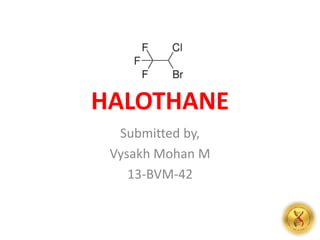
• Molecular formula – CF3CHClBr
• IUPAC Name – 2-bromo-2-chloro-1,1,1-
trifluoroethane
• Brand Name – Fluothane
• Induction and maintenance anaesthetic agent
HALOTHANE
PHYSICAL AND CHEMICAL PROPERTIES
• Volatile Heavy liquid (Specific gravity – 1.87)
• Boiling point – 50.20C
• Vapour pressure – 243 mmHg at 200C
• Molecular Weight – 197.4 u
• Decomposes when exposed to light (Amber
coloured bottles and addition of thymol)
• Non-explosive and non-inflammable
HALOTHANE
MINUMUM ALVEOLAR CONCENTRATION/MAC*
• Dogs – 1.87
• Cats – 1.19
• Cattle – 0.76
• Horses – 0.88
• Humans – 0.76
HALOTHANE
DOSE
• Induction (Halothane alone)
– All species : 2.0 – 4.0% (of inspired air)
• Maintenance (Halothane alone)
– Small animals : 0.5 – 1.5%
– Large animals : 1.0 – 2.0%
HALOTHANE
PHARMACOKINETICS
• Rapidly absorbed and rapidly excreted
through lungs
– 20% : Biotransformation in liver and excreted
through lungs
– 60% : Excreted unchanged through lungs
– 20% : Excreted via other routes, either unchanged
or metabolised and stored in body for many hours
to days
HALOTHANE
ADVESE EFFECTS
• Vasodilatation, hypotension, shivering and
tremors on recovery
• Malignant hyperthermia
• Cardiac arrhythmias
• Cardiopulmonary depression and cardiac
arrest
HALOTHANE
CONTRAINDICATIONS AND PRECAUTIONS
• Not used for pig breeds like Poland China and
Pietrain
• Used with caution in animals with increased
CSF, head injury, etc.
• Not used in animals having problems after
previous halothane exposure
HALOTHANE
CLINICAL USES AND ADMINISTRATION
• Capable of induction and maintenance of
anaesthesia without assistance from other
CNS depressants
• Used in a closed rebreathing system with
precision thermo-stable or thermo-
compensated, calibrated vapourisers
• Open and semi-open systems are used only in
case of very small dogs, cats and laboratory
animals
HALOTHANE
RELATED SUBSTANCES
• Enflurane, isoflurane and sevoflurane.
• Incidence of hepatic reaction with these
agents is lower
• Lower blood solubility resulting in faster
induction of and recovery from anaesthesia
HALOTHANE
AVAILABILITY
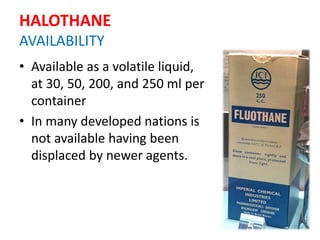
• Available as a volatile liquid,
at 30, 50, 200, and 250 ml per
container
• In many developed nations is
not available having been
displaced by newer agents.
REFERENCES
• Veterinary Pharmacology and Therapeutics –
Harpal Singh Sandhu
• Veterinary Anaesthesia and Pain Management
Secrets – Stephen A Greene
• Wright’s Veterinary Anaesthesia and Analgesia –
L W Hall
• Veterinary Anaesthesia – William V Lumb and E E
E Wynn Jones
• http://www.drugs.com/pro/Halothane
• http://en.wikipedia.org/wiki/Halothane