Presented By :
Dr Farooque Siddiqui
Oral & Maxillofacial Resident
In administering an anesthesia
Signpost
Guides in determination of depth of anesthesia
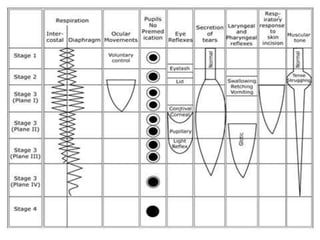
 Guedel describe depth of anaesthesia by dividing it
into stages and planes.
 Guedel’s criteria based on :
 Respiration
 Eyeball movement
 Presence or absence of various reflexes
 Gillespie added other criteria
 Secretion of tears
 Response to skin incision
 Evaluation of pharyngeal &
laryngeal reflexes
 Stages were first described for ether anesthesia
 Can be used with modification for all agents
 Can be recognized during both induction & recovery
 Starts from beginning of anaesthetic inhalation and
lasts up to the loss of consciousness.
 Pain is progressively abolished.
 Patient remains conscious, can hear and see, and feels
a dream like state
 Reflexes and respiration remain normal.
 Some minor operations can be carried out during this
stage
 But it is difficult to maintain
 Therefore use is limited to short procedures
 Stage starts from loss of consciousness upto gain of
rhythmical respiration
 Respiration – Irregular and large in volume
 Heart rate and BP raises
 Pupils – Large and divergent
 Muscle tone increased – jaw may be tight
 Patient may shout or struggle
 Involuntary micturation , or defecation
 Extends from onset of regular respiration to cessation of
spontaneous breathing.
 This has been divided into 4 planes:
o Plane 1- Roving eyeballs.
o This plane ends when eyes become fixed.
o Plane 2- Loss of corneal and laryngeal reflexes.
o Plane 3- Pupil starts dilating and light reflex is lost.
o Plane 4- Intercostal paralysis
Shallow abdominal respiration
Dilated pupil.
 As anaesthesia passes to deeper planes
 Progressively-muscle tone decreases
 BP falls
 Heart Rate increases with weak pulse
 Respiration decreases in depth and later in frequency
 There is cessation of breathing leading to failure of
circulation and death.
 Pupil is widely dilated
 Muscles are totally flabby
 Pulse is thready or imperceptible
 BP is very low.
Stage of anesthesia

Stage of anesthesia

  • 2.
    Presented By : DrFarooque Siddiqui Oral & Maxillofacial Resident
  • 3.
    In administering ananesthesia Signpost Guides in determination of depth of anesthesia  Guedel describe depth of anaesthesia by dividing it into stages and planes.
  • 4.
     Guedel’s criteriabased on :  Respiration  Eyeball movement  Presence or absence of various reflexes  Gillespie added other criteria  Secretion of tears  Response to skin incision  Evaluation of pharyngeal & laryngeal reflexes
  • 5.
     Stages werefirst described for ether anesthesia  Can be used with modification for all agents  Can be recognized during both induction & recovery
  • 7.
     Starts frombeginning of anaesthetic inhalation and lasts up to the loss of consciousness.  Pain is progressively abolished.  Patient remains conscious, can hear and see, and feels a dream like state
  • 8.
     Reflexes andrespiration remain normal.  Some minor operations can be carried out during this stage  But it is difficult to maintain  Therefore use is limited to short procedures
  • 9.
     Stage startsfrom loss of consciousness upto gain of rhythmical respiration  Respiration – Irregular and large in volume  Heart rate and BP raises  Pupils – Large and divergent  Muscle tone increased – jaw may be tight  Patient may shout or struggle  Involuntary micturation , or defecation
  • 11.
     Extends fromonset of regular respiration to cessation of spontaneous breathing.  This has been divided into 4 planes: o Plane 1- Roving eyeballs. o This plane ends when eyes become fixed. o Plane 2- Loss of corneal and laryngeal reflexes. o Plane 3- Pupil starts dilating and light reflex is lost. o Plane 4- Intercostal paralysis Shallow abdominal respiration Dilated pupil.
  • 12.
     As anaesthesiapasses to deeper planes  Progressively-muscle tone decreases  BP falls  Heart Rate increases with weak pulse  Respiration decreases in depth and later in frequency
  • 13.
     There iscessation of breathing leading to failure of circulation and death.  Pupil is widely dilated  Muscles are totally flabby  Pulse is thready or imperceptible  BP is very low.