Halothane
By: Aram A. Shah
University of Sulaimani
Faculty of medical sciences
School of Medicine
Department of Pharmacology
‫الرحيم‬‫الرحمن‬‫هللا‬‫بسم‬
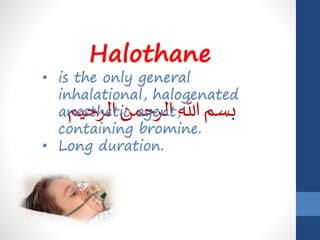
Halothane
• is the only general
inhalational, halogenated
anesthetic agent,
containing bromine.
• Long duration.
Hlaothane is an
• Inhalational
• General Anesthetic
General Anesthesia
 General anesthesia is a reversible state of central nervous
system (CNS) depression, causing loss of response to and
perception of stimuli.
For patients undergoing surgical or medical procedures,
anesthesia provides five important benefits:
• Sedation and reduced anxiety
• Lack of awareness and amnesia
• Skeletal muscle relaxation
• Suppression of undesirable reflexes
• Analgesia
 Because no single agent provides all desirable properties,
several categories of drugs are combined to produce optimal
anesthesia
Choosing Proper Anesthetic
Status of organ systems
1. Cardiovascular system: Anesthetic agents suppress
cardiovascular function to varying degrees. This is an
important consideration in patients with Heart and coronary
artery diseases.
• Hypotension may develop during anesthesia, resulting in
reduced perfusion pressure and ischemic injury to tissues.
• Halothane, sensitize the heart to arrhythmogenic effects of
sympathomimetic agents.
2. Respiratory system: Inhaled agents depress respiration but
also act as bronchodilators, These effects may influence the
ability to provide adequate ventilation and oxygenation during
and after surgery.
3. Liver and kidney: The liver and kidneys influence long-term
distribution and clearance of drugs and are also target organs
for toxic effects.
4. Nervous system: The presence of neurologic disorders (for
example, epilepsy, myasthenia gravis, neuromuscular
disease, compromised cerebral circulation) influences the
selection of anesthetic.
5. Pregnancy: Special precautions should be observed when
anesthetics are administered during pregnancy. Effects on fetal
organogenesis are a major concern in early pregnancy.
• Commonly, patients receive one or more of preanesthetic
medications for preventing undesirable anesthetic effects.
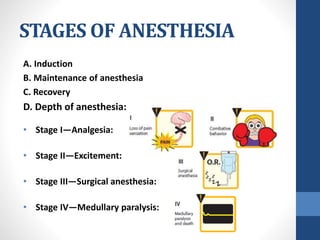
STAGES OF ANESTHESIA
A. Induction
B. Maintenance of anesthesia
C. Recovery
D. Depth of anesthesia:
• Stage I—Analgesia:
• Stage II—Excitement:
• Stage III—Surgical anesthesia:
• Stage IV—Medullary paralysis:
Inhalational Anesthetics
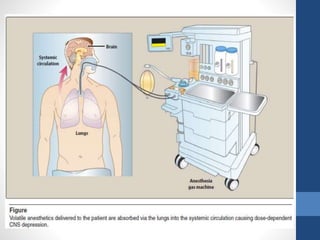
• Inhaled gases are used primarily for maintenance of
anesthesia after administration of an IV agent.
• Inhalational agents have very steep dose–response
curves and very narrow therapeutic indices, so the
difference in concentrations causing surgical anesthesia
and severe cardiac and respiratory depression.
• No antagonists exist.
HALOTHANE
• Halothane is the prototype to which newer inhalation anesthetics
are compared.
• When halothane was introduced, its rapid induction and quick
recovery made it an anesthetic of choice.
• Due to adverse effects and the availability of other anesthetics with
fewer complications, halothane has been replaced in most
countries.

------------------------------------------------------------------------------------------
• Chemical and Physical Properties
• Halogenated compound chemically:
2-bromo-2-chloro-1,1,1-tri fluoro ethane
• Volatile, so kept in sealed bottles
• Colorless, Pleasant odor, Non-irritant
• Non-explosive, Non-inflammable
• Light-sensitive
• Corrosive, Interaction – rubber and plastic tubing
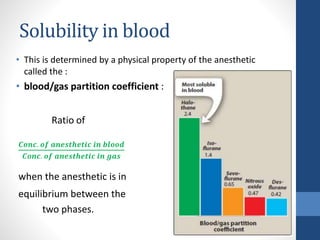
Solubility in blood
• This is determined by a physical property of the anesthetic
called the :
• blood/gas partition coefficient :
Ratio of
𝑪𝒐𝒏𝒄. 𝒐𝒇 𝒂𝒏𝒆𝒔𝒕𝒉𝒆𝒕𝒊𝒄 𝒊𝒏 𝒃𝒍𝒐𝒐𝒅
𝑪𝒐𝒏𝒄. 𝒐𝒇 𝒂𝒏𝒆𝒔𝒕𝒉𝒆𝒕𝒊𝒄 𝒊𝒏 𝒈𝒂𝒔
when the anesthetic is in
equilibrium between the
two phases.
Potency
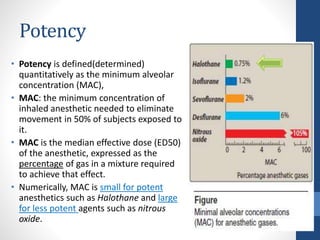
• Potency is defined(determined)
quantitatively as the minimum alveolar
concentration (MAC),
• MAC: the minimum concentration of
inhaled anesthetic needed to eliminate
movement in 50% of subjects exposed to
it.
• MAC is the median effective dose (ED50)
of the anesthetic, expressed as the
percentage of gas in a mixture required
to achieve that effect.
• Numerically, MAC is small for potent
anesthetics such as Halothane and large
for less potent agents such as nitrous
oxide.
Therapeutic uses
• Halothane is a potent anesthetic but a relatively weak
analgesic. Thus, it is usually coadministered with nitrous oxide,
opioids, or local anesthetics.
• It is a potent bronchodilator.
• Halothane relaxes both skeletal and uterine muscles and can
be used in obstetrics when uterine relaxation is indicated.
• Halothane is not hepatotoxic in children (unlike its potential
effect on adults).
• Combined with its pleasant odor, it is suitable in pediatrics for
inhalation induction, although sevoflurane is now the agent of
choice.
Pharmacokinetics
 Potent general anesthetic
• MAC : 0.75%, thus lower MAC value, more drug potency.
• Blood/Gas Partition Coefficient: 2.4
Produces a smooth and relatively rapid induction.
Metabolism: 20-40% is metabolized in liver by oxidation,
normally excreted in form of trifluoroacetic acid.
Clearance: Around 60-80% is cleared out unchanged by
lungs.
Mechanism of Action
• No specific receptor has been identified as the locus of general
anesthetic action –generally-.
• It appears that a variety of molecular mechanisms may
contribute to the activity of general anesthetics.
• Halothane activates GABAA , glycine receptors, 5-HT3and twin-
pore K+ channels .
• It antagonizes NMDA receptor.
• It inhibits nACh(block excitatory postsynaptic currents of nicotinic
receptors) and voltage-gated sodium channels.
-----------------------------------------------------------------------------------------
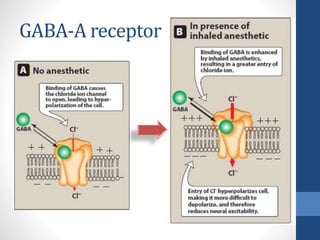
 At clinically effective concentrations, general anesthetics increase
the sensitivity of the γ-aminobutyric acid (GABA-A) receptors to
the inhibitory neurotransmitter GABA. This increases chloride ion
influx and cause
Hyperpolarization  Decrease Excitability  CNS Depression
GABA-A receptor
Disadvantages
• Weak analgesic (thus is usually coadministerd with N2O,
opioids)
• Is a strong respiratory depressant
• Is a strong cardiovascular depressant; halothane is
vagomimetic and cause atropine-sensitive bradycardia.
• Cardiac arrhythmias: serious if hypercapnia develops due
to hypoventilation and an increase in the plasma
concentration of catecholamines(Sensitizes heart to
catecholamines)
• Hypotensive effect (Rx: phenylephrine recommended)
• Hepatotoxic: is oxidatively metabolized in the liver to
tissue-toxic hydrocarbons (e.g., trifluroethanol and
bromide ion), could lead to hepatitis.
Disadvantages cont.
Malignant hyperthermia:
• In a very small percentage of susceptible patients, a rare life-threatening
condition.
• MH causes a drastic and uncontrolled increase in skeletal muscle oxidative
metabolism, overwhelming the body’s capacity to supply oxygen, remove
carbon dioxide, and regulate temperature, eventually leading to circulatory
collapse and death if not treated immediately.
• Susceptibility to MH is often inherited as an autosomal dominant disorder.
-----------------------------------------------------------------------------------------------
• Dantrolene is given as the anesthetic mixture is withdrawn, and measures
are taken to rapidly cool the patient.
• Dantrolene blocks release of Ca2+ from the sarcoplasmic reticulum of
muscle cells, reducing heat production and relaxing muscle tone.
Contraindications
• Liver dysfunction
• History of unexplained jaundice or pyrexia after a previous
exposure to halothane is an absolute contraindication to its
future use in that patient.
• Halothane is contraindicated in patients with known, or
suspected, genetic predisposition to malignant hyperthermia.
• Hypovolemic
References
• Lippincott Illustrated Reviews: Pharmacology, Sixth Edition
• Broad Review Series(BRS) Pharmacology, Sixth Edition
• www.Wikipedia.com
• www.Howmed.net
• www.Piramal.com
• www.RxList.com
• Dorland’s illustrated medical dictionary
Halothane by Dr. Aram Shah

Halothane by Dr. Aram Shah

  • 1.
    Halothane By: Aram A.Shah University of Sulaimani Faculty of medical sciences School of Medicine Department of Pharmacology
  • 2.
    ‫الرحيم‬‫الرحمن‬‫هللا‬‫بسم‬ Halothane • is theonly general inhalational, halogenated anesthetic agent, containing bromine. • Long duration.
  • 3.
    Hlaothane is an •Inhalational • General Anesthetic
  • 4.
    General Anesthesia  Generalanesthesia is a reversible state of central nervous system (CNS) depression, causing loss of response to and perception of stimuli. For patients undergoing surgical or medical procedures, anesthesia provides five important benefits: • Sedation and reduced anxiety • Lack of awareness and amnesia • Skeletal muscle relaxation • Suppression of undesirable reflexes • Analgesia  Because no single agent provides all desirable properties, several categories of drugs are combined to produce optimal anesthesia
  • 5.
    Choosing Proper Anesthetic Statusof organ systems 1. Cardiovascular system: Anesthetic agents suppress cardiovascular function to varying degrees. This is an important consideration in patients with Heart and coronary artery diseases. • Hypotension may develop during anesthesia, resulting in reduced perfusion pressure and ischemic injury to tissues. • Halothane, sensitize the heart to arrhythmogenic effects of sympathomimetic agents. 2. Respiratory system: Inhaled agents depress respiration but also act as bronchodilators, These effects may influence the ability to provide adequate ventilation and oxygenation during and after surgery.
  • 6.
    3. Liver andkidney: The liver and kidneys influence long-term distribution and clearance of drugs and are also target organs for toxic effects. 4. Nervous system: The presence of neurologic disorders (for example, epilepsy, myasthenia gravis, neuromuscular disease, compromised cerebral circulation) influences the selection of anesthetic. 5. Pregnancy: Special precautions should be observed when anesthetics are administered during pregnancy. Effects on fetal organogenesis are a major concern in early pregnancy. • Commonly, patients receive one or more of preanesthetic medications for preventing undesirable anesthetic effects.
  • 7.
    STAGES OF ANESTHESIA A.Induction B. Maintenance of anesthesia C. Recovery D. Depth of anesthesia: • Stage I—Analgesia: • Stage II—Excitement: • Stage III—Surgical anesthesia: • Stage IV—Medullary paralysis:
  • 8.
    Inhalational Anesthetics • Inhaledgases are used primarily for maintenance of anesthesia after administration of an IV agent. • Inhalational agents have very steep dose–response curves and very narrow therapeutic indices, so the difference in concentrations causing surgical anesthesia and severe cardiac and respiratory depression. • No antagonists exist.
  • 10.
    HALOTHANE • Halothane isthe prototype to which newer inhalation anesthetics are compared. • When halothane was introduced, its rapid induction and quick recovery made it an anesthetic of choice. • Due to adverse effects and the availability of other anesthetics with fewer complications, halothane has been replaced in most countries. ------------------------------------------------------------------------------------------ • Chemical and Physical Properties • Halogenated compound chemically: 2-bromo-2-chloro-1,1,1-tri fluoro ethane • Volatile, so kept in sealed bottles • Colorless, Pleasant odor, Non-irritant • Non-explosive, Non-inflammable • Light-sensitive • Corrosive, Interaction – rubber and plastic tubing
  • 11.
    Solubility in blood •This is determined by a physical property of the anesthetic called the : • blood/gas partition coefficient : Ratio of 𝑪𝒐𝒏𝒄. 𝒐𝒇 𝒂𝒏𝒆𝒔𝒕𝒉𝒆𝒕𝒊𝒄 𝒊𝒏 𝒃𝒍𝒐𝒐𝒅 𝑪𝒐𝒏𝒄. 𝒐𝒇 𝒂𝒏𝒆𝒔𝒕𝒉𝒆𝒕𝒊𝒄 𝒊𝒏 𝒈𝒂𝒔 when the anesthetic is in equilibrium between the two phases.
  • 12.
    Potency • Potency isdefined(determined) quantitatively as the minimum alveolar concentration (MAC), • MAC: the minimum concentration of inhaled anesthetic needed to eliminate movement in 50% of subjects exposed to it. • MAC is the median effective dose (ED50) of the anesthetic, expressed as the percentage of gas in a mixture required to achieve that effect. • Numerically, MAC is small for potent anesthetics such as Halothane and large for less potent agents such as nitrous oxide.
  • 13.
    Therapeutic uses • Halothaneis a potent anesthetic but a relatively weak analgesic. Thus, it is usually coadministered with nitrous oxide, opioids, or local anesthetics. • It is a potent bronchodilator. • Halothane relaxes both skeletal and uterine muscles and can be used in obstetrics when uterine relaxation is indicated. • Halothane is not hepatotoxic in children (unlike its potential effect on adults). • Combined with its pleasant odor, it is suitable in pediatrics for inhalation induction, although sevoflurane is now the agent of choice.
  • 14.
    Pharmacokinetics  Potent generalanesthetic • MAC : 0.75%, thus lower MAC value, more drug potency. • Blood/Gas Partition Coefficient: 2.4 Produces a smooth and relatively rapid induction. Metabolism: 20-40% is metabolized in liver by oxidation, normally excreted in form of trifluoroacetic acid. Clearance: Around 60-80% is cleared out unchanged by lungs.
  • 15.
    Mechanism of Action •No specific receptor has been identified as the locus of general anesthetic action –generally-. • It appears that a variety of molecular mechanisms may contribute to the activity of general anesthetics. • Halothane activates GABAA , glycine receptors, 5-HT3and twin- pore K+ channels . • It antagonizes NMDA receptor. • It inhibits nACh(block excitatory postsynaptic currents of nicotinic receptors) and voltage-gated sodium channels. -----------------------------------------------------------------------------------------  At clinically effective concentrations, general anesthetics increase the sensitivity of the γ-aminobutyric acid (GABA-A) receptors to the inhibitory neurotransmitter GABA. This increases chloride ion influx and cause Hyperpolarization  Decrease Excitability  CNS Depression
  • 16.
  • 17.
    Disadvantages • Weak analgesic(thus is usually coadministerd with N2O, opioids) • Is a strong respiratory depressant • Is a strong cardiovascular depressant; halothane is vagomimetic and cause atropine-sensitive bradycardia. • Cardiac arrhythmias: serious if hypercapnia develops due to hypoventilation and an increase in the plasma concentration of catecholamines(Sensitizes heart to catecholamines) • Hypotensive effect (Rx: phenylephrine recommended) • Hepatotoxic: is oxidatively metabolized in the liver to tissue-toxic hydrocarbons (e.g., trifluroethanol and bromide ion), could lead to hepatitis.
  • 18.
    Disadvantages cont. Malignant hyperthermia: •In a very small percentage of susceptible patients, a rare life-threatening condition. • MH causes a drastic and uncontrolled increase in skeletal muscle oxidative metabolism, overwhelming the body’s capacity to supply oxygen, remove carbon dioxide, and regulate temperature, eventually leading to circulatory collapse and death if not treated immediately. • Susceptibility to MH is often inherited as an autosomal dominant disorder. ----------------------------------------------------------------------------------------------- • Dantrolene is given as the anesthetic mixture is withdrawn, and measures are taken to rapidly cool the patient. • Dantrolene blocks release of Ca2+ from the sarcoplasmic reticulum of muscle cells, reducing heat production and relaxing muscle tone.
  • 19.
    Contraindications • Liver dysfunction •History of unexplained jaundice or pyrexia after a previous exposure to halothane is an absolute contraindication to its future use in that patient. • Halothane is contraindicated in patients with known, or suspected, genetic predisposition to malignant hyperthermia. • Hypovolemic
  • 20.
    References • Lippincott IllustratedReviews: Pharmacology, Sixth Edition • Broad Review Series(BRS) Pharmacology, Sixth Edition • www.Wikipedia.com • www.Howmed.net • www.Piramal.com • www.RxList.com • Dorland’s illustrated medical dictionary