Nitrous Oxide/Oxygen
Sedation
WestHealth ED/UC
2014
 Pharmacologic properties
 Considerations for use
 Contraindications
 Potential complications
 Safety
 Care and education
Objectives
 Nitrous Oxide is a very quick acting inhaled sedation
medicine that decreases discomfort and anxiety.
 Sometimes called “laughing gas”
 Often given at the dentists office
 Nitrous Oxide is a sweet-smelling, colorless gas.
 It is heavier than air or oxygen
 What does that mean?
 Spilled/wasted gas that is not scavenged from the room
ends up on the floor
What is Nitrous Oxide?
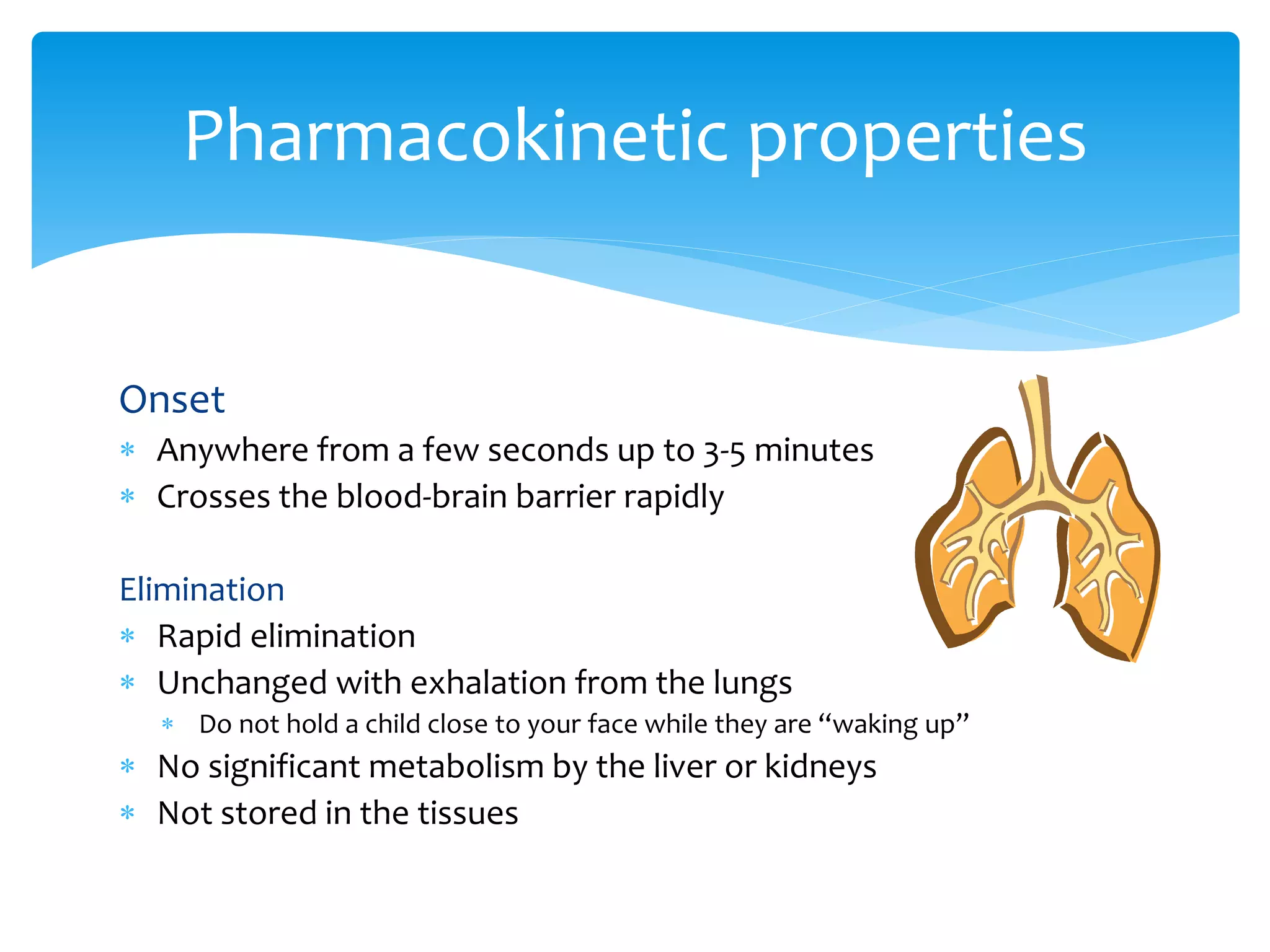
Pharmacokinetic properties
Onset
 Anywhere from a few seconds up to 3-5 minutes
 Crosses the blood-brain barrier rapidly
Elimination
 Rapid elimination
 Unchanged with exhalation from the lungs
 Do not hold a child close to your face while they are “waking up”
 No significant metabolism by the liver or kidneys
 Not stored in the tissues
Nitrous is generally used for shorter/brief procedures, it
is not to be used for prolonged periods
 IV starts
 Nitrous provides some venous dilation!
 Difficult bladder catheterization
 Laceration repairs
 I&D
 Foreign body removal
 And more…
What are we using it for?
 Anxiolytic
 similar to oral Versed
 Analgesic
 For minimally painful procedures, it does not provide
maximum pain relief. Consider topical anesthetics, etc.
 Amnestic
Clinical Properties
The most common side effects are:
Nausea
Vomiting
Diffusion hypoxia
The incidence of these side effects increases the longer the
patient is exposed to the gas, and when used at higher doses
(>50%)
Side Effects
 -Consider pre-medicating with anti-emetics.
 If nausea does not resolve consider turning down or
turning off the Nitrous and provide O2 bolus
 Patients are “awake” so risk of aspiration is low
Nausea and Vomiting
 When N2O is discontinued, it leaves blood more quickly
than nitrogen (N2) from the air is absorbed
 The combination of N2O and N2 in the alveoli dilute O2 in
the alveoli which can lead to hypoxia.
Administer 100% oxygen for 5 minutes at the end of Nitrous
sedation to wash out the nitrous at the end of procedure.
*use mask so the exiting Nitrous is exhaled into the
mask instead of the room.
Diffusion hypoxia
Trapped gas will expand or will increase pressure if it
can’t expand…
What does that mean?
Nitrous should not be administered to any patient that
has a condition where air may be trapped in the body
 Pneumothorax – can double in volume in 10 minutes
 Bowel obstruction
 CHI (because of possible increased ICP)
 Intraocular surgery
 Diving within 24 hours
 Severe bullous emphysema (caution with Cystic Fibrosis)
Trapped Gas
 Patients that can not have high concentrations of
oxygen
 Impaired level of consciousness
 Intoxicated with drugs or alcohol
 Pregnancy
 Vitamin B-12 deficiency
 Healthy patients rebuild their own B-12 quickly so it is
not an issue.
Other Contraindications
 Screen patient, family members, and staff
 Impaired fetal development in 1st and possibly 2nd
trimesters
Infertility and miscarriage reported with unscavenged
systems
Pregnancy
 Patient masks and tubing are single use/disposable
 Equipment should be wiped down with department
specific cleaning agent between patient uses
 The flowmeter on the system has a one-way valve to
prevent secretions from back flow into the system
Infection Control
 Maintenance will check equipment quarterly or at anytime
if malfunction is suspected.
 Scavenging system/make sure you are connected correctly
to wall suction
 Gas connections and proper pressure readings
 O2 pressure= 1500-2000
 N2O pressure=750
 O2 tank runs out 3X faster than N2O tank.
 When N2O pressure decreases less than 750 you probably
only have 30 minutes left in tank. Replace immediately
when procedure complete.
Checking/maintaining equipment
 Inspect Nitrous system for wear or leaks
 Appropriately connected to suction/scavenging
system
 Appropriate sized mask for the patient to prevent gas
leak around the mask.
 Can increase/decrease the amount of air in the mask by
adding/subtracting air with luer lock syringe on front of
mask
 Back up O2 and N2O tanks in place
Equipment Setup
 Room and equipment set up per policy
 Patient assessment and documentation completed by
RN
 NPO status discussed- though patient not required to
be NPO
 Patient & family questioned about pregnancy
Prior to administration
 Formal informed consent does NOT need to be
obtained by the provider (i.e. no 4 page sheet to fill
out)
 RNs will obtain a brief consent per nursing flow sheet
Consent
 Gain the patients trust by allowing them to familiarize
themselves with the equipment before you use it
 Educate the patient and parents about expectations
 Consider scenting the mask with flavored chapstick, but
beware as this can increase nausea in an already nauseated
patient
 Try to start with the patient sitting up, it is less intimidating
 Consider letting the patient hold the mask themselves, but
only if they are able to maintain a good seal.
Rapport
 All patients are different
 Nitrous oxide does not work for everyone. Children
either react or don’t. More time on drug does not
equal greater sedation.
 Discuss other options if the procedure can not be
completed or you are unable to achieve desired
effect.
What else do I need to know?
 Attach to wall suction for proper scavenging
 Visually inspect for leaks
 Attach appropriate sized mask set-up
 Make sure you and equipment are out of the way of
the provider performing the procedure
 5 minutes of pre-oxygenation per policy
Administration
 Pulse oximeter
 Cardiac monitor
 Blood pressure cuff
Same equipment as Moderate
Sedation
Mask On = Gas On
Mask Off = Gas Off
Mask On, Mask Off
1. Open both tanks (O2 and N2O)
2. Turn the On/Off switch to On
3. Adjust the green (O2) and blue (N2O) levers
to administer a 50/50 mixture of oxygen and
Nitrous
Never turn on the gases until the
mask is sealed on the patients face!
As Easy as 1,2,3…
 Grey bag should be ¾ full
 If too much then decrease O2 flow
 If flat then increase O2 flow
 Flush button used to increase O2 for immediate use
 Black box is vacuum control and should see ball at
low end of green
 Green bag doesn’t need to be full
 If too full then most likely suction not working well
Adminstration
 Begin with a 50/50 mix of O2 and N2O and titrate to
achieve desired level of sedation/anxiolysis
 Nitrous oxide may be administered to a maximum of
70%
Remember the patient is not “asleep”
 Patient should appear calm and relaxed
 Eyes will remain open
Desired Effects
 2 RNs at bedside at first
 One to chart and one to administer N2O
 Only need 2 RNs while N2O is flowing
 Eventually experienced RNs can administer alone
 No male alone with female patients. Patients can have
sexual hallucinations with Nitrous
Policy
 Does not require it’s own procedure note
 Nitrous is considered “anxiolysis and analgesia” not
sedation.
 Please ensure your scribe does not document
anything about “moderate or deep sedation” as per
typical notes.
 Consider documenting “Nitrous Oxide administered
via nurse driven protocol for anxiolysis”
Provider Documentation
 Mild analgesic/anxiolytic
 Nurse driven and administered
 Does not require informed consent or “sedation note”
 Does have contraindications we should be familiar with
 We do not run the equipment but get familiar with it the
next time you are at WestHealth
 Peds and ECC providers are only providers credentialed at
WH. Please place supervision note for UC providers.
Take home for providers

Nitrous oxide

  • 1.
  • 2.
     Pharmacologic properties Considerations for use  Contraindications  Potential complications  Safety  Care and education Objectives
  • 3.
     Nitrous Oxideis a very quick acting inhaled sedation medicine that decreases discomfort and anxiety.  Sometimes called “laughing gas”  Often given at the dentists office  Nitrous Oxide is a sweet-smelling, colorless gas.  It is heavier than air or oxygen  What does that mean?  Spilled/wasted gas that is not scavenged from the room ends up on the floor What is Nitrous Oxide?
  • 4.
    Pharmacokinetic properties Onset  Anywherefrom a few seconds up to 3-5 minutes  Crosses the blood-brain barrier rapidly Elimination  Rapid elimination  Unchanged with exhalation from the lungs  Do not hold a child close to your face while they are “waking up”  No significant metabolism by the liver or kidneys  Not stored in the tissues
  • 5.
    Nitrous is generallyused for shorter/brief procedures, it is not to be used for prolonged periods  IV starts  Nitrous provides some venous dilation!  Difficult bladder catheterization  Laceration repairs  I&D  Foreign body removal  And more… What are we using it for?
  • 6.
     Anxiolytic  similarto oral Versed  Analgesic  For minimally painful procedures, it does not provide maximum pain relief. Consider topical anesthetics, etc.  Amnestic Clinical Properties
  • 7.
    The most commonside effects are: Nausea Vomiting Diffusion hypoxia The incidence of these side effects increases the longer the patient is exposed to the gas, and when used at higher doses (>50%) Side Effects
  • 8.
     -Consider pre-medicatingwith anti-emetics.  If nausea does not resolve consider turning down or turning off the Nitrous and provide O2 bolus  Patients are “awake” so risk of aspiration is low Nausea and Vomiting
  • 9.
     When N2Ois discontinued, it leaves blood more quickly than nitrogen (N2) from the air is absorbed  The combination of N2O and N2 in the alveoli dilute O2 in the alveoli which can lead to hypoxia. Administer 100% oxygen for 5 minutes at the end of Nitrous sedation to wash out the nitrous at the end of procedure. *use mask so the exiting Nitrous is exhaled into the mask instead of the room. Diffusion hypoxia
  • 10.
    Trapped gas willexpand or will increase pressure if it can’t expand… What does that mean? Nitrous should not be administered to any patient that has a condition where air may be trapped in the body  Pneumothorax – can double in volume in 10 minutes  Bowel obstruction  CHI (because of possible increased ICP)  Intraocular surgery  Diving within 24 hours  Severe bullous emphysema (caution with Cystic Fibrosis) Trapped Gas
  • 11.
     Patients thatcan not have high concentrations of oxygen  Impaired level of consciousness  Intoxicated with drugs or alcohol  Pregnancy  Vitamin B-12 deficiency  Healthy patients rebuild their own B-12 quickly so it is not an issue. Other Contraindications
  • 12.
     Screen patient,family members, and staff  Impaired fetal development in 1st and possibly 2nd trimesters Infertility and miscarriage reported with unscavenged systems Pregnancy
  • 13.
     Patient masksand tubing are single use/disposable  Equipment should be wiped down with department specific cleaning agent between patient uses  The flowmeter on the system has a one-way valve to prevent secretions from back flow into the system Infection Control
  • 14.
     Maintenance willcheck equipment quarterly or at anytime if malfunction is suspected.  Scavenging system/make sure you are connected correctly to wall suction  Gas connections and proper pressure readings  O2 pressure= 1500-2000  N2O pressure=750  O2 tank runs out 3X faster than N2O tank.  When N2O pressure decreases less than 750 you probably only have 30 minutes left in tank. Replace immediately when procedure complete. Checking/maintaining equipment
  • 15.
     Inspect Nitroussystem for wear or leaks  Appropriately connected to suction/scavenging system  Appropriate sized mask for the patient to prevent gas leak around the mask.  Can increase/decrease the amount of air in the mask by adding/subtracting air with luer lock syringe on front of mask  Back up O2 and N2O tanks in place Equipment Setup
  • 16.
     Room andequipment set up per policy  Patient assessment and documentation completed by RN  NPO status discussed- though patient not required to be NPO  Patient & family questioned about pregnancy Prior to administration
  • 17.
     Formal informedconsent does NOT need to be obtained by the provider (i.e. no 4 page sheet to fill out)  RNs will obtain a brief consent per nursing flow sheet Consent
  • 18.
     Gain thepatients trust by allowing them to familiarize themselves with the equipment before you use it  Educate the patient and parents about expectations  Consider scenting the mask with flavored chapstick, but beware as this can increase nausea in an already nauseated patient  Try to start with the patient sitting up, it is less intimidating  Consider letting the patient hold the mask themselves, but only if they are able to maintain a good seal. Rapport
  • 19.
     All patientsare different  Nitrous oxide does not work for everyone. Children either react or don’t. More time on drug does not equal greater sedation.  Discuss other options if the procedure can not be completed or you are unable to achieve desired effect. What else do I need to know?
  • 20.
     Attach towall suction for proper scavenging  Visually inspect for leaks  Attach appropriate sized mask set-up  Make sure you and equipment are out of the way of the provider performing the procedure  5 minutes of pre-oxygenation per policy Administration
  • 21.
     Pulse oximeter Cardiac monitor  Blood pressure cuff Same equipment as Moderate Sedation
  • 22.
    Mask On =Gas On Mask Off = Gas Off Mask On, Mask Off
  • 23.
    1. Open bothtanks (O2 and N2O) 2. Turn the On/Off switch to On 3. Adjust the green (O2) and blue (N2O) levers to administer a 50/50 mixture of oxygen and Nitrous Never turn on the gases until the mask is sealed on the patients face! As Easy as 1,2,3…
  • 24.
     Grey bagshould be ¾ full  If too much then decrease O2 flow  If flat then increase O2 flow  Flush button used to increase O2 for immediate use  Black box is vacuum control and should see ball at low end of green  Green bag doesn’t need to be full  If too full then most likely suction not working well Adminstration
  • 25.
     Begin witha 50/50 mix of O2 and N2O and titrate to achieve desired level of sedation/anxiolysis  Nitrous oxide may be administered to a maximum of 70% Remember the patient is not “asleep”  Patient should appear calm and relaxed  Eyes will remain open Desired Effects
  • 26.
     2 RNsat bedside at first  One to chart and one to administer N2O  Only need 2 RNs while N2O is flowing  Eventually experienced RNs can administer alone  No male alone with female patients. Patients can have sexual hallucinations with Nitrous Policy
  • 27.
     Does notrequire it’s own procedure note  Nitrous is considered “anxiolysis and analgesia” not sedation.  Please ensure your scribe does not document anything about “moderate or deep sedation” as per typical notes.  Consider documenting “Nitrous Oxide administered via nurse driven protocol for anxiolysis” Provider Documentation
  • 28.
     Mild analgesic/anxiolytic Nurse driven and administered  Does not require informed consent or “sedation note”  Does have contraindications we should be familiar with  We do not run the equipment but get familiar with it the next time you are at WestHealth  Peds and ECC providers are only providers credentialed at WH. Please place supervision note for UC providers. Take home for providers