Inhalational Anesthetic
Agents.
Halothane
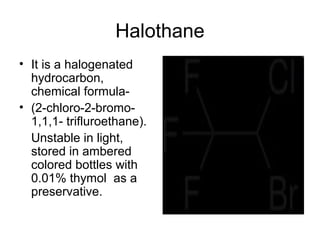
• It is a halogenated
hydrocarbon,
chemical formula-
• (2-chloro-2-bromo-
1,1,1- trifluroethane).
Unstable in light,
stored in ambered
colored bottles with
0.01% thymol as a
preservative.
History
• 1st
synthesized in the year 1951 by ICI and
introduced to Anesthesia in 1956 by M.
Johnstone in Manchester.
• Since it is not an explosive agent with pleasant
odor it became very popular and continue to
reign till newer drugs like isoflurane, sevoflurane
were made available.
• It is still popular in 3rd
world countries because of
cost factor but in developed countries replaced
by Sevoflurane.
Cont-
• It sensitizes the myocardium to catecholamine.
• Repeated uses noted severe Liver injury known
as Halothane Hepatitis, 1in 10,000 cases,
probably because of a metabolite trifluoroacetic
acid. Because of its depressant effect on
myocardium it is contraindicated in patients with
heart failure, susceptible to arrhythmia and in
Pheochromocytoma.
Pharmacokinetics
Uses
• Induction of Anesthesia.
• Maintenance of Anesthesia.
Uses
• Induction of Anesthesia.
• Maintenance of Anesthesia.

Inhalational anesthetic agents

  • 1.
  • 2.
    Halothane • It isa halogenated hydrocarbon, chemical formula- • (2-chloro-2-bromo- 1,1,1- trifluroethane). Unstable in light, stored in ambered colored bottles with 0.01% thymol as a preservative.
  • 3.
    History • 1st synthesized inthe year 1951 by ICI and introduced to Anesthesia in 1956 by M. Johnstone in Manchester. • Since it is not an explosive agent with pleasant odor it became very popular and continue to reign till newer drugs like isoflurane, sevoflurane were made available. • It is still popular in 3rd world countries because of cost factor but in developed countries replaced by Sevoflurane.
  • 4.
    Cont- • It sensitizesthe myocardium to catecholamine. • Repeated uses noted severe Liver injury known as Halothane Hepatitis, 1in 10,000 cases, probably because of a metabolite trifluoroacetic acid. Because of its depressant effect on myocardium it is contraindicated in patients with heart failure, susceptible to arrhythmia and in Pheochromocytoma.
  • 5.
  • 6.
    Uses • Induction ofAnesthesia. • Maintenance of Anesthesia.
  • 7.
    Uses • Induction ofAnesthesia. • Maintenance of Anesthesia.