NEUROMUSCULAR
BLOCKERS
Presented By : Patel Omkumar
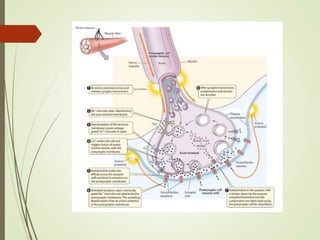
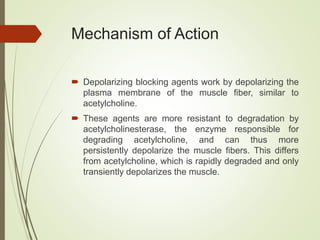
 Neuromuscular-blocking drugs block neuromuscular
transmission at the neuromuscular junction.
 Causing paralysis of the affected skeletal muscles.
 This is accomplished either by acting presynaptically via the
inhibition of acetylcholine (ACh) synthesis or release, or by
acting postsynaptically at the acetylcholine receptors of the
motor nerve end-plate.
 While some drugs act presynaptically (such as botulinum
toxin and tetanus toxin), those of current clinical importance
work postsynaptically.
Classification of Drugs
 Non-depolarizing blocking agents
 Example- tubocurarine, pancuronium, vecuronium and
atracurium, Gallamine
 Depolarizing blocking agents
 Example- succinylcholine (suxamethonium), decamethonium
rarely used clinically.
Non-depolarizing blocking
agents
 This drugs does not depolarize the motor end
plate.
 The quaternary ammonium muscle relaxants
belong to this class.
 Quaternary ammonium muscle relaxants are quaternary
ammonium salts used as drugs for muscle relaxation, most
commonly in anesthesia. It is necessary to prevent
spontaneous movement of muscle during surgical
operations.
 Which are poorly absorbed and rapidly excreted and can’t
cross placenta.
 They inhibit neuron transmission to muscle by competitively
blocking the binding of ACh to its nicotinic receptors, and
block the ionotropic activity of the ACh receptors.
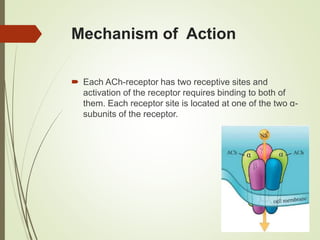
Mechanism of Action
 Each ACh-receptor has two receptive sites and
activation of the receptor requires binding to both of
them. Each receptor site is located at one of the two α-
subunits of the receptor.
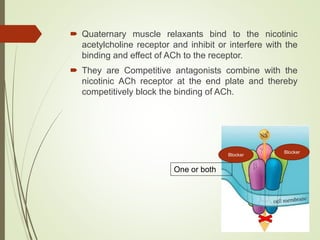
 Quaternary muscle relaxants bind to the nicotinic
acetylcholine receptor and inhibit or interfere with the
binding and effect of ACh to the receptor.
 They are Competitive antagonists combine with the
nicotinic ACh receptor at the end plate and thereby
competitively block the binding of ACh.
One or both
Blocker
Blocker
 A decrease in binding of acetylcholine leads
to a decrease in its effect and neuron
transmission to the muscle is less likely to
occur.
 It is generally accepted that non-depolarizing
agents block by acting as reversible
competitive inhibitors.
 Non-depolarising blocking agents also block
facilitatory presynaptic autoreceptors, and thus inhibit
the release of ACh during repetitive stimulation of the
motor nerve resulting in the phenomenon of tetanic
fade.
 Tetanic fade(a term used to describe the failure of
muscle tension to be maintained during a brief period
of nerve stimulation at a frequency high enough to
produce a fused tetanus)
Postsynaptic neuromuscular blockers
Competitive (non depolarizing blockers)
 Long Acting
 Pancuronium
 Intermediate acting
 Atracurium
 Vecuronium
 Rocuronium
 Cisatracurium
 Short acting
 Mivacurium
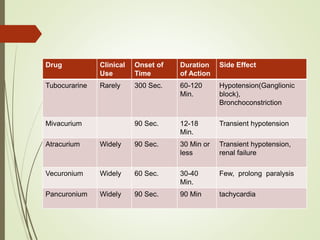
Drug Clinical
Use
Onset of
Time
Duration
of Action
Side Effect
Tubocurarine Rarely 300 Sec. 60-120
Min.
Hypotension(Ganglionic
block),
Bronchoconstriction
Mivacurium 90 Sec. 12-18
Min.
Transient hypotension
Atracurium Widely 90 Sec. 30 Min or
less
Transient hypotension,
renal failure
Vecuronium Widely 60 Sec. 30-40
Min.
Few, prolong paralysis
Pancuronium Widely 90 Sec. 90 Min tachycardia
 There action can be overcome by increasing conc.
Ach in synaptic gap or by the cholinesterase inhibitor,
neostigmine, physostigmine.
 Sugammadex, a macromolecule that selectively binds
steroidal neuromuscular blocking drugs such as
pancuronium as an inactive complex in the plasma.
The complex is excreted unchanged in the urine.
Sugammadex is claimed to produce more rapid
reversal of block than neostigmine.
Depolarizing blocking agents
 A depolarizing neuromuscular blocking agent
is a form of neuromuscular blocker that
depolarizes the motor end plate.
 An example is succinylcholine.
Mechanism of Action
 Depolarizing blocking agents work by depolarizing the
plasma membrane of the muscle fiber, similar to
acetylcholine.
 These agents are more resistant to degradation by
acetylcholinesterase, the enzyme responsible for
degrading acetylcholine, and can thus more
persistently depolarize the muscle fibers. This differs
from acetylcholine, which is rapidly degraded and only
transiently depolarizes the muscle.
 The constant depolarization and triggering of
the receptors keeps the endplate resistant to
activation by acetylcholine.
 A normal neuron transmission to muscle
cannot cause contraction of the muscle
because the endplate is depolarized and
thereby the muscle paralysed.
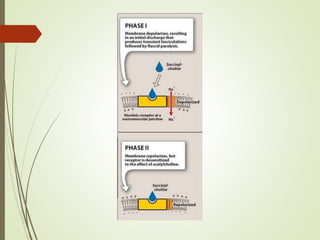
 There are two phases to the depolarizing block. During
Phase I (depolarizing phase), they cause muscular
fasciculation (muscle twitches) while they are
depolarizing the muscle fibers. Eventually, after
sufficient depolarization has occurred, Phase II
(desensitizing phase) sets in and the muscle is no
longer responsive to acetylcholine released by the
motor neurons. And full neuromuscular block has been
achieved.
Succinylcholine
 The dose of succinylcholine required for
tracheal intubation in adults is 1.0-1.5 mg kg
 This dose produces profound block within 60
sec. which is faster than any other NMBDs.
But very short duration of action about 5-10
minutes because of plasma cholinesterase,
which has an enormous capacity to hydrolyse
succinylcholine.
Adverse Effect
 Bradycardia
 Muscle pain day after surgery due to initial
fasciculation.
 Hyperkalaemia
Therapeutic Uses
 Facilitate endoscopy and intubation
 As adjuvant in general anesthesia to induce
muscle relaxation
 Orthopedic surgery.
THANK YOU

Neuromuscular blocker

  • 1.
  • 2.
     Neuromuscular-blocking drugsblock neuromuscular transmission at the neuromuscular junction.  Causing paralysis of the affected skeletal muscles.  This is accomplished either by acting presynaptically via the inhibition of acetylcholine (ACh) synthesis or release, or by acting postsynaptically at the acetylcholine receptors of the motor nerve end-plate.  While some drugs act presynaptically (such as botulinum toxin and tetanus toxin), those of current clinical importance work postsynaptically.
  • 3.
    Classification of Drugs Non-depolarizing blocking agents  Example- tubocurarine, pancuronium, vecuronium and atracurium, Gallamine  Depolarizing blocking agents  Example- succinylcholine (suxamethonium), decamethonium rarely used clinically.
  • 5.
    Non-depolarizing blocking agents  Thisdrugs does not depolarize the motor end plate.  The quaternary ammonium muscle relaxants belong to this class.
  • 6.
     Quaternary ammoniummuscle relaxants are quaternary ammonium salts used as drugs for muscle relaxation, most commonly in anesthesia. It is necessary to prevent spontaneous movement of muscle during surgical operations.  Which are poorly absorbed and rapidly excreted and can’t cross placenta.  They inhibit neuron transmission to muscle by competitively blocking the binding of ACh to its nicotinic receptors, and block the ionotropic activity of the ACh receptors.
  • 7.
    Mechanism of Action Each ACh-receptor has two receptive sites and activation of the receptor requires binding to both of them. Each receptor site is located at one of the two α- subunits of the receptor.
  • 8.
     Quaternary musclerelaxants bind to the nicotinic acetylcholine receptor and inhibit or interfere with the binding and effect of ACh to the receptor.  They are Competitive antagonists combine with the nicotinic ACh receptor at the end plate and thereby competitively block the binding of ACh. One or both Blocker Blocker
  • 9.
     A decreasein binding of acetylcholine leads to a decrease in its effect and neuron transmission to the muscle is less likely to occur.  It is generally accepted that non-depolarizing agents block by acting as reversible competitive inhibitors.
  • 10.
     Non-depolarising blockingagents also block facilitatory presynaptic autoreceptors, and thus inhibit the release of ACh during repetitive stimulation of the motor nerve resulting in the phenomenon of tetanic fade.  Tetanic fade(a term used to describe the failure of muscle tension to be maintained during a brief period of nerve stimulation at a frequency high enough to produce a fused tetanus)
  • 11.
    Postsynaptic neuromuscular blockers Competitive(non depolarizing blockers)  Long Acting  Pancuronium  Intermediate acting  Atracurium  Vecuronium  Rocuronium  Cisatracurium  Short acting  Mivacurium
  • 12.
    Drug Clinical Use Onset of Time Duration ofAction Side Effect Tubocurarine Rarely 300 Sec. 60-120 Min. Hypotension(Ganglionic block), Bronchoconstriction Mivacurium 90 Sec. 12-18 Min. Transient hypotension Atracurium Widely 90 Sec. 30 Min or less Transient hypotension, renal failure Vecuronium Widely 60 Sec. 30-40 Min. Few, prolong paralysis Pancuronium Widely 90 Sec. 90 Min tachycardia
  • 13.
     There actioncan be overcome by increasing conc. Ach in synaptic gap or by the cholinesterase inhibitor, neostigmine, physostigmine.  Sugammadex, a macromolecule that selectively binds steroidal neuromuscular blocking drugs such as pancuronium as an inactive complex in the plasma. The complex is excreted unchanged in the urine. Sugammadex is claimed to produce more rapid reversal of block than neostigmine.
  • 14.
    Depolarizing blocking agents A depolarizing neuromuscular blocking agent is a form of neuromuscular blocker that depolarizes the motor end plate.  An example is succinylcholine.
  • 16.
    Mechanism of Action Depolarizing blocking agents work by depolarizing the plasma membrane of the muscle fiber, similar to acetylcholine.  These agents are more resistant to degradation by acetylcholinesterase, the enzyme responsible for degrading acetylcholine, and can thus more persistently depolarize the muscle fibers. This differs from acetylcholine, which is rapidly degraded and only transiently depolarizes the muscle.
  • 17.
     The constantdepolarization and triggering of the receptors keeps the endplate resistant to activation by acetylcholine.  A normal neuron transmission to muscle cannot cause contraction of the muscle because the endplate is depolarized and thereby the muscle paralysed.
  • 18.
     There aretwo phases to the depolarizing block. During Phase I (depolarizing phase), they cause muscular fasciculation (muscle twitches) while they are depolarizing the muscle fibers. Eventually, after sufficient depolarization has occurred, Phase II (desensitizing phase) sets in and the muscle is no longer responsive to acetylcholine released by the motor neurons. And full neuromuscular block has been achieved.
  • 20.
    Succinylcholine  The doseof succinylcholine required for tracheal intubation in adults is 1.0-1.5 mg kg  This dose produces profound block within 60 sec. which is faster than any other NMBDs. But very short duration of action about 5-10 minutes because of plasma cholinesterase, which has an enormous capacity to hydrolyse succinylcholine.
  • 21.
    Adverse Effect  Bradycardia Muscle pain day after surgery due to initial fasciculation.  Hyperkalaemia
  • 22.
    Therapeutic Uses  Facilitateendoscopy and intubation  As adjuvant in general anesthesia to induce muscle relaxation  Orthopedic surgery.
  • 23.