THIOPENTONE
Derived from babituric acid - urea and malonic
acid
• In No 2- Retaining oxygen atom called Oxybarbiturate and
replacement of this atom by Sulphar atom is called Thiobarbiturate.
• In No 5- Phenyl group causes anticonvulsant activity, hypnotic
activity.
• Bacteriostatic property due to highly alkaline pH.
• Commercial preparation of barbiturates often contain a mixture of 6
part of anhydrous Na2Co3 .
• It prevents precipitation of insoluble acidic form of barbiturates by
atmospheric CO2.
• Powdered form of thiopentone is stable at room temperature
indefinitely
• Refrigerated solution of thiopentone are stable up to 2 weeks.
• At 22 degree celcius; 6 days
PREPARATION
• Sodium thiopentone (Racemic mixtures ) is prepared by dissolving a
yellowish powder in sterile water to provide a 2.5% solution (ie
25mg/ml).
• In this concentration 20mls of solution will contain 500mg.
• Diluent for reconstitution
• 0.9% NS
• STERILE WATER
• 5%DEXTROSE SOLUTION
• Barbiturates are prepared commercially from highly alkaline solution
as sodium salts that are readily soluble in water and saline.
• Ph of 2.5% solution of Thiopentone is 10.5.
• Incompatible with mixture with drugs which are acidic in solution
such as
opioids
catecholamines
neuromuscular blocking drugs
Dose
• ED 50 = 2.2 – 2.7 mg / Kg
• Induction dose: Adults : 3-6 mg/kg given I/V over 5- 15 sec.
• Sedation dose: 0.5 to 1.5 mg/kg I/V.
• Neonates:2-3 mg/kg.
• Rectal dose:-30-50 mg/kg
• IV maintenance infusion: 50-100 mg every 10-12 min
• Most frequently admnistered I/V for induction in adults and childern.
• It can be used rectally in case of children
MECHANISM OF ACTION
• Ultra short-acting barbiturate anaesthetics depress the central
nervous system (CNS) to produce hypnosis and anaesthesia
without analgesia.
• Site of action: GABA: BZD: Chloride receptor complex in
CNS
• When GABAA receptors are activated, trans-membrane
chloride conductance increases, resulting in hyperpolarisation
of post- synaptic cell membrane and functional inhibition of
post synaptic neurons.
Pharmacokinetics
• Distribution determined by-
Lipid solubility
Protein binding(80%)
Degree of ionization(60%)
• Maximal brain uptake of thiopentone occurs in 30 sec .
• It decreases over next 5 min to one-half the initial peak concentration
due to redistribution from brain to other tissues.
• Rapid awakening after I/V induction-REDISTRIBUTION.
• After 30 min, ~ 10 % remains in the brain due to redistribution.
• Protein binding: — Protein binding parallels to lipid solubility (i.e.
unionized component).
• Thiopentone is a highly lipid soluble drug with high protein binding,
with binding to albumin ranging from 72 to 86%.
• Decreased protein binding due to Hypoproteinemia (cirrhosis of
liver)
• Uraemia or aspirin, phenylbutazone may lead to increased free fraction
of the drug; hence enhanced effect.
• Skeletal muscles most prominent site for redistribution .
• Equilibrium with muscle reached in 15 min after I/V injection.
• Fat is the only compartment in which thiopentone continues to remain
30 min after injection.
• Fat is potential reservoir for maintaining plasma concentration of drug.
• Redistribution of thiopentone is most important for awakening.
• Metabolized in liver to hydroxythiopental and carboxylic acid an is
water soluble.
PHARMACODYNAMICS
Central Nervous System
• Dose dependent depression of cerebral cortex, ascending reticular
activating system and medullary centre resulting in sedation, hypnosis,
anaesthesia, respiratory depression.
• Decrease in Cerebral metabolic oxygen consumption, Cerebral blood
flow and ICP
• Anticonvulsant effect
• Stimulates CTZ, so nausea and vomiting
• It has no analgesic property
• Facilitate CSF absorption which results in reduction in CSF volume
this combined with decrease in CBF, makes thiopentone highly
effective in lowering ICT.
• Decrease in intracranial pressure exceeds the decline in cerebral
arterial pressure ,thus results in increase cerebral perfusion
pressure(CPP).
CVS
• Myocardial depression: dose dependent
• Mean BP: There is either a fall in or no change in mean arterial blood
pressure depending on volume status.
• Compensatory increase in heart rate due to decrease in mean BP
• Liver:
• Blood flow is not affected (rather increases hepatic blood flow) unless
there is hypoxia.
• Induction of microsomal enzymes
• Induction of aminolevulinic acid synthetase stimulate the formation
porphyrins,which may precipitate acute intermittent porphyria in
susceptible individuals
• Kidney:
• Decrease in renal blood flow and GFR
• GIT: Decrease in peristalsis.
• Eye:
• Pupil first dilate and then constrict
• Sensitivity to light remains until the patients is deep enough to permit
skin incision.
• At this stage, eyeballs are centrally placed.
• Decrease in IOP.
• Loss of eyelash reflex is the sign of induction of anaesthesia.
Indications
• Induction
• Maintenance of anesthesia
• Premedication
• Pre- anaesthetic Sedation: Rectal suspension
• Sedation
• Convulsions (treatment)—Thiopental for injection (3mg/kg)(GTCS) states
• Narcoanalysis
• Cerebral protection: Thiopental for injection is indicated to protect the brain
from the effects of hypoxia and ischemia following head injuries and other
related conditions
CONTRAINDICATIONS
• When the patient has respiratory obstruction or an inadequate airway
• Cardiovascular instability
• Status asthmaticus
• Porphyria
• Without proper equipment (IV instrumentation) and airway equipment
(means of artificial ventilation), thiopental should not be administered.
• Hypersensitivity
Side/Adverse Effects
• Local: On intravenous/ perivenous injection, it may cause pain,
swelling, ulceration, hematoma due to its high pH (highly alkaline).
• Treatment is 10ml of 1% xylocaine with hydralase 1000U into area
(causes vasodilatation and absorption of drug).
Accidental intra- arterial injection:
• The pH of 2.5% drug solution is 10.5 (strong alkali).
• When it is injected into artery and mixed with blood (pH= 7.4= less
alkaline) it gets precipitated as solid crystals of thiopentone and
haemoglobin.
• It results in local inflammation and blocks small arterioles, causes
vasospasm due to local release of noradrenaline.
• Arteriospasm
• Severe pain
• Blanching of the arm and fingers.
• Oedema,
• Ulceration
• Gangrene of hand/ arm may follow.
• Onset of unconsciousness is delayed.
Corrective measures
• Stop the injection.
• Leave the needle in place (do not take out needle otherwise we may
lose artery access).
• Inject 500U heparin (it reverses alkalinity and prevents thrombosis).
• Inject 5 ml xylocaine 1- 2% into the artery.
• Dilute the injected Pentothal (Thiopental Sodium for Injection, USP)
by removing the tourniquet and any restrictive garments and flush with
normal saline.
• Inject the artery with a dilute solution (10- 20ml) of papaverine, 40 to
80 mg, or 10 mL of 1% procaine, to inhibit smooth muscle spasm.
• Continue anaesthesia with Halothane (vasodilator)
• Postpone surgery if possible.
• Oral anticoagulants may be required.
• If necessary, perform sympathetic block of the brachial plexus and/or
stellate ganglion to relieve pain and assist in opening collateral
circulation.
• Papaverine can be injected into the subclavian artery, if desired.
• Consider local infiltration of an alpha-adrenergic blocking agent such
as phentolamine into the vasospastic area.
Handling
• The powder is soluble in distilled water, normal saline and alcohol.
• It should be reconstituted in distilled water or normal saline to prevent
precipitation.
• Store below 25 celsius ,in dry place, protect from light.
• Avoid Lactated Ringer’s solution.
• It should be prepared as 2.5% solution as higher concentrated solution
will result in higher pH (more alkaline solution).
• Solution of 2.5% in distilled water is isotonic.
• The bacteriostatic properties of commercial preparations are due to
their highly alkaline pH.
• It does not contain anti- bacterial agents.
• The powder form is stable at room temperature.
• Cloudy solution should be discarded.
Propofol
Preprations of Propofol
• Diprivan(1%)- 10% soyabean oil, 2.25% glycerol, 1.2% egg
phosphatide ,0.005%disodium edenate.
• Ampofol(low lipid emulsion)- 5%soyabean oil, 0.6% egg
lecithin,Diprifusor TCI devices.
• Propofol lipura
• Fospropofol(Lusedra/Aquavan) prodrug
• Group alkylphenols
• The formulation most commonly used is that of 1% propofol,
• 10% soybean oil
• 1.2% purified egg phospholipid added as emulsifier,
• 2.25% of glycerol as a tonicity-adjusting agent,
• sodium hydroxide to change the pH may be diluted with 5% dextrose
in water
• Sometimes EDTA (inhibit microorganism)
• Milky white coloured , sterile , non pyrogenic ,oil in water emulsion
• Highly lipid soluble ,Slightly water soluble
• Isotonic pH- 6 to8.5
• 2,6- diisopropylphenol(C12H18O)
• Weak acid,
• unionized,
• Pka-11
• Protein binding-95-98%
PHARMACOKINETICS
• Propofol is oxidized to 1,4-diisopropyl quinol in the liver Propofol is
oxidized to 1,4-diisopropyl quinol in the liver.
• Induction of anesthesia starts within 40 seconds from the start of
injection (the time for one arm-brain circulation)
• Propofol is hemodynamic depressant
• Reduce hepatic blood flow therefore it reduces metabolizam of other
drugs by the liver.
• Propofol
• Half life elemination 4-7 hours.
• Clearance 20-30 mg/kg/min
• Volume of distribution 2-10 L/kg
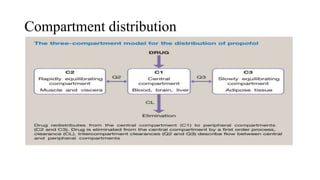
Three-compartment models.
• After a single bolus dose, blood propofol levels decrease rapidly as a
result of redistribution and elimination.
• Onset-<40 seconds, peak effect -90-100 seconds
• Propofol is described by a three-compartment model give initial and
slow distribution half-lives of
• Phase 1- 2 to 8 minutes
• Phase 2 - 30 to 70 minutes muscle and fat
• Phase 3 - elimination half-life of 4 to 23.5 hours.
Compartment distribution
Geriatric Age
• Patients 80 years old or older generally need 50% of the propofol dose
of patients 20 years old to target the same level of sedation or
hypnosis.
• Older individuals - decreased clearance rates and a smaller central
compartment volume.
• Reduced cardiac output.
Effect in children
• Children have larger central compartment volume (50%) and a more
rapid clearance (25%).
• Children less than 3 years of age have larger central compartment and
systemic clearance values than in adults or older children.
• Therefore larger dose are required in this age group.
Opioids and Bendzodiazepines
• In the presence of a sedative Benzodiazepines(midazolam) , blood
propofol concentrations become elevated by approximately 25%
• Opioids increases blood propofol concentrations through a reduction
in the elimination and distribution clearance of propofol.
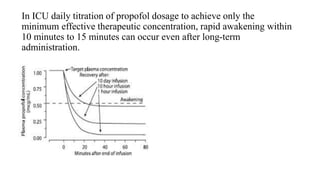
In ICU daily titration of propofol dosage to achieve only the
minimum effective therapeutic concentration, rapid awakening within
10 minutes to 15 minutes can occur even after long-term
administration.
PHARMACODYNAMICS
Central Nervous System
• The hypnotic action of propofol is mostly mediated by enhancing γ-
aminobutyric acid (GABA)-induced chloride current through its
binding to the β subunit of the GABAA receptor.
• Sites on the β1, β2, and β3 subunits of the transmembrane domains are
crucial for the hypnotic action of propofol
Other CNS effects of propofol
• Propofol decreases intracranial pressure (ICP).
• The decrease in ICP (30% to 50%) is associated with significant
decreases in cerebral perfusion pressure (CPP).
• Head-injured patients should be restricted to doses providing mild to
moderate sedation (i.e., blood concentration of 2 μg/mL, infusion of
1.5-4.5 mg/kg/hr)
• Neuroprotective effects -
• Reduce the metabolic oxygen as it maintain the balance between
energy supply and demand.
• Increase the tolerance to hypoxia by the neuronal tissue
• The onset of hypnosis after a dose of 2.5 mg/kg is rapid (one arm–
brain circulation), with a peak effect seen at 90 to 100 seconds.
• ED50 of propofol for loss of consciousness is 1 to 1.5 mg/kg after a
bolus.
• The duration of hypnosis 5 to 10 minutes after 2 to 2.5 mg/kg.
• Effect of age induction dose, which is highest at younger than 2 years
(95% effective dose [ED95], 2.88 mg/kg)
• Decreases with increasing age.
• Propofol causes a concentration-dependent decrease in the bispectral
index (BIS),
• 50% and 95% of patients unable to respond to a verbal command at a
BIS of 63 and 51, respectively.
• The concentration at which 50% of volunteers failed to respond to
verbal command is 2.35 μg/mL.
• Propofol infusions of at least 2 mg/kg/hour were necessary to provide
amnesia.
• Drug abuse because it increases DOPAMINE in nucleus acumens.
• Propofol is used as a sedative in the intensive care unit (ICU); in 20%
to 40% of patients, the propofol dosage regimen must be repeatedly
adjusted upward to maintain the same effect
Effects on the Respiratory System
• Apnea can occur during induction dose of propofol.
• Incidence and duration of apnea depend on dose, speed of injection,
and concomitant premedication.
• It occurs for more than 30 seconds, 40 % decrease in Tidal volume ,
20% increase in respiratory rate)
Cardiovascular effects
• Decreses cardiac activity by 25% - 40%
• Baroreflex blunted while induction, therefore no tachycardic response
to hypotension
• Attenuates the heart rate response to atropine in a dose-dependent
manner.
• It also suppresses atrial (supraventricular) tachycardias and probably
should be avoided during electrophysiologic studies.
Propofol versus volatile anesthetics in patients
who undergo cardiac surgry.
• Large dose of propofol (120 μg/kg/minute) or a small dose of
propofol (60 μg/kg/minute) during cardiacsurgery, or titrating
isoflurane throughout the operation, showed improved
hemodynamic function in the large-dose propofol group
compared with the isoflurane or small-dose propofol group.
• Isoflurane preconditioning, combined with propofol
postconditioning, attenuating postischemic myocardial
reperfusion injury.
Metabolic effects
• During prolonged infusion in ICU to older patient serum
triglyceride concentrations should be routinely monitored.
• The sedation guidelines of the American College of Critical
Care Medicine also recommend “that patients receiving
propofol for long term sedation should be monitored for
unexplained metabolic acidosis or arrhythmias.
• The recommended maximal dose of propofol infusion rate is
80 μg/kg/minute (<5 mg/kg/hour).
• No dosage adjustments are needed for patients with renal or
hepatic failure
• Kidney- vasoconstriction of splanchnic and renal blood
vessels which causes decrease in RBF and GFR.
• Prolonged infusions results in green urine due to phenols in
urine and due to increased uric acid crystals in urine.
• Eyes- decrease in IOP by 30-40%, helps in blunting increase
in IOP due to succinylcholine or laryngoscopy.
Propofol infusion syndrome
• Risk factor
• Decreased oxygen delivery to tissues
• serious neurological injury
• sepsis
• high dosages of one or more of the steroids, inotropes
• high-dose infusions of propofol (greater than 5 mg/kg/h for
greater than 48h).
• The syndrome has also been reported following large-dose in
short-term infusions during surgical anesthesia.
• Rare but lethal syndrome associated with infusion of
propofol at 4 mg/kg/hour or more for 48 hours or longer.
• The clinical features
• Acute refractory bradycardia leading to asystole in the
presence of one or more of the following:
• Metabolic acidosis (base deficit >10 mmol/L),
• Rhabdomyolysis,
• Hyperlipidemia, fatty liver.
• ECG changes ST segment elevation
TARGET CONTROLLED INFUSIONS IN
ANESTHESIA
• Effect site (Brain)concentration targeting where the
calculated concentration of the drug at the effect site .
• When the effect site concentration is set the system will
administer a bolus to rapidly fill the central compartment
producing a step-wise increase in plasma concentration
thereby increasing the effector site concentration.
• The TCI systems repeat the calculations and alter the rate of
infusion every 10 seconds.
• In the 3-compartment model, 3 superimposed infusions are
required: two first order exponentially decreasing infusions to
match drug that is removed from the central to the peripheral
compartments by distribution and a third infusion at a
constant rate to replace drug removed by elimination.
Indications
• Induction and maintenance of anesthesia
• Monitored anaesthesia care(MAC) sedation
• Combined sedation and regional anaesthesia
• Short surgical procedure,
• ICU sedation
• Conscious sedation.
• Induction in malignant hyperthermia
Non Anesthetic use
• Antiemitic effects (10- 15mg IV)
• Antipruritic Effects 10mg
• Anticonvulsant activity 1mg/kg IV
• Bronchoconstriction
• Antioxdant
Side effects
• Pain on injection site
• Bradicardia
• Hypertirglyceridemia
• Allergic reaction
• Lactic acidosis
• Abuse potential
• Proconvulsant activity
• Bacterial Growth- Pseudomonas , E.coli, Candida albicans
• Green colour urine (prolong infision)
Labor and Delivery
• Propofol is not recommended for obstetrics, including cesarean section
deliveries.
• Propofol crosses the placenta, and as with other general anesthetic
agents,
• Propofol is associated with neonatal depression
Induction of General Anesthesia:
• Healthy Adults Less Than 55 Years of Age: 40 mg every 10 seconds
until induction onset (2 mg/kg to 2.5 mg/kg).
• Elderly, Debilitated, or ASA-PS III or IV Patients: 20 mg every 10
seconds until induction onset (1 mg/kg to 1.5 mg/kg).
• Cardiac Anesthesia: 20 mg every 10 seconds until induction onset (0.5
mg/kg to 1.5 mg/kg).
• Neurosurgical Patients: 20 mg every 10 seconds until induction onset
(1 mg/kg to 2 mg/kg).
• Pediatric Patients - healthy, from 3 years to 16 years of age: 2.5 mg/kg
to 3.5 mg/kg administered over 20 seconds to 30 seconds.
Maintenance of General Anesthesia:
• Infusion Healthy Adults Less Than 55 Years of Age: 6 mg/kg/h to 12 mg/kg/h
• Elderly, Debilitated, ASA-PS III or IV Patients: 3 mg/kg/h to 6 mg/kg/h
• Cardiac Anesthesia: Most patients require:
• Propofol with Secondary Opioid –100 mcg/kg/min to 150 mcg/kg/min.
• Low-Dose Propofol with Primary Opioid – 50mcg/kg/min to 100 mcg/kg/min.
• Neurosurgical Patients: 6 mg/kg/h to 12 mg/kg/h
• Pediatric Patients - healthy, from 2 months of age to 16 years of age: 7.5
mg/kg/h to 18 mg/kg/h
• Following the first half hour of maintenance, if clinical signs of light
anesthesia are not present, the infusion rate should be decreased
Monitored Anesthesia Care (MAC) Sedation
• During initiation of MAC sedation, slow infusion or slow injection
techniques are preferable over rapid bolus administration.
• Initiation of MAC Sedation: Healthy Adults Less Than 55 Years of
Age: Slow infusion or slow injection techniques are recommended to
avoid apnea or hypotension.
• Doase requirement 6 mg/kg/h to 9 mg/kg/h for 3 minutes to 5 minutes
followed immediately by a maintenance infusion(1.5 mg/kg/h to 4.5
mg/kg/h) or incremental bolus doses of 10 mg.
• In Elderly, Debilitated, Neurosurgical, or ASA-PS III or IV
Patients:Most patients require 80% of the usual adult dose.
Initiation and Maintenance of ICU Sedation in
Intubated, Mechanically Ventilated
• Adult Patients - Because of the residual effects of previous anesthetic or
sedative agents, in most patients the initial infusion should be 5 mcg/kg/min
(0.3 mg/kg/h) for at least 5 minutes.
• Subsequent increments of 0.3mg/kg/k to 0.6 mg/kg/h over 5 minutes to 10
minutes may be for desired clinical effect is achieved.
• Maintenance rates of 0.3 mg/kg/h to 3 mg/kg/h or higher may be required.
• Should not exceed 4 mg/kg/hour unless the benefits outweigh the risks
• Maintenance of MAC Sedation: Healthy Adults Less Than 55 Years of Age: A
variable rate infusion technique is preferable over an intermittent bolus
technique.
• Evaluation of CNS function should be done daily throughout
maintenance to determine the minimum dose of propofol required for
sedation.
• The tubing and any unused popofol drug product should be discarded
after 12 hours because propofol contains no preservatives and is
capable of supporting growth of microorganisms.
Handling
Administration with Lidocaine
• It should be given prior to propofol administration or
• or It can be added to Propofol immediately before administration and
in quantities not exceeding 20 mg lidocaine/200 mg Propofol
Administration with Other Fluids
It should not be diluted to a concentration less than 2 mg/mL
compatible with the following intravenous fluids.
• - 5% Dextrose Injection(prefered)
• - Lactated Ringers Injection
• - Lactated Ringers and 5% Dextrose Injection
• - 5% Dextrose and 0.45% Sodium Chloride Injection
• - 5% Dextrose and 0.2% Sodium Chloride Injection
Precautions before opening
• Parenteral drug should be inspected visually for particulate matter and
discoloration and expiry date prior to administration.
• Store below 25 celsius, Don't freez.
• Propofol should only be administered through a filter with a pore size
of 5 micron or greater.
• Strict aseptic technique must always be maintained during handling.
• Propofol is a single access parenteral product (single patient infusion
vial) which contains 0.005% disodium edetate to inhibit the rate of
growth of microorganisms, up to 12 hours.
• The vial rubber stopper should be disinfected using 70% isopropyl
alcohol.
• Propofol should be drawn into a sterile syringe immediately after a
vial is opened.
• When withdrawing Propofol from vials, a sterile vent spike should be
used.
• The syringe should be labelled with appropriate information including
the date and time the vial was opened. Administration should
commence promptly and be completed within 12 hours after the vial
has been opened.
• Propofol must be prepared for single-patient use only.
• Any unused Propofol drug product, reservoirs, dedicated
administration tubing and/or solutions containing
• Propofol must be discarded at the end of the anesthetic procedure or at
12 hours
• The IV line should be flushed every 12 hours and at the end of the
anesthetic procedure to remove residual Propofol.
Thiopentone and propofol

Thiopentone and propofol

  • 1.
  • 2.
    Derived from babituricacid - urea and malonic acid • In No 2- Retaining oxygen atom called Oxybarbiturate and replacement of this atom by Sulphar atom is called Thiobarbiturate. • In No 5- Phenyl group causes anticonvulsant activity, hypnotic activity.
  • 3.
    • Bacteriostatic propertydue to highly alkaline pH. • Commercial preparation of barbiturates often contain a mixture of 6 part of anhydrous Na2Co3 . • It prevents precipitation of insoluble acidic form of barbiturates by atmospheric CO2. • Powdered form of thiopentone is stable at room temperature indefinitely • Refrigerated solution of thiopentone are stable up to 2 weeks. • At 22 degree celcius; 6 days
  • 4.
    PREPARATION • Sodium thiopentone(Racemic mixtures ) is prepared by dissolving a yellowish powder in sterile water to provide a 2.5% solution (ie 25mg/ml). • In this concentration 20mls of solution will contain 500mg. • Diluent for reconstitution • 0.9% NS • STERILE WATER • 5%DEXTROSE SOLUTION
  • 5.
    • Barbiturates areprepared commercially from highly alkaline solution as sodium salts that are readily soluble in water and saline. • Ph of 2.5% solution of Thiopentone is 10.5. • Incompatible with mixture with drugs which are acidic in solution such as opioids catecholamines neuromuscular blocking drugs
  • 6.
    Dose • ED 50= 2.2 – 2.7 mg / Kg • Induction dose: Adults : 3-6 mg/kg given I/V over 5- 15 sec. • Sedation dose: 0.5 to 1.5 mg/kg I/V. • Neonates:2-3 mg/kg. • Rectal dose:-30-50 mg/kg • IV maintenance infusion: 50-100 mg every 10-12 min • Most frequently admnistered I/V for induction in adults and childern. • It can be used rectally in case of children
  • 7.
    MECHANISM OF ACTION •Ultra short-acting barbiturate anaesthetics depress the central nervous system (CNS) to produce hypnosis and anaesthesia without analgesia. • Site of action: GABA: BZD: Chloride receptor complex in CNS • When GABAA receptors are activated, trans-membrane chloride conductance increases, resulting in hyperpolarisation of post- synaptic cell membrane and functional inhibition of post synaptic neurons.
  • 8.
    Pharmacokinetics • Distribution determinedby- Lipid solubility Protein binding(80%) Degree of ionization(60%) • Maximal brain uptake of thiopentone occurs in 30 sec . • It decreases over next 5 min to one-half the initial peak concentration due to redistribution from brain to other tissues. • Rapid awakening after I/V induction-REDISTRIBUTION. • After 30 min, ~ 10 % remains in the brain due to redistribution.
  • 9.
    • Protein binding:— Protein binding parallels to lipid solubility (i.e. unionized component). • Thiopentone is a highly lipid soluble drug with high protein binding, with binding to albumin ranging from 72 to 86%. • Decreased protein binding due to Hypoproteinemia (cirrhosis of liver) • Uraemia or aspirin, phenylbutazone may lead to increased free fraction of the drug; hence enhanced effect.
  • 10.
    • Skeletal musclesmost prominent site for redistribution . • Equilibrium with muscle reached in 15 min after I/V injection. • Fat is the only compartment in which thiopentone continues to remain 30 min after injection. • Fat is potential reservoir for maintaining plasma concentration of drug. • Redistribution of thiopentone is most important for awakening. • Metabolized in liver to hydroxythiopental and carboxylic acid an is water soluble.
  • 11.
    PHARMACODYNAMICS Central Nervous System •Dose dependent depression of cerebral cortex, ascending reticular activating system and medullary centre resulting in sedation, hypnosis, anaesthesia, respiratory depression. • Decrease in Cerebral metabolic oxygen consumption, Cerebral blood flow and ICP • Anticonvulsant effect • Stimulates CTZ, so nausea and vomiting • It has no analgesic property
  • 12.
    • Facilitate CSFabsorption which results in reduction in CSF volume this combined with decrease in CBF, makes thiopentone highly effective in lowering ICT. • Decrease in intracranial pressure exceeds the decline in cerebral arterial pressure ,thus results in increase cerebral perfusion pressure(CPP).
  • 13.
    CVS • Myocardial depression:dose dependent • Mean BP: There is either a fall in or no change in mean arterial blood pressure depending on volume status. • Compensatory increase in heart rate due to decrease in mean BP
  • 14.
    • Liver: • Bloodflow is not affected (rather increases hepatic blood flow) unless there is hypoxia. • Induction of microsomal enzymes • Induction of aminolevulinic acid synthetase stimulate the formation porphyrins,which may precipitate acute intermittent porphyria in susceptible individuals • Kidney: • Decrease in renal blood flow and GFR • GIT: Decrease in peristalsis.
  • 15.
    • Eye: • Pupilfirst dilate and then constrict • Sensitivity to light remains until the patients is deep enough to permit skin incision. • At this stage, eyeballs are centrally placed. • Decrease in IOP. • Loss of eyelash reflex is the sign of induction of anaesthesia.
  • 16.
    Indications • Induction • Maintenanceof anesthesia • Premedication • Pre- anaesthetic Sedation: Rectal suspension • Sedation • Convulsions (treatment)—Thiopental for injection (3mg/kg)(GTCS) states • Narcoanalysis • Cerebral protection: Thiopental for injection is indicated to protect the brain from the effects of hypoxia and ischemia following head injuries and other related conditions
  • 17.
    CONTRAINDICATIONS • When thepatient has respiratory obstruction or an inadequate airway • Cardiovascular instability • Status asthmaticus • Porphyria • Without proper equipment (IV instrumentation) and airway equipment (means of artificial ventilation), thiopental should not be administered. • Hypersensitivity
  • 18.
    Side/Adverse Effects • Local:On intravenous/ perivenous injection, it may cause pain, swelling, ulceration, hematoma due to its high pH (highly alkaline). • Treatment is 10ml of 1% xylocaine with hydralase 1000U into area (causes vasodilatation and absorption of drug).
  • 19.
    Accidental intra- arterialinjection: • The pH of 2.5% drug solution is 10.5 (strong alkali). • When it is injected into artery and mixed with blood (pH= 7.4= less alkaline) it gets precipitated as solid crystals of thiopentone and haemoglobin. • It results in local inflammation and blocks small arterioles, causes vasospasm due to local release of noradrenaline.
  • 20.
    • Arteriospasm • Severepain • Blanching of the arm and fingers. • Oedema, • Ulceration • Gangrene of hand/ arm may follow. • Onset of unconsciousness is delayed.
  • 21.
    Corrective measures • Stopthe injection. • Leave the needle in place (do not take out needle otherwise we may lose artery access). • Inject 500U heparin (it reverses alkalinity and prevents thrombosis). • Inject 5 ml xylocaine 1- 2% into the artery. • Dilute the injected Pentothal (Thiopental Sodium for Injection, USP) by removing the tourniquet and any restrictive garments and flush with normal saline. • Inject the artery with a dilute solution (10- 20ml) of papaverine, 40 to 80 mg, or 10 mL of 1% procaine, to inhibit smooth muscle spasm.
  • 22.
    • Continue anaesthesiawith Halothane (vasodilator) • Postpone surgery if possible. • Oral anticoagulants may be required. • If necessary, perform sympathetic block of the brachial plexus and/or stellate ganglion to relieve pain and assist in opening collateral circulation. • Papaverine can be injected into the subclavian artery, if desired. • Consider local infiltration of an alpha-adrenergic blocking agent such as phentolamine into the vasospastic area.
  • 23.
    Handling • The powderis soluble in distilled water, normal saline and alcohol. • It should be reconstituted in distilled water or normal saline to prevent precipitation. • Store below 25 celsius ,in dry place, protect from light. • Avoid Lactated Ringer’s solution. • It should be prepared as 2.5% solution as higher concentrated solution will result in higher pH (more alkaline solution). • Solution of 2.5% in distilled water is isotonic.
  • 24.
    • The bacteriostaticproperties of commercial preparations are due to their highly alkaline pH. • It does not contain anti- bacterial agents. • The powder form is stable at room temperature. • Cloudy solution should be discarded.
  • 25.
  • 26.
    Preprations of Propofol •Diprivan(1%)- 10% soyabean oil, 2.25% glycerol, 1.2% egg phosphatide ,0.005%disodium edenate. • Ampofol(low lipid emulsion)- 5%soyabean oil, 0.6% egg lecithin,Diprifusor TCI devices. • Propofol lipura • Fospropofol(Lusedra/Aquavan) prodrug
  • 27.
    • Group alkylphenols •The formulation most commonly used is that of 1% propofol, • 10% soybean oil • 1.2% purified egg phospholipid added as emulsifier, • 2.25% of glycerol as a tonicity-adjusting agent, • sodium hydroxide to change the pH may be diluted with 5% dextrose in water • Sometimes EDTA (inhibit microorganism)
  • 28.
    • Milky whitecoloured , sterile , non pyrogenic ,oil in water emulsion • Highly lipid soluble ,Slightly water soluble • Isotonic pH- 6 to8.5 • 2,6- diisopropylphenol(C12H18O) • Weak acid, • unionized, • Pka-11 • Protein binding-95-98%
  • 29.
    PHARMACOKINETICS • Propofol isoxidized to 1,4-diisopropyl quinol in the liver Propofol is oxidized to 1,4-diisopropyl quinol in the liver. • Induction of anesthesia starts within 40 seconds from the start of injection (the time for one arm-brain circulation) • Propofol is hemodynamic depressant • Reduce hepatic blood flow therefore it reduces metabolizam of other drugs by the liver.
  • 30.
    • Propofol • Halflife elemination 4-7 hours. • Clearance 20-30 mg/kg/min • Volume of distribution 2-10 L/kg
  • 31.
    Three-compartment models. • Aftera single bolus dose, blood propofol levels decrease rapidly as a result of redistribution and elimination. • Onset-<40 seconds, peak effect -90-100 seconds • Propofol is described by a three-compartment model give initial and slow distribution half-lives of • Phase 1- 2 to 8 minutes • Phase 2 - 30 to 70 minutes muscle and fat • Phase 3 - elimination half-life of 4 to 23.5 hours.
  • 32.
  • 33.
    Geriatric Age • Patients80 years old or older generally need 50% of the propofol dose of patients 20 years old to target the same level of sedation or hypnosis. • Older individuals - decreased clearance rates and a smaller central compartment volume. • Reduced cardiac output.
  • 34.
    Effect in children •Children have larger central compartment volume (50%) and a more rapid clearance (25%). • Children less than 3 years of age have larger central compartment and systemic clearance values than in adults or older children. • Therefore larger dose are required in this age group.
  • 35.
    Opioids and Bendzodiazepines •In the presence of a sedative Benzodiazepines(midazolam) , blood propofol concentrations become elevated by approximately 25% • Opioids increases blood propofol concentrations through a reduction in the elimination and distribution clearance of propofol.
  • 36.
    In ICU dailytitration of propofol dosage to achieve only the minimum effective therapeutic concentration, rapid awakening within 10 minutes to 15 minutes can occur even after long-term administration.
  • 37.
    PHARMACODYNAMICS Central Nervous System •The hypnotic action of propofol is mostly mediated by enhancing γ- aminobutyric acid (GABA)-induced chloride current through its binding to the β subunit of the GABAA receptor. • Sites on the β1, β2, and β3 subunits of the transmembrane domains are crucial for the hypnotic action of propofol
  • 38.
    Other CNS effectsof propofol • Propofol decreases intracranial pressure (ICP). • The decrease in ICP (30% to 50%) is associated with significant decreases in cerebral perfusion pressure (CPP). • Head-injured patients should be restricted to doses providing mild to moderate sedation (i.e., blood concentration of 2 μg/mL, infusion of 1.5-4.5 mg/kg/hr) • Neuroprotective effects - • Reduce the metabolic oxygen as it maintain the balance between energy supply and demand. • Increase the tolerance to hypoxia by the neuronal tissue
  • 39.
    • The onsetof hypnosis after a dose of 2.5 mg/kg is rapid (one arm– brain circulation), with a peak effect seen at 90 to 100 seconds. • ED50 of propofol for loss of consciousness is 1 to 1.5 mg/kg after a bolus. • The duration of hypnosis 5 to 10 minutes after 2 to 2.5 mg/kg. • Effect of age induction dose, which is highest at younger than 2 years (95% effective dose [ED95], 2.88 mg/kg) • Decreases with increasing age.
  • 40.
    • Propofol causesa concentration-dependent decrease in the bispectral index (BIS), • 50% and 95% of patients unable to respond to a verbal command at a BIS of 63 and 51, respectively. • The concentration at which 50% of volunteers failed to respond to verbal command is 2.35 μg/mL.
  • 41.
    • Propofol infusionsof at least 2 mg/kg/hour were necessary to provide amnesia. • Drug abuse because it increases DOPAMINE in nucleus acumens. • Propofol is used as a sedative in the intensive care unit (ICU); in 20% to 40% of patients, the propofol dosage regimen must be repeatedly adjusted upward to maintain the same effect
  • 42.
    Effects on theRespiratory System • Apnea can occur during induction dose of propofol. • Incidence and duration of apnea depend on dose, speed of injection, and concomitant premedication. • It occurs for more than 30 seconds, 40 % decrease in Tidal volume , 20% increase in respiratory rate)
  • 43.
    Cardiovascular effects • Decresescardiac activity by 25% - 40% • Baroreflex blunted while induction, therefore no tachycardic response to hypotension • Attenuates the heart rate response to atropine in a dose-dependent manner. • It also suppresses atrial (supraventricular) tachycardias and probably should be avoided during electrophysiologic studies.
  • 44.
    Propofol versus volatileanesthetics in patients who undergo cardiac surgry. • Large dose of propofol (120 μg/kg/minute) or a small dose of propofol (60 μg/kg/minute) during cardiacsurgery, or titrating isoflurane throughout the operation, showed improved hemodynamic function in the large-dose propofol group compared with the isoflurane or small-dose propofol group. • Isoflurane preconditioning, combined with propofol postconditioning, attenuating postischemic myocardial reperfusion injury.
  • 45.
    Metabolic effects • Duringprolonged infusion in ICU to older patient serum triglyceride concentrations should be routinely monitored. • The sedation guidelines of the American College of Critical Care Medicine also recommend “that patients receiving propofol for long term sedation should be monitored for unexplained metabolic acidosis or arrhythmias. • The recommended maximal dose of propofol infusion rate is 80 μg/kg/minute (<5 mg/kg/hour). • No dosage adjustments are needed for patients with renal or hepatic failure
  • 46.
    • Kidney- vasoconstrictionof splanchnic and renal blood vessels which causes decrease in RBF and GFR. • Prolonged infusions results in green urine due to phenols in urine and due to increased uric acid crystals in urine. • Eyes- decrease in IOP by 30-40%, helps in blunting increase in IOP due to succinylcholine or laryngoscopy.
  • 47.
    Propofol infusion syndrome •Risk factor • Decreased oxygen delivery to tissues • serious neurological injury • sepsis • high dosages of one or more of the steroids, inotropes • high-dose infusions of propofol (greater than 5 mg/kg/h for greater than 48h). • The syndrome has also been reported following large-dose in short-term infusions during surgical anesthesia.
  • 48.
    • Rare butlethal syndrome associated with infusion of propofol at 4 mg/kg/hour or more for 48 hours or longer. • The clinical features • Acute refractory bradycardia leading to asystole in the presence of one or more of the following: • Metabolic acidosis (base deficit >10 mmol/L), • Rhabdomyolysis, • Hyperlipidemia, fatty liver. • ECG changes ST segment elevation
  • 49.
    TARGET CONTROLLED INFUSIONSIN ANESTHESIA • Effect site (Brain)concentration targeting where the calculated concentration of the drug at the effect site . • When the effect site concentration is set the system will administer a bolus to rapidly fill the central compartment producing a step-wise increase in plasma concentration thereby increasing the effector site concentration.
  • 50.
    • The TCIsystems repeat the calculations and alter the rate of infusion every 10 seconds. • In the 3-compartment model, 3 superimposed infusions are required: two first order exponentially decreasing infusions to match drug that is removed from the central to the peripheral compartments by distribution and a third infusion at a constant rate to replace drug removed by elimination.
  • 51.
    Indications • Induction andmaintenance of anesthesia • Monitored anaesthesia care(MAC) sedation • Combined sedation and regional anaesthesia • Short surgical procedure, • ICU sedation • Conscious sedation. • Induction in malignant hyperthermia
  • 52.
    Non Anesthetic use •Antiemitic effects (10- 15mg IV) • Antipruritic Effects 10mg • Anticonvulsant activity 1mg/kg IV • Bronchoconstriction • Antioxdant
  • 53.
    Side effects • Painon injection site • Bradicardia • Hypertirglyceridemia • Allergic reaction • Lactic acidosis • Abuse potential • Proconvulsant activity • Bacterial Growth- Pseudomonas , E.coli, Candida albicans • Green colour urine (prolong infision)
  • 54.
    Labor and Delivery •Propofol is not recommended for obstetrics, including cesarean section deliveries. • Propofol crosses the placenta, and as with other general anesthetic agents, • Propofol is associated with neonatal depression
  • 55.
    Induction of GeneralAnesthesia: • Healthy Adults Less Than 55 Years of Age: 40 mg every 10 seconds until induction onset (2 mg/kg to 2.5 mg/kg). • Elderly, Debilitated, or ASA-PS III or IV Patients: 20 mg every 10 seconds until induction onset (1 mg/kg to 1.5 mg/kg). • Cardiac Anesthesia: 20 mg every 10 seconds until induction onset (0.5 mg/kg to 1.5 mg/kg). • Neurosurgical Patients: 20 mg every 10 seconds until induction onset (1 mg/kg to 2 mg/kg). • Pediatric Patients - healthy, from 3 years to 16 years of age: 2.5 mg/kg to 3.5 mg/kg administered over 20 seconds to 30 seconds.
  • 56.
    Maintenance of GeneralAnesthesia: • Infusion Healthy Adults Less Than 55 Years of Age: 6 mg/kg/h to 12 mg/kg/h • Elderly, Debilitated, ASA-PS III or IV Patients: 3 mg/kg/h to 6 mg/kg/h • Cardiac Anesthesia: Most patients require: • Propofol with Secondary Opioid –100 mcg/kg/min to 150 mcg/kg/min. • Low-Dose Propofol with Primary Opioid – 50mcg/kg/min to 100 mcg/kg/min. • Neurosurgical Patients: 6 mg/kg/h to 12 mg/kg/h • Pediatric Patients - healthy, from 2 months of age to 16 years of age: 7.5 mg/kg/h to 18 mg/kg/h • Following the first half hour of maintenance, if clinical signs of light anesthesia are not present, the infusion rate should be decreased
  • 57.
    Monitored Anesthesia Care(MAC) Sedation • During initiation of MAC sedation, slow infusion or slow injection techniques are preferable over rapid bolus administration. • Initiation of MAC Sedation: Healthy Adults Less Than 55 Years of Age: Slow infusion or slow injection techniques are recommended to avoid apnea or hypotension. • Doase requirement 6 mg/kg/h to 9 mg/kg/h for 3 minutes to 5 minutes followed immediately by a maintenance infusion(1.5 mg/kg/h to 4.5 mg/kg/h) or incremental bolus doses of 10 mg. • In Elderly, Debilitated, Neurosurgical, or ASA-PS III or IV Patients:Most patients require 80% of the usual adult dose.
  • 58.
    Initiation and Maintenanceof ICU Sedation in Intubated, Mechanically Ventilated • Adult Patients - Because of the residual effects of previous anesthetic or sedative agents, in most patients the initial infusion should be 5 mcg/kg/min (0.3 mg/kg/h) for at least 5 minutes. • Subsequent increments of 0.3mg/kg/k to 0.6 mg/kg/h over 5 minutes to 10 minutes may be for desired clinical effect is achieved. • Maintenance rates of 0.3 mg/kg/h to 3 mg/kg/h or higher may be required. • Should not exceed 4 mg/kg/hour unless the benefits outweigh the risks • Maintenance of MAC Sedation: Healthy Adults Less Than 55 Years of Age: A variable rate infusion technique is preferable over an intermittent bolus technique.
  • 59.
    • Evaluation ofCNS function should be done daily throughout maintenance to determine the minimum dose of propofol required for sedation. • The tubing and any unused popofol drug product should be discarded after 12 hours because propofol contains no preservatives and is capable of supporting growth of microorganisms.
  • 60.
    Handling Administration with Lidocaine •It should be given prior to propofol administration or • or It can be added to Propofol immediately before administration and in quantities not exceeding 20 mg lidocaine/200 mg Propofol
  • 61.
    Administration with OtherFluids It should not be diluted to a concentration less than 2 mg/mL compatible with the following intravenous fluids. • - 5% Dextrose Injection(prefered) • - Lactated Ringers Injection • - Lactated Ringers and 5% Dextrose Injection • - 5% Dextrose and 0.45% Sodium Chloride Injection • - 5% Dextrose and 0.2% Sodium Chloride Injection
  • 62.
    Precautions before opening •Parenteral drug should be inspected visually for particulate matter and discoloration and expiry date prior to administration. • Store below 25 celsius, Don't freez. • Propofol should only be administered through a filter with a pore size of 5 micron or greater. • Strict aseptic technique must always be maintained during handling. • Propofol is a single access parenteral product (single patient infusion vial) which contains 0.005% disodium edetate to inhibit the rate of growth of microorganisms, up to 12 hours.
  • 63.
    • The vialrubber stopper should be disinfected using 70% isopropyl alcohol. • Propofol should be drawn into a sterile syringe immediately after a vial is opened. • When withdrawing Propofol from vials, a sterile vent spike should be used. • The syringe should be labelled with appropriate information including the date and time the vial was opened. Administration should commence promptly and be completed within 12 hours after the vial has been opened.
  • 64.
    • Propofol mustbe prepared for single-patient use only. • Any unused Propofol drug product, reservoirs, dedicated administration tubing and/or solutions containing • Propofol must be discarded at the end of the anesthetic procedure or at 12 hours • The IV line should be flushed every 12 hours and at the end of the anesthetic procedure to remove residual Propofol.