Made by
Rasel Mahbub
Dept.Of pharmacy
Jagannath University
01915923493
PROPOFOL
 Introduction: Propofol is an intravenous sedative-
hypnotic that was introduced for clinical use in 1977.
Since the introduction of propofol into cliical practice,
it has become the intravenous induction agents
include rapid induction of general anaesthesia.
 Pharmacology: Propofol is commonly used for
conscious sedation, as an anaesthetic indiction agent
for the maintenance of general anaesthesia.
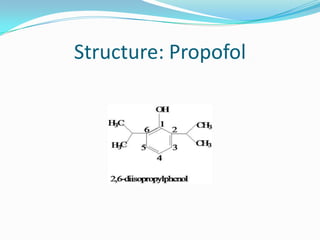
 Propofol is a subsituted iso-propyl-phenol formulated
as a 1% aqueous solution. The propofol emulsion
formulation contain soybean oil, glycesol & egg
lecithin.
Structure: Propofol
Mechanism of action
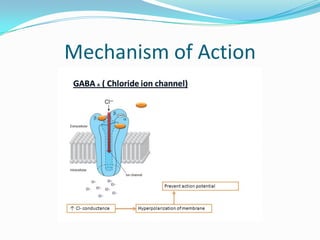
 The mechanism of action of propofol is related to its
interaction with ‘gamma aminobutyric’ acid (GABA)
which is the principle inhibitory neurotransmitter in
the CNS.
 Propofol works by increasing GABA mediated
inhibitory tone in the CNS.
 Propofol decrease the rate of dissociation of the GABA
from the receptor, thereby increasing the duration of
GABA activated opening of the chloride channel
resulting hyperpolarization of the cell membrane.
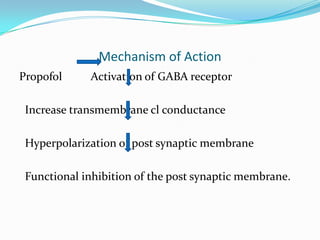
Mechanism of Action
Propofol Activation of GABA receptor
Increase transmembrane cl conductance
Hyperpolarization of post synaptic membrane
Functional inhibition of the post synaptic membrane.
Mechanism of Action
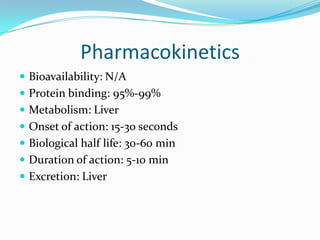
Pharmacokinetics
 Bioavailability: N/A
 Protein binding: 95%-99%
 Metabolism: Liver
 Onset of action: 15-30 seconds
 Biological half life: 30-60 min
 Duration of action: 5-10 min
 Excretion: Liver
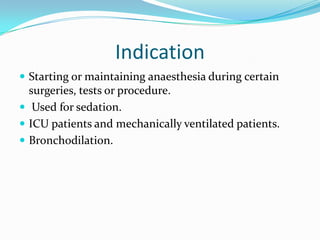
Indication
 Starting or maintaining anaesthesia during certain
surgeries, tests or procedure.
 Used for sedation.
 ICU patients and mechanically ventilated patients.
 Bronchodilation.
Contraindication
 Hypersensityvity to propofol which contain: soybean
oil, egg or egg product.
 Obsterical procedures.
 It is not recommended for use in nursing mothers.
 It is not recommended for anaesthesia in children
below the age of 3 yrs.
Interactions
 Halothane, enflurane, isoflurane drug.
 Narcotic drug such as: morphine, meperidine
 Doxylamine drugs
 Clonazepam drugs
 Antidepressant such as:
 amoxapine
 amitriptyline
 doxepin
 Barbiturates such as:
 pentobarbital
 secobarbital
Side effects
 Nausea
 Cough
 Burning or stining around the IV needle.
 Itching or skin rash
 Numbness or tingly feeling
 Confusion
 Agitation
 Anxiety
 Muscle pain
 Discolored urine
Brand name in BangladeshBrand name Contains Dosage
form
Manufacture
POFOL I.V Propofol 10mg/ml I.V
injection
Popular
pharmaceuticals
FRESOFOL Propofol 10mg/ml I.V
injection
Fresenius kabi/HYE
impex international
RECOFOL Propofol 10mg/ml I.V
injection
Bayer Schering
oy/Tajarat
Doses
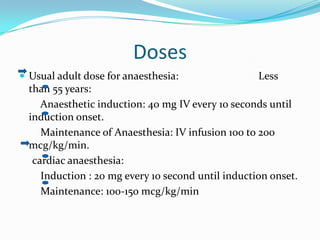
 Usual adult dose for anaesthesia: Less
than 55 years:
Anaesthetic induction: 40 mg IV every 10 seconds until
induction onset.
Maintenance of Anaesthesia: IV infusion 100 to 200
mcg/kg/min.
cardiac anaesthesia:
Induction : 20 mg every 10 second until induction onset.
Maintenance: 100-150 mcg/kg/min
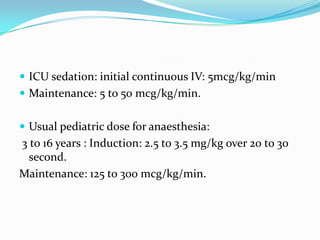
 ICU sedation: initial continuous IV: 5mcg/kg/min
 Maintenance: 5 to 50 mcg/kg/min.
 Usual pediatric dose for anaesthesia:
3 to 16 years : Induction: 2.5 to 3.5 mg/kg over 20 to 30
second.
Maintenance: 125 to 300 mcg/kg/min.

Propofol

  • 1.
    Made by Rasel Mahbub Dept.Ofpharmacy Jagannath University 01915923493
  • 2.
    PROPOFOL  Introduction: Propofolis an intravenous sedative- hypnotic that was introduced for clinical use in 1977. Since the introduction of propofol into cliical practice, it has become the intravenous induction agents include rapid induction of general anaesthesia.
  • 3.
     Pharmacology: Propofolis commonly used for conscious sedation, as an anaesthetic indiction agent for the maintenance of general anaesthesia.  Propofol is a subsituted iso-propyl-phenol formulated as a 1% aqueous solution. The propofol emulsion formulation contain soybean oil, glycesol & egg lecithin.
  • 4.
  • 5.
    Mechanism of action The mechanism of action of propofol is related to its interaction with ‘gamma aminobutyric’ acid (GABA) which is the principle inhibitory neurotransmitter in the CNS.  Propofol works by increasing GABA mediated inhibitory tone in the CNS.  Propofol decrease the rate of dissociation of the GABA from the receptor, thereby increasing the duration of GABA activated opening of the chloride channel resulting hyperpolarization of the cell membrane.
  • 6.
    Mechanism of Action PropofolActivation of GABA receptor Increase transmembrane cl conductance Hyperpolarization of post synaptic membrane Functional inhibition of the post synaptic membrane.
  • 7.
  • 8.
    Pharmacokinetics  Bioavailability: N/A Protein binding: 95%-99%  Metabolism: Liver  Onset of action: 15-30 seconds  Biological half life: 30-60 min  Duration of action: 5-10 min  Excretion: Liver
  • 9.
    Indication  Starting ormaintaining anaesthesia during certain surgeries, tests or procedure.  Used for sedation.  ICU patients and mechanically ventilated patients.  Bronchodilation.
  • 10.
    Contraindication  Hypersensityvity topropofol which contain: soybean oil, egg or egg product.  Obsterical procedures.  It is not recommended for use in nursing mothers.  It is not recommended for anaesthesia in children below the age of 3 yrs.
  • 11.
    Interactions  Halothane, enflurane,isoflurane drug.  Narcotic drug such as: morphine, meperidine  Doxylamine drugs  Clonazepam drugs  Antidepressant such as:  amoxapine  amitriptyline  doxepin  Barbiturates such as:  pentobarbital  secobarbital
  • 12.
    Side effects  Nausea Cough  Burning or stining around the IV needle.  Itching or skin rash  Numbness or tingly feeling  Confusion  Agitation  Anxiety  Muscle pain  Discolored urine
  • 13.
    Brand name inBangladeshBrand name Contains Dosage form Manufacture POFOL I.V Propofol 10mg/ml I.V injection Popular pharmaceuticals FRESOFOL Propofol 10mg/ml I.V injection Fresenius kabi/HYE impex international RECOFOL Propofol 10mg/ml I.V injection Bayer Schering oy/Tajarat
  • 14.
    Doses  Usual adultdose for anaesthesia: Less than 55 years: Anaesthetic induction: 40 mg IV every 10 seconds until induction onset. Maintenance of Anaesthesia: IV infusion 100 to 200 mcg/kg/min. cardiac anaesthesia: Induction : 20 mg every 10 second until induction onset. Maintenance: 100-150 mcg/kg/min
  • 15.
     ICU sedation:initial continuous IV: 5mcg/kg/min  Maintenance: 5 to 50 mcg/kg/min.  Usual pediatric dose for anaesthesia: 3 to 16 years : Induction: 2.5 to 3.5 mg/kg over 20 to 30 second. Maintenance: 125 to 300 mcg/kg/min.