
COMPUTER SIMULATION
TECHNIQUES
STC411 ALTERNATIVE ANIMAL USE
VYSAKH MOHAN M (13-BVM-42)
ALTERNATIVE ANIMAL USE
 In 1959 Russell and Burch introduced the concepts of replacement,
reduction and refinement as a starting point for the humane treatment of
laboratory animals.
The 3R’s are:
 Replacement
 To replace the use of animals by lower organisms, or non-biological methods.
 Refinement
 To refine scientific procedures so that any suffering, discomfort or pain endured
by the animals is minimal, consistent with the scientific objective.
 Reduction
 To reduce the number of animals used to the minimum consistent with statistical
and scientific validity.
COMPUTER SIMULATION
 A computer model is the algorithms and
equations used to capture the behavior of
the system being modeled.
 By contrast, computer simulation is the
actual running of the program that
contains these equations or algorithms
COMPUTER SIMULATION
 In-silico - "performed on computer or via
computer simulation"
 The phrase was coined in 1989 as an allusion to
the Latin phrases in-vivo, in- vitro, and in-situ
ADVANTAGES
 Reduction
 Refinement
 Replacement
 Translation – “results of animal
experimentation to human”
COMPUTER SIMULATION
TECHNIQUES IN VARIOUS
FIELDS
COMPUTER
SIMULATION
IN EDUCATION
IN EDUCATION
 COMPUTER MODELS USED IN HUMAN
PHYSIOLOGICAL STUDIES INCLUDES
 a comprehensive physiological model
 pH and carbon dioxide regulation
 pulsatile hemodynamics in the aorta
 determinants of cardiac output
 effects of medically important drugs on the
circulatory system
 simulation of the digestion of a meal
 responses of organisms to exposure to high
and low temperatures
 influence of hormones on muscle cells
 renal excretory response to volume and
osmolarity changes
SIMULATOR SOFTWARE - BIOSPHERA
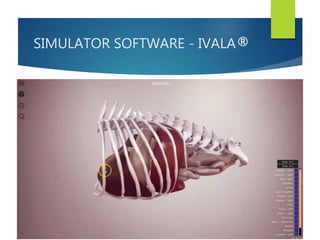
SIMULATOR SOFTWARE - IVALA®
LIMITATIONS
 Biological complexities
 Missed experiences
 Biological variability
 Publication of results
 Student attitudes
COMPUTER
SIMULATION
IN BIOMEDICAL
RESEARCH
BIOMEDICAL RESEARCH
 A broad area of science that involves the
investigation of the biological process and the
causes of disease, through careful
experimentation, observation, laboratory work,
analysis, and testing
SOME EXAMPLES OF
COMPUTER SIMULATION
IN BIOMEDICAL RESEARCH
 Kidney function – transport of electrolytes and water in and
out of kidney
 Cardiac function – enzyme metabolism of cardiac muscle,
cardiac pressure flow relationships, etc.
 Lung function – respiratory mechanics
 Sensory physiology – peripheral auditory system and single
auditory nerve fibre transmission of vibrations
 Neurophysiology – impulse propagation along
myelinated acxons
 Developmental biology – shape changes in embryonic
cells
COMPUTER
SIMULATION
IN BEHAVIOURAL
RESEARCH
BEHAVIORAL RESEARCH
 Study of the variables that impact the
formation of habits
SOME EXAMPLES OF
COMPUTER SIMULATION
OF BEHAVIORAL PHENOMENA
 Spacing mechanisms and animal movements
 Learning, memory, and problem solving
 Sensation and perception
 Communication
 Body maintenance
 Reproduction and parental care
LIMITATIONS
 Lack of knowledge of all possible parameters
 No satisfactory model exists
 Development of computer simulation depends on
the use of animals in biomedical research
COMPUTER
SIMULATION
IN OTHER FIELDS
DRUG DISCOVERY WITH VIRTUAL
SCREENING
 for example, using the protein docking
algorithm EADock, researchers found
potential inhibitors to an enzyme
associated with cancer activity in silico
CELL MODELS
 Efforts have been made to establish computer
models of cellular behavior
 for example, in 2007 researchers developed an in
silico model of tuberculosis to aid in drug
discovery, with the prime benefit of its being faster
than real time simulated growth rates, allowing
phenomena of interest to be observed in minutes
rather than months
GENETICS
 Digital genetic sequences obtained
from DNA sequencing may be stored
in sequence databases, be analyzed, be
digitally altered and/or be used as
templates for creating new actual DNA
using artificial gene synthesis
PROTEIN DESIGN
 example is RosettaDesign, a software package under
development and free for academic use
 RosettaDesign can be used to identify sequences
compatible with a given protein backbone
 Some of Rosetta design's successes include the
design of a novel protein fold, redesign of an existing
protein for greater stability, increased binding affinity
between two proteins, and the design of novel
enzymes
THANK
YOU

STC411 Computer Simulation Techniques

  • 1.
    COMPUTER SIMULATION TECHNIQUES STC411 ALTERNATIVEANIMAL USE VYSAKH MOHAN M (13-BVM-42)
  • 2.
    ALTERNATIVE ANIMAL USE In 1959 Russell and Burch introduced the concepts of replacement, reduction and refinement as a starting point for the humane treatment of laboratory animals. The 3R’s are:  Replacement  To replace the use of animals by lower organisms, or non-biological methods.  Refinement  To refine scientific procedures so that any suffering, discomfort or pain endured by the animals is minimal, consistent with the scientific objective.  Reduction  To reduce the number of animals used to the minimum consistent with statistical and scientific validity.
  • 3.
    COMPUTER SIMULATION  Acomputer model is the algorithms and equations used to capture the behavior of the system being modeled.  By contrast, computer simulation is the actual running of the program that contains these equations or algorithms
  • 4.
    COMPUTER SIMULATION  In-silico- "performed on computer or via computer simulation"  The phrase was coined in 1989 as an allusion to the Latin phrases in-vivo, in- vitro, and in-situ
  • 5.
    ADVANTAGES  Reduction  Refinement Replacement  Translation – “results of animal experimentation to human”
  • 6.
  • 7.
  • 8.
    IN EDUCATION  COMPUTERMODELS USED IN HUMAN PHYSIOLOGICAL STUDIES INCLUDES  a comprehensive physiological model  pH and carbon dioxide regulation  pulsatile hemodynamics in the aorta  determinants of cardiac output  effects of medically important drugs on the circulatory system
  • 9.
     simulation ofthe digestion of a meal  responses of organisms to exposure to high and low temperatures  influence of hormones on muscle cells  renal excretory response to volume and osmolarity changes
  • 10.
  • 11.
  • 12.
    LIMITATIONS  Biological complexities Missed experiences  Biological variability  Publication of results  Student attitudes
  • 13.
  • 14.
    BIOMEDICAL RESEARCH  Abroad area of science that involves the investigation of the biological process and the causes of disease, through careful experimentation, observation, laboratory work, analysis, and testing
  • 15.
    SOME EXAMPLES OF COMPUTERSIMULATION IN BIOMEDICAL RESEARCH  Kidney function – transport of electrolytes and water in and out of kidney  Cardiac function – enzyme metabolism of cardiac muscle, cardiac pressure flow relationships, etc.  Lung function – respiratory mechanics  Sensory physiology – peripheral auditory system and single auditory nerve fibre transmission of vibrations  Neurophysiology – impulse propagation along myelinated acxons  Developmental biology – shape changes in embryonic cells
  • 16.
  • 17.
    BEHAVIORAL RESEARCH  Studyof the variables that impact the formation of habits
  • 18.
    SOME EXAMPLES OF COMPUTERSIMULATION OF BEHAVIORAL PHENOMENA  Spacing mechanisms and animal movements  Learning, memory, and problem solving  Sensation and perception  Communication  Body maintenance  Reproduction and parental care
  • 19.
    LIMITATIONS  Lack ofknowledge of all possible parameters  No satisfactory model exists  Development of computer simulation depends on the use of animals in biomedical research
  • 20.
  • 21.
    DRUG DISCOVERY WITHVIRTUAL SCREENING  for example, using the protein docking algorithm EADock, researchers found potential inhibitors to an enzyme associated with cancer activity in silico
  • 22.
    CELL MODELS  Effortshave been made to establish computer models of cellular behavior  for example, in 2007 researchers developed an in silico model of tuberculosis to aid in drug discovery, with the prime benefit of its being faster than real time simulated growth rates, allowing phenomena of interest to be observed in minutes rather than months
  • 23.
    GENETICS  Digital geneticsequences obtained from DNA sequencing may be stored in sequence databases, be analyzed, be digitally altered and/or be used as templates for creating new actual DNA using artificial gene synthesis
  • 24.
    PROTEIN DESIGN  exampleis RosettaDesign, a software package under development and free for academic use  RosettaDesign can be used to identify sequences compatible with a given protein backbone  Some of Rosetta design's successes include the design of a novel protein fold, redesign of an existing protein for greater stability, increased binding affinity between two proteins, and the design of novel enzymes
  • 25.

Editor's Notes

  • #2 Computer Simulation: The use of specially devised computer programs to simulate cells, tissues, fluids, organs, and organ systems for research purposes; to develop mathematical models and algorithms for use in toxicity testing; and to simulate experiments traditionally done with animals, for educational purposes
  • #6 Translation: Computer simulations to translate results of animal experimentations to human are becoming a tangible and a powerful tool for increased safety and efficiency. We believe that computer simulation can allow for the modelling of biological process in the mouse, which can then be used for translating results of animal experimentation much more safely and effectively into human health