GENERAL ANAESTHESIA
Dr. YASHASWINI P
Introduction
• General anaesthetics (GAs) are drugs which
causes reversible loss of all sensation and
consciousness.
• The cardinal features of GA
– Loss of all sensation, especially pain
– Sleep (consciousness) and amnesia
– Immobility and muscle relaxation
– Abolition of somatic and autonomic reflexes
Classification
• Inhalation Gas: Nitrous Oxide
• Volatile Liquid: Halothane, Enflurane,
Isoflurane, Desflurane, Sevoflurane
• Intravenous
– Inducing Agent: thiopentone Sod.,
methohexitone, Sod Propfol, Etomidate
– Slower acting drugs:
– Dissociative anaesthesia: Ketamine
– Opioids: Fentanyl, alfentanil, Sufentanil, Remifentanil
– Benzodiazepines: Diazepam, Lorazepam, Midazolam
Starts from beginning of anaesthetic inhalation and lasts upto
the loss of consciousness
• Pain is progressively abolished during this stage
• Patient remains conscious, can hear and see, and feels a
dream like state
• Reflexes and respiration remain normal
• It is difficult to maintain - use is limited to short procedures
only
Stage II: Stage of Delirium and
Excitement
• From loss of consciousness to beginning of automatic breathing
• Eyelash reflex diasaapear
• Excitement - patient may shout, struggle and hold his breath
• Muscle tone increases, jaws are tightly closed.
• Breathing is jerky; vomiting, involuntary micturition or defecation
may occur.
• No stimulus or operative procedure carried out during this stage.
• Potentially dangerous responses can occur during this stage
including vomiting, laryngospasm and uncontrolled movement.
• This stage is not found with modern anaesthesia – preanaesthetic
medication, rapid induction etc
Stage III: Stage of Surgical anaesthesia
• Extends from onset of spontaneus respiration to respiratory
paralysis.
• This has been divided into 4 planes:
– Plane 1: Roving eye balls. This plane ends when eyes
become fixed.
– Plane 2: Loss of corneal and laryngeal reflexes.
– Plane 3: Pupil starts dilating and light reflex is lost.
• This was the desired phase of surgery when muscle relaxant were
not used
– Plane 4: Intercostal paralysis, shallow abdominal
respiration, dilated pupil.
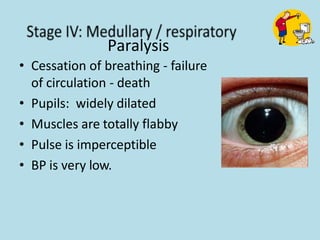
Paralysis
• Cessation of breathing - failure
of circulation - death
• Pupils: widely dilated
• Muscles are totally flabby
• Pulse is imperceptible
• BP is very low.
1. Diethyl ether (C2H5 – O – C2H5)
• Colourless, highly volatile liquid with a
pungent odour. Boiling point – 35ºC
• Produces irritating vapours and are
inflammable and explosive
• Pharmacokinetics:
-85 to 90 percent is eliminated through lung and
remaining through skin, urine, milk and sweat
- Can cross the placental barrier
Ether – contd.
• Advantages
- Can be used without
complicated apparatus
- Potent anaesthetic and good
analgesic
- Muscle relaxation
- Wide safety of margin
- Respiratory stimulation and
bronchodilatation
- Does not sensitize the heart to
adrenaline
- No cardiac arrythmias
- Can be used in delivery
- Less likely hepato or
nephrotoxicity
• Disadvantages
- Inflammable and
explosive
- Slow induction and
unpleasant - atropine
- Slow recovery – nausea &
vomiting
- Cardiac arrest
- Convulsion in children
- Cross tolerance – ethyl
alcohol
2. Nitrous oxide/laughing gas (N2O)
• Colorless, odourless inorganic gas with sweet taste
• Noninflammable and nonirritating, but of low
potency
• Very potent analgesic
• Carrier and adjuvant to other anaesthetics –
70%N2O + 25-30% O2 + 0.2-2% HALOTHANE
• As a single agent used wit O2 in dental extraction and
in obstetrics
Nitrous oxide – contd.
• Advantages:
- Non-inflammable and
nonirritant
- Rapid induction and recovery
- Very potent analgesic (low
concentration)
- No nausea and vomiting
- Nontoxic to liver, kidney and
brain
• Disadvantages:
– Not potent alone
(supplementation)
– Hypoxia
– Inhibits methionine
synthetase (precursor to DNA
synthesis)
– Inhibits vitamin B-12
metabolism
– Gas filled spaces - dangerous
3. Halothane
• Fluorinated volatile liquid with sweet odour,
non-irritant non-inflammable and supplied in
amber coloured bottle
• Potent anaesthetic, 2-4% for induction and
0.5-1% for maintenance
• Boiling point - 50ºC
• Pharmacokinetics: 60 to 80% eliminated
unchanged. 20% retained in body for 24 hours
and metabolized
Halothane – contd.
• Advantages:
- Non-inflammable and non-
irritant
- Pharyngeal and laryngeal
reflexes – bronchodilatation
- Potent and speedy
induction & recovery
- Inhibits intestinal and uterine
contractions
- Safe in Asthmatics
- Suitable for Children's
• Disadvantages:
- Special apparatus
- Poor analgesic and muscle relaxation
- Hypotension – direct action (Ca++) and failure
of sympathetic activity
- Arrythmia
• Direct vagal stimulation,
• Direct depression of SA node and
lack of baroreceptor action
- Respiratory depression
- Decreased urine formation – due to
decreased gfr
- Hepatitis: 1 in 10,000
- Malignant hyperthermia: Ryanodine
receptor (RYR1)
- Prolong labour
5. Isoflurane:
• Isomer of enflurane and have simmilar
properties but slightly more potent
• Induction dose is 1.5 – 3% and maintenance
dose is 1 – 2%
• By special vapourizer
Isoflurane – contd.
• Advantages:
- Rapid induction and recovery
- Good muscle relaxation
- Good coronary vasodilatation
- Less Myocardial depression than
no myocardial sensitization to
adrenaline
- No renal or hepatotoxicity
- Low nausea and vomiting
- No dilatation of pupil and no loss
of light reflex in deep
anaesthesia
- No seizure and preferred in
neurosurgery
- Uterine muscle relaxation
• Disadvantages:
- Pungent and respiratory
irritant
- Special apparatus
required
- Respiratory depression
- Maintenance only, no
induction
- ß adrenergic receptor
stimulation
- Costly
Intravenous Anaesthetics:
• For induction only
• Rapid induction (one arm-brain
circulation time=11sec
• For maintenance not used
• Alone – supplemented with
analgesic and muscle relaxants
Intravenous:
• Inducing agents:
Thiopentone, Methohexitone
sodium, propofol and
etomidate
– Benzodiazepines (slower
acting):
Diazepam, Lorazepam,
Midazolam
• Dissociative anaesthesia:
Ketamine
• Neurolept analgesia:
Fentanyl
Thiopentone sodium:
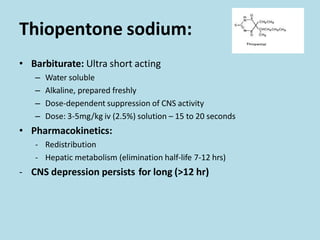
• Barbiturate: Ultra short acting
– Water soluble
– Alkaline, prepared freshly
– Dose-dependent suppression of CNS activity
– Dose: 3-5mg/kg iv (2.5%) solution – 15 to 20 seconds
• Pharmacokinetics:
- Redistribution
- Hepatic metabolism (elimination half-life 7-12 hrs)
- CNS depression persists for long (>12 hr)
Side effects of Thiopentone:
• Pre-anaesthetic course - laryngospasm
• Noncompatibility - succinylcholine
• Tissue necrosis--gangrene
• Post-anaesthetic course - analgesic
Thiopentone – contd.
• Advantages:
– Rapid induction
– Does not sensitize
myocardium to adrenaline
– No nausea and vomiting
– Non-explosive and non-
irritant
– Short operations (alone)
– Other uses: convulsion,
psychiatric patients and
narcoanalysis of criminals
• Disadvantages:
- Depth of anaesthesia difficult to
judge
- Pharyngeal and laryngeal reflexes
persists - apnoea – controlled
ventilation
- Respiratory depression
- Hypotension (rapid) – shock and
hypovolemia
- Poor analgesic and muscle
relaxant
- Gangrene and necrosis
- Shivering and delirium
2. Propofol
• Replacing thiopentone now
• Oily liquid used as 1% emulsion
• Rapid induction (one arm-brain circulation time): 15 – 45 seconds and
lasts for 5–10 minutes
• Rapid distribution – distribution half-life (2-4 min)
• Short elimination half-life (100 min)
• Dose: Induction - 2mg/kg bolus i.v.
Maintenance - 9 mg/kg/hr i.v.
• Propofol is extensively metabolized
– 88% of an administered dose appears in the urine
• Metabolized by hepatic conjugation of the inactive glucuronide
metabolites
Propofol – contd.
Advantages:
- Rapid induction &
maintenance
- Does not sensitize
myocardium to adrenaline
- No nausea and vomiting
- Non-explosive and non-
irritant
- Total i.v. anaesthesia
- Short operations (alone)
- Preffered in asthmatics
Disadvantages:
- Induction apnoea
- Hypotension
- Bradycardia
- Dose dependent respiratory
depression
- Pain during injection: local
anaesthetic combination
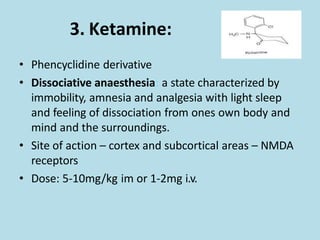
3. Ketamine:
• Phencyclidine derivative
• Dissociative anaesthesia: a state characterized by
immobility, amnesia and analgesia with light sleep
and feeling of dissociation from ones own body and
mind and the surroundings.
• Site of action – cortex and subcortical areas – NMDA
receptors
• Dose: 5-10mg/kg im or 1-2mg i.v.
Ketamine – contd.
• Disadvantages:
- Non-purposive limb movements and nystagmus
- Emergence phenomenon – 50% patients- delirium &
hallucination, fear reaction
- Hypertensives (sympathetic stimulation)
- Increase in IOT and ICP
- Uterine stimulation
- Psychosis and shizophrenia
- Rare laryngospasm
- Poor muscle relaxation
Ketamine – contd.
Uses:
1. Characteristics of sympathetic nervous system stimulation
(increase HR, BP & CO) – hypovolumic shock
2. In head and neck surgery
3. In asthmatics, CHF, HTN, IHD
4. Short surgical procedures – burn dressing, forceps delivery,
breech extraction manual removal of placenta and dentistry
- angiography, cardiac
5. Combination with diazepam
catheterization
6. OPD surgical procedures
7. Those who don’t want loss of
consciousness
4. Fentanyl
• Neurolept analgesia: droperidol
• Opioid analgesic- for painful surgical procedures
• Duration of action: 30-50 min.
• Uses:
- in combination with diazepam used in diagnostic, endoscopic
and angiographic procedures
- Adjunct to spinal and nerve block anaesthesia
Fentanyl – contd.
Advantages:
- Smooth onset and rapid
recovery
- Suppression of vomiting
and coughing
- Less fall in BP and no
sensitization to adrenaline
Disadvantages:
- Respiratory depression
- Increase tone of chest
muscle
- Nausea, vomiting and
itching during recovery
Complications of anaesthesia:
During anaesthesia:
 Respiratory depression
 Salivation, respiratory secretions
 Cardiac arrhythmias
 Fall in BP
 Aspiration
 Laryngospasm and asphyxia
 Awareness
 Delirium and convulsion
 Fire and explosion
After anaesthesia:
 Nausea and vomiting
 Persisting sedation
 Pneumonia
 Organ damage – liver, kidney
 Nerve palsies
 Emergence delirium
 Cognitive defects
Preanesthetic medication:
• Definition:
It is the term applied to the
use of drugs prior to the
administration of an
anaesthetic agent to make
anaesthesia safer and more
agreeable to the patient.
• Aim:
 Relief of anxiety
 Amnesia for peri
operative events
 Analgesia
 Decrease secretions
 Antiemetic effects
 Decrease acidity and
volume of gastric juice
Preanaesthetic medication – contd.
• Drugs used: 6 A’s
 Anxiolytics –SEDATIVES – diazepam or lorazepam,
midazolam, promethazine etc.
Amnesia: lorazepam, Midazolam
 Anticholinergics – Atropine/Hyoscine/glycopyrrolate
 Antacids: H2 blockers – ranitidine, famotidine etc.
 Antiemetics – Metoclopramide, domperidone etc.
Analgesia - Opioids – Morphine and its congeners
THNAK YOU

General Anaesthesia. ಬೈ ಗೌತಮ್ ಕನ್ನಡಿಗ

  • 1.
  • 2.
    Introduction • General anaesthetics(GAs) are drugs which causes reversible loss of all sensation and consciousness. • The cardinal features of GA – Loss of all sensation, especially pain – Sleep (consciousness) and amnesia – Immobility and muscle relaxation – Abolition of somatic and autonomic reflexes
  • 3.
    Classification • Inhalation Gas:Nitrous Oxide • Volatile Liquid: Halothane, Enflurane, Isoflurane, Desflurane, Sevoflurane • Intravenous – Inducing Agent: thiopentone Sod., methohexitone, Sod Propfol, Etomidate – Slower acting drugs: – Dissociative anaesthesia: Ketamine – Opioids: Fentanyl, alfentanil, Sufentanil, Remifentanil – Benzodiazepines: Diazepam, Lorazepam, Midazolam
  • 4.
    Starts from beginningof anaesthetic inhalation and lasts upto the loss of consciousness • Pain is progressively abolished during this stage • Patient remains conscious, can hear and see, and feels a dream like state • Reflexes and respiration remain normal • It is difficult to maintain - use is limited to short procedures only
  • 5.
    Stage II: Stageof Delirium and Excitement • From loss of consciousness to beginning of automatic breathing • Eyelash reflex diasaapear • Excitement - patient may shout, struggle and hold his breath • Muscle tone increases, jaws are tightly closed. • Breathing is jerky; vomiting, involuntary micturition or defecation may occur. • No stimulus or operative procedure carried out during this stage. • Potentially dangerous responses can occur during this stage including vomiting, laryngospasm and uncontrolled movement. • This stage is not found with modern anaesthesia – preanaesthetic medication, rapid induction etc
  • 6.
    Stage III: Stageof Surgical anaesthesia • Extends from onset of spontaneus respiration to respiratory paralysis. • This has been divided into 4 planes: – Plane 1: Roving eye balls. This plane ends when eyes become fixed. – Plane 2: Loss of corneal and laryngeal reflexes. – Plane 3: Pupil starts dilating and light reflex is lost. • This was the desired phase of surgery when muscle relaxant were not used – Plane 4: Intercostal paralysis, shallow abdominal respiration, dilated pupil.
  • 7.
    Paralysis • Cessation ofbreathing - failure of circulation - death • Pupils: widely dilated • Muscles are totally flabby • Pulse is imperceptible • BP is very low.
  • 9.
    1. Diethyl ether(C2H5 – O – C2H5) • Colourless, highly volatile liquid with a pungent odour. Boiling point – 35ºC • Produces irritating vapours and are inflammable and explosive • Pharmacokinetics: -85 to 90 percent is eliminated through lung and remaining through skin, urine, milk and sweat - Can cross the placental barrier
  • 10.
    Ether – contd. •Advantages - Can be used without complicated apparatus - Potent anaesthetic and good analgesic - Muscle relaxation - Wide safety of margin - Respiratory stimulation and bronchodilatation - Does not sensitize the heart to adrenaline - No cardiac arrythmias - Can be used in delivery - Less likely hepato or nephrotoxicity • Disadvantages - Inflammable and explosive - Slow induction and unpleasant - atropine - Slow recovery – nausea & vomiting - Cardiac arrest - Convulsion in children - Cross tolerance – ethyl alcohol
  • 11.
    2. Nitrous oxide/laughinggas (N2O) • Colorless, odourless inorganic gas with sweet taste • Noninflammable and nonirritating, but of low potency • Very potent analgesic • Carrier and adjuvant to other anaesthetics – 70%N2O + 25-30% O2 + 0.2-2% HALOTHANE • As a single agent used wit O2 in dental extraction and in obstetrics
  • 12.
    Nitrous oxide –contd. • Advantages: - Non-inflammable and nonirritant - Rapid induction and recovery - Very potent analgesic (low concentration) - No nausea and vomiting - Nontoxic to liver, kidney and brain • Disadvantages: – Not potent alone (supplementation) – Hypoxia – Inhibits methionine synthetase (precursor to DNA synthesis) – Inhibits vitamin B-12 metabolism – Gas filled spaces - dangerous
  • 13.
    3. Halothane • Fluorinatedvolatile liquid with sweet odour, non-irritant non-inflammable and supplied in amber coloured bottle • Potent anaesthetic, 2-4% for induction and 0.5-1% for maintenance • Boiling point - 50ºC • Pharmacokinetics: 60 to 80% eliminated unchanged. 20% retained in body for 24 hours and metabolized
  • 14.
    Halothane – contd. •Advantages: - Non-inflammable and non- irritant - Pharyngeal and laryngeal reflexes – bronchodilatation - Potent and speedy induction & recovery - Inhibits intestinal and uterine contractions - Safe in Asthmatics - Suitable for Children's • Disadvantages: - Special apparatus - Poor analgesic and muscle relaxation - Hypotension – direct action (Ca++) and failure of sympathetic activity - Arrythmia • Direct vagal stimulation, • Direct depression of SA node and lack of baroreceptor action - Respiratory depression - Decreased urine formation – due to decreased gfr - Hepatitis: 1 in 10,000 - Malignant hyperthermia: Ryanodine receptor (RYR1) - Prolong labour
  • 15.
    5. Isoflurane: • Isomerof enflurane and have simmilar properties but slightly more potent • Induction dose is 1.5 – 3% and maintenance dose is 1 – 2% • By special vapourizer
  • 16.
    Isoflurane – contd. •Advantages: - Rapid induction and recovery - Good muscle relaxation - Good coronary vasodilatation - Less Myocardial depression than no myocardial sensitization to adrenaline - No renal or hepatotoxicity - Low nausea and vomiting - No dilatation of pupil and no loss of light reflex in deep anaesthesia - No seizure and preferred in neurosurgery - Uterine muscle relaxation • Disadvantages: - Pungent and respiratory irritant - Special apparatus required - Respiratory depression - Maintenance only, no induction - ß adrenergic receptor stimulation - Costly
  • 18.
    Intravenous Anaesthetics: • Forinduction only • Rapid induction (one arm-brain circulation time=11sec • For maintenance not used • Alone – supplemented with analgesic and muscle relaxants Intravenous: • Inducing agents: Thiopentone, Methohexitone sodium, propofol and etomidate – Benzodiazepines (slower acting): Diazepam, Lorazepam, Midazolam • Dissociative anaesthesia: Ketamine • Neurolept analgesia: Fentanyl
  • 19.
    Thiopentone sodium: • Barbiturate:Ultra short acting – Water soluble – Alkaline, prepared freshly – Dose-dependent suppression of CNS activity – Dose: 3-5mg/kg iv (2.5%) solution – 15 to 20 seconds • Pharmacokinetics: - Redistribution - Hepatic metabolism (elimination half-life 7-12 hrs) - CNS depression persists for long (>12 hr)
  • 20.
    Side effects ofThiopentone: • Pre-anaesthetic course - laryngospasm • Noncompatibility - succinylcholine • Tissue necrosis--gangrene • Post-anaesthetic course - analgesic
  • 21.
    Thiopentone – contd. •Advantages: – Rapid induction – Does not sensitize myocardium to adrenaline – No nausea and vomiting – Non-explosive and non- irritant – Short operations (alone) – Other uses: convulsion, psychiatric patients and narcoanalysis of criminals • Disadvantages: - Depth of anaesthesia difficult to judge - Pharyngeal and laryngeal reflexes persists - apnoea – controlled ventilation - Respiratory depression - Hypotension (rapid) – shock and hypovolemia - Poor analgesic and muscle relaxant - Gangrene and necrosis - Shivering and delirium
  • 22.
    2. Propofol • Replacingthiopentone now • Oily liquid used as 1% emulsion • Rapid induction (one arm-brain circulation time): 15 – 45 seconds and lasts for 5–10 minutes • Rapid distribution – distribution half-life (2-4 min) • Short elimination half-life (100 min) • Dose: Induction - 2mg/kg bolus i.v. Maintenance - 9 mg/kg/hr i.v. • Propofol is extensively metabolized – 88% of an administered dose appears in the urine • Metabolized by hepatic conjugation of the inactive glucuronide metabolites
  • 23.
    Propofol – contd. Advantages: -Rapid induction & maintenance - Does not sensitize myocardium to adrenaline - No nausea and vomiting - Non-explosive and non- irritant - Total i.v. anaesthesia - Short operations (alone) - Preffered in asthmatics Disadvantages: - Induction apnoea - Hypotension - Bradycardia - Dose dependent respiratory depression - Pain during injection: local anaesthetic combination
  • 24.
    3. Ketamine: • Phencyclidinederivative • Dissociative anaesthesia: a state characterized by immobility, amnesia and analgesia with light sleep and feeling of dissociation from ones own body and mind and the surroundings. • Site of action – cortex and subcortical areas – NMDA receptors • Dose: 5-10mg/kg im or 1-2mg i.v.
  • 25.
    Ketamine – contd. •Disadvantages: - Non-purposive limb movements and nystagmus - Emergence phenomenon – 50% patients- delirium & hallucination, fear reaction - Hypertensives (sympathetic stimulation) - Increase in IOT and ICP - Uterine stimulation - Psychosis and shizophrenia - Rare laryngospasm - Poor muscle relaxation
  • 26.
    Ketamine – contd. Uses: 1.Characteristics of sympathetic nervous system stimulation (increase HR, BP & CO) – hypovolumic shock 2. In head and neck surgery 3. In asthmatics, CHF, HTN, IHD 4. Short surgical procedures – burn dressing, forceps delivery, breech extraction manual removal of placenta and dentistry - angiography, cardiac 5. Combination with diazepam catheterization 6. OPD surgical procedures 7. Those who don’t want loss of consciousness
  • 27.
    4. Fentanyl • Neuroleptanalgesia: droperidol • Opioid analgesic- for painful surgical procedures • Duration of action: 30-50 min. • Uses: - in combination with diazepam used in diagnostic, endoscopic and angiographic procedures - Adjunct to spinal and nerve block anaesthesia
  • 28.
    Fentanyl – contd. Advantages: -Smooth onset and rapid recovery - Suppression of vomiting and coughing - Less fall in BP and no sensitization to adrenaline Disadvantages: - Respiratory depression - Increase tone of chest muscle - Nausea, vomiting and itching during recovery
  • 30.
    Complications of anaesthesia: Duringanaesthesia:  Respiratory depression  Salivation, respiratory secretions  Cardiac arrhythmias  Fall in BP  Aspiration  Laryngospasm and asphyxia  Awareness  Delirium and convulsion  Fire and explosion After anaesthesia:  Nausea and vomiting  Persisting sedation  Pneumonia  Organ damage – liver, kidney  Nerve palsies  Emergence delirium  Cognitive defects
  • 31.
    Preanesthetic medication: • Definition: Itis the term applied to the use of drugs prior to the administration of an anaesthetic agent to make anaesthesia safer and more agreeable to the patient. • Aim:  Relief of anxiety  Amnesia for peri operative events  Analgesia  Decrease secretions  Antiemetic effects  Decrease acidity and volume of gastric juice
  • 32.
    Preanaesthetic medication –contd. • Drugs used: 6 A’s  Anxiolytics –SEDATIVES – diazepam or lorazepam, midazolam, promethazine etc. Amnesia: lorazepam, Midazolam  Anticholinergics – Atropine/Hyoscine/glycopyrrolate  Antacids: H2 blockers – ranitidine, famotidine etc.  Antiemetics – Metoclopramide, domperidone etc. Analgesia - Opioids – Morphine and its congeners
  • 33.