Inhalational
Anaesthetic Agents
Mr. Harshad Khade
MSc. Medical Technology (OTA)
Symbiosis International University, Pune.
Inhalational Anaesthetic Agents
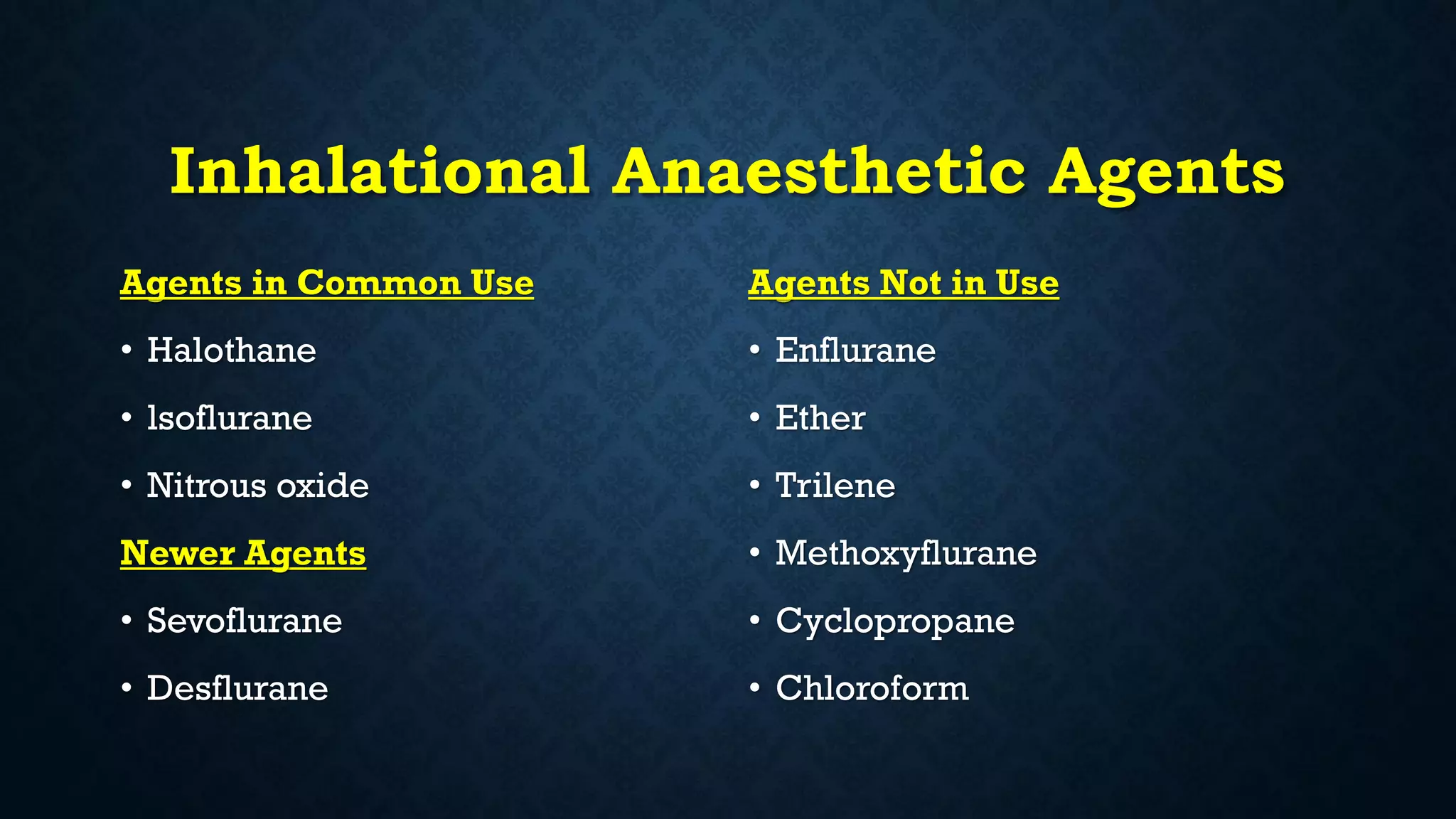
Agents in Common Use
• Halothane
• lsoflurane
• Nitrous oxide
Newer Agents
• Sevoflurane
• Desflurane
Agents Not in Use
• Enflurane
• Ether
• Trilene
• Methoxyflurane
• Cyclopropane
• Chloroform
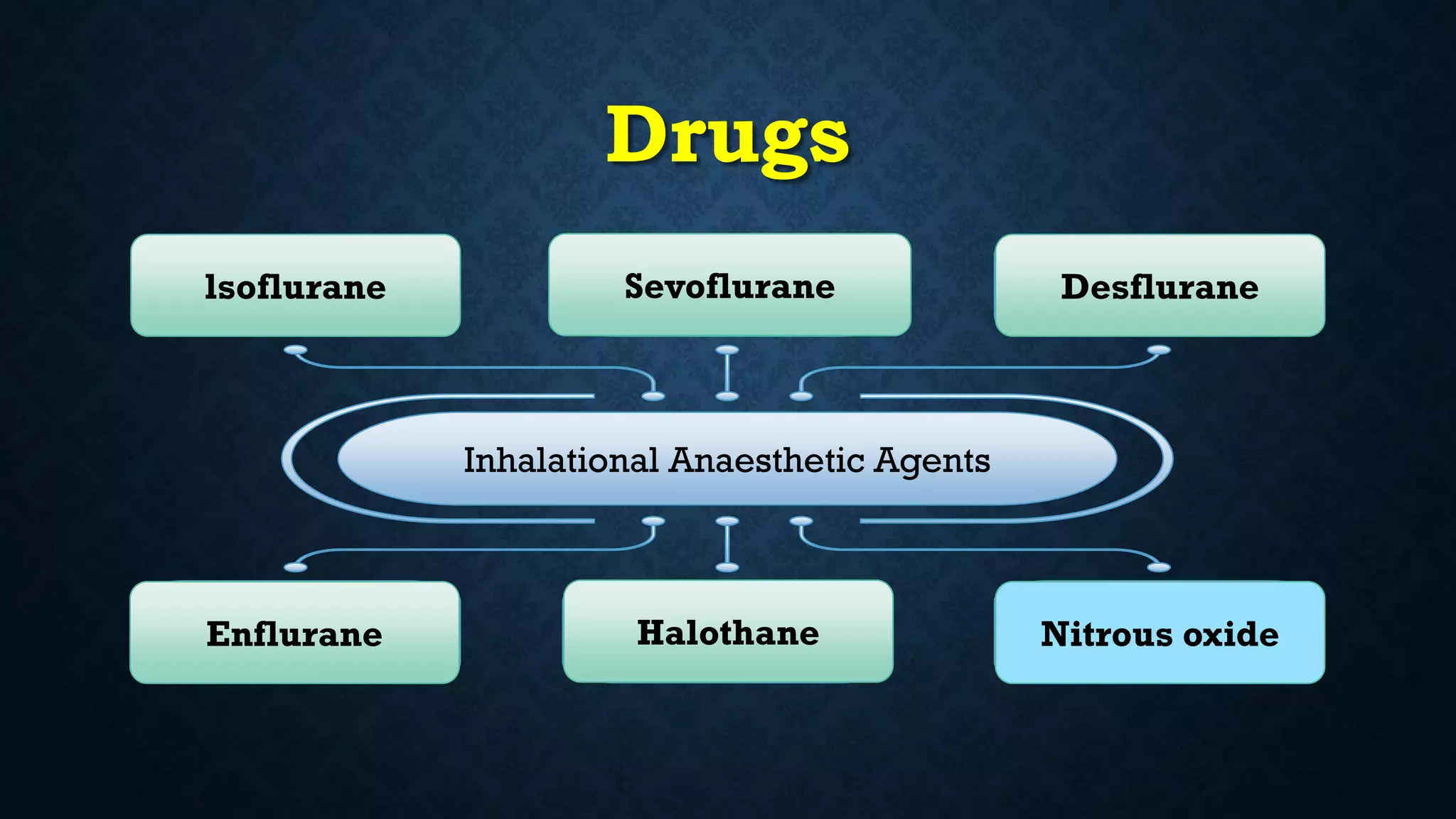
Drugs
lsoflurane Sevoflurane
Nitrous oxide
Halothane
Enflurane
Desflurane
Inhalational Anaesthetic Agents
Isoflurane
Class
• Volatile inhaled agent
Uses
1. For the induction and maintenance of general anaesthesia and has been
used.
2. For sedation during intensive care.
Main action
• General anaesthesia (reversible loss of both awareness and recall of
noxious stimuli).
Presentation
• As a clear, colourless liquid with a pungent smell, which is non-flammable;
• The commercial preparation contains no additives or stabilizers and is
supplied in amber-coloured bottles.
• The molecular weight of isoflurane is 184.5, the boiling point 48.5°C, and
the saturated vapour pressure 32 kpa at 20°C.
• The mac of isoflurane is 1.15 (0.50 in 70% N2 O), although it is age-
dependent and ranges from 1.05 in elderly patients to 1.6 in neonates;
• The blood:gas partition coefficient is 1.4, and the fat:blood partition
coefficient is 50.
• The oil:gas partition coefficient is 97.
• Mechanism of Action Uncertain
Mode of action
• The mechanism of general anaesthesia remains to be fully elucidated.
• General anaesthetics appear to disrupt synaptic transmission (especially in
the area of the ventrobasal thalamus).
• This mechanism may include potentiation of the gabaa and glycine receptors
and antagonism at nmda receptors.
• Their mode of action at the molecular level appears to involve the expansion
of hydrophobic regions in the neuronal membrane, either within the lipid
phase or within hydrophobic sites in cell membranes.
Routes of administration/dose
• Isoflurane is administered by inhalation;
• The agent has a pleasant, non-irritant odour.
• The concentration used for induction of anaesthesia is quoted as 5–8%.
• Maintenance of anaesthesia is usually achieved using between 0.5 and 3%.
Dose
• Titrated to effect; MAC (age 40)=1.15
Onset
• Higher solubility than sevoflurane and desflurane therefore uptake is
slower than the modern agents.
• Onset of effect is hastened by using higher flows of carrier gases and by
using higher concentrations of volatile agent.
Duration
• Clinical recovery in less than 15 minutes (usually).
• Theoretically a slower wake-up than the modern agents due to higher
solubility.
Elimination
• Pulmonary
Effects
• CNS
• Isoflurane produces an additive central nervous system (CNS)-depressant
effect along with other sedative/ hypnotics and analgesics.
• Has the potential to increase intracranial pressure which can be mitigated
with hyperventilation. Delirium.
• CVS Dose-related hypotension (vasodilation).
• Respiratory
• Respiratory depression with rapid, shallow respiratory pattern.
• Loss of intercostal muscle function creates a rocking boat appearance.
• Isoflurane is irritating to the airways and can cause breath-holding, cough,
laryngospasm or bronchospasm.
• Its pungent quality makes it unsuitable for use with a mask induction.
• GI
• Nausea, vomiting.
• MSK
• Potentiates neuromuscular blockade.
• Malignant hyperthermia trigger.
Contraindications
• Malignant hyperthermia susceptibility
Sevoflurane
Class
• Volatile inhaled anesthetic.
Uses
• Used for maintenance of anesthesia.
• Can be used for induction of anesthesia particularly in children.
• Rarely may be used as a treatment for status asthmaticus.
Main action
• General anaesthesia (reversible loss of both awareness and recall of
noxious stimuli).
• Presentation
• As a clear, colourless liquid which is non-flammable;
• The commercial preparation contains no additives or stabilizers and is
supplied in amber-coloured bottles.
• The molecular weight of sevoflurane is 200, the boiling point 58.6°C, and
the saturated vapour pressure 22.7 kpa at 20°C.
• The mac of sevoflurane is age-dependent and ranges from 1.4 in elderly
patients to 3.3 in neonates (0.7–2.0 in the presence of 65% N2 O);
• The blood:gas partition coefficient is 0.63–0.69, and the fat:blood partition
coefficient is 52.
• The oil:gas partition coefficient is 47–54.
• Degradation of sevoflurane may occur by two pathways in the presence of
warm, dessicated alkaline co2 absorbants (potassium hydroxide > sodium
hydroxide) at low fresh gas flows
Mode of action
• The mechanism of general anaesthesia remains to be fully elucidated.
General anaesthetics appear to disrupt synaptic transmission (especially in
the area of the ventrobasal thalamus).
• This mechanism may include potentiation of the GABAA and glycine
receptors and antagonism at NMDA receptors.
• Their mode of action at the molecular level appears to involve the
expansion of hydrophobic regions in the neuronal membrane, either within
the lipid phase or within hydrophobic sites in cell membranes.
Routes of administration/dose
• Sevoflurane is administered by inhalation; the agent has a pleasant, non-
irritant odour.
• The concentration used for induction of anaesthesia is quoted as 5–8%.
Maintenance of anaesthesia is usually achieved using between 0.5 and 3%.
Dose
• Titrated to effect; MAC (age 40) = 2.1%.
Onset
• Low solubility allows rapid uptake and equilibration.
• Onset of effect is hastened by using higher flows of carrier gases and by
using higher concentrations of volatile agent.
Duration
• Clinical recovery in less than 10 minutes (usually).
• If given for prolonged periods, wake-up will be slower as adipose stores
have been saturated and are slow to offload.
Elimination
• Pulmonary (major); hepatic (2-5%); renal (metabolites excretion only)
Effects
• CNS
• Sevoflurane produces an additive central nervous system (CNS)-
depressant effect along with other sedative/hypnotics and analgesics.
• Has the potential to increase intracranial pressure which can be mitigated
with hyperventilation. Delirium.
• CVS Dose-related hypotension (vasodilation).
• Respiratory
• Respiratory depression with a rapid, shallow respiratory pattern.
• Loss of intercostal muscle function creates a rocking boat appearance.
• Causes bronchodilation.
• Sevoflurane is sweet-smelling and not as irritating to the respiratory tract
as desflurane.
• GI Nausea, vomiting.
• MSK
• Potentiates neuromuscular blockade.
• Malignant hyperthermia trigger.
• Misc.
• Potential nephrotoxicity due to Compound A which is produced through
contact with soda lime.
• Compound A can be produced if sevoflurane is used with very low fresh gas
flows or for long MAC-hours.
• Therefore, sevoflurane must be used with a minimum of 2 litres/ minute of
fresh gas flow.
Contraindications
• Malignant hyperthermia susceptibility
Desflurane
Class
• Volatile inhaled anesthetic
Uses
• Desflurane is used for the induction and maintenance of general
anaesthesia
Main action
• General anaesthesia (reversible loss of both awareness and recall of
noxious stimuli).
Presentation
• As a clear, colourless liquid that should be protected from light.
• The commercial preparation contains no additives and is flammable at a
concentration of 17%.
• The molecular weight of desflurane is 168;
• The boiling point is 22.8°C, and the saturated vapour pressure is 88.5 kpa
at 20°C.
• The mac of desflurane is age-dependent and ranges from 5.17 ± 0.65% to
10.65% (1.67 ± 0.4% to 7.75% in the presence of 60% N2 O);
• The blood:gas partition coefficient is 0.45, and the fat:blood partition
coefficient is 29.
• Desflurane is stable in the presence of moist soda lime.
Mode of action
• The mechanism of general anaesthesia remains to be fully elucidated. General
anaesthetics appear to disrupt synaptic transmission (especially in the area of
the ventrobasal thalamus).
• This mechanism may include potentiation of the gamma-amino-butyric acid
(GABA) type A (GABAA) and glycine receptors and antagonism at N-methyl-
D-aspartate (NMDA) receptors.
Routs of administration/dose
• Desflurane is administered by inhalation.
• Because of the high saturated vapour pressure, desflurane must be
administered by a specific pressurized and heated vaporizer.
• The concentration used for induction of anaesthesia is quoted as 4–11%,
although induction is usually achieved using a different agent.
• Maintenance of anaesthesia is usually achieved by using between 2% and 6%.
Dose
• Titrated to effect; MAC (age 40) = 6.0%
Onset
• Low solubility allows rapid uptake and equilibration.
• Onset of effect is hastened by using higher flows of carrier gases and
by using higher concentrations of volatile agent.
Duration
• Clinical recovery in less than 10 minutes (2-2.5 x faster washout than
Isoflurane)
Elimination
• Pulmonary (major); negligible hepatic (0.02%)
Effects
• CNS
• Desflurane produces an additive central nervous system (CNS)
depressant effect along with other sedative/ hypnotics and analgesics.
• Sympatho-excitation can occur with rapid increase in concentration of
desflurane.
• Has the potential to increase intracranial pressure which can be mitigated
with hyperventilation.
• May cause headache, agitation, dizziness
• CVS
• Dose-related hypotension (vasodilation).
• Tachycardia and hypertension may be seen due to sympathetic nervous
system activation.
• Respiratory
• Respiratory depression with a rapid, shallow respiratory pattern.
• Loss of intercostal muscle function creates a rocking boat appearance.
• Desflurane is irritating to the airways and can cause breath-holding,
cough, laryngospasm or bronchospasm in susceptible individuals,
especially if used as sole agent for induction.
• GI
• Potential immune-mediated hepatotoxicity.
• Nausea, vomiting.
• MSK
• Potentiates neuromuscular blockade;
• malignant hyperthermia trigger.
• Misc.
• Significant carbon monoxide production occurs on exposure to
dessicated CO2 absorbing agents therefore must not be used with low-
flow anesthesia.
• Rapid elimination requires initiation of post-operative analgesia prior to
emergence.
Contraindications
• Malignant hyperthermia susceptibility
Enflurane
Class
• Volatile inhaled anesthetic
Uses
• Enflurane is used for the induction and maintenance of general
anaesthesia
Main action
• General anaesthesia (reversible loss of both awareness and recall of
noxious stimuli).
• Presentation
• As a clear, colourless liquid (that should be protected from light) with a
characteristic sweet smell.
• The commercial preparation contains no stabilizers or preservatives; it is
non-flammable in normal anaesthetic concentrations.
• The molecular weight of enflurane is 184.5, the boiling point 56.5°C, and
the saturated vapour pressure 23.3 kpa at 20°C.The MAC of enflurane is
1.68 (0.57 in 70% N2 O),
• The oil/water solubility coefficient 120, and the blood/gas solubility
coefficient 1.91.
• The drug is readily soluble in rubber; it does not attack metals.
Mode of action
• The mechanism of general anaesthesia remains to be fully elucidated.
• General anaesthetics appear to disrupt synaptic transmission.
Routes of administration/doses
• Enflurane is administered by inhalation, conventionally via a calibrated
vaporizer.
• The concentration used for the inhalational induction of anaesthesia is 1–
10% and for maintenance 0.6–3%.
Effects
• CVS
• Enflurane is a negative inotrope; it also causes a decrease in the systemic
vascular resistance, and these two effects produce a decrease in the mean
arterial pressure.
• Unlike halothane, enflurane produces a slight reflex tachycardia.
• The drug decreases coronary vascular resistance;
• it also reduces the rate of phase IV depolarization, increases the threshold
potential, and prolongs the effective refractory period
• Rs
• Enflurane is a powerful respiratory depressant, markedly decreasing the
tidal volume, although the respiratory rate may increase during the
administration of the drug.
• A slight increase in the paco2 may result in spontaneously breathing
subjects; the drug also decreases the ventilatory response to hypoxia and
hypercapnia.
• Cns
• The principal effect of enflurane is general anaesthesia; the drug has little
analgesic effect.
• Gu
• Enflurane decreases the renal blood flow and glomerular filtration rate;
• A small volume of concentrated urine results
Halothane
Class
• Volatile inhaled anesthetic
Uses
• Halothane is used for the induction and maintenance of general
anaesthesia
Main action
• General anaesthesia (reversible loss of both awareness and recall of
noxious stimuli).
Presentation
• As a clear, colourless liquid (that should be protected from light) with a
characteristic sweet smell.
• The commercial preparation contains 0.01% thymol which prevents
decomposition on exposure to light; it is non-flammable at normal
anaesthetic concentrations.
• The molecular weight of halothane is 197.4, the boiling point 50.2°C, and
the saturated vapour pressure 32 kPa at 20°C.
• The MAC of halothane is 0.75 (0.29 in the presence of 70% N2 O), the
oil/water solubility coefficient 220, and the blood/gas solubility
coefficient 2.5.The drug is readily soluble in rubber;
• It does not attack metals in the absence of water vapour but will attack
brass, aluminium, and lead in the presence of water vapour.
• Mode of action
• The mechanism of general anaesthesia remains to be fully elucidated.
General anaesthetics appear to disrupt synaptic transmission (especially
in the area of the ventrobasal thalamus).
• This mechanism may include potentiation of the GABAA and glycine
receptors and antagonism at NMDA receptors.
Routes of administration/doses
• Halothane is administered by inhalation, conventionally via a calibrated
vaporizer.
• The concentration used for the inhalational induction of anaesthesia is 2–
4% and for maintenance 0.5–2%.
Effects
• CVS
• Halothane causes a dose-related decrease in myocardial contractility and
cardiac output, with an attendant decrease in cardiac work and
myocardial oxygen consumption, possibly by inhibition of Ca2+ flux
within myocardial cells and of the interaction between Ca2+ and the
contractile proteins
• RS
• Halothane is a respiratory depressant, markedly decreasing the tidal
volume, although the respiratory rate may increase.
• CNS
• The principal effect of halothane is general anaesthesia; the drug has
little, if any, analgesic effect.
Nitric Oxide
Class
• Nitrous oxide is an inhaled agent but not a volatile agent.
Uses
• It is used as an adjunct to general anesthesia.
• It has a weak effect and therefore cannot be used as the sole agent for
general anesthesia and
• It is most commonly used in combination with a volatile agent.
• It can be used on its own for sedation or analgesia as can be seen in the
obstetric or dental setting.
Main actions Vasodilatation.
Presentation
• In aluminium cylinders containing 100/800 ppm of NO and nitrogen;
• The cylinders may contain either 353 l at standard temperature and
pressure (STP) of NO in nitrogen or 1963 l at STP.
• Pure no is toxic and corrosive.
• No can also be supplied via stainless steel medical gas piping.
Mode of action
• No is produced in vivo by no synthase which uses the substrate l-arginine.
• No diffuses to the vascular smooth muscle layer and stimulates guanylate
cyclase;
• The cyclic guanosine monophosphate (cgmp) produced activates a
phosphorylation cascade which leads to smooth muscle relaxation and
vasodilatation.
Routes of administration/doses
• NO is administered by inhalation in a dose of 5–20 ppm;
• The drug can either be injected into the patient limb of the inspiratory
circuit of a ventilator during inspiration only or administered using a
continuous-flow system which delivers NO throughout the respiratory cycle.
• The former technique reduces a ‘bolus’ effect seen with a continuous-flow
technique, in addition to reducing nitrogen dioxide formation.
• This latter effect is achieved by decreasing the time allowed for oxygen and
no to mix.
• The delivery system is designed to minimize the oxidation of no to nitrogen
dioxide.
• Monitoring of no concentrations can be achieved by a chemiluminescence
monitor or electrochemical detector.
Dose
• Delivered in concentrations of up to 70% in oxygen.
• Actual MAC is 104%.
Onset
• Immediate due to very low solubility.
Duration
• Offset of effect is rapid after discontinuation.
Elimination
• Pulmonary
Effects
• CNS
• N2O is a potent analgesic.
• It increases cerebral metabolic rate, cerebral blood flow and intracranial
pressure and is therefore not a good choice for patients with decreased
intracranial compliance.
CVS
• N2O has a mild sympathomimetic effect but causes direct myocardial
depression.
• The net effect is a modest decrease in blood pressure and heart rate.
• Increased coronary tone may exacerbate ischemia in susceptible
patients.
• Respiratory
• N2O produces mild respiratory depression which is potentiated by
opioids, hypnotics and volatile anesthetics.
• It has no bronchodilatory effect.
• It exacerbates pulmonary hypertension.
• Misc.
• N2O expands the volume of gas-containing spaces as N2O diffuses across
membranes more readily than nitrogen can diffuse out.
• Thus the size of a pneumothorax, emphysematous bleb or distended
bowel loop will increase when N2O is used.
• Misc.
• Bone marrow suppression due to inhibition of methionine synthetase, can
occur if N2O is used for extended periods.
• N2O enhances opioid-induced rigidity.
• Finally, N2O is an operating room pollutant;
• N2O levels (in parts per million) in the operating room environment are
measured regularly to comply with workplace safety regulations.
Contraindications
• Raised intracranial pressure, pneumothorax or bowel obstruction.
• Should be used with caution in patients with coronary disease or
emphysema.
“
”
Thank You
(+91) 8087788417

Inhalational Anaesthetic Agents

  • 1.
    Inhalational Anaesthetic Agents Mr. HarshadKhade MSc. Medical Technology (OTA) Symbiosis International University, Pune.
  • 2.
    Inhalational Anaesthetic Agents Agentsin Common Use • Halothane • lsoflurane • Nitrous oxide Newer Agents • Sevoflurane • Desflurane Agents Not in Use • Enflurane • Ether • Trilene • Methoxyflurane • Cyclopropane • Chloroform
  • 3.
  • 4.
    Isoflurane Class • Volatile inhaledagent Uses 1. For the induction and maintenance of general anaesthesia and has been used. 2. For sedation during intensive care. Main action • General anaesthesia (reversible loss of both awareness and recall of noxious stimuli).
  • 5.
    Presentation • As aclear, colourless liquid with a pungent smell, which is non-flammable; • The commercial preparation contains no additives or stabilizers and is supplied in amber-coloured bottles. • The molecular weight of isoflurane is 184.5, the boiling point 48.5°C, and the saturated vapour pressure 32 kpa at 20°C. • The mac of isoflurane is 1.15 (0.50 in 70% N2 O), although it is age- dependent and ranges from 1.05 in elderly patients to 1.6 in neonates; • The blood:gas partition coefficient is 1.4, and the fat:blood partition coefficient is 50. • The oil:gas partition coefficient is 97. • Mechanism of Action Uncertain
  • 6.
    Mode of action •The mechanism of general anaesthesia remains to be fully elucidated. • General anaesthetics appear to disrupt synaptic transmission (especially in the area of the ventrobasal thalamus). • This mechanism may include potentiation of the gabaa and glycine receptors and antagonism at nmda receptors. • Their mode of action at the molecular level appears to involve the expansion of hydrophobic regions in the neuronal membrane, either within the lipid phase or within hydrophobic sites in cell membranes. Routes of administration/dose • Isoflurane is administered by inhalation; • The agent has a pleasant, non-irritant odour. • The concentration used for induction of anaesthesia is quoted as 5–8%. • Maintenance of anaesthesia is usually achieved using between 0.5 and 3%.
  • 7.
    Dose • Titrated toeffect; MAC (age 40)=1.15 Onset • Higher solubility than sevoflurane and desflurane therefore uptake is slower than the modern agents. • Onset of effect is hastened by using higher flows of carrier gases and by using higher concentrations of volatile agent. Duration • Clinical recovery in less than 15 minutes (usually). • Theoretically a slower wake-up than the modern agents due to higher solubility. Elimination • Pulmonary
  • 8.
    Effects • CNS • Isofluraneproduces an additive central nervous system (CNS)-depressant effect along with other sedative/ hypnotics and analgesics. • Has the potential to increase intracranial pressure which can be mitigated with hyperventilation. Delirium. • CVS Dose-related hypotension (vasodilation). • Respiratory • Respiratory depression with rapid, shallow respiratory pattern. • Loss of intercostal muscle function creates a rocking boat appearance. • Isoflurane is irritating to the airways and can cause breath-holding, cough, laryngospasm or bronchospasm. • Its pungent quality makes it unsuitable for use with a mask induction.
  • 9.
    • GI • Nausea,vomiting. • MSK • Potentiates neuromuscular blockade. • Malignant hyperthermia trigger. Contraindications • Malignant hyperthermia susceptibility
  • 10.
    Sevoflurane Class • Volatile inhaledanesthetic. Uses • Used for maintenance of anesthesia. • Can be used for induction of anesthesia particularly in children. • Rarely may be used as a treatment for status asthmaticus. Main action • General anaesthesia (reversible loss of both awareness and recall of noxious stimuli).
  • 11.
    • Presentation • Asa clear, colourless liquid which is non-flammable; • The commercial preparation contains no additives or stabilizers and is supplied in amber-coloured bottles. • The molecular weight of sevoflurane is 200, the boiling point 58.6°C, and the saturated vapour pressure 22.7 kpa at 20°C. • The mac of sevoflurane is age-dependent and ranges from 1.4 in elderly patients to 3.3 in neonates (0.7–2.0 in the presence of 65% N2 O); • The blood:gas partition coefficient is 0.63–0.69, and the fat:blood partition coefficient is 52. • The oil:gas partition coefficient is 47–54. • Degradation of sevoflurane may occur by two pathways in the presence of warm, dessicated alkaline co2 absorbants (potassium hydroxide > sodium hydroxide) at low fresh gas flows
  • 12.
    Mode of action •The mechanism of general anaesthesia remains to be fully elucidated. General anaesthetics appear to disrupt synaptic transmission (especially in the area of the ventrobasal thalamus). • This mechanism may include potentiation of the GABAA and glycine receptors and antagonism at NMDA receptors. • Their mode of action at the molecular level appears to involve the expansion of hydrophobic regions in the neuronal membrane, either within the lipid phase or within hydrophobic sites in cell membranes. Routes of administration/dose • Sevoflurane is administered by inhalation; the agent has a pleasant, non- irritant odour. • The concentration used for induction of anaesthesia is quoted as 5–8%. Maintenance of anaesthesia is usually achieved using between 0.5 and 3%.
  • 13.
    Dose • Titrated toeffect; MAC (age 40) = 2.1%. Onset • Low solubility allows rapid uptake and equilibration. • Onset of effect is hastened by using higher flows of carrier gases and by using higher concentrations of volatile agent. Duration • Clinical recovery in less than 10 minutes (usually). • If given for prolonged periods, wake-up will be slower as adipose stores have been saturated and are slow to offload. Elimination • Pulmonary (major); hepatic (2-5%); renal (metabolites excretion only)
  • 14.
    Effects • CNS • Sevofluraneproduces an additive central nervous system (CNS)- depressant effect along with other sedative/hypnotics and analgesics. • Has the potential to increase intracranial pressure which can be mitigated with hyperventilation. Delirium. • CVS Dose-related hypotension (vasodilation). • Respiratory • Respiratory depression with a rapid, shallow respiratory pattern. • Loss of intercostal muscle function creates a rocking boat appearance. • Causes bronchodilation. • Sevoflurane is sweet-smelling and not as irritating to the respiratory tract as desflurane.
  • 15.
    • GI Nausea,vomiting. • MSK • Potentiates neuromuscular blockade. • Malignant hyperthermia trigger. • Misc. • Potential nephrotoxicity due to Compound A which is produced through contact with soda lime. • Compound A can be produced if sevoflurane is used with very low fresh gas flows or for long MAC-hours. • Therefore, sevoflurane must be used with a minimum of 2 litres/ minute of fresh gas flow. Contraindications • Malignant hyperthermia susceptibility
  • 16.
    Desflurane Class • Volatile inhaledanesthetic Uses • Desflurane is used for the induction and maintenance of general anaesthesia Main action • General anaesthesia (reversible loss of both awareness and recall of noxious stimuli).
  • 17.
    Presentation • As aclear, colourless liquid that should be protected from light. • The commercial preparation contains no additives and is flammable at a concentration of 17%. • The molecular weight of desflurane is 168; • The boiling point is 22.8°C, and the saturated vapour pressure is 88.5 kpa at 20°C. • The mac of desflurane is age-dependent and ranges from 5.17 ± 0.65% to 10.65% (1.67 ± 0.4% to 7.75% in the presence of 60% N2 O); • The blood:gas partition coefficient is 0.45, and the fat:blood partition coefficient is 29. • Desflurane is stable in the presence of moist soda lime.
  • 18.
    Mode of action •The mechanism of general anaesthesia remains to be fully elucidated. General anaesthetics appear to disrupt synaptic transmission (especially in the area of the ventrobasal thalamus). • This mechanism may include potentiation of the gamma-amino-butyric acid (GABA) type A (GABAA) and glycine receptors and antagonism at N-methyl- D-aspartate (NMDA) receptors. Routs of administration/dose • Desflurane is administered by inhalation. • Because of the high saturated vapour pressure, desflurane must be administered by a specific pressurized and heated vaporizer. • The concentration used for induction of anaesthesia is quoted as 4–11%, although induction is usually achieved using a different agent. • Maintenance of anaesthesia is usually achieved by using between 2% and 6%.
  • 19.
    Dose • Titrated toeffect; MAC (age 40) = 6.0% Onset • Low solubility allows rapid uptake and equilibration. • Onset of effect is hastened by using higher flows of carrier gases and by using higher concentrations of volatile agent. Duration • Clinical recovery in less than 10 minutes (2-2.5 x faster washout than Isoflurane) Elimination • Pulmonary (major); negligible hepatic (0.02%)
  • 20.
    Effects • CNS • Desfluraneproduces an additive central nervous system (CNS) depressant effect along with other sedative/ hypnotics and analgesics. • Sympatho-excitation can occur with rapid increase in concentration of desflurane. • Has the potential to increase intracranial pressure which can be mitigated with hyperventilation. • May cause headache, agitation, dizziness • CVS • Dose-related hypotension (vasodilation). • Tachycardia and hypertension may be seen due to sympathetic nervous system activation.
  • 21.
    • Respiratory • Respiratorydepression with a rapid, shallow respiratory pattern. • Loss of intercostal muscle function creates a rocking boat appearance. • Desflurane is irritating to the airways and can cause breath-holding, cough, laryngospasm or bronchospasm in susceptible individuals, especially if used as sole agent for induction. • GI • Potential immune-mediated hepatotoxicity. • Nausea, vomiting. • MSK • Potentiates neuromuscular blockade; • malignant hyperthermia trigger.
  • 22.
    • Misc. • Significantcarbon monoxide production occurs on exposure to dessicated CO2 absorbing agents therefore must not be used with low- flow anesthesia. • Rapid elimination requires initiation of post-operative analgesia prior to emergence. Contraindications • Malignant hyperthermia susceptibility
  • 23.
    Enflurane Class • Volatile inhaledanesthetic Uses • Enflurane is used for the induction and maintenance of general anaesthesia Main action • General anaesthesia (reversible loss of both awareness and recall of noxious stimuli).
  • 24.
    • Presentation • Asa clear, colourless liquid (that should be protected from light) with a characteristic sweet smell. • The commercial preparation contains no stabilizers or preservatives; it is non-flammable in normal anaesthetic concentrations. • The molecular weight of enflurane is 184.5, the boiling point 56.5°C, and the saturated vapour pressure 23.3 kpa at 20°C.The MAC of enflurane is 1.68 (0.57 in 70% N2 O), • The oil/water solubility coefficient 120, and the blood/gas solubility coefficient 1.91. • The drug is readily soluble in rubber; it does not attack metals. Mode of action • The mechanism of general anaesthesia remains to be fully elucidated. • General anaesthetics appear to disrupt synaptic transmission.
  • 25.
    Routes of administration/doses •Enflurane is administered by inhalation, conventionally via a calibrated vaporizer. • The concentration used for the inhalational induction of anaesthesia is 1– 10% and for maintenance 0.6–3%. Effects • CVS • Enflurane is a negative inotrope; it also causes a decrease in the systemic vascular resistance, and these two effects produce a decrease in the mean arterial pressure. • Unlike halothane, enflurane produces a slight reflex tachycardia. • The drug decreases coronary vascular resistance; • it also reduces the rate of phase IV depolarization, increases the threshold potential, and prolongs the effective refractory period
  • 26.
    • Rs • Enfluraneis a powerful respiratory depressant, markedly decreasing the tidal volume, although the respiratory rate may increase during the administration of the drug. • A slight increase in the paco2 may result in spontaneously breathing subjects; the drug also decreases the ventilatory response to hypoxia and hypercapnia. • Cns • The principal effect of enflurane is general anaesthesia; the drug has little analgesic effect. • Gu • Enflurane decreases the renal blood flow and glomerular filtration rate; • A small volume of concentrated urine results
  • 27.
    Halothane Class • Volatile inhaledanesthetic Uses • Halothane is used for the induction and maintenance of general anaesthesia Main action • General anaesthesia (reversible loss of both awareness and recall of noxious stimuli).
  • 28.
    Presentation • As aclear, colourless liquid (that should be protected from light) with a characteristic sweet smell. • The commercial preparation contains 0.01% thymol which prevents decomposition on exposure to light; it is non-flammable at normal anaesthetic concentrations. • The molecular weight of halothane is 197.4, the boiling point 50.2°C, and the saturated vapour pressure 32 kPa at 20°C. • The MAC of halothane is 0.75 (0.29 in the presence of 70% N2 O), the oil/water solubility coefficient 220, and the blood/gas solubility coefficient 2.5.The drug is readily soluble in rubber; • It does not attack metals in the absence of water vapour but will attack brass, aluminium, and lead in the presence of water vapour.
  • 29.
    • Mode ofaction • The mechanism of general anaesthesia remains to be fully elucidated. General anaesthetics appear to disrupt synaptic transmission (especially in the area of the ventrobasal thalamus). • This mechanism may include potentiation of the GABAA and glycine receptors and antagonism at NMDA receptors. Routes of administration/doses • Halothane is administered by inhalation, conventionally via a calibrated vaporizer. • The concentration used for the inhalational induction of anaesthesia is 2– 4% and for maintenance 0.5–2%.
  • 30.
    Effects • CVS • Halothanecauses a dose-related decrease in myocardial contractility and cardiac output, with an attendant decrease in cardiac work and myocardial oxygen consumption, possibly by inhibition of Ca2+ flux within myocardial cells and of the interaction between Ca2+ and the contractile proteins • RS • Halothane is a respiratory depressant, markedly decreasing the tidal volume, although the respiratory rate may increase. • CNS • The principal effect of halothane is general anaesthesia; the drug has little, if any, analgesic effect.
  • 31.
    Nitric Oxide Class • Nitrousoxide is an inhaled agent but not a volatile agent. Uses • It is used as an adjunct to general anesthesia. • It has a weak effect and therefore cannot be used as the sole agent for general anesthesia and • It is most commonly used in combination with a volatile agent. • It can be used on its own for sedation or analgesia as can be seen in the obstetric or dental setting. Main actions Vasodilatation.
  • 32.
    Presentation • In aluminiumcylinders containing 100/800 ppm of NO and nitrogen; • The cylinders may contain either 353 l at standard temperature and pressure (STP) of NO in nitrogen or 1963 l at STP. • Pure no is toxic and corrosive. • No can also be supplied via stainless steel medical gas piping. Mode of action • No is produced in vivo by no synthase which uses the substrate l-arginine. • No diffuses to the vascular smooth muscle layer and stimulates guanylate cyclase; • The cyclic guanosine monophosphate (cgmp) produced activates a phosphorylation cascade which leads to smooth muscle relaxation and vasodilatation.
  • 33.
    Routes of administration/doses •NO is administered by inhalation in a dose of 5–20 ppm; • The drug can either be injected into the patient limb of the inspiratory circuit of a ventilator during inspiration only or administered using a continuous-flow system which delivers NO throughout the respiratory cycle. • The former technique reduces a ‘bolus’ effect seen with a continuous-flow technique, in addition to reducing nitrogen dioxide formation. • This latter effect is achieved by decreasing the time allowed for oxygen and no to mix. • The delivery system is designed to minimize the oxidation of no to nitrogen dioxide. • Monitoring of no concentrations can be achieved by a chemiluminescence monitor or electrochemical detector.
  • 34.
    Dose • Delivered inconcentrations of up to 70% in oxygen. • Actual MAC is 104%. Onset • Immediate due to very low solubility. Duration • Offset of effect is rapid after discontinuation. Elimination • Pulmonary
  • 35.
    Effects • CNS • N2Ois a potent analgesic. • It increases cerebral metabolic rate, cerebral blood flow and intracranial pressure and is therefore not a good choice for patients with decreased intracranial compliance. CVS • N2O has a mild sympathomimetic effect but causes direct myocardial depression. • The net effect is a modest decrease in blood pressure and heart rate. • Increased coronary tone may exacerbate ischemia in susceptible patients.
  • 36.
    • Respiratory • N2Oproduces mild respiratory depression which is potentiated by opioids, hypnotics and volatile anesthetics. • It has no bronchodilatory effect. • It exacerbates pulmonary hypertension. • Misc. • N2O expands the volume of gas-containing spaces as N2O diffuses across membranes more readily than nitrogen can diffuse out. • Thus the size of a pneumothorax, emphysematous bleb or distended bowel loop will increase when N2O is used.
  • 37.
    • Misc. • Bonemarrow suppression due to inhibition of methionine synthetase, can occur if N2O is used for extended periods. • N2O enhances opioid-induced rigidity. • Finally, N2O is an operating room pollutant; • N2O levels (in parts per million) in the operating room environment are measured regularly to comply with workplace safety regulations. Contraindications • Raised intracranial pressure, pneumothorax or bowel obstruction. • Should be used with caution in patients with coronary disease or emphysema.
  • 39.