
ENVIRONMENTAL
ECONOMICS &
ENVIRONMENTAL
POLICY
Josefino Tulabing Larena,CPS,CPE,MPA
ENVIRONMENTAL ECONOMICS
- An area of economics that studies
the economic impact of
environmental policies.
- is a sub-field of economics that is
concerned with environmental
issues.
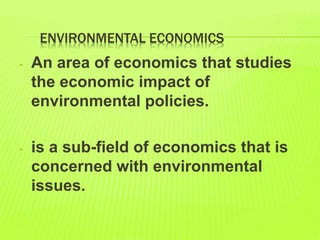
ENVIRONMENTAL ECONOMICS
National Bureau of Economic
Research Environmental Economics
program:
ENVIRONMENTAL ECONOMICS
- “ Environmental Economics
undertakes theoretical or empirical
studies of the economic effects of
national or local environmental
policies around the world. Particular
issues include the costs and
benefits of alternative environmental
policies to deal with air pollution,
water quality, toxic substances,
solid waste, and global warming. ”
APPROACHES AND APPLICATIONS
Approaches:
- Using “evolutionary thinking in
economics.”
- Evolutionary theory has been
central to economics for well over
one hundred years.
APPROACHES AND APPLICATIONS
- Occasionally, economists have
appealed directly to biological
evolution as a source of insight
into the workings of the economy.
APPROACHES AND APPLICATIONS
Darwinian biological Evolution
- gradual adaptation through natural
selection
- is a process consisting of three
component principles, namely;
- variation,
- heredity and
- individual selection
APPROACHES AND APPLICATIONS
Variation –
- Variety and diversity, whether fully
random or not, are essential
because without them there can be
no evolution whatsoever.
APPROACHES AND APPLICATIONS
- The neoclassical approach with
homogeneous/uniform agents is
incapable of addressing such
“variation evolution” in economics.
- The information driving evolution
in actual cases is the distribution
of variation in a given population.
APPROACHES AND APPLICATIONS
- Variation comes forth via mutations
and sexual recombination.
- Heredity means that selected units
have some degree of durability and
resilience, via a mechanism that
passes on characteristics to other
units.
- Individual selection is based on
competition between individuals in the
face of selection pressure (scarce
resources, space, mating partners,
APPROACHES AND APPLICATIONS
- Punctuated equilibrium (Eldredge
and Gould 1972) refers to a pattern
in natural history characterized by
relatively long periods of stasis
interrupted by bursts of rapid
change.
APPROACHES AND APPLICATIONS
- Sorting and selection is a
distinction proposed by Vrba and
Gould (1986) to elaborate the
notions of hierarchies of selection
and macroevolution.
- The term “selection” is reserved
for the traditional Darwinian cause-
effect mechanism of differential
survival of adaptive traits which
increase or maintain “fitness”
APPROACHES AND APPLICATIONS
- i.e.
“the expected relative frequency of
descendants in the next generation.”
- Selection is a gradual and marginal
process involving the adaptation of
species to a relatively stable
environment.
APPROACHES AND APPLICATIONS
- “Sorting” is a broader term
referring to differential survival, no
matter what the reason.
- Selection implies causality; a firm
or an organism survives because it
is more efficient or more fit.
- Sorting is merely a differential
outcome.
APPROACHES AND APPLICATIONS
- Lamarckian evolution means that
mutations or heredity can be
steered by the unit or some
external actor.
- This may be more appropriate as a
model for economic evolution than
for biological evolution,
- because economic actors can
consciously influence the direction
of economic evolution (Hodgson
APPROACHES AND APPLICATIONS
- Coevolution is a useful concept for
integrating evolutionary and
environmental economics.
- It refers to the simultaneous
evolution of relevant interactive
species, or species and
ecosystems, and analogously
economic activities and their
natural environments.
APPROACHES AND APPLICATIONS
Potential Application Areas
- Sustainable long-run development
- Evolutionary thinking can help
clarify the debate between advocates of
“weak” and “strong” sustainability.
- The standard economic approach to
sustainability, weak sustainability,
focuses on maintaining the total
capital stock necessary to insure that
net national product is no declining
(Pearce and Atkinson 1995).
APPROACHES AND APPLICATIONS
- Near-perfect and reversible
substitution between “natural
capital” and human created
capital (“machines and
knowledge”) is assumed.
- This view reduces
“sustainability” to sustaining
economic growth (Solow 1992).
APPROACHES AND APPLICATIONS
- Environment and Technology
- Much of the general research on
evolution and technology, based
on neo-Schumpeterian analysis
(Dosi et al. 1988) and Nelson and
Winter (1982), is directly applicable
to technological change as
discussed in environmental
economics.
APPROACHES AND APPLICATIONS
- Some work has already been done
in this direction (Ayres and Miller
1980; Faber and Proops 1990;
Kemp 1997).
- Important focal points of this
research is as follows.
- The lock-in of non-optimal
technologies creates
environmental and other social
costs.
APPROACHES AND APPLICATIONS
- Biological Evolution, Ecosystems,
Resilience and Biodiversity
- The newer concepts of
“resilience” and “biodiversity”
from contemporary ecology can
be used to examine the long-run
evolution of socio-economic
systems (Levin et al. 1998).
APPROACHES AND APPLICATIONS
- Spatial Evolution
- Consideration of the spatial and
international dimensions of
environmental economics
problems has increased over the
last decade.
- Attention has been given to the
relationship between
environmental factors,
environmental regulation and
international trade, and location of
APPROACHES AND APPLICATIONS
- Most of these are based on
neoclassical theory that regards
international issues in terms of
allocation and externalities.
ENVIRONMENTAL POLICY
OVERVIEW
- Environmental policy refers to the
commitment of an organization to the
laws, regulations, and other policy
mechanisms concerning
environmental issues.
- These issues generally include air and
water pollution, solid waste
management, biodiversity, ecosystem
management, maintenance of
biodiversity, the protection of natural
resources, wildlife and endangered
ENVIRONMENTAL POLICY
RATONALE
- The rationale for governmental
involvement in the environment is
market failure in the form of forces
beyond the control of one person
(externality), including the free
rider problem and the tragedy of
the commons.
ENVIRONMENTAL POLICY
- An example of an externality is a
factory that engages in water
pollution in a river. The cost of
such action is paid by society-at-
large, when they must clean the
water before drinking it and is
external to the costs of the factory.
ENVIRONMENTAL POLICY
- The free rider problem is when the
private marginal cost of taking
action to protect the environment
is greater than the private marginal
benefit, but the social marginal
cost is less than the social
marginal benefit.
ENVIRONMENTAL POLICY
- The tragedy of the commons is the
problem that, because no one
person owns the commons, each
individual has an incentive to
utilize common resources as much
as possible.
- Without governmental
involvement, the commons is
overused.
- Examples of tragedies of the
ENVIRONMENTAL POLICY
- Policies concerning energy or
regulation of toxic substances
including pesticides and many
types of industrial waste are part of
the topic of environmental policy.
ENVIRONMENTAL POLICY
- This policy can be deliberately
taken to direct and oversee human
activities and thereby prevent
harmful effects on the biophysical
environment and natural
resources, as well as to make sure
that changes in the environment do
not have harmful effects on
humans.
EQUITY AND RESOURCES
Efficiency versus equity
- we need to remember that even
when an efficient solution occurs,
it might not be desirable.
- Recall that the fundamental
theorem of welfare economics says
nothing about the distribution of
resources in an efficient solution.
EQUITY AND RESOURCES
- Equity issues are also important.
Policymakers need to consider
how various groups will be
impacted.
- This can be complicated in
environmental economics.
- For example, how should the
welfare of future generations be
weighed when making global
warming policy?
EQUITY AND RESOURCES
Note that there are two types of
economic analysis:
Positive economics
– studies how the economy actually
functions. It is purely descriptive.
e.g.: how do people respond to
higher energy prices?
EQUITY AND RESOURCES
Normative economics
– the study of whether or not the
economy produces socially desirable
results. Requires value judgments,
e.g.: What is the best way to reduce
gasoline consumption (e.g. tax,
CAFÉ, oil import tariff)?
EQUITY AND RESOURCES
Resources used:
- Government resources such as
financial, human and even powers
are critical to a successful
implementation of environmental
policy.
- Environmental policy instruments
are tools used by governments to
implement their environmental
policies.
EQUITY AND RESOURCES
- Governments may use a number of
different types of instruments.
- For example, economic incentives
and market-based instruments
such as taxes and tax exemptions,
tradable permits, and fees can be
very effective to encourage
compliance with environmental
policy.
ECONOMIC VALUE OF EARTH’S ECOSYSTEM
Economic Value of Earth’s
Ecosystem
- The services of ecological systems
and the natural capital stocks that
produce them are critical to the
functioning of the Earth’s life-
support system.
- They contribute to human welfare,
both directly and indirectly, and
therefore represent part of the total
ECONOMIC VALUE OF EARTH’S ECOSYSTEM
- We have estimated the current
economic value of 17 ecosystem
services for 16 biomes, based on
published studies and a few
original calculations.
- For the entire biosphere, the value
(most of which is outside the
market) is estimated to be in the
range of US$16–54 trillion per year,
with an average of US$33 trillion
per year.
ECONOMIC VALUE OF EARTH’S ECOSYSTEM
- Because of the nature of the
uncertainties, this must be
considered a minimum estimate.
- Global gross national product total
is around US$18 trillion per year.
ECONOMIC VALUE OF EARTH’S ECOSYSTEM
- Because ecosystem services are
not fully ‘captured’ in commercial
markets or adequately quantified in
terms comparable with economic
services and manufactured capital,
they are often given too little
weight in policy decisions.
ECONOMIC VALUE OF EARTH’S ECOSYSTEM
- The economies of the Earth would
grind to a halt without the services
of ecological life-support systems,
so in one sense their total value to
the economy is infinite.
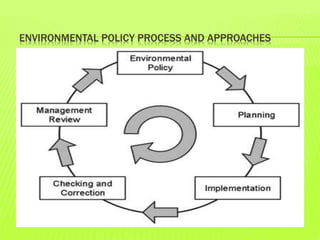
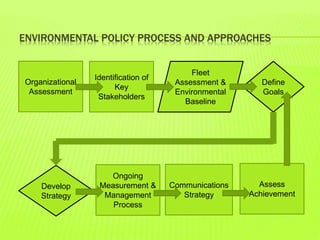
ENVIRONMENTAL POLICY PROCESS AND APPROACHES
Organizational
Assessment
Fleet
Assessment &
Environmental
Baseline
Define
Goals
Identification of
Key
Stakeholders
Develop
Strategy
Communications
Strategy
Assess
Achievement
Ongoing
Measurement &
Management
Process
ENVIRONMENTAL POLICY PROCESS AND APPROACHES
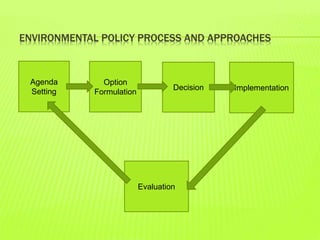
Agenda
Setting
Option
Formulation
Decision
Evaluation
Implementation
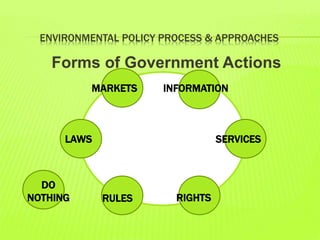
ENVIRONMENTAL POLICY PROCESS & APPROACHES
Forms of Government Actions
MARKETS INFORMATION
RIGHTSRULES
LAWS SERVICES
DO
NOTHING
ENVIRONMENTAL POLICY PROCESS & APPROACHES
PROCESS FLOW AS A “GAME”
1.What are the structure & rules of
the game and how do they affect the
outcome?
2.Who are the players?
3.What tools do the players have to
influence the game?
4.Where in the game are players
most influential?
STRUCTURE OF THE ENVIRONMENTAL POLICY “GAME” IN
THE U.S.
•Fragmentation of Authority
•Federalism
–National Government
–State Government
–Local Government
•Separation of Powers
–Executive
–Legislative
–Judiciary
•Checks & Balances
STRUCTURE OF THE ENVIRONMENTAL POLICY “GAME” IN
THE U.S.
•Political Power is Widely Dispersed
& Fluid
–Pluralism
–Elections
–Rights
•Diverse Interests & Values Survive
Political Loss
IMPLICATIONS
•Many “access points” to government
•Policy requires broad political
consensus to advance
•Easier to stall policy than it is to make it
•Policy change tends to be incremental
–Crises
–Issues of Low political salience
•Environmental Policy = ∑many policies
–Duplication & Overlap
–Inconsistency & Conflict
PLAYERS IN THE ENVIRONMENTAL POLICY GAME
– CHIEF EXECUTIVES
• Chief Executive
–White House Staff
–CEQ
–OM
• Executive Agency Chiefs
–Political appointees
•Dept. Secretaries
•Deputy & Assistant
Secretaries
PLAYERS IN THE ENVIRONMENTAL POLICY GAME
•Tools
–Executive Authority
•Decision-making
•reorganization
•Executive orders
•Hire & fire
–Agenda setting
PLAYERS IN THE ENVIRONMENTAL POLICY GAME
- BUREAUCRACY
•Many Agencies
–EPA –DA
–DOI –DC
–USACE
•Agency Personnel
–Political Appointees
–Professional staff
PLAYERS IN THE ENVIRONMENTAL POLICY GAME
- BUREAUCRACY
•Sub-agencies
–Dept. of Interior
•F&WS
•NPS
•BLM
–Dept. of Agriculture
•Forest Service
•NRCS (SCS)
PLAYERS IN THE ENVIRONMENTAL POLICY GAME
- BUREAUCRACY
•Tools
–Information
–Professional/analytic staff
–Implementation power
(client contact)
PLAYERS IN THE ENVIRONMENTAL POLICY GAME
- LEGISLATIVE BRANCH
•House & Senate
–Leadership
•Majority party
•Minority party
–Membership
–Committees & staffs
PLAYERS IN THE ENVIRONMENTAL POLICY GAME
- LEGISLATIVE BRANCH
•Tools
–Law-making power
–Budgetary power
–Investigative power
–Standing committees & staff
–Approval of senior agency
appointments
PLAYERS IN THE ENVIRONMENTAL POLICY GAME
- JUDICIAL BRANCH
•Courts
–Federal courts
–Appellate courts
–Supreme Court
•Tools
–Constitutional authority
–Insulation from electoral politics
–Case selection & legal
methodology
PLAYERS IN THE ENVIRONMENTAL POLICY GAME
- STATES
•Duplicate Federal “Cast of
Characters”
•States Rights to Define Policy
•Federal Policy Implementation
Roles
PLAYERS IN THE ENVIRONMENTAL POLICY GAME
- INTEREST GROUPS & NGOS
•Non-Governmental Organizations
–Industry & Trade associations
•Nat’l. Assoc. of Home Builders
•American Mining Association
• Teamsters
–Environmental Groups
–Property Rights & Wise Use Groups
•Media
•Public
PLAYERS IN THE ENVIRONMENTAL POLICY GAME
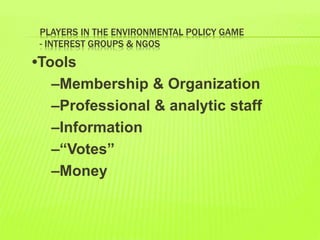
- INTEREST GROUPS & NGOS
•Tools
–Membership & Organization
–Professional & analytic staff
–Information
–“Votes”
–Money
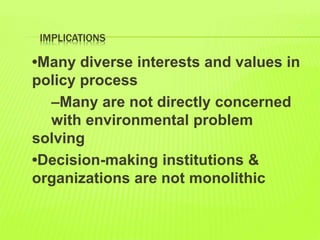
IMPLICATIONS
•Many diverse interests and values in
policy process
–Many are not directly concerned
with environmental problem
solving
•Decision-making institutions &
organizations are not monolithic
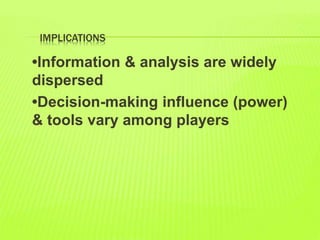
IMPLICATIONS
•Information & analysis are widely
dispersed
•Decision-making influence (power)
& tools vary among players
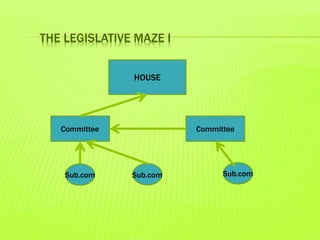
THE LEGISLATIVE MAZE I
HOUSE
Sub.com
Committee Committee
Sub.com Sub.com
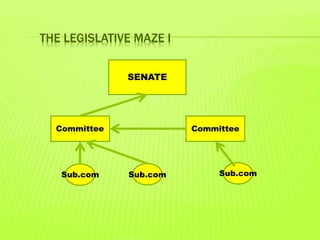
THE LEGISLATIVE MAZE I
SENATE
Sub.com
Committee Committee
Sub.com Sub.com
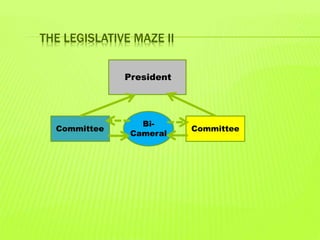
THE LEGISLATIVE MAZE II
President
Committee Committee
Bi-
Cameral
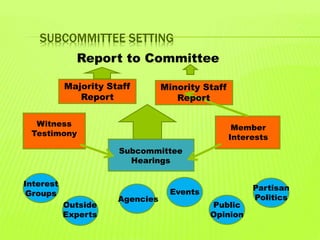
SUBCOMMITTEE SETTING
Majority Staff
Report
Witness
Testimony
Member
Interests
Interest
Groups
Outside
Experts
Agencies
Events
Public
Opinion
Partisan
Politics
Minority Staff
Report
Subcommittee
Hearings
Report to Committee
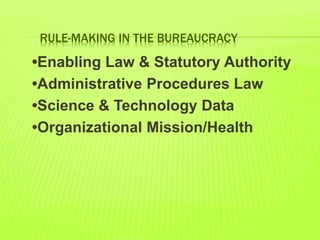
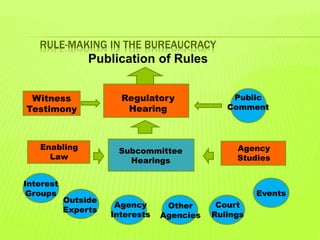
RULE-MAKING IN THE BUREAUCRACY
•Enabling Law & Statutory Authority
•Administrative Procedures Law
•Science & Technology Data
•Organizational Mission/Health
RULE-MAKING IN THE BUREAUCRACY
Witness
Testimony
Enabling
Law
Agency
Studies
Interest
Groups
Outside
Experts
Agency
Interests
Events
Court
Rulings
Other
Agencies
Regulatory
Hearing
Subcommittee
Hearings
Publication of Rules
Public
Comment
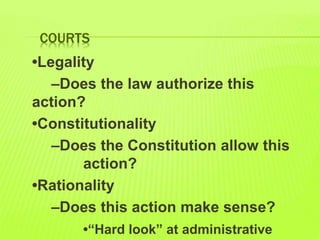
COURTS
•Legality
–Does the law authorize this
action?
•Constitutionality
–Does the Constitution allow this
action?
•Rationality
–Does this action make sense?
•“Hard look” at administrative
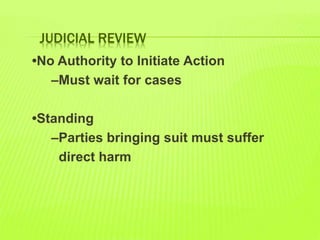
JUDICIAL REVIEW
•No Authority to Initiate Action
–Must wait for cases
•Standing
–Parties bringing suit must suffer
direct harm
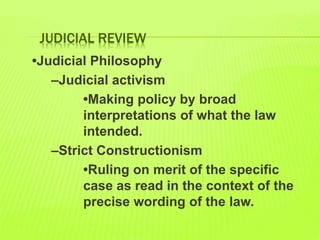
JUDICIAL REVIEW
•Judicial Philosophy
–Judicial activism
•Making policy by broad
interpretations of what the law
intended.
–Strict Constructionism
•Ruling on merit of the specific
case as read in the context of the
precise wording of the law.
ENVIRONMENTAL POLICY PROCESS & APPROACHES
The most critical consideration in
coming up with good Environmental
Policy, besides of having passed
through rigorous processes, is the
appreciation or acceptance of
political leaders. Although, they must
come up in the identification of
stakeholders.
ENVIRONMENTAL POLICY PROCESS & APPROACHES
The norm is,
“LOBBYING”
REFLECTION
If I am the Chief Executive, especially
in a local government unit, perhaps I
should consider Environmental
Protection as the top priority
program.
REFLECTION
As there are surmounting concerns
in the environment that are
impacting so much on the needs of
the people;
- Food Productions
- Water supply
- increasing temperature
- Energy
THANK YOU!!!
Enroll now BS.
Enviromental
Management
St. Paul University
Dumaguete

Environmental Economics & Environmental Policy

  • 1.
  • 2.
    ENVIRONMENTAL ECONOMICS - Anarea of economics that studies the economic impact of environmental policies. - is a sub-field of economics that is concerned with environmental issues.
  • 3.
    ENVIRONMENTAL ECONOMICS National Bureauof Economic Research Environmental Economics program:
  • 4.
    ENVIRONMENTAL ECONOMICS - “Environmental Economics undertakes theoretical or empirical studies of the economic effects of national or local environmental policies around the world. Particular issues include the costs and benefits of alternative environmental policies to deal with air pollution, water quality, toxic substances, solid waste, and global warming. ”
  • 5.
    APPROACHES AND APPLICATIONS Approaches: -Using “evolutionary thinking in economics.” - Evolutionary theory has been central to economics for well over one hundred years.
  • 6.
    APPROACHES AND APPLICATIONS -Occasionally, economists have appealed directly to biological evolution as a source of insight into the workings of the economy.
  • 7.
    APPROACHES AND APPLICATIONS Darwinianbiological Evolution - gradual adaptation through natural selection - is a process consisting of three component principles, namely; - variation, - heredity and - individual selection
  • 8.
    APPROACHES AND APPLICATIONS Variation– - Variety and diversity, whether fully random or not, are essential because without them there can be no evolution whatsoever.
  • 9.
    APPROACHES AND APPLICATIONS -The neoclassical approach with homogeneous/uniform agents is incapable of addressing such “variation evolution” in economics. - The information driving evolution in actual cases is the distribution of variation in a given population.
  • 10.
    APPROACHES AND APPLICATIONS -Variation comes forth via mutations and sexual recombination. - Heredity means that selected units have some degree of durability and resilience, via a mechanism that passes on characteristics to other units. - Individual selection is based on competition between individuals in the face of selection pressure (scarce resources, space, mating partners,
  • 11.
    APPROACHES AND APPLICATIONS -Punctuated equilibrium (Eldredge and Gould 1972) refers to a pattern in natural history characterized by relatively long periods of stasis interrupted by bursts of rapid change.
  • 12.
    APPROACHES AND APPLICATIONS -Sorting and selection is a distinction proposed by Vrba and Gould (1986) to elaborate the notions of hierarchies of selection and macroevolution. - The term “selection” is reserved for the traditional Darwinian cause- effect mechanism of differential survival of adaptive traits which increase or maintain “fitness”
  • 13.
    APPROACHES AND APPLICATIONS -i.e. “the expected relative frequency of descendants in the next generation.” - Selection is a gradual and marginal process involving the adaptation of species to a relatively stable environment.
  • 14.
    APPROACHES AND APPLICATIONS -“Sorting” is a broader term referring to differential survival, no matter what the reason. - Selection implies causality; a firm or an organism survives because it is more efficient or more fit. - Sorting is merely a differential outcome.
  • 15.
    APPROACHES AND APPLICATIONS -Lamarckian evolution means that mutations or heredity can be steered by the unit or some external actor. - This may be more appropriate as a model for economic evolution than for biological evolution, - because economic actors can consciously influence the direction of economic evolution (Hodgson
  • 16.
    APPROACHES AND APPLICATIONS -Coevolution is a useful concept for integrating evolutionary and environmental economics. - It refers to the simultaneous evolution of relevant interactive species, or species and ecosystems, and analogously economic activities and their natural environments.
  • 17.
    APPROACHES AND APPLICATIONS PotentialApplication Areas - Sustainable long-run development - Evolutionary thinking can help clarify the debate between advocates of “weak” and “strong” sustainability. - The standard economic approach to sustainability, weak sustainability, focuses on maintaining the total capital stock necessary to insure that net national product is no declining (Pearce and Atkinson 1995).
  • 18.
    APPROACHES AND APPLICATIONS -Near-perfect and reversible substitution between “natural capital” and human created capital (“machines and knowledge”) is assumed. - This view reduces “sustainability” to sustaining economic growth (Solow 1992).
  • 19.
    APPROACHES AND APPLICATIONS -Environment and Technology - Much of the general research on evolution and technology, based on neo-Schumpeterian analysis (Dosi et al. 1988) and Nelson and Winter (1982), is directly applicable to technological change as discussed in environmental economics.
  • 20.
    APPROACHES AND APPLICATIONS -Some work has already been done in this direction (Ayres and Miller 1980; Faber and Proops 1990; Kemp 1997). - Important focal points of this research is as follows. - The lock-in of non-optimal technologies creates environmental and other social costs.
  • 21.
    APPROACHES AND APPLICATIONS -Biological Evolution, Ecosystems, Resilience and Biodiversity - The newer concepts of “resilience” and “biodiversity” from contemporary ecology can be used to examine the long-run evolution of socio-economic systems (Levin et al. 1998).
  • 22.
    APPROACHES AND APPLICATIONS -Spatial Evolution - Consideration of the spatial and international dimensions of environmental economics problems has increased over the last decade. - Attention has been given to the relationship between environmental factors, environmental regulation and international trade, and location of
  • 23.
    APPROACHES AND APPLICATIONS -Most of these are based on neoclassical theory that regards international issues in terms of allocation and externalities.
  • 24.
    ENVIRONMENTAL POLICY OVERVIEW - Environmentalpolicy refers to the commitment of an organization to the laws, regulations, and other policy mechanisms concerning environmental issues. - These issues generally include air and water pollution, solid waste management, biodiversity, ecosystem management, maintenance of biodiversity, the protection of natural resources, wildlife and endangered
  • 25.
    ENVIRONMENTAL POLICY RATONALE - Therationale for governmental involvement in the environment is market failure in the form of forces beyond the control of one person (externality), including the free rider problem and the tragedy of the commons.
  • 26.
    ENVIRONMENTAL POLICY - Anexample of an externality is a factory that engages in water pollution in a river. The cost of such action is paid by society-at- large, when they must clean the water before drinking it and is external to the costs of the factory.
  • 27.
    ENVIRONMENTAL POLICY - Thefree rider problem is when the private marginal cost of taking action to protect the environment is greater than the private marginal benefit, but the social marginal cost is less than the social marginal benefit.
  • 28.
    ENVIRONMENTAL POLICY - Thetragedy of the commons is the problem that, because no one person owns the commons, each individual has an incentive to utilize common resources as much as possible. - Without governmental involvement, the commons is overused. - Examples of tragedies of the
  • 29.
    ENVIRONMENTAL POLICY - Policiesconcerning energy or regulation of toxic substances including pesticides and many types of industrial waste are part of the topic of environmental policy.
  • 30.
    ENVIRONMENTAL POLICY - Thispolicy can be deliberately taken to direct and oversee human activities and thereby prevent harmful effects on the biophysical environment and natural resources, as well as to make sure that changes in the environment do not have harmful effects on humans.
  • 31.
    EQUITY AND RESOURCES Efficiencyversus equity - we need to remember that even when an efficient solution occurs, it might not be desirable. - Recall that the fundamental theorem of welfare economics says nothing about the distribution of resources in an efficient solution.
  • 32.
    EQUITY AND RESOURCES -Equity issues are also important. Policymakers need to consider how various groups will be impacted. - This can be complicated in environmental economics. - For example, how should the welfare of future generations be weighed when making global warming policy?
  • 33.
    EQUITY AND RESOURCES Notethat there are two types of economic analysis: Positive economics – studies how the economy actually functions. It is purely descriptive. e.g.: how do people respond to higher energy prices?
  • 34.
    EQUITY AND RESOURCES Normativeeconomics – the study of whether or not the economy produces socially desirable results. Requires value judgments, e.g.: What is the best way to reduce gasoline consumption (e.g. tax, CAFÉ, oil import tariff)?
  • 35.
    EQUITY AND RESOURCES Resourcesused: - Government resources such as financial, human and even powers are critical to a successful implementation of environmental policy. - Environmental policy instruments are tools used by governments to implement their environmental policies.
  • 36.
    EQUITY AND RESOURCES -Governments may use a number of different types of instruments. - For example, economic incentives and market-based instruments such as taxes and tax exemptions, tradable permits, and fees can be very effective to encourage compliance with environmental policy.
  • 37.
    ECONOMIC VALUE OFEARTH’S ECOSYSTEM Economic Value of Earth’s Ecosystem - The services of ecological systems and the natural capital stocks that produce them are critical to the functioning of the Earth’s life- support system. - They contribute to human welfare, both directly and indirectly, and therefore represent part of the total
  • 38.
    ECONOMIC VALUE OFEARTH’S ECOSYSTEM - We have estimated the current economic value of 17 ecosystem services for 16 biomes, based on published studies and a few original calculations. - For the entire biosphere, the value (most of which is outside the market) is estimated to be in the range of US$16–54 trillion per year, with an average of US$33 trillion per year.
  • 39.
    ECONOMIC VALUE OFEARTH’S ECOSYSTEM - Because of the nature of the uncertainties, this must be considered a minimum estimate. - Global gross national product total is around US$18 trillion per year.
  • 40.
    ECONOMIC VALUE OFEARTH’S ECOSYSTEM - Because ecosystem services are not fully ‘captured’ in commercial markets or adequately quantified in terms comparable with economic services and manufactured capital, they are often given too little weight in policy decisions.
  • 41.
    ECONOMIC VALUE OFEARTH’S ECOSYSTEM - The economies of the Earth would grind to a halt without the services of ecological life-support systems, so in one sense their total value to the economy is infinite.
  • 42.
  • 43.
    ENVIRONMENTAL POLICY PROCESSAND APPROACHES Organizational Assessment Fleet Assessment & Environmental Baseline Define Goals Identification of Key Stakeholders Develop Strategy Communications Strategy Assess Achievement Ongoing Measurement & Management Process
  • 44.
    ENVIRONMENTAL POLICY PROCESSAND APPROACHES Agenda Setting Option Formulation Decision Evaluation Implementation
  • 45.
    ENVIRONMENTAL POLICY PROCESS& APPROACHES Forms of Government Actions MARKETS INFORMATION RIGHTSRULES LAWS SERVICES DO NOTHING
  • 46.
    ENVIRONMENTAL POLICY PROCESS& APPROACHES PROCESS FLOW AS A “GAME” 1.What are the structure & rules of the game and how do they affect the outcome? 2.Who are the players? 3.What tools do the players have to influence the game? 4.Where in the game are players most influential?
  • 47.
    STRUCTURE OF THEENVIRONMENTAL POLICY “GAME” IN THE U.S. •Fragmentation of Authority •Federalism –National Government –State Government –Local Government •Separation of Powers –Executive –Legislative –Judiciary •Checks & Balances
  • 48.
    STRUCTURE OF THEENVIRONMENTAL POLICY “GAME” IN THE U.S. •Political Power is Widely Dispersed & Fluid –Pluralism –Elections –Rights •Diverse Interests & Values Survive Political Loss
  • 49.
    IMPLICATIONS •Many “access points”to government •Policy requires broad political consensus to advance •Easier to stall policy than it is to make it •Policy change tends to be incremental –Crises –Issues of Low political salience •Environmental Policy = ∑many policies –Duplication & Overlap –Inconsistency & Conflict
  • 50.
    PLAYERS IN THEENVIRONMENTAL POLICY GAME – CHIEF EXECUTIVES • Chief Executive –White House Staff –CEQ –OM • Executive Agency Chiefs –Political appointees •Dept. Secretaries •Deputy & Assistant Secretaries
  • 51.
    PLAYERS IN THEENVIRONMENTAL POLICY GAME •Tools –Executive Authority •Decision-making •reorganization •Executive orders •Hire & fire –Agenda setting
  • 52.
    PLAYERS IN THEENVIRONMENTAL POLICY GAME - BUREAUCRACY •Many Agencies –EPA –DA –DOI –DC –USACE •Agency Personnel –Political Appointees –Professional staff
  • 53.
    PLAYERS IN THEENVIRONMENTAL POLICY GAME - BUREAUCRACY •Sub-agencies –Dept. of Interior •F&WS •NPS •BLM –Dept. of Agriculture •Forest Service •NRCS (SCS)
  • 54.
    PLAYERS IN THEENVIRONMENTAL POLICY GAME - BUREAUCRACY •Tools –Information –Professional/analytic staff –Implementation power (client contact)
  • 55.
    PLAYERS IN THEENVIRONMENTAL POLICY GAME - LEGISLATIVE BRANCH •House & Senate –Leadership •Majority party •Minority party –Membership –Committees & staffs
  • 56.
    PLAYERS IN THEENVIRONMENTAL POLICY GAME - LEGISLATIVE BRANCH •Tools –Law-making power –Budgetary power –Investigative power –Standing committees & staff –Approval of senior agency appointments
  • 57.
    PLAYERS IN THEENVIRONMENTAL POLICY GAME - JUDICIAL BRANCH •Courts –Federal courts –Appellate courts –Supreme Court •Tools –Constitutional authority –Insulation from electoral politics –Case selection & legal methodology
  • 58.
    PLAYERS IN THEENVIRONMENTAL POLICY GAME - STATES •Duplicate Federal “Cast of Characters” •States Rights to Define Policy •Federal Policy Implementation Roles
  • 59.
    PLAYERS IN THEENVIRONMENTAL POLICY GAME - INTEREST GROUPS & NGOS •Non-Governmental Organizations –Industry & Trade associations •Nat’l. Assoc. of Home Builders •American Mining Association • Teamsters –Environmental Groups –Property Rights & Wise Use Groups •Media •Public
  • 60.
    PLAYERS IN THEENVIRONMENTAL POLICY GAME - INTEREST GROUPS & NGOS •Tools –Membership & Organization –Professional & analytic staff –Information –“Votes” –Money
  • 61.
    IMPLICATIONS •Many diverse interestsand values in policy process –Many are not directly concerned with environmental problem solving •Decision-making institutions & organizations are not monolithic
  • 62.
    IMPLICATIONS •Information & analysisare widely dispersed •Decision-making influence (power) & tools vary among players
  • 63.
    THE LEGISLATIVE MAZEI HOUSE Sub.com Committee Committee Sub.com Sub.com
  • 64.
    THE LEGISLATIVE MAZEI SENATE Sub.com Committee Committee Sub.com Sub.com
  • 65.
    THE LEGISLATIVE MAZEII President Committee Committee Bi- Cameral
  • 66.
  • 67.
    RULE-MAKING IN THEBUREAUCRACY •Enabling Law & Statutory Authority •Administrative Procedures Law •Science & Technology Data •Organizational Mission/Health
  • 68.
    RULE-MAKING IN THEBUREAUCRACY Witness Testimony Enabling Law Agency Studies Interest Groups Outside Experts Agency Interests Events Court Rulings Other Agencies Regulatory Hearing Subcommittee Hearings Publication of Rules Public Comment
  • 69.
    COURTS •Legality –Does the lawauthorize this action? •Constitutionality –Does the Constitution allow this action? •Rationality –Does this action make sense? •“Hard look” at administrative
  • 70.
    JUDICIAL REVIEW •No Authorityto Initiate Action –Must wait for cases •Standing –Parties bringing suit must suffer direct harm
  • 71.
    JUDICIAL REVIEW •Judicial Philosophy –Judicialactivism •Making policy by broad interpretations of what the law intended. –Strict Constructionism •Ruling on merit of the specific case as read in the context of the precise wording of the law.
  • 72.
    ENVIRONMENTAL POLICY PROCESS& APPROACHES The most critical consideration in coming up with good Environmental Policy, besides of having passed through rigorous processes, is the appreciation or acceptance of political leaders. Although, they must come up in the identification of stakeholders.
  • 73.
    ENVIRONMENTAL POLICY PROCESS& APPROACHES The norm is, “LOBBYING”
  • 74.
    REFLECTION If I amthe Chief Executive, especially in a local government unit, perhaps I should consider Environmental Protection as the top priority program.
  • 75.
    REFLECTION As there aresurmounting concerns in the environment that are impacting so much on the needs of the people; - Food Productions - Water supply - increasing temperature - Energy
  • 76.
    THANK YOU!!! Enroll nowBS. Enviromental Management St. Paul University Dumaguete