Extinction
Extinction 
The Definition and Causes
What is Extinction? 
 Extinction occurs when the last existing 
member of a given species dies 
 In other words…there aren’t any more left! 
 It is a scientific certainty when there are 
not any surviving individuals left to 
reproduce 
 Functional Extinction 
 Only a handful of individuals are left 
 Odds of reproduction are slim
Causes of Extinction 
 Genetics and Demographics 
 Small populations = increased risk 
 Mutations 
• Causes a flux in natural selection 
• Beneficial genetic traits are overruled 
 Loss of Genetic Diversity 
• Shallow gene pools promote massive inbreeding
Causes Con’t. 
 Habitat Degradation 
 One of the most influential 
 Has many causes 
 Some due to humans 
 Some due to other factors
Habitat Degradation 
 Toxicity 
 Kills off species directly through food/water 
 Indirectly via sterilization 
 Can occur in short spans (a single generation) 
 Can occur over several generations 
• Increasing toxicity 
• Increasing competition for habitat resources
Habitat Degradation 
 Destruction of Habitat 
 “Save the Rainforests!” 
 Elimination of living space 
 Change in habitat 
• Rainforest to pasture lands 
 Leads to diminishing resources 
• Increases competition 
 Can be caused by natural processes 
• Volcanoes, floods, drought, etc…
Causes Con’t. 
 Predation 
 Competition 
 Disease 
 Coextinction 
 Mass Extinction 
 Planned Extinction
Predation 
 Introduction of predators 
 Invasive alien species 
 Transported by humans 
• Cattle, rats, zebra muscles, etc… 
• Sometimes on purpose, sometimes not 
 Can eat other species 
 Eat food sources 
 Introduce diseases
Coextinction 
 The loss of one species leads to the loss 
of another 
 Chain of extinction 
 Can be caused by small impacts in the 
beginning 
 A predator looses its food source 
 Affected by interconnectedness in nature
Mass Extinction 
 Aka: an extinction event 
 A sharp decrease in the number of 
species on Earth in a short period of time 
 Coincides with a sharp drop in speciation 
 The process by which new biological species 
arise 
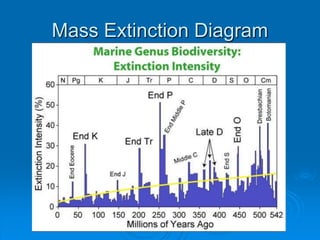
 There have been at least 5 
 Last one was 65M years ago
Mass Extinction Diagram
Mass Extinction 
 Nearly 2/3rds (or more) of all animal 
species that ever existed on the planet are 
now gone. 
• With contemporary extinction being attributed to 
HUMAN activity. 
 Numerous factors go into the extinction of 
a specific species. 
• Though all point the finger to climate change.
Mass Extinction 
 Began about three-million years ago 
(Continental Glaciations). 
 Hypotheses for initial extinction: 
• Sea level depletion vs. Temperature decrease 
 Though these hypotheses aren’t mutually 
exclusive, they may have conspired 
together.
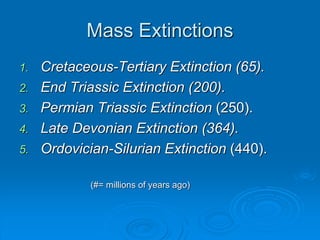
Mass Extinctions 
1. Cretaceous-Tertiary Extinction (65). 
2. End Triassic Extinction (200). 
3. Permian Triassic Extinction (250). 
4. Late Devonian Extinction (364). 
5. Ordovician-Silurian Extinction (440). 
(#= millions of years ago)
Planned Extinction 
 Human controlled 
 Thought of to help humans 
 Deadly viruses 
 Smallpox 
• Extinct in the wild 
 Polio 
• Near extinct (only in small parts of the world)
Natural Causes of 
Extinction
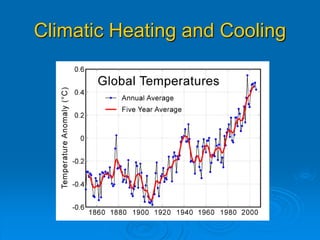
Climatic Heating and Cooling
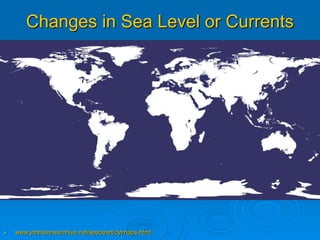
Changes in Sea Level or Currents 
 www.johnstonsarchive.net/spaceart/cylmaps.html
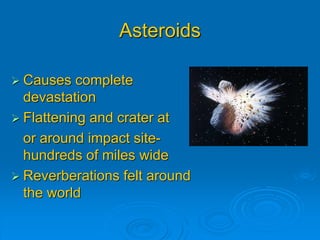
Asteroids 
 Causes complete 
devastation 
 Flattening and crater at 
or around impact site-hundreds 
of miles wide 
 Reverberations felt around 
the world
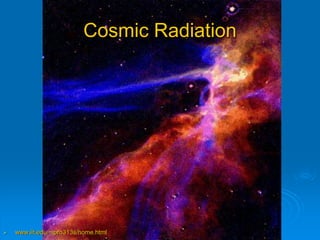
Cosmic Radiation 
 www.iit.edu/~ipro313s/home.html
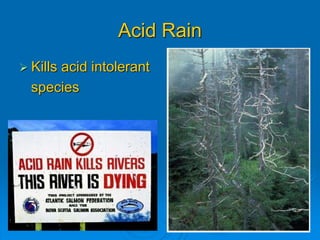
Acid Rain 
 Kills acid intolerant 
species
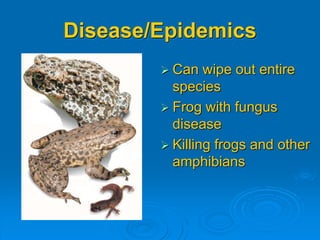
Disease/Epidemics 
 Can wipe out entire 
species 
 Frog with fungus 
disease 
 Killing frogs and other 
amphibians
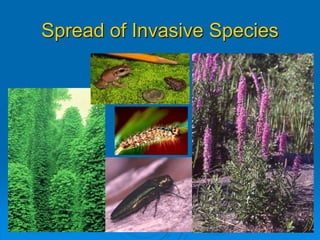
Spread of Invasive Species
Natural factors usually occur at a slower 
rate and therefore cause a low extinction 
rate. Human activities occur at a faster 
rate and cause higher extinction rates. 
Human activities are mostly responsible 
for the present extinction rates. 
http://www.gov.mb.ca/conservation/sustain/extinct.pdf
Human Causes of 
Extinction
Top Human Causes of 
Extinction: 
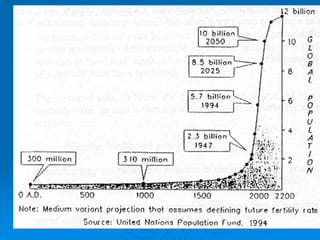
Increased human population 
Destruction/Fragmentation of 
habitat 
Pollution 
Climate change/Global warming
Extinctions caused by humans are generally 
considered to be a recent phenomena. HOWEVER: 
•In Australia—earliest humans: 64,000 years ago 
extinction—30,000-60,000 years 
ago 
•In the Americas—80% of large animals became 
extinct around the same time as first human presence 
there
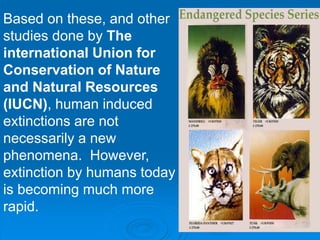
Based on these, and other 
studies done by The 
international Union for 
Conservation of Nature 
and Natural Resources 
(IUCN), human induced 
extinctions are not 
necessarily a new 
phenomena. However, 
extinction by humans today 
is becoming much more 
rapid.
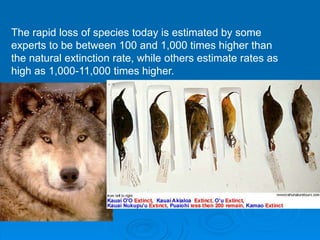
The rapid loss of species today is estimated by some 
experts to be between 100 and 1,000 times higher than 
the natural extinction rate, while others estimate rates as 
high as 1,000-11,000 times higher.
Habitat Degradation 
Habitat loss and degradation affect 86% 
of all threatened birds, 86% of mammals and 
88% of threatened amphibians
Climate change/Global Warming 
John W. Williams from UW-Madison suggests that changes 
in regions such as the Peruvian Andes, portions of the 
Himalayas and southern Australia could have a profound 
impact on indigenous plants and animals 
Williams and his research partners used computer models 
to estimate how various parts of the world would be 
affected by regional changes consistent with the IPCC's 
climate models. 
Their findings indicated that “By the end of the 21st century, 
large portions of the Earth’s surface may experience 
climates not found at present and some 2th century 
climates may disappear.”
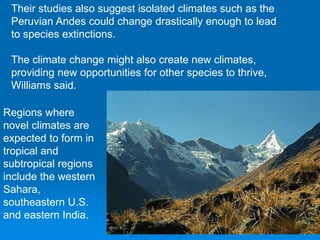
Their studies also suggest isolated climates such as the 
Peruvian Andes could change drastically enough to lead 
to species extinctions. 
The climate change might also create new climates, 
providing new opportunities for other species to thrive, 
Williams said. 
Regions where 
novel climates are 
expected to form in 
tropical and 
subtropical regions 
include the western 
Sahara, 
southeastern U.S. 
and eastern India.
Extinction Hotspots
Where and what are hotspots? 
 “The concept of biodiversity hotspots was 
penned by British ecologist Norman Myers in 
1988 as a means to address the dilemma of 
identifying the areas most important for 
preserving species.” (national geographic) 
 Hotspots are included in 6 continents excluding 
Antarctica. 
 Hotspots are heavily distributed along shore 
lines and near the equator.
 Hotspots are effected by many factors 
including 
 Logging 
 Agriculture 
 Hunting 
 Climate change 
 Government 
 Hotspots can be added and removed from 
the classification of “hotspot” by what 
recovery or lack of prevention is taking 
place in each area.
What is required to be considered a 
hotspot 
 “The region must support at least 1,500 
plant species found nowhere else in the 
world, and it must have lost at least 70 
percent of its original habitat.”
Interactive maps 
 http://www.biodiversityhotspots.org/xp/Hot 
spots/home/interactive_map.xml 
 http://www.zeroextinction.org/pointmapper/ 
azefiles/index.html
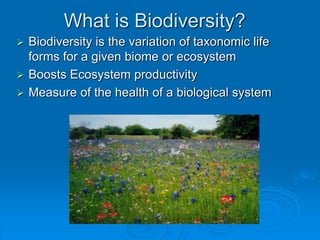
What is Biodiversity? 
 Biodiversity is the variation of taxonomic life 
forms for a given biome or ecosystem 
 Boosts Ecosystem productivity 
 Measure of the health of a biological system
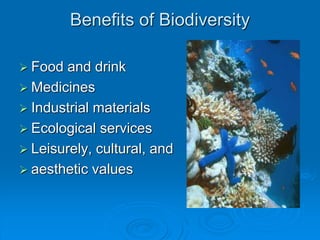
Benefits of Biodiversity 
 Food and drink 
 Medicines 
 Industrial materials 
 Ecological services 
 Leisurely, cultural, and 
 aesthetic values
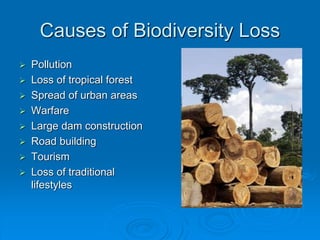
Causes of Biodiversity Loss 
 Pollution 
 Loss of tropical forest 
 Spread of urban areas 
 Warfare 
 Large dam construction 
 Road building 
 Tourism 
 Loss of traditional 
lifestyles
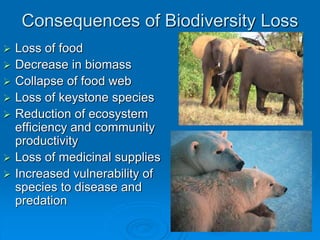
Consequences of Biodiversity Loss 
 Loss of food 
 Decrease in biomass 
 Collapse of food web 
 Loss of keystone species 
 Reduction of ecosystem 
efficiency and community 
productivity 
 Loss of medicinal supplies 
 Increased vulnerability of 
species to disease and 
predation
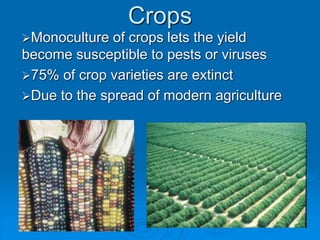
Crops 
Monoculture of crops lets the yield 
become susceptible to pests or viruses 
75% of crop varieties are extinct 
Due to the spread of modern agriculture
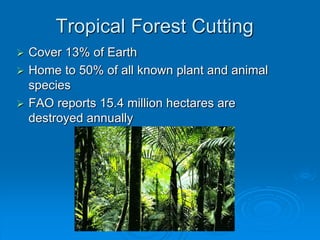
Tropical Forest Cutting 
 Cover 13% of Earth 
 Home to 50% of all known plant and animal 
species 
 FAO reports 15.4 million hectares are 
destroyed annually
The Convention on Biological 
Diversity 
Mission Statement 
“The objectives of this convention are the 
conservation of biological diversity, sustainable 
use of its components and the fair and equitable 
sharing of the benefits arising out of the 
utilization of genetic resources.” 
 Since it was adopted at the Earth Summit in Rio de Janeiro in 1992, 
189 countries have signed and implemented it. The United States 
signed it in 1993 but has yet to put it into action still today
The Convention on Biological 
Diversity 
2010 Biodiversity Target 
Members adopted a plan to significantly reduce the present 
rate of biodiversity loss at the global, regional and 
national level by the year 2010.

ecological extinction

  • 1.
  • 2.
  • 3.
    What is Extinction?  Extinction occurs when the last existing member of a given species dies  In other words…there aren’t any more left!  It is a scientific certainty when there are not any surviving individuals left to reproduce  Functional Extinction  Only a handful of individuals are left  Odds of reproduction are slim
  • 4.
    Causes of Extinction  Genetics and Demographics  Small populations = increased risk  Mutations • Causes a flux in natural selection • Beneficial genetic traits are overruled  Loss of Genetic Diversity • Shallow gene pools promote massive inbreeding
  • 5.
    Causes Con’t. Habitat Degradation  One of the most influential  Has many causes  Some due to humans  Some due to other factors
  • 6.
    Habitat Degradation Toxicity  Kills off species directly through food/water  Indirectly via sterilization  Can occur in short spans (a single generation)  Can occur over several generations • Increasing toxicity • Increasing competition for habitat resources
  • 7.
    Habitat Degradation Destruction of Habitat  “Save the Rainforests!”  Elimination of living space  Change in habitat • Rainforest to pasture lands  Leads to diminishing resources • Increases competition  Can be caused by natural processes • Volcanoes, floods, drought, etc…
  • 8.
    Causes Con’t. Predation  Competition  Disease  Coextinction  Mass Extinction  Planned Extinction
  • 9.
    Predation  Introductionof predators  Invasive alien species  Transported by humans • Cattle, rats, zebra muscles, etc… • Sometimes on purpose, sometimes not  Can eat other species  Eat food sources  Introduce diseases
  • 10.
    Coextinction  Theloss of one species leads to the loss of another  Chain of extinction  Can be caused by small impacts in the beginning  A predator looses its food source  Affected by interconnectedness in nature
  • 11.
    Mass Extinction Aka: an extinction event  A sharp decrease in the number of species on Earth in a short period of time  Coincides with a sharp drop in speciation  The process by which new biological species arise  There have been at least 5  Last one was 65M years ago
  • 12.
  • 13.
    Mass Extinction Nearly 2/3rds (or more) of all animal species that ever existed on the planet are now gone. • With contemporary extinction being attributed to HUMAN activity.  Numerous factors go into the extinction of a specific species. • Though all point the finger to climate change.
  • 14.
    Mass Extinction Began about three-million years ago (Continental Glaciations).  Hypotheses for initial extinction: • Sea level depletion vs. Temperature decrease  Though these hypotheses aren’t mutually exclusive, they may have conspired together.
  • 15.
    Mass Extinctions 1.Cretaceous-Tertiary Extinction (65). 2. End Triassic Extinction (200). 3. Permian Triassic Extinction (250). 4. Late Devonian Extinction (364). 5. Ordovician-Silurian Extinction (440). (#= millions of years ago)
  • 16.
    Planned Extinction Human controlled  Thought of to help humans  Deadly viruses  Smallpox • Extinct in the wild  Polio • Near extinct (only in small parts of the world)
  • 17.
    Natural Causes of Extinction
  • 18.
  • 19.
    Changes in SeaLevel or Currents  www.johnstonsarchive.net/spaceart/cylmaps.html
  • 20.
    Asteroids  Causescomplete devastation  Flattening and crater at or around impact site-hundreds of miles wide  Reverberations felt around the world
  • 21.
    Cosmic Radiation www.iit.edu/~ipro313s/home.html
  • 22.
    Acid Rain Kills acid intolerant species
  • 23.
    Disease/Epidemics  Canwipe out entire species  Frog with fungus disease  Killing frogs and other amphibians
  • 24.
  • 25.
    Natural factors usuallyoccur at a slower rate and therefore cause a low extinction rate. Human activities occur at a faster rate and cause higher extinction rates. Human activities are mostly responsible for the present extinction rates. http://www.gov.mb.ca/conservation/sustain/extinct.pdf
  • 26.
    Human Causes of Extinction
  • 27.
    Top Human Causesof Extinction: Increased human population Destruction/Fragmentation of habitat Pollution Climate change/Global warming
  • 28.
    Extinctions caused byhumans are generally considered to be a recent phenomena. HOWEVER: •In Australia—earliest humans: 64,000 years ago extinction—30,000-60,000 years ago •In the Americas—80% of large animals became extinct around the same time as first human presence there
  • 30.
    Based on these,and other studies done by The international Union for Conservation of Nature and Natural Resources (IUCN), human induced extinctions are not necessarily a new phenomena. However, extinction by humans today is becoming much more rapid.
  • 31.
    The rapid lossof species today is estimated by some experts to be between 100 and 1,000 times higher than the natural extinction rate, while others estimate rates as high as 1,000-11,000 times higher.
  • 32.
    Habitat Degradation Habitatloss and degradation affect 86% of all threatened birds, 86% of mammals and 88% of threatened amphibians
  • 33.
    Climate change/Global Warming John W. Williams from UW-Madison suggests that changes in regions such as the Peruvian Andes, portions of the Himalayas and southern Australia could have a profound impact on indigenous plants and animals Williams and his research partners used computer models to estimate how various parts of the world would be affected by regional changes consistent with the IPCC's climate models. Their findings indicated that “By the end of the 21st century, large portions of the Earth’s surface may experience climates not found at present and some 2th century climates may disappear.”
  • 34.
    Their studies alsosuggest isolated climates such as the Peruvian Andes could change drastically enough to lead to species extinctions. The climate change might also create new climates, providing new opportunities for other species to thrive, Williams said. Regions where novel climates are expected to form in tropical and subtropical regions include the western Sahara, southeastern U.S. and eastern India.
  • 35.
  • 36.
    Where and whatare hotspots?  “The concept of biodiversity hotspots was penned by British ecologist Norman Myers in 1988 as a means to address the dilemma of identifying the areas most important for preserving species.” (national geographic)  Hotspots are included in 6 continents excluding Antarctica.  Hotspots are heavily distributed along shore lines and near the equator.
  • 37.
     Hotspots areeffected by many factors including  Logging  Agriculture  Hunting  Climate change  Government  Hotspots can be added and removed from the classification of “hotspot” by what recovery or lack of prevention is taking place in each area.
  • 38.
    What is requiredto be considered a hotspot  “The region must support at least 1,500 plant species found nowhere else in the world, and it must have lost at least 70 percent of its original habitat.”
  • 39.
    Interactive maps http://www.biodiversityhotspots.org/xp/Hot spots/home/interactive_map.xml  http://www.zeroextinction.org/pointmapper/ azefiles/index.html
  • 40.
    What is Biodiversity?  Biodiversity is the variation of taxonomic life forms for a given biome or ecosystem  Boosts Ecosystem productivity  Measure of the health of a biological system
  • 41.
    Benefits of Biodiversity  Food and drink  Medicines  Industrial materials  Ecological services  Leisurely, cultural, and  aesthetic values
  • 42.
    Causes of BiodiversityLoss  Pollution  Loss of tropical forest  Spread of urban areas  Warfare  Large dam construction  Road building  Tourism  Loss of traditional lifestyles
  • 43.
    Consequences of BiodiversityLoss  Loss of food  Decrease in biomass  Collapse of food web  Loss of keystone species  Reduction of ecosystem efficiency and community productivity  Loss of medicinal supplies  Increased vulnerability of species to disease and predation
  • 44.
    Crops Monoculture ofcrops lets the yield become susceptible to pests or viruses 75% of crop varieties are extinct Due to the spread of modern agriculture
  • 45.
    Tropical Forest Cutting  Cover 13% of Earth  Home to 50% of all known plant and animal species  FAO reports 15.4 million hectares are destroyed annually
  • 46.
    The Convention onBiological Diversity Mission Statement “The objectives of this convention are the conservation of biological diversity, sustainable use of its components and the fair and equitable sharing of the benefits arising out of the utilization of genetic resources.”  Since it was adopted at the Earth Summit in Rio de Janeiro in 1992, 189 countries have signed and implemented it. The United States signed it in 1993 but has yet to put it into action still today
  • 47.
    The Convention onBiological Diversity 2010 Biodiversity Target Members adopted a plan to significantly reduce the present rate of biodiversity loss at the global, regional and national level by the year 2010.