MILLER/SPOOLMAN
LIVING IN THE ENVIRONMENT                17TH


                  Chapter 5
                  Biodiversity, Species
                  Interactions, and Population
                  Control
Core Case Study: Southern Sea Otters: Are
 They Back from the Brink of Extinction?
 • Habitat

 • Hunted: early 1900s

 • Partial recovery

 • Why care about sea otters?
    • Ethics
    • Tourism dollars
    • Keystone species
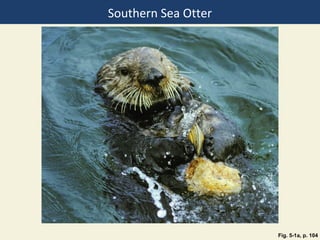
Southern Sea Otter


                     Fig. 5-1a, p. 104
Species Interact in Five Major Ways
• Interspecific Competition

• Predation

• Parasitism

• Mutualism

• Commensalism
Most Species Compete with One
     Another for Certain Resources
• For limited resources

• Ecological niche for exploiting resources

• Some niches overlap
Some Species Evolve Ways to Share
             Resources
• Resource partitioning
   • Using only parts of resource

   • Using at different times

   • Using in different ways
Resource Partitioning Among Warblers


                                       Fig. 5-2, p. 106
Specialist Species of Honeycreepers


                                      Fig. 5-3, p. 107
Most Consumer Species Feed on Live
   Organisms of Other Species (1)
• Predators may capture prey by
   1. Walking
   2. Swimming
   3. Flying
   4. Pursuit and ambush
   5. Camouflage
   6. Chemical warfare
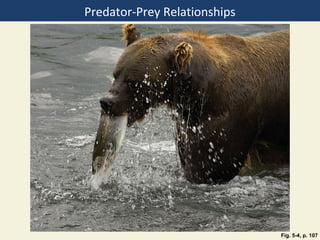
Predator-Prey Relationships


                              Fig. 5-4, p. 107
Most Consumer Species Feed on Live
      Organisms of Other Species (2)
• Prey may avoid capture by
   1. Run, swim, fly
   2. Protection: shells, bark, thorns
   3. Camouflage
   4. Chemical warfare
   5. Warning coloration
   6. Mimicry
   7. Deceptive looks
   8. Deceptive behavior
Some Ways Prey Species Avoid
      Their Predators


                               Fig. 5-5, p. 109
Some Species Feed off Other Species
       by Living on or in Them
• Parasitism

• Parasite is usually much smaller than the host

• Parasite rarely kills the host

• Parasite-host interaction may lead to coevolution
Parasitism: Trout with Blood-Sucking Sea Lamprey


                                             Fig. 5-7, p. 110
In Some Interactions, Both Species
                Benefit
• Mutualism

• Nutrition and protection relationship

• Gut inhabitant mutualism

• Not cooperation: it’s mutual exploitation
Mutualism: Hummingbird and Flower


                                    Fig. 5-8, p. 110
Mutualism: Oxpeckers Clean Rhinoceros; Anemones
           Protect and Feed Clownfish


                                           Fig. 5-9, p. 111
In Some Interactions, One Species Benefits
      and the Other Is Not Harmed
 • Commensalism

 • Epiphytes

 • Birds nesting in trees
Commensalism: Bromiliad Roots on Tree Trunk Without
                  Harming Tree


                                             Fig. 5-10, p. 111
Most Populations Live Together in
        Clumps or Patches (1)
• Population: group of interbreeding individuals of the
  same species

• Population distribution
   1. Clumping
   2. Uniform dispersion
   3. Random dispersion
Most Populations Live Together in
       Clumps or Patches (2)
• Why clumping?
  1. Species tend to cluster where resources are
     available
  2. Groups have a better chance of finding clumped
     resources
  3. Protects some animals from predators
  4. Packs allow some to get prey
Population of Snow Geese


                           Fig. 5-11, p. 112
Generalized Dispersion Patterns


                                  Fig. 5-12, p. 112
Populations Can Grow, Shrink, or
              Remain Stable (1)
• Population size governed by
   •   Births
   •   Deaths
   •   Immigration
   •   Emigration

• Population change =
  (births + immigration) – (deaths + emigration)
Populations Can Grow, Shrink, or
           Remain Stable (2)
• Age structure
  • Pre-reproductive age
  • Reproductive age
  • Post-reproductive age
Some Factors Can Limit Population
                 Size
• Range of tolerance
   • Variations in physical and chemical environment

• Limiting factor principle
   • Too much or too little of any physical or chemical
     factor can limit or prevent growth of a population,
     even if all other factors are at or near the optimal
     range of tolerance
   • Precipitation
   • Nutrients
   • Sunlight, etc
Trout Tolerance of Temperature


                                 Fig. 5-13, p. 113
No Population Can Grow Indefinitely:
     J-Curves and S-Curves (1)
• Size of populations controlled by limiting factors:
   •   Light
   •   Water
   •   Space
   •   Nutrients
   •   Exposure to too many competitors, predators or
       infectious diseases
No Population Can Grow Indefinitely:
     J-Curves and S-Curves (2)
• Environmental resistance
   • All factors that act to limit the growth of a population

• Carrying capacity (K)
   • Maximum population a given habitat can sustain
No Population Can Grow Indefinitely:
     J-Curves and S-Curves (3)
• Exponential growth
   • Starts slowly, then accelerates to carrying capacity
     when meets environmental resistance

• Logistic growth
   • Decreased population growth rate as population size
     reaches carrying capacity
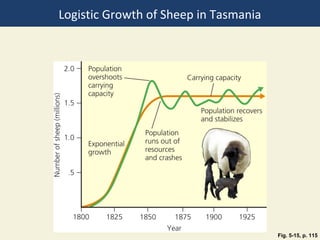
Logistic Growth of Sheep in Tasmania


                                       Fig. 5-15, p. 115
When a Population Exceeds Its Habitat’s
Carrying Capacity, Its Population Can Crash
 • A population exceeds the area’s carrying capacity

 • Reproductive time lag may lead to overshoot
    • Population crash


 • Damage may reduce area’s carrying capacity
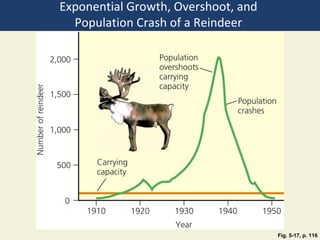
Exponential Growth, Overshoot, and
  Population Crash of a Reindeer


                                     Fig. 5-17, p. 116
Species Have Different Reproductive
            Patterns (1)
• Some species

   •   Many, usually small, offspring
   •   Little or no parental care
   •   Massive deaths of offspring
   •   Insects, bacteria, algae


Tend to grow at exponential rates.
Species Have Different Reproductive
            Patterns (2)
• Other species
  •   Reproduce later in life
  •   Small number of offspring with long life spans
  •   Young offspring grow inside mother
  •   Long time to maturity
  •   Protected by parents, and potentially groups
  •   Humans
  •   Elephants

  Tend to grow at logistic rate.
Under Some Circumstances Population
   Density Affects Population Size
• Density-dependent population controls
  •   Predation
  •   Parasitism
  •   Infectious disease
  •   Competition for resources
Several Different Types of Population
       Change Occur in Nature
• Stable

• Irruptive
   • Population surge, followed by crash

• Cyclic fluctuations, boom-and-bust cycles
   • Top-down population regulation
   • Bottom-up population regulation

• Irregular
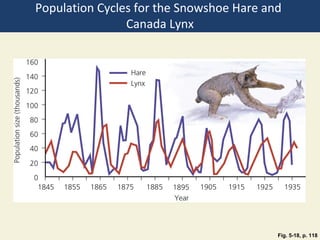
Population Cycles for the Snowshoe Hare and
                Canada Lynx


                                          Fig. 5-18, p. 118
Humans Are Not Exempt from
      Nature’s Population Controls
• Ireland
   • Potato crop in 1845


• Bubonic plague
   • Fourteenth century


• AIDS
   • Global epidemic
Communities and Ecosystems Change over
     Time: Ecological Succession
 • Natural ecological restoration
    • Primary succession-start from nothing
    • Secondary succession-start with cleared soil
Some Ecosystems Start from Scratch:
        Primary Succession
• No soil in a terrestrial system

• No bottom sediment in an aquatic system

• Takes hundreds to thousands of years

• Need to build up soils/sediments to provide
  necessary nutrients
Primary Ecological Succession


                                Fig. 5-19, p. 119
Some Ecosystems Do Not Have to Start from
    Scratch: Secondary Succession (1)
• Some soil remains in a terrestrial system

• Some bottom sediment remains in an aquatic system

• Ecosystem has been
   • Disturbed
   • Removed
   • Destroyed
Natural Ecological Restoration of Disturbed Land


                                             Fig. 5-20, p. 120
Secondary Ecological Succession in Yellowstone Following
                      the 1998 Fire


                                                 Fig. 5-21, p. 120
Some Ecosystems Do Not Have to Start from
    Scratch: Secondary Succession (2)
• Primary and secondary succession
   • Tend to increase biodiversity
   • Increase species richness and interactions among species

• Primary and secondary succession can be interrupted by
   •   Fires
   •   Hurricanes
   •   Clear-cutting of forests
   •   Plowing of grasslands
   •   Invasion by nonnative species
Succession Doesn’t Follow a
            Predictable Path
• Traditional view
   • Balance of nature and a climax community

• Current view
   • Ever-changing mosaic of patches of vegetation
   • Mature late-successional ecosystems
      • State of continual disturbance and change
Three Big Ideas

1. Certain interactions among species affect their use
   of resources and their population sizes.
2. There are always limits to population growth in
   nature.

3. Changes in environmental conditions cause
   communities and ecosystems to gradually alter
   their species composition and population sizes
   (ecological succession).

Bio 105 Chapter 5

  • 1.
    MILLER/SPOOLMAN LIVING IN THEENVIRONMENT 17TH Chapter 5 Biodiversity, Species Interactions, and Population Control
  • 2.
    Core Case Study:Southern Sea Otters: Are They Back from the Brink of Extinction? • Habitat • Hunted: early 1900s • Partial recovery • Why care about sea otters? • Ethics • Tourism dollars • Keystone species
  • 3.
    Southern Sea Otter Fig. 5-1a, p. 104
  • 4.
    Species Interact inFive Major Ways • Interspecific Competition • Predation • Parasitism • Mutualism • Commensalism
  • 5.
    Most Species Competewith One Another for Certain Resources • For limited resources • Ecological niche for exploiting resources • Some niches overlap
  • 6.
    Some Species EvolveWays to Share Resources • Resource partitioning • Using only parts of resource • Using at different times • Using in different ways
  • 7.
    Resource Partitioning AmongWarblers Fig. 5-2, p. 106
  • 8.
    Specialist Species ofHoneycreepers Fig. 5-3, p. 107
  • 9.
    Most Consumer SpeciesFeed on Live Organisms of Other Species (1) • Predators may capture prey by 1. Walking 2. Swimming 3. Flying 4. Pursuit and ambush 5. Camouflage 6. Chemical warfare
  • 10.
  • 11.
    Most Consumer SpeciesFeed on Live Organisms of Other Species (2) • Prey may avoid capture by 1. Run, swim, fly 2. Protection: shells, bark, thorns 3. Camouflage 4. Chemical warfare 5. Warning coloration 6. Mimicry 7. Deceptive looks 8. Deceptive behavior
  • 12.
    Some Ways PreySpecies Avoid Their Predators Fig. 5-5, p. 109
  • 13.
    Some Species Feedoff Other Species by Living on or in Them • Parasitism • Parasite is usually much smaller than the host • Parasite rarely kills the host • Parasite-host interaction may lead to coevolution
  • 14.
    Parasitism: Trout withBlood-Sucking Sea Lamprey Fig. 5-7, p. 110
  • 15.
    In Some Interactions,Both Species Benefit • Mutualism • Nutrition and protection relationship • Gut inhabitant mutualism • Not cooperation: it’s mutual exploitation
  • 16.
    Mutualism: Hummingbird andFlower Fig. 5-8, p. 110
  • 17.
    Mutualism: Oxpeckers CleanRhinoceros; Anemones Protect and Feed Clownfish Fig. 5-9, p. 111
  • 18.
    In Some Interactions,One Species Benefits and the Other Is Not Harmed • Commensalism • Epiphytes • Birds nesting in trees
  • 19.
    Commensalism: Bromiliad Rootson Tree Trunk Without Harming Tree Fig. 5-10, p. 111
  • 20.
    Most Populations LiveTogether in Clumps or Patches (1) • Population: group of interbreeding individuals of the same species • Population distribution 1. Clumping 2. Uniform dispersion 3. Random dispersion
  • 21.
    Most Populations LiveTogether in Clumps or Patches (2) • Why clumping? 1. Species tend to cluster where resources are available 2. Groups have a better chance of finding clumped resources 3. Protects some animals from predators 4. Packs allow some to get prey
  • 22.
    Population of SnowGeese Fig. 5-11, p. 112
  • 23.
  • 24.
    Populations Can Grow,Shrink, or Remain Stable (1) • Population size governed by • Births • Deaths • Immigration • Emigration • Population change = (births + immigration) – (deaths + emigration)
  • 25.
    Populations Can Grow,Shrink, or Remain Stable (2) • Age structure • Pre-reproductive age • Reproductive age • Post-reproductive age
  • 26.
    Some Factors CanLimit Population Size • Range of tolerance • Variations in physical and chemical environment • Limiting factor principle • Too much or too little of any physical or chemical factor can limit or prevent growth of a population, even if all other factors are at or near the optimal range of tolerance • Precipitation • Nutrients • Sunlight, etc
  • 27.
    Trout Tolerance ofTemperature Fig. 5-13, p. 113
  • 28.
    No Population CanGrow Indefinitely: J-Curves and S-Curves (1) • Size of populations controlled by limiting factors: • Light • Water • Space • Nutrients • Exposure to too many competitors, predators or infectious diseases
  • 29.
    No Population CanGrow Indefinitely: J-Curves and S-Curves (2) • Environmental resistance • All factors that act to limit the growth of a population • Carrying capacity (K) • Maximum population a given habitat can sustain
  • 30.
    No Population CanGrow Indefinitely: J-Curves and S-Curves (3) • Exponential growth • Starts slowly, then accelerates to carrying capacity when meets environmental resistance • Logistic growth • Decreased population growth rate as population size reaches carrying capacity
  • 31.
    Logistic Growth ofSheep in Tasmania Fig. 5-15, p. 115
  • 32.
    When a PopulationExceeds Its Habitat’s Carrying Capacity, Its Population Can Crash • A population exceeds the area’s carrying capacity • Reproductive time lag may lead to overshoot • Population crash • Damage may reduce area’s carrying capacity
  • 33.
    Exponential Growth, Overshoot,and Population Crash of a Reindeer Fig. 5-17, p. 116
  • 34.
    Species Have DifferentReproductive Patterns (1) • Some species • Many, usually small, offspring • Little or no parental care • Massive deaths of offspring • Insects, bacteria, algae Tend to grow at exponential rates.
  • 35.
    Species Have DifferentReproductive Patterns (2) • Other species • Reproduce later in life • Small number of offspring with long life spans • Young offspring grow inside mother • Long time to maturity • Protected by parents, and potentially groups • Humans • Elephants Tend to grow at logistic rate.
  • 36.
    Under Some CircumstancesPopulation Density Affects Population Size • Density-dependent population controls • Predation • Parasitism • Infectious disease • Competition for resources
  • 37.
    Several Different Typesof Population Change Occur in Nature • Stable • Irruptive • Population surge, followed by crash • Cyclic fluctuations, boom-and-bust cycles • Top-down population regulation • Bottom-up population regulation • Irregular
  • 38.
    Population Cycles forthe Snowshoe Hare and Canada Lynx Fig. 5-18, p. 118
  • 39.
    Humans Are NotExempt from Nature’s Population Controls • Ireland • Potato crop in 1845 • Bubonic plague • Fourteenth century • AIDS • Global epidemic
  • 40.
    Communities and EcosystemsChange over Time: Ecological Succession • Natural ecological restoration • Primary succession-start from nothing • Secondary succession-start with cleared soil
  • 41.
    Some Ecosystems Startfrom Scratch: Primary Succession • No soil in a terrestrial system • No bottom sediment in an aquatic system • Takes hundreds to thousands of years • Need to build up soils/sediments to provide necessary nutrients
  • 42.
  • 43.
    Some Ecosystems DoNot Have to Start from Scratch: Secondary Succession (1) • Some soil remains in a terrestrial system • Some bottom sediment remains in an aquatic system • Ecosystem has been • Disturbed • Removed • Destroyed
  • 44.
    Natural Ecological Restorationof Disturbed Land Fig. 5-20, p. 120
  • 45.
    Secondary Ecological Successionin Yellowstone Following the 1998 Fire Fig. 5-21, p. 120
  • 46.
    Some Ecosystems DoNot Have to Start from Scratch: Secondary Succession (2) • Primary and secondary succession • Tend to increase biodiversity • Increase species richness and interactions among species • Primary and secondary succession can be interrupted by • Fires • Hurricanes • Clear-cutting of forests • Plowing of grasslands • Invasion by nonnative species
  • 47.
    Succession Doesn’t Followa Predictable Path • Traditional view • Balance of nature and a climax community • Current view • Ever-changing mosaic of patches of vegetation • Mature late-successional ecosystems • State of continual disturbance and change
  • 48.
    Three Big Ideas 1.Certain interactions among species affect their use of resources and their population sizes. 2. There are always limits to population growth in nature. 3. Changes in environmental conditions cause communities and ecosystems to gradually alter their species composition and population sizes (ecological succession).

Editor's Notes

  • #4 Figure 5.1: An endangered southern sea otter in Monterey Bay, California (USA), uses a stone to crack the shell of a clam (left). It lives in a giant kelp bed (right). Scientific studies indicate that the otters act as a keystone species in a kelp forest system by helping to control the populations of sea urchins and other kelp-eating species.
  • #8 Figure 5.2: Sharing the wealth: This diagram illustrates resource partitioning among five species of insect-eating warblers in the spruce forests of the U.S. state of Maine. Each species minimizes competition with the others for food by spending at least half its feeding time in a distinct portion (yellow highlighted areas) of the spruce trees, and by consuming somewhat different insect species. (After R. H. MacArthur, “Population Ecology of Some Warblers in Northeastern Coniferous Forests,” Ecology 36 (1958): 533–536. )
  • #9 Figure 5.3: Specialist species of honeycreepers: Through natural selection, different species of honeycreepers developed specialized ecological niches that reduced competition between these species. Each species has evolved a specialized beak to take advantage of certain types of food resources.
  • #11 Figure 5.4: Predator-prey relationship: This brown bear (the predator) in the U.S. state of Alaska has captured and will feed on this salmon (the prey) .
  • #13 Figure 5.5: These prey species have developed specialized ways to avoid their predators: (a, b) camouflage , (c–e) chemical warfare , (d, e) warning coloration , (f) mimicry , (g) deceptive looks , and (h) deceptive behavior.
  • #17 Figure 5.8: Mutualism: This hummingbird benefits by feeding on nectar in this flower, and it benefits the flower by pollinating it.
  • #20 Figure 5.10: In an example of commensalism , this bromeliad—an epiphyte, or air plant—in Brazil’s Atlantic tropical rain forest roots on the trunk of a tree, rather than in soil, without penetrating or harming the tree. In this interaction, the epiphyte gains access to sunlight, water, and nutrients from the tree’s debris; the tree apparently remains unharmed and gains no benefit.
  • #23 Figure 5.11: This large group of birds is a population, or flock, of snow geese.
  • #24 Figure 5.12: This diagram illustrates three general dispersion patterns for populations. Clumps (a) are the most common dispersion pattern, mostly because resources such as grass and water are usually found in patches. Where such resources are scarce, uniform dispersion (b) is more common. Where they are plentiful, a random dispersion (c) is more likely. Question: Why do you think elephants live in clumps or groups?
  • #28 Figure 5.13: This diagram illustrates the range of tolerance for a population of organisms, such as trout, to a physical environmental factor—in this case, water temperature. Range of tolerance restrictions prevent particular species from taking over an ecosystem by keeping their population size in check. Question: For humans, what is an example of a range of tolerance for a physical environmental factor?
  • #32 Figure 5.15: This graph tracks the logistic growth of a sheep population on the island of Tasmania between 1800 and 1925. After sheep were introduced in 1800, their population grew exponentially, thanks to an ample food supply and few predators. By 1855, they had overshot the land’s carrying capacity. Their numbers then stabilized and fluctuated around a carrying capacity of about 1.6 million sheep.
  • #34 Figure 5.17: This graph tracks the exponential growth, overshoot, and population crash of reindeer introduced onto the small Bering Sea island of St. Paul. When 26 reindeer (24 of them female) were introduced in 1910, lichens, mosses, and other food sources were plentiful. By 1935, the herd size had soared to 2,000, overshooting the island’s carrying capacity. This led to a population crash, when the herd size plummeted to only 8 reindeer by 1950. Question: Why do you think the sizes of some populations level off while others such as the reindeer in this example exceed their carrying capacities and crash?
  • #39 Figure 5.18: This graph represents the population cycles for the snowshoe hare and the Canadian lynx. At one time, scientists believed these curves provided evidence that these predator and prey populations regulated one another. More recent research suggests that the periodic swings in the hare population are caused by a combination of top-down population control —through predation by lynx and other predators—and bottom-up population control , in which changes in the availability of the food supply for hares help to determine their population size, which in turn helps to determine the lynx population size. (Data from D. A. MacLulich)
  • #43 Figure 5.19: Primary ecological succession: Over almost a thousand years, these plant communities developed, starting on bare rock exposed by a retreating glacier on Isle Royal, Michigan (USA) in northern Lake Superior. The details of this process vary from one site to another. Question: What are two ways in which lichens, mosses, and plants might get started growing on bare rock?
  • #45 Figure 5.20: Natural ecological restoration of disturbed land: This diagram shows the undisturbed secondary ecological succession of plant communities on an abandoned farm field in the U.S. state of North Carolina. It took 150–200 years after the farmland was abandoned for the area to become covered with a mature oak and hickory forest. A new disturbance such as deforestation or fire would create conditions favoring pioneer species such as annual weeds. In the absence of new disturbances, secondary succession would recur over time, but not necessarily in the same sequence shown here. See an animation based on this figure at CengageNOW. Questions: Do you think the annual weeds (left) would continue to thrive in the mature forest (right)? Why or why not ?
  • #46 Figure 5.21: These young lodgepole pines growing around standing dead trees after a 1998 forest fire in Yellowstone National Park are an example of secondary ecological succession.