Ecological Design Principles
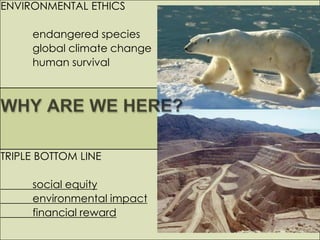
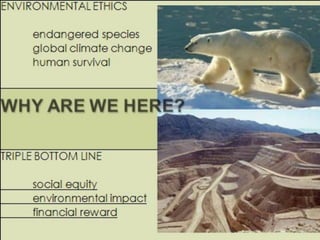
ENVIRONMENTAL ETHICS

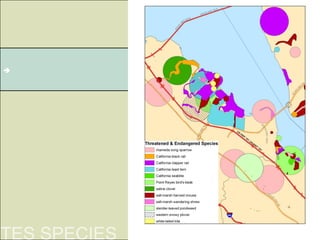
     endangered species
     global climate change
     human survival


TRIPLE BOTTOM LINE

     social equity
     environmental impact
     financial reward
HUMAN CONTEXT
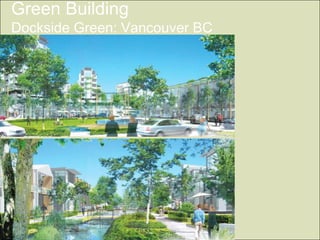
Green Building
Dockside Green: Vancouver BC
Green Building
Dockside Green: Vancouver BC


   Brownfield Site
   Vegetated Architectural Systems
   Sustainable Stormwater Management
   100% Reuse of wastewater for industrial process
   Biodiesel plant on the site; tenants encouraged to use diesel vehicles
   Biomass Energy Generation
   LEED Platinum
   7+ environmental awards
Green Building
Dockside Green: Vancouver BC
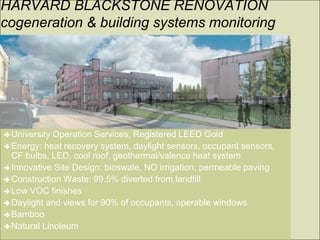
HARVARD BLACKSTONE RENOVATION
cogeneration & building systems monitoring


 University Operation Services, Registered LEED Gold
 Energy: heat recovery system, daylight sensors, occupant sensors,
  CF bulbs, LED, cool roof, geothermal/valence heat system
 Innovative Site Design: bioswale, NO irrigation, permeable paving
 Construction Waste: 99.5% diverted from landfill
 Low VOC finishes
 Daylight and views for 90% of occupants, operable windows
 Bamboo
 Natural Linoleum
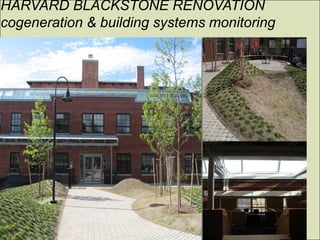
HARVARD BLACKSTONE RENOVATION
cogeneration & building systems monitoring
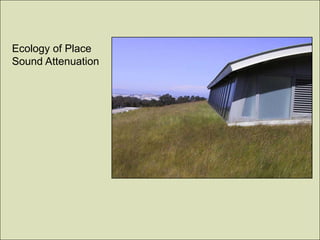
Ecology of Place
Sound Attenuation
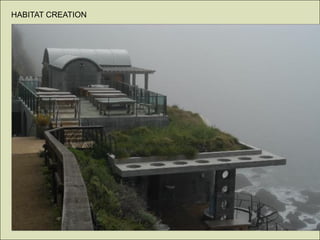
HABITAT CREATION
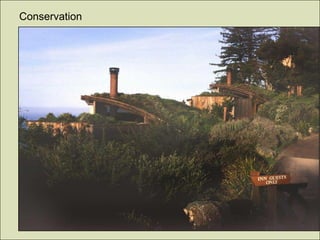
Conservation
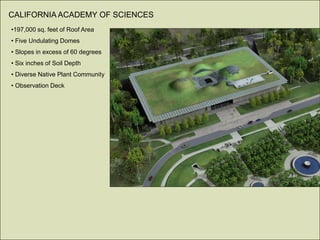
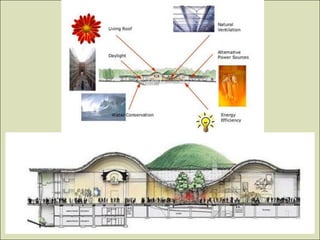
CALIFORNIA ACADEMY OF SCIENCES
•197,000 sq. feet of Roof Area
• Five Undulating Domes
• Slopes in excess of 60 degrees
• Six inches of Soil Depth
• Diverse Native Plant Community
• Observation Deck
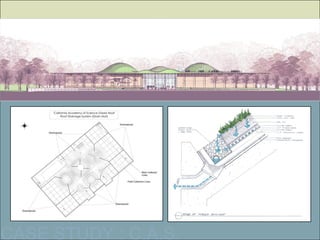
CASE STUDY : C.A.S.

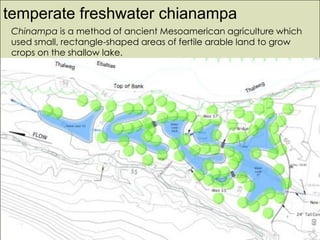
temperate freshwater chianampa
 Chinampa is a method of ancient Mesoamerican agriculture which
 used small, rectangle-shaped areas of fertile arable land to grow
 crops on the shallow lake.
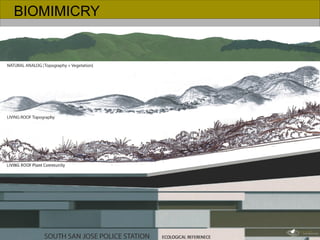
BIOMIMICRY
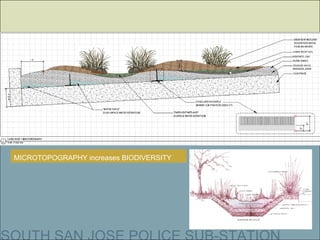
MICROTOPOGRAPHY increases BIODIVERSITY
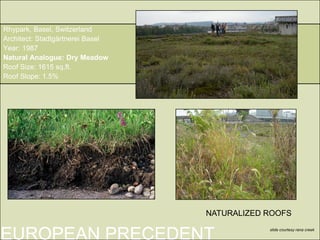
Rhypark, Basel, Switzerland
Architect: Stadtgärtnerei Basel
Year: 1987
Natural Analogue: Dry Meadow
Roof Size: 1615 sq.ft.
Roof Slope: 1.5%


                                  NATURALIZED ROOFS

EUROPEAN PRECEDENT                            slide courtesy rana creek
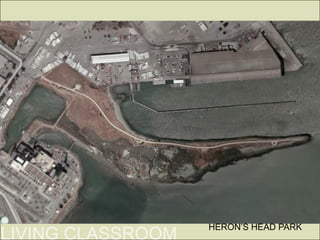
HERON’S HEAD PARK
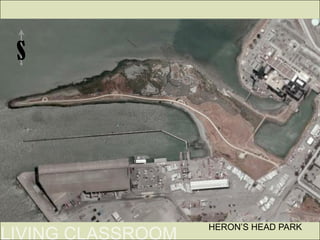
S


    HERON’S HEAD PARK
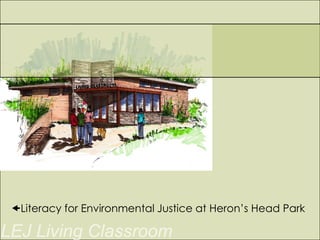
Literacy for Environmental Justice at Heron’s Head Park
NATIVE SYSTEMS
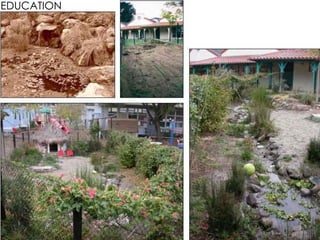
EDUCATION
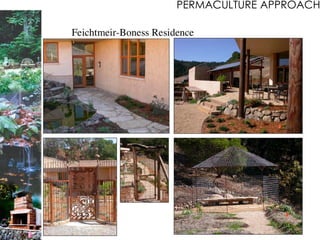
PERMACULTURE APPROACH
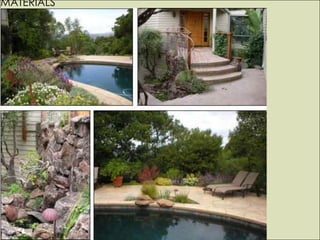
MATERIALS
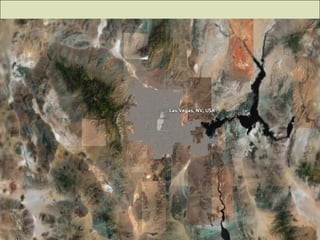
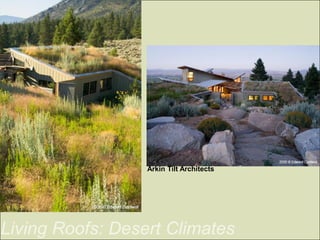
Living Roofs-Desert Climates
Arkin Tilt Architects
ECOLOGICAL DESIGN PRINCIPLES
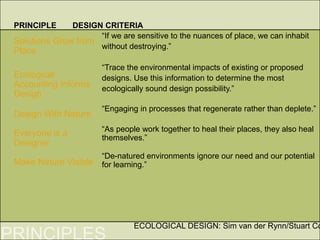
PRINCIPLE     DESIGN CRITERIA
                    “If we are sensitive to the nuances of place, we can inhabit
Solutions Grow from
                    without destroying.”
Place
                       “Trace the environmental impacts of existing or proposed
Ecological             designs. Use this information to determine the most
Accounting Informs     ecologically sound design possibility.”
Design
                       “Engaging in processes that regenerate rather than deplete.”
Design With Nature
                       “As people work together to heal their places, they also heal
Everyone is a          themselves.”
Designer
                       “De-natured environments ignore our need and our potential
Make Nature Visible for learning.”


                                ECOLOGICAL DESIGN: Sim van der Rynn/Stuart Co
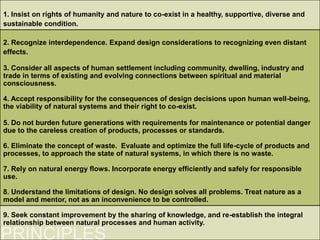
1. Insist on rights of humanity and nature to co-exist in a healthy, supportive, diverse and
sustainable condition.

2. Recognize interdependence. Expand design considerations to recognizing even distant
effects.

3. Consider all aspects of human settlement including community, dwelling, industry and
trade in terms of existing and evolving connections between spiritual and material
consciousness.

4. Accept responsibility for the consequences of design decisions upon human well-being,
the viability of natural systems and their right to co-exist.

5. Do not burden future generations with requirements for maintenance or potential danger
due to the careless creation of products, processes or standards.

6. Eliminate the concept of waste. Evaluate and optimize the full life-cycle of products and
processes, to approach the state of natural systems, in which there is no waste.

7. Rely on natural energy flows. Incorporate energy efficiently and safely for responsible
use.

8. Understand the limitations of design. No design solves all problems. Treat nature as a
model and mentor, not as an inconvenience to be controlled.
9. Seek constant improvement by the sharing of knowledge, and re-establish the integral
relationship between natural processes and human activity.
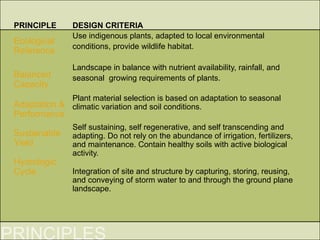
PRINCIPLE      DESIGN CRITERIA
               Use indigenous plants, adapted to local environmental
Ecological
               conditions, provide wildlife habitat.
Reference
               Landscape in balance with nutrient availability, rainfall, and
Balanced       seasonal growing requirements of plants.
Capacity
             Plant material selection is based on adaptation to seasonal
Adaptation & climatic variation and soil conditions.
Performance
               Self sustaining, self regenerative, and self transcending and
Sustainable    adapting. Do not rely on the abundance of irrigation, fertilizers,
Yield          and maintenance. Contain healthy soils with active biological
               activity.
Hydrologic
Cycle          Integration of site and structure by capturing, storing, reusing,
               and conveying of storm water to and through the ground plane
               landscape.
Special Thanks to the following
      for Photos and Design Principles

ECOLOGICAL DESIGN: Josiah Cain

ECOLOGICAL DESIGN: Sim van der Rynn/Stuart Cowen
RANA CREEK: Paul Kephart/Restoration View

HANOVER PRINCIPLES: Wm. McDonough

Ecological design principles

  • 1.
  • 2.
    ENVIRONMENTAL ETHICS endangered species global climate change human survival TRIPLE BOTTOM LINE social equity environmental impact financial reward
  • 3.
  • 5.
  • 6.
    Green Building Dockside Green:Vancouver BC  Brownfield Site  Vegetated Architectural Systems  Sustainable Stormwater Management  100% Reuse of wastewater for industrial process  Biodiesel plant on the site; tenants encouraged to use diesel vehicles  Biomass Energy Generation  LEED Platinum  7+ environmental awards
  • 7.
  • 8.
    HARVARD BLACKSTONE RENOVATION cogeneration& building systems monitoring  University Operation Services, Registered LEED Gold  Energy: heat recovery system, daylight sensors, occupant sensors, CF bulbs, LED, cool roof, geothermal/valence heat system  Innovative Site Design: bioswale, NO irrigation, permeable paving  Construction Waste: 99.5% diverted from landfill  Low VOC finishes  Daylight and views for 90% of occupants, operable windows  Bamboo  Natural Linoleum
  • 9.
    HARVARD BLACKSTONE RENOVATION cogeneration& building systems monitoring
  • 10.
  • 11.
  • 12.
  • 13.
    CALIFORNIA ACADEMY OFSCIENCES •197,000 sq. feet of Roof Area • Five Undulating Domes • Slopes in excess of 60 degrees • Six inches of Soil Depth • Diverse Native Plant Community • Observation Deck
  • 15.
  • 16.
  • 17.
    temperate freshwater chianampa Chinampa is a method of ancient Mesoamerican agriculture which used small, rectangle-shaped areas of fertile arable land to grow crops on the shallow lake.
  • 18.
  • 19.
  • 20.
    Rhypark, Basel, Switzerland Architect:Stadtgärtnerei Basel Year: 1987 Natural Analogue: Dry Meadow Roof Size: 1615 sq.ft. Roof Slope: 1.5% NATURALIZED ROOFS EUROPEAN PRECEDENT slide courtesy rana creek
  • 21.
  • 22.
    S HERON’S HEAD PARK
  • 23.
    Literacy for EnvironmentalJustice at Heron’s Head Park
  • 25.
  • 26.
  • 28.
  • 30.
  • 31.
  • 32.
  • 33.
  • 34.
    PRINCIPLE DESIGN CRITERIA “If we are sensitive to the nuances of place, we can inhabit Solutions Grow from without destroying.” Place “Trace the environmental impacts of existing or proposed Ecological designs. Use this information to determine the most Accounting Informs ecologically sound design possibility.” Design “Engaging in processes that regenerate rather than deplete.” Design With Nature “As people work together to heal their places, they also heal Everyone is a themselves.” Designer “De-natured environments ignore our need and our potential Make Nature Visible for learning.” ECOLOGICAL DESIGN: Sim van der Rynn/Stuart Co
  • 35.
    1. Insist onrights of humanity and nature to co-exist in a healthy, supportive, diverse and sustainable condition. 2. Recognize interdependence. Expand design considerations to recognizing even distant effects. 3. Consider all aspects of human settlement including community, dwelling, industry and trade in terms of existing and evolving connections between spiritual and material consciousness. 4. Accept responsibility for the consequences of design decisions upon human well-being, the viability of natural systems and their right to co-exist. 5. Do not burden future generations with requirements for maintenance or potential danger due to the careless creation of products, processes or standards. 6. Eliminate the concept of waste. Evaluate and optimize the full life-cycle of products and processes, to approach the state of natural systems, in which there is no waste. 7. Rely on natural energy flows. Incorporate energy efficiently and safely for responsible use. 8. Understand the limitations of design. No design solves all problems. Treat nature as a model and mentor, not as an inconvenience to be controlled. 9. Seek constant improvement by the sharing of knowledge, and re-establish the integral relationship between natural processes and human activity.
  • 36.
    PRINCIPLE DESIGN CRITERIA Use indigenous plants, adapted to local environmental Ecological conditions, provide wildlife habitat. Reference Landscape in balance with nutrient availability, rainfall, and Balanced seasonal growing requirements of plants. Capacity Plant material selection is based on adaptation to seasonal Adaptation & climatic variation and soil conditions. Performance Self sustaining, self regenerative, and self transcending and Sustainable adapting. Do not rely on the abundance of irrigation, fertilizers, Yield and maintenance. Contain healthy soils with active biological activity. Hydrologic Cycle Integration of site and structure by capturing, storing, reusing, and conveying of storm water to and through the ground plane landscape.
  • 38.
    Special Thanks tothe following for Photos and Design Principles ECOLOGICAL DESIGN: Josiah Cain ECOLOGICAL DESIGN: Sim van der Rynn/Stuart Cowen RANA CREEK: Paul Kephart/Restoration View HANOVER PRINCIPLES: Wm. McDonough