POPULATION ECOLOGY
MEGHA GUPTA
JYOTSNA KAPOOR
What is ECOLOGY ?
• Ecology – study of all relationships among
organisms and their abiotic environment
• Population- all the members of particular species
that live together in the same area at the same
time.
• Community – all the populations of different
species that live together in the same area
• Ecosystem – a community and its environment
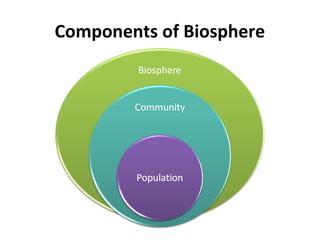
• Biosphere – global ecological system comprises
all the communities on earth & includes all
interactions among different communities &
earth’s atmosphere, lithosphere and
hydrosphere.
Components of Biosphere
POPULATION ECOLOGY ????
• Branch of biology that deals with
the number of individuals of a
particular species that are found
in an area & how and why those
numbers change over time.
Attributes of a Population
1.1. Natality/ Birth RateNatality/ Birth Rate : ratio of live births in an
area to the population of an area
2.2. Mortality/ Death RateMortality/ Death Rate : ratio of deaths in an
area to the population of an area
3.3. Population Density :Population Density : number of individuals of
a population present per unit area at a given
time
4.4. Sex RatioSex Ratio : number of females or males per
thousand individuals
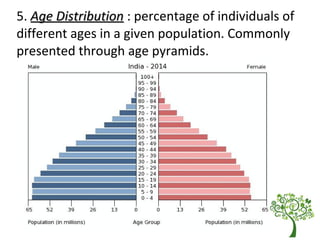
5. Age DistributionAge Distribution : percentage of individuals of
different ages in a given population. Commonly
presented through age pyramids.
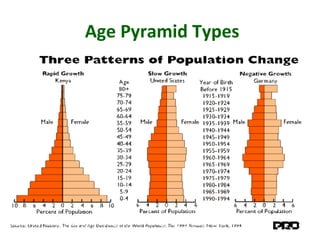
Age Pyramid Types
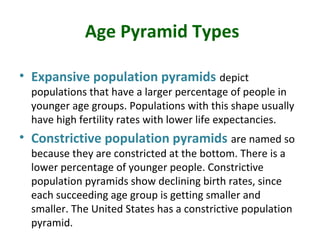
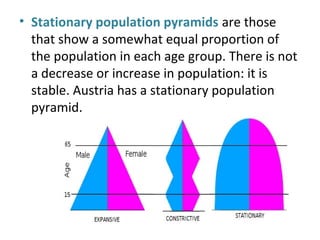
• Expansive population pyramids depict
populations that have a larger percentage of people in
younger age groups. Populations with this shape usually
have high fertility rates with lower life expectancies.
• Constrictive population pyramids are named so
because they are constricted at the bottom. There is a
lower percentage of younger people. Constrictive
population pyramids show declining birth rates, since
each succeeding age group is getting smaller and
smaller. The United States has a constrictive population
pyramid.
• Stationary population pyramids are those
that show a somewhat equal proportion of
the population in each age group. There is not
a decrease or increase in population: it is
stable. Austria has a stationary population
pyramid.
Age Pyramid Types
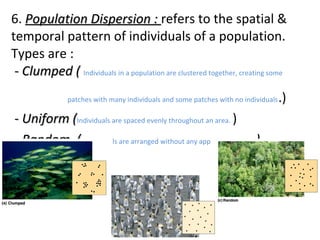
6. Population Dispersion :Population Dispersion : refers to the spatial &
temporal pattern of individuals of a population.
Types are :
- Clumped (- Clumped ( Individuals in a population are clustered together, creating some
patches with many individuals and some patches with no individuals.)
- Uniform (- Uniform (Individuals are spaced evenly throughout an area. )
- Random (- Random ( Individuals are arranged without any apparent pattern ))
Population Dispersal
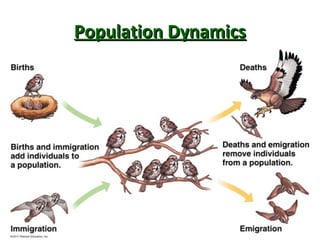
• The movement of individuals into or out of the
population or the population area.
EMIGRATION – one way outward movement of individuals from an area.
IMMIGRATION – one way inward movement of individuals into an area.
MIGRATION – periodic departure & return of individuals to same area.
• Population size is affected by :
- No. of births (b)
- No. of deaths (d)
- Immigrants (i)
- Emigrants (e)
• Growth Rate of Population (r) :
a)rate of change in size [r = b – d]
b) population ↑’s in size as long as b>d
c) r= (b-d) +(i-e) { when migration is a factor}
PopulationPopulation DynamicsDynamics
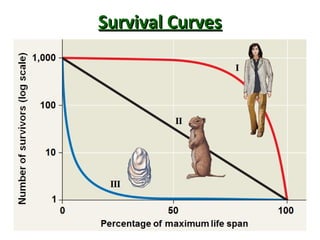
Survivorship Curves
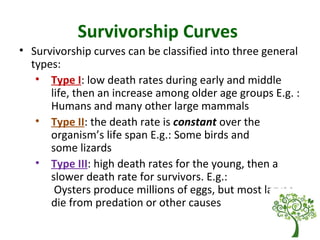
• Survivorship curves can be classified into three general
types:
• Type I: low death rates during early and middle
life, then an increase among older age groups E.g. :
Humans and many other large mammals
• Type II: the death rate is constant over the
organism’s life span E.g.: Some birds and
some lizards
• Type III: high death rates for the young, then a
slower death rate for survivors. E.g.:
Oysters produce millions of eggs, but most larvae
die from predation or other causes
Survival CurvesSurvival Curves
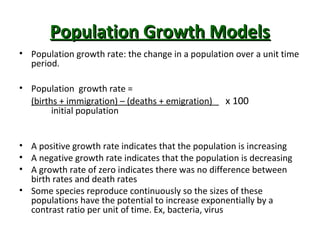
Population Growth ModelsPopulation Growth Models
• Population growth rate: the change in a population over a unit time
period.
• Population growth rate =
(births + immigration) – (deaths + emigration) x 100
initial population
• A positive growth rate indicates that the population is increasing
• A negative growth rate indicates that the population is decreasing
• A growth rate of zero indicates there was no difference between
birth rates and death rates
• Some species reproduce continuously so the sizes of these
populations have the potential to increase exponentially by a
contrast ratio per unit of time. Ex, bacteria, virus
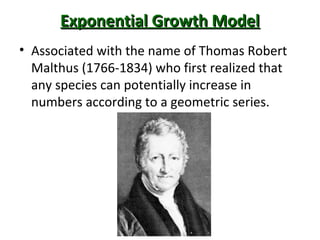
Exponential Growth ModelExponential Growth Model
• Associated with the name of Thomas Robert
Malthus (1766-1834) who first realized that
any species can potentially increase in
numbers according to a geometric series.
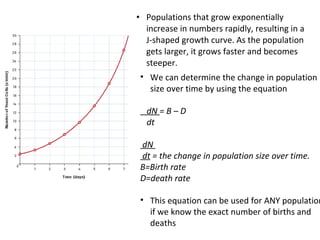
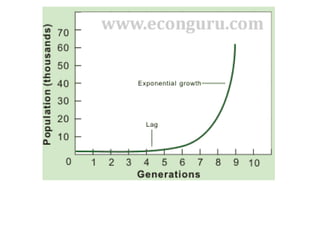
• Populations that grow exponentially
increase in numbers rapidly, resulting in a
J-shaped growth curve. As the population
gets larger, it grows faster and becomes
steeper.
• We can determine the change in population
size over time by using the equation
dN = B – D
dt
dN
dt = the change in population size over time.
B=Birth rate
D=death rate
• This equation can be used for ANY population
if we know the exact number of births and
deaths
Limitations
• Environmental limitations prevent populations
from experiencing continuous growth
• Per capita birth rate decrease and the per
capita death rate increases as competition for
resources such as food and shelter occurs
Large sudden birth rates in Canada due to
breeding periods (frogs reproduce in fixed
intervals) not continuously
Logistic Growth Model
• Environmental limitations create this model. It describes limited
population growth, often due to limited resources or predation.
• An environment only provides enough resources to sustain only a
limited amount of any species.
• The maximum number of individuals that an environment can
support indefinitely is its carrying capacity (K).
• N=population size
• If a population is very small then plenty of resources are available
and therefore the value of (K-N)/K is close to 1.
• Vice versa, if the population is large, few resources are available and
the value of (K-N)/K is small and the per capita growth rate is very
low.
• Lastly, if the size of the population exceeds the carrying capacity of
the habitat then the population would decrease from lack of food
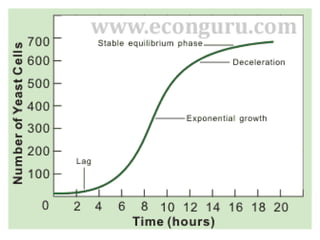
and other resources. If this is graphed it produces an S shape curve.
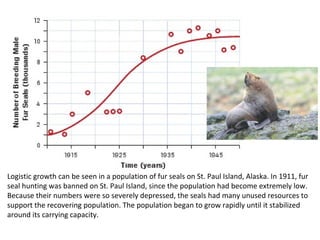
Logistic growth can be seen in a population of fur seals on St. Paul Island, Alaska. In 1911, fur
seal hunting was banned on St. Paul Island, since the population had become extremely low.
Because their numbers were so severely depressed, the seals had many unused resources to
support the recovering population. The population began to grow rapidly until it stabilized
around its carrying capacity.
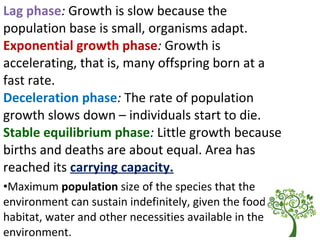
Lag phase: Growth is slow because the
population base is small, organisms adapt.
Exponential growth phase: Growth is
accelerating, that is, many offspring born at a
fast rate.
Deceleration phase: The rate of population
growth slows down – individuals start to die.
Stable equilibrium phase: Little growth because
births and deaths are about equal. Area has
reached its carrying capacity.
•Maximum population size of the species that the
environment can sustain indefinitely, given the food,
habitat, water and other necessities available in the
environment.
• The logistic population growth model and
life histories.
– This model predicts different growth rates for
different populations, relative to carrying
capacity.
• Resource availability depends on the situation.
• The life history traits that natural selection favors may
vary with population density and environmental
conditions.
• In K-selection, organisms live and reproduce around
K, and are sensitive to population density.
• In r-selection, organisms exhibit high rates of
reproduction and occur in variable environments in
which population densities fluctuate well below K.
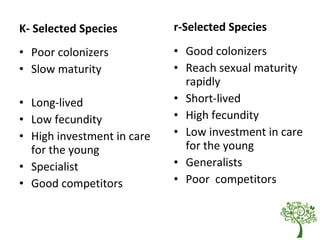
K- Selected Species
• Good colonizers
• Reach sexual maturity
rapidly
• Short-lived
• High fecundity
• Low investment in care
for the young
• Generalists
• Poor competitors
r-Selected Species
• Poor colonizers
• Slow maturity
• Long-lived
• Low fecundity
• High investment in care
for the young
• Specialist
• Good competitors
Factors that influence and
regulate population growth
• There are two general questions about
regulation of population growth:
• What environmental factors stop a
population from growing indefinitely?
• Why do some populations show radical
fluctuations in size over time, while others
remain stable?
Factors that influence and regulate
population growth : density
• Density dependent factors :
 competition for resources,
 territoriality,
 disease,
 predation,
 toxic wastes, and
 intrinsic factors
• Density independent factors :
 Environmental factors ; ex:
hurricanes, fires etc
Density Dependent Factors
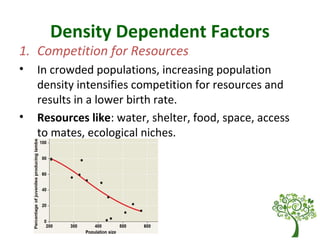
1. Competition for Resources
• In crowded populations, increasing population
density intensifies competition for resources and
results in a lower birth rate.
• Resources like: water, shelter, food, space, access
to mates, ecological niches.
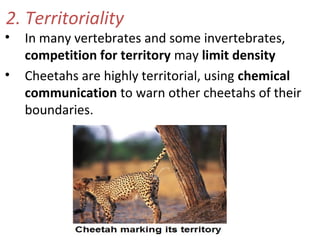
2. Territoriality
• In many vertebrates and some invertebrates,
competition for territory may limit density
• Cheetahs are highly territorial, using chemical
communication to warn other cheetahs of their
boundaries.
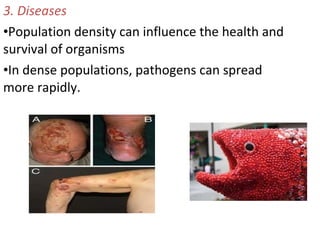
3. Diseases
•Population density can influence the health and
survival of organisms
•In dense populations, pathogens can spread
more rapidly.
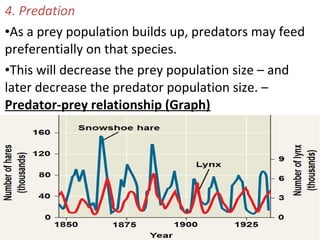
4. Predation
•As a prey population builds up, predators may feed
preferentially on that species.
•This will decrease the prey population size – and
later decrease the predator population size. –
Predator-prey relationship (Graph)
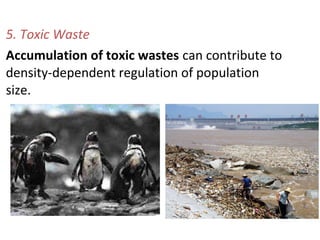
5. Toxic Waste
Accumulation of toxic wastes can contribute to
density-dependent regulation of population
size.
6. Intrinsic / Physiological Factors
For some populations, intrinsic (physiological) factors
appear to regulate population size.
Population ecologyy

Population ecologyy

  • 1.
  • 2.
    What is ECOLOGY? • Ecology – study of all relationships among organisms and their abiotic environment • Population- all the members of particular species that live together in the same area at the same time. • Community – all the populations of different species that live together in the same area • Ecosystem – a community and its environment • Biosphere – global ecological system comprises all the communities on earth & includes all interactions among different communities & earth’s atmosphere, lithosphere and hydrosphere.
  • 3.
  • 4.
    POPULATION ECOLOGY ???? •Branch of biology that deals with the number of individuals of a particular species that are found in an area & how and why those numbers change over time.
  • 5.
    Attributes of aPopulation 1.1. Natality/ Birth RateNatality/ Birth Rate : ratio of live births in an area to the population of an area 2.2. Mortality/ Death RateMortality/ Death Rate : ratio of deaths in an area to the population of an area 3.3. Population Density :Population Density : number of individuals of a population present per unit area at a given time 4.4. Sex RatioSex Ratio : number of females or males per thousand individuals
  • 6.
    5. Age DistributionAgeDistribution : percentage of individuals of different ages in a given population. Commonly presented through age pyramids.
  • 7.
    Age Pyramid Types •Expansive population pyramids depict populations that have a larger percentage of people in younger age groups. Populations with this shape usually have high fertility rates with lower life expectancies. • Constrictive population pyramids are named so because they are constricted at the bottom. There is a lower percentage of younger people. Constrictive population pyramids show declining birth rates, since each succeeding age group is getting smaller and smaller. The United States has a constrictive population pyramid.
  • 8.
    • Stationary populationpyramids are those that show a somewhat equal proportion of the population in each age group. There is not a decrease or increase in population: it is stable. Austria has a stationary population pyramid.
  • 9.
  • 10.
    6. Population Dispersion:Population Dispersion : refers to the spatial & temporal pattern of individuals of a population. Types are : - Clumped (- Clumped ( Individuals in a population are clustered together, creating some patches with many individuals and some patches with no individuals.) - Uniform (- Uniform (Individuals are spaced evenly throughout an area. ) - Random (- Random ( Individuals are arranged without any apparent pattern ))
  • 11.
    Population Dispersal • Themovement of individuals into or out of the population or the population area. EMIGRATION – one way outward movement of individuals from an area. IMMIGRATION – one way inward movement of individuals into an area. MIGRATION – periodic departure & return of individuals to same area. • Population size is affected by : - No. of births (b) - No. of deaths (d) - Immigrants (i) - Emigrants (e) • Growth Rate of Population (r) : a)rate of change in size [r = b – d] b) population ↑’s in size as long as b>d c) r= (b-d) +(i-e) { when migration is a factor}
  • 12.
  • 13.
    Survivorship Curves • Survivorshipcurves can be classified into three general types: • Type I: low death rates during early and middle life, then an increase among older age groups E.g. : Humans and many other large mammals • Type II: the death rate is constant over the organism’s life span E.g.: Some birds and some lizards • Type III: high death rates for the young, then a slower death rate for survivors. E.g.: Oysters produce millions of eggs, but most larvae die from predation or other causes
  • 14.
  • 15.
    Population Growth ModelsPopulationGrowth Models • Population growth rate: the change in a population over a unit time period. • Population growth rate = (births + immigration) – (deaths + emigration) x 100 initial population • A positive growth rate indicates that the population is increasing • A negative growth rate indicates that the population is decreasing • A growth rate of zero indicates there was no difference between birth rates and death rates • Some species reproduce continuously so the sizes of these populations have the potential to increase exponentially by a contrast ratio per unit of time. Ex, bacteria, virus
  • 16.
    Exponential Growth ModelExponentialGrowth Model • Associated with the name of Thomas Robert Malthus (1766-1834) who first realized that any species can potentially increase in numbers according to a geometric series.
  • 17.
    • Populations thatgrow exponentially increase in numbers rapidly, resulting in a J-shaped growth curve. As the population gets larger, it grows faster and becomes steeper. • We can determine the change in population size over time by using the equation dN = B – D dt dN dt = the change in population size over time. B=Birth rate D=death rate • This equation can be used for ANY population if we know the exact number of births and deaths
  • 19.
    Limitations • Environmental limitationsprevent populations from experiencing continuous growth • Per capita birth rate decrease and the per capita death rate increases as competition for resources such as food and shelter occurs Large sudden birth rates in Canada due to breeding periods (frogs reproduce in fixed intervals) not continuously
  • 20.
    Logistic Growth Model •Environmental limitations create this model. It describes limited population growth, often due to limited resources or predation. • An environment only provides enough resources to sustain only a limited amount of any species. • The maximum number of individuals that an environment can support indefinitely is its carrying capacity (K). • N=population size • If a population is very small then plenty of resources are available and therefore the value of (K-N)/K is close to 1. • Vice versa, if the population is large, few resources are available and the value of (K-N)/K is small and the per capita growth rate is very low. • Lastly, if the size of the population exceeds the carrying capacity of the habitat then the population would decrease from lack of food and other resources. If this is graphed it produces an S shape curve.
  • 21.
    Logistic growth canbe seen in a population of fur seals on St. Paul Island, Alaska. In 1911, fur seal hunting was banned on St. Paul Island, since the population had become extremely low. Because their numbers were so severely depressed, the seals had many unused resources to support the recovering population. The population began to grow rapidly until it stabilized around its carrying capacity.
  • 23.
    Lag phase: Growthis slow because the population base is small, organisms adapt. Exponential growth phase: Growth is accelerating, that is, many offspring born at a fast rate. Deceleration phase: The rate of population growth slows down – individuals start to die. Stable equilibrium phase: Little growth because births and deaths are about equal. Area has reached its carrying capacity. •Maximum population size of the species that the environment can sustain indefinitely, given the food, habitat, water and other necessities available in the environment.
  • 24.
    • The logisticpopulation growth model and life histories. – This model predicts different growth rates for different populations, relative to carrying capacity. • Resource availability depends on the situation. • The life history traits that natural selection favors may vary with population density and environmental conditions. • In K-selection, organisms live and reproduce around K, and are sensitive to population density. • In r-selection, organisms exhibit high rates of reproduction and occur in variable environments in which population densities fluctuate well below K.
  • 25.
    K- Selected Species •Good colonizers • Reach sexual maturity rapidly • Short-lived • High fecundity • Low investment in care for the young • Generalists • Poor competitors r-Selected Species • Poor colonizers • Slow maturity • Long-lived • Low fecundity • High investment in care for the young • Specialist • Good competitors
  • 26.
    Factors that influenceand regulate population growth • There are two general questions about regulation of population growth: • What environmental factors stop a population from growing indefinitely? • Why do some populations show radical fluctuations in size over time, while others remain stable?
  • 27.
    Factors that influenceand regulate population growth : density • Density dependent factors :  competition for resources,  territoriality,  disease,  predation,  toxic wastes, and  intrinsic factors • Density independent factors :  Environmental factors ; ex: hurricanes, fires etc
  • 28.
    Density Dependent Factors 1.Competition for Resources • In crowded populations, increasing population density intensifies competition for resources and results in a lower birth rate. • Resources like: water, shelter, food, space, access to mates, ecological niches.
  • 29.
    2. Territoriality • Inmany vertebrates and some invertebrates, competition for territory may limit density • Cheetahs are highly territorial, using chemical communication to warn other cheetahs of their boundaries.
  • 30.
    3. Diseases •Population densitycan influence the health and survival of organisms •In dense populations, pathogens can spread more rapidly.
  • 31.
    4. Predation •As aprey population builds up, predators may feed preferentially on that species. •This will decrease the prey population size – and later decrease the predator population size. – Predator-prey relationship (Graph)
  • 32.
    5. Toxic Waste Accumulationof toxic wastes can contribute to density-dependent regulation of population size.
  • 33.
    6. Intrinsic /Physiological Factors For some populations, intrinsic (physiological) factors appear to regulate population size.