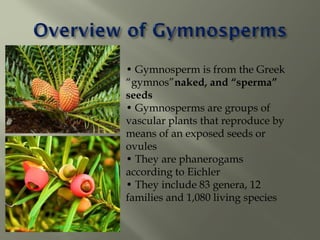
• Gymnosperm is from the Greek
“gymnos”naked, and “sperma”
seeds
• Gymnosperms are groups of
vascular plants that reproduce by
means of an exposed seeds or
ovules
• They are phanerogams
according to Eichler
• They include 83 genera, 12
families and 1,080 living species
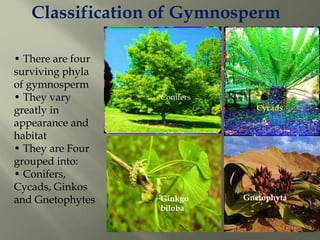
• There are four
surviving phyla
of gymnosperm
• They vary
greatly in
appearance and
habitat
• They are Four
grouped into:
• Conifers,
Cycads, Ginkos
and Gnetophytes
Cycads
Conifers
Cycads
Ginkgo
biloba
Classification of Gymnosperm
Gnetophyta
Characteristics of Gymnosperm
• Most gymnosperms are evergreen with a small
percentage that tends to be
deciduous
• Most are trees (woody stem) Eg: redwood A few are
shrubs
• Seeds are not borne on flower or in fruit as
angiosperms
• They are paraphyletic taxonomically
• They have a root system similar to a dicot stem
• Also called spermatophytes
• Most possess needle- like leaves
• Have vascular tissues
• Tracheids (are present in all) and vessel elements
(present only in gnetophytes
• They have cone as their reproductive structure
(strobili-strobilus)
• Two types of cones: pollen cone (pollen) and ovulate
cones (eggs)
• They form spores: micro-megaspores are produced by
sporophyte generation
• These gymnosperms include the tallest and oldest
trees
General Characteristics: Habitat
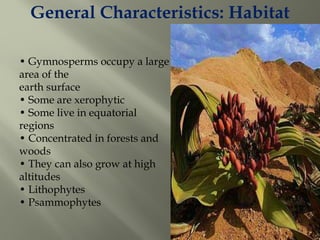
• Gymnosperms occupy a large
area of the
earth surface
• Some are xerophytic
• Some live in equatorial
regions
• Concentrated in forests and
woods
• They can also grow at high
altitudes
• Lithophytes
• Psammophytes
Reproduction In Gymnosperms
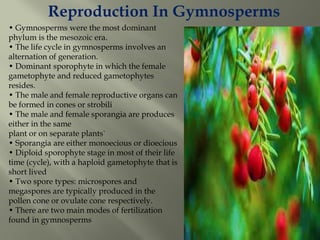
• Gymnosperms were the most dominant
phylum is the mesozoic era.
• The life cycle in gymnosperms involves an
alternation of generation.
• Dominant sporophyte in which the female
gametophyte and reduced gametophytes
resides.
• The male and female reproductive organs can
be formed in cones or strobili
• The male and female sporangia are produces
either in the same
plant or on separate plants`
• Sporangia are either monoecious or dioecious
• Diploid sporophyte stage in most of their life
time (cycle), with a haploid gametophyte that is
short lived
• Two spore types: microspores and
megaspores are typically produced in the
pollen cone or ovulate cone respectively.
• There are two main modes of fertilization
found in gymnosperms
Importance of Gymnosperms
Food Value
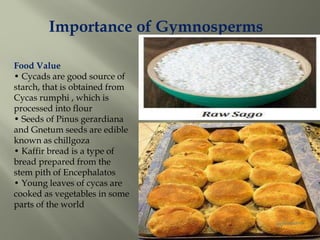
• Cycads are good source of
starch, that is obtained from
Cycas rumphi , which is
processed into flour
• Seeds of Pinus gerardiana
and Gnetum seeds are edible
known as chillgoza
• Kaffir bread is a type of
bread prepared from the
stem pith of Encephalatos
• Young leaves of cycas are
cooked as vegetables in some
parts of the world
Medicinal value
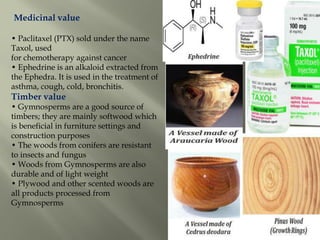
• Paclitaxel (PTX) sold under the name
Taxol, used
for chemotherapy against cancer
• Ephedrine is an alkaloid extracted from
the Ephedra. It is used in the treatment of
asthma, cough, cold, bronchitis.
Timber value
• Gymnosperms are a good source of
timbers; they are mainly softwood which
is beneficial in furniture settings and
construction purposes
• The woods from conifers are resistant
to insects and fungus
• Woods from Gymnosperms are also
durable and of light weight
• Plywood and other scented woods are
all products processed from
Gymnosperms
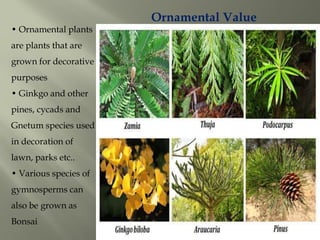
Ornamental Value
• Ornamental plants
are plants that are
grown for decorative
purposes
• Ginkgo and other
pines, cycads and
Gnetum species used
in decoration of
lawn, parks etc..
• Various species of
gymnosperms can
also be grown as
Bonsai
In Conclusion:
• Gymnosperms are under the group sub group of plants
called the phanerogams
• They are non-flowering, but seed bearing.
• That they are photosynthetic in nature.
• Cycads, conifers, ginkos and gnetophytes are four
groups of plants that are closely related, which forms the
four main categories of gymnosperm.
• These categories of plants are useful to mankind both in
medicine, food, and the
ecosystem.
Reference
• Nabor, Murray W., INTRODUCTION TO BOTANY, Copyright
2004 Pearson Education, Inc., publishing as Benjamin Cummings,
1301 Sansome St., San Francisco, CA 94111
•www.khanacademy.org/science/biology/gymnosperms-
inplants/ discussion/--c3-c4-andcycads/conifers-gneptosida--
andplants- agriculture
•http://www.svenlandrein.com/systematiccoursepages/gymno
•‘Always learn
to be a smart
student’
-Mr. Fasama
H. Kollie
Thanku