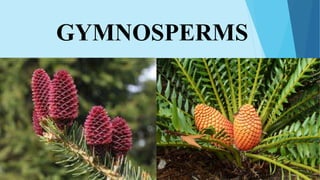
GYMNOSPERMS
Gymnosperms are a group of seed-
producing plants that are characterized by
their "naked" seeds, meaning that the seeds
are not enclosed in a fruit but are typically
borne on the surface of cones or other
structures.
They represent one of the major groups of
vascular plants and have been around for
hundreds of millions of years.
Diversity:
Gymnosperms are a diverse group that
includes about 1,000 species, organized into
four main orders: Coniferales (conifers),
Cycadales (cycads), Ginkgoales (ginkgoes), and
Gnetales (a small group including Ephedra and
others).
Cone-Bearing:
Gymnosperms are often referred to as
cone-bearing plants because they
produce reproductive structures in the
form of cones.
These cones can be male (pollen cones)
or female (seed cones).
Naked Seeds:
Gymnosperms have seeds that are not
enclosed within a fruit.
This distinguishes them from
angiosperms (flowering plants) whose
seeds are enclosed within fruits.
Conifers:
The conifers are the most well-known
group of gymnosperms. They include
familiar trees like pines, spruces, firs,
and cedars.
Conifers are typically evergreen and
have needle-like or scale-like leaves.
Cycads:
Cycads are a group of gymnosperms with a
tropical and subtropical distribution.
They have palm-like leaves and are known
for their distinctive appearance.
They are often considered living fossils and
have a long evolutionary history.
Ginkgoes:
The ginkgo is a unique gymnosperm
species that is known for its
distinctive fan-shaped leaves.
It is the only surviving species in its
order, and it is often planted as an
ornamental tree in urban areas.
Gnetophytes:
This group includes the Ephedra
plants, which are used for various
purposes in traditional medicine, and
the Welwitschia, a bizarre-looking
plant found in deserts.
Heterosporous:
Gymnosperms are heterosporous,
meaning they produce two types of
spores: microspores (male) and
megaspores (female).
These spores develop into the male and
female gametophytes, respectively.
Wind Pollination:
Gymnosperms are typically wind-
pollinated, which means that they do
not rely on animals to transfer pollen.
This method of pollination is less
efficient than insect pollination, which
is more common in angiosperms.
Economic and Ecological Importance:
Gymnosperms have significant economic and
ecological importance.
They are a source of timber, paper, and various
other products. They also play a crucial role in
many forest ecosystems, providing habitat and
resources for wildlife.
Conservation:
Some gymnosperm species are
endangered or threatened due to habitat
loss and other factors.
Conservation efforts are in place to
protect and preserve these ancient plants.
Evolutionary Significance:
Gymnosperms are important in the context of plant
evolution.
They represent an intermediate step between the non-
vascular plants (mosses and liverworts) and the more
advanced angiosperms.
They are often considered "living fossils."

GYMNOSPERMS.pptx

  • 1.
  • 2.
    Gymnosperms are agroup of seed- producing plants that are characterized by their "naked" seeds, meaning that the seeds are not enclosed in a fruit but are typically borne on the surface of cones or other structures. They represent one of the major groups of vascular plants and have been around for hundreds of millions of years.
  • 3.
    Diversity: Gymnosperms are adiverse group that includes about 1,000 species, organized into four main orders: Coniferales (conifers), Cycadales (cycads), Ginkgoales (ginkgoes), and Gnetales (a small group including Ephedra and others).
  • 4.
    Cone-Bearing: Gymnosperms are oftenreferred to as cone-bearing plants because they produce reproductive structures in the form of cones. These cones can be male (pollen cones) or female (seed cones).
  • 5.
    Naked Seeds: Gymnosperms haveseeds that are not enclosed within a fruit. This distinguishes them from angiosperms (flowering plants) whose seeds are enclosed within fruits.
  • 6.
    Conifers: The conifers arethe most well-known group of gymnosperms. They include familiar trees like pines, spruces, firs, and cedars. Conifers are typically evergreen and have needle-like or scale-like leaves.
  • 7.
    Cycads: Cycads are agroup of gymnosperms with a tropical and subtropical distribution. They have palm-like leaves and are known for their distinctive appearance. They are often considered living fossils and have a long evolutionary history.
  • 8.
    Ginkgoes: The ginkgo isa unique gymnosperm species that is known for its distinctive fan-shaped leaves. It is the only surviving species in its order, and it is often planted as an ornamental tree in urban areas.
  • 9.
    Gnetophytes: This group includesthe Ephedra plants, which are used for various purposes in traditional medicine, and the Welwitschia, a bizarre-looking plant found in deserts.
  • 10.
    Heterosporous: Gymnosperms are heterosporous, meaningthey produce two types of spores: microspores (male) and megaspores (female). These spores develop into the male and female gametophytes, respectively.
  • 11.
    Wind Pollination: Gymnosperms aretypically wind- pollinated, which means that they do not rely on animals to transfer pollen. This method of pollination is less efficient than insect pollination, which is more common in angiosperms.
  • 12.
    Economic and EcologicalImportance: Gymnosperms have significant economic and ecological importance. They are a source of timber, paper, and various other products. They also play a crucial role in many forest ecosystems, providing habitat and resources for wildlife.
  • 13.
    Conservation: Some gymnosperm speciesare endangered or threatened due to habitat loss and other factors. Conservation efforts are in place to protect and preserve these ancient plants.
  • 14.
    Evolutionary Significance: Gymnosperms areimportant in the context of plant evolution. They represent an intermediate step between the non- vascular plants (mosses and liverworts) and the more advanced angiosperms. They are often considered "living fossils."