The Diversity of Plants
Bryophytes
 The first plant group above the
water line.
 Only non-vascular group, lacks
upright structure.
 Use diffusion of water to hydrate
cells.
 Depends on damp environment
and access to water.
 Also requires water for sperm to
swim through to eggs.
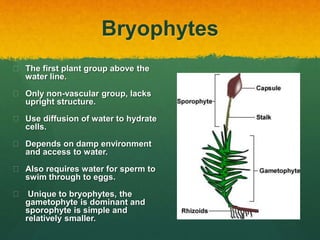
 Unique to bryophytes, the
gametophyte is dominant and
sporophyte is simple and
relatively smaller.
As a
Non-Renewable
Resource
•Plant pioneers out of the
water and onto dry land.
•Maintain the Earth’s
ecosystem’s humidity
levels.
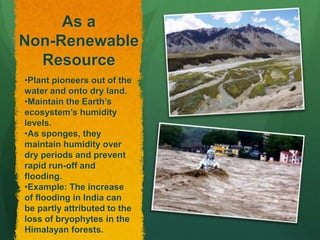
•As sponges, they
maintain humidity over
dry periods and prevent
rapid run-off and
flooding.
•Example: The increase
of flooding in India can
be partly attributed to the
loss of bryophytes in the
Himalayan forests.
FERNS
Basic Information
Ferns usually grow in tropical
areas
Vascular plants with internal
vein structures
Reproduce from spores and an
intermediate stage called
gametophyte
Reproduction
 Patches stuck to the pinnae
 Patches are where you find the spores
 Spores grow inside casings called sporangia
 Take a piece of mature fertile fern frond and place it face
up so that the spore material is on the underneath of the
frond , then leave it overnight, you’re likely to find the
next day that the spores have been released as a fine
coloured powder
 They show up as a fine pattern tracing the form of the fern
frond. They can be black, brown, reddish, yellow or even
green, but they are extremely small. Each of these spores
is capable - through a circuitous process - of growing into
an adult fern.
Interesting Facts
 There are about 12,000 different types of Ferns
 These plants are among the oldest living organisms on the
planet; they existed on the planet for nearly 400 million
years.
 Reproduction of ferns takes place in two morphologically
different phases known as sporophyte and gametophyte
 Ferns can absorb heavy metals from the air and soil. They
can be used to prevent pollution or for the cleaning of
already polluted areas
 Ferns are able to absorb nitrogen from the air. Because of
this feature, some farmers use ferns as natural fertilizers
on the rice fields
Gymnosperms
 Gymnosperms include conifers (redwoods,
sequoias, cedars, junipers, pine trees)
 Coniferous forests cover much of Northern
Eurasia and North America
 Almost 200 million acres of coniferous forests
are in national forests
 Conifers are the tallest organisms in the world
Gymnosperms
 Gymnosperms can reproduce without water due
to their pollen, which can be transferred by
wind.
 Gymnosperms advanced ahead of bryophytes
and ferns this way
Gymnosperms
 Our ecosystems provide medicinal plants, food,
timber, clean air and water, and homes for
wildlife
 About 1 billion of our population relies on
forests
 We deforest by doing slash and burn, ranching,
excessive logging for timber
 The effects are irreversible
Gymnosperms
 Forests soak up carbon dioxide
 Global warming is worsening due to
deforestation
 15% of greenhouse gases emissions are already
due to deforestation
Angiosperm
Basic Information
 Angiosperms are vascular plants.
 Angiosperms are reproductive
plants, producing gametophytes in
order to produce an ovule that will
later on develop into a seed.
 Basic sex organs include: sepals,
petals, stamens, anther, carpel,
ovary and stigma.
Different Types of
Angiosperms
Monocots
 Have only one seed
leaf, and include veins
in the leaves, flower
parts are in multiples
of 3 and there are
scattered vascular
bundles within the
plant
 Examples: corn, grass,
palm trees
Dicots
 Have two seed leaves,
netlike vein patterns in
leaves, flower parts are
in multiples of 4 or 5
and vascular bundles
are in distinct rings
within the plant
 Examples: roses,
sunflowers, cacti, and
apple and cherry trees
Monocots vs. Dicots
Angiosperms Importance
to the Ecosystem
 Angiosperms are the primary food
source for animals.
 They provide us with oxygen for us
to breathe.
 The provide lumber for buildings
and other objects.
 They are the basis for many drugs.

Group project

  • 1.
  • 5.
    Bryophytes  The firstplant group above the water line.  Only non-vascular group, lacks upright structure.  Use diffusion of water to hydrate cells.  Depends on damp environment and access to water.  Also requires water for sperm to swim through to eggs.  Unique to bryophytes, the gametophyte is dominant and sporophyte is simple and relatively smaller.
  • 7.
    As a Non-Renewable Resource •Plant pioneersout of the water and onto dry land. •Maintain the Earth’s ecosystem’s humidity levels. •As sponges, they maintain humidity over dry periods and prevent rapid run-off and flooding. •Example: The increase of flooding in India can be partly attributed to the loss of bryophytes in the Himalayan forests.
  • 8.
  • 9.
    Basic Information Ferns usuallygrow in tropical areas Vascular plants with internal vein structures Reproduce from spores and an intermediate stage called gametophyte
  • 10.
    Reproduction  Patches stuckto the pinnae  Patches are where you find the spores  Spores grow inside casings called sporangia  Take a piece of mature fertile fern frond and place it face up so that the spore material is on the underneath of the frond , then leave it overnight, you’re likely to find the next day that the spores have been released as a fine coloured powder  They show up as a fine pattern tracing the form of the fern frond. They can be black, brown, reddish, yellow or even green, but they are extremely small. Each of these spores is capable - through a circuitous process - of growing into an adult fern.
  • 12.
    Interesting Facts  Thereare about 12,000 different types of Ferns  These plants are among the oldest living organisms on the planet; they existed on the planet for nearly 400 million years.  Reproduction of ferns takes place in two morphologically different phases known as sporophyte and gametophyte  Ferns can absorb heavy metals from the air and soil. They can be used to prevent pollution or for the cleaning of already polluted areas  Ferns are able to absorb nitrogen from the air. Because of this feature, some farmers use ferns as natural fertilizers on the rice fields
  • 13.
    Gymnosperms  Gymnosperms includeconifers (redwoods, sequoias, cedars, junipers, pine trees)  Coniferous forests cover much of Northern Eurasia and North America  Almost 200 million acres of coniferous forests are in national forests  Conifers are the tallest organisms in the world
  • 15.
    Gymnosperms  Gymnosperms canreproduce without water due to their pollen, which can be transferred by wind.  Gymnosperms advanced ahead of bryophytes and ferns this way
  • 16.
    Gymnosperms  Our ecosystemsprovide medicinal plants, food, timber, clean air and water, and homes for wildlife  About 1 billion of our population relies on forests  We deforest by doing slash and burn, ranching, excessive logging for timber  The effects are irreversible
  • 17.
    Gymnosperms  Forests soakup carbon dioxide  Global warming is worsening due to deforestation  15% of greenhouse gases emissions are already due to deforestation
  • 19.
    Angiosperm Basic Information  Angiospermsare vascular plants.  Angiosperms are reproductive plants, producing gametophytes in order to produce an ovule that will later on develop into a seed.  Basic sex organs include: sepals, petals, stamens, anther, carpel, ovary and stigma.
  • 21.
    Different Types of Angiosperms Monocots Have only one seed leaf, and include veins in the leaves, flower parts are in multiples of 3 and there are scattered vascular bundles within the plant  Examples: corn, grass, palm trees Dicots  Have two seed leaves, netlike vein patterns in leaves, flower parts are in multiples of 4 or 5 and vascular bundles are in distinct rings within the plant  Examples: roses, sunflowers, cacti, and apple and cherry trees
  • 22.
  • 23.
    Angiosperms Importance to theEcosystem  Angiosperms are the primary food source for animals.  They provide us with oxygen for us to breathe.  The provide lumber for buildings and other objects.  They are the basis for many drugs.