Gunn Diode
 A Gunn diode is also known as a transferred electron device (TED).
 Phenomenon was observed by J.B. Gunn in 1963
 It is a form of diode used in high-frequency electronics.
 It consists only of n-doped semiconductor material, whereas most diodes consist of both
P and N-doped regions. In practice, a Gunn diode has a region of negative differential
resistance.
 Gallium Arsenide Gunn Diodes are made for frequencies up to 200GHz whereas
Gallium Nitride can reach upto 3THz.
 Electric field ε across the n type Ga As sample , the drift velocity v of carriers
inside the semiconductor .
Differential mobility dv / dε = -ve
2
3
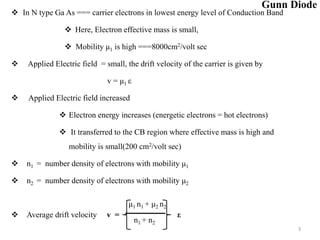
 In N type Ga As === carrier electrons in lowest energy level of Conduction Band
 Here, Electron effective mass is small,
 Mobility μ1 is high ===8000cm2/volt sec
 Applied Electric field = small, the drift velocity of the carrier is given by
v = μ1 ε
 Applied Electric field increased
 Electron energy increases (energetic electrons = hot electrons)
 It transferred to the CB region where effective mass is high and
mobility is small(200 cm2/volt sec)
 n1 = number density of electrons with mobility μ1
 n2 = number density of electrons with mobility μ2
 Average drift velocity v = ε
μ1 n1 + μ2 n2
n1 + n2
Gunn Diode
Gunn Diode
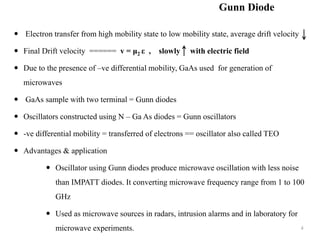
 Electron transfer from high mobility state to low mobility state, average drift velocity
 Final Drift velocity ====== v = μ2 ε , slowly with electric field
 Due to the presence of –ve differential mobility, GaAs used for generation of
microwaves
 GaAs sample with two terminal = Gunn diodes
 Oscillators constructed using N – Ga As diodes = Gunn oscillators
 -ve differential mobility = transferred of electrons == oscillator also called TEO
 Advantages & application
 Oscillator using Gunn diodes produce microwave oscillation with less noise
than IMPATT diodes. It converting microwave frequency range from 1 to 100
GHz
 Used as microwave sources in radars, intrusion alarms and in laboratory for
microwave experiments. 4

Gunn diode

  • 2.
    Gunn Diode  AGunn diode is also known as a transferred electron device (TED).  Phenomenon was observed by J.B. Gunn in 1963  It is a form of diode used in high-frequency electronics.  It consists only of n-doped semiconductor material, whereas most diodes consist of both P and N-doped regions. In practice, a Gunn diode has a region of negative differential resistance.  Gallium Arsenide Gunn Diodes are made for frequencies up to 200GHz whereas Gallium Nitride can reach upto 3THz.  Electric field ε across the n type Ga As sample , the drift velocity v of carriers inside the semiconductor . Differential mobility dv / dε = -ve 2
  • 3.
    3  In Ntype Ga As === carrier electrons in lowest energy level of Conduction Band  Here, Electron effective mass is small,  Mobility μ1 is high ===8000cm2/volt sec  Applied Electric field = small, the drift velocity of the carrier is given by v = μ1 ε  Applied Electric field increased  Electron energy increases (energetic electrons = hot electrons)  It transferred to the CB region where effective mass is high and mobility is small(200 cm2/volt sec)  n1 = number density of electrons with mobility μ1  n2 = number density of electrons with mobility μ2  Average drift velocity v = ε μ1 n1 + μ2 n2 n1 + n2 Gunn Diode
  • 4.
    Gunn Diode  Electrontransfer from high mobility state to low mobility state, average drift velocity  Final Drift velocity ====== v = μ2 ε , slowly with electric field  Due to the presence of –ve differential mobility, GaAs used for generation of microwaves  GaAs sample with two terminal = Gunn diodes  Oscillators constructed using N – Ga As diodes = Gunn oscillators  -ve differential mobility = transferred of electrons == oscillator also called TEO  Advantages & application  Oscillator using Gunn diodes produce microwave oscillation with less noise than IMPATT diodes. It converting microwave frequency range from 1 to 100 GHz  Used as microwave sources in radars, intrusion alarms and in laboratory for microwave experiments. 4