MESFET
Course coordinator: Arpan Deyasi
2/19/2021 1
Arpan Deyasi, India
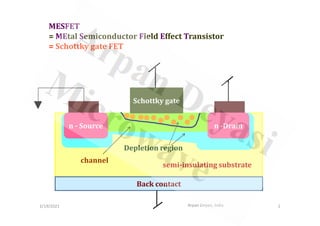
MESFET
= MEtal Semiconductor Field Effect Transistor
= Schottky gate FET
Schottky gate
p
n - Source n -Drain
Back contact
semi-insulating substrate
Depletion region
channel
2/19/2021 2
Arpan Deyasi, India
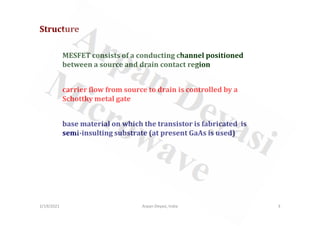
MESFET consists of a conducting channel positioned
between a source and drain contact region
Structure
carrier flow from source to drain is controlled by a
Schottky metal gate
2/19/2021 3
Arpan Deyasi, India
base material on which the transistor is fabricated is
semi-insulting substrate (at present GaAs is used)
buffer layer is epitaxially grown over the substrate to isolate
defects in the substrate from the transistor
Structure
lightly doped (n) conducting layer of semiconducting
material is developed for channel formation
2/19/2021 4
Arpan Deyasi, India
two Ohmic contacts, the source and drain, are fabricated on
the highly doped layer to provide access to the external
circuit
Schottky contact is fabricated as gate contact
depletion region is wide enough to pinch off the channel
without applied voltage, so the enhancement-mode
MESFET is naturally "OFF“
When a positive voltage is applied between the gate and
source, the depletion region shrinks, and the channel
becomes conductive
Enhancement-mode MESFET
2/19/2021 5
Arpan Deyasi, India
becomes conductive
a positive gate-to-source voltage puts the Schottky diode
in forward bias, where a large current can flow
If the depletion region does not extend all the way to
the p-type substrate, the MESFET is a depletion-mode
MESFET
A depletion-mode MESFET is conductive or "ON" when
VGS is not applied and is turned "OFF" upon the
application of a -V , which increases the width of the
Depletion mode MESFET
2/19/2021 6
Arpan Deyasi, India
application of a -VGS, which increases the width of the
depletion region such that it "pinches off" the channel
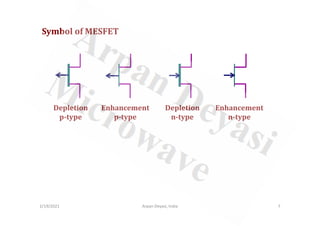
Symbol of MESFET
Depletion
p-type
Enhancement
p-type
Depletion
n-type
Enhancement
n-type
2/19/2021 Arpan Deyasi, India 7
p-type p-type n-type n-type
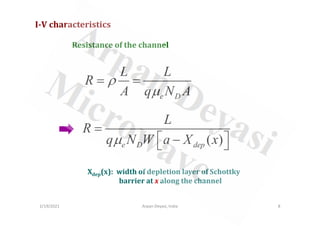
I-V characteristics
Resistance of the channel
e D
L L
R
A q N A
ρ
µ
= =
L
2/19/2021 8
Arpan Deyasi, India
( )
e D dep
L
R
q N W a X x
µ
=
 
−
 
Xdep(x): width of depletion layer of Schottky
barrier at x along the channel
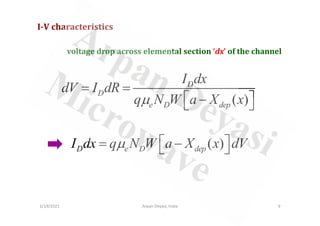
I-V characteristics
( )
D
D
e D dep
I dx
dV I dR
q N W a X x
µ
= =
 
−
 
voltage drop across elemental section ‘dx’ of the channel
2/19/2021 9
Arpan Deyasi, India
( )
D e D dep
I dx q N W a X x dV
µ  
= −
 
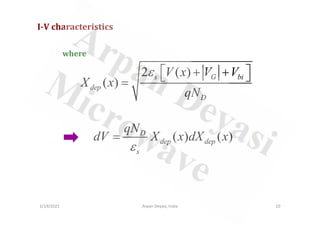
I-V characteristics
where
2 ( )
( )
s G bi
dep
D
V x V V
X x
qN
ε  + + 
 
=
2/19/2021 10
Arpan Deyasi, India
( ) ( )
D
dep dep
s
qN
dV X x dX x
ε
=
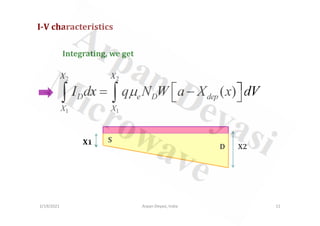
I-V characteristics
2 2
1 1
( )
X X
D e D dep
X X
I dx q N W a X x dV
µ  
= −
 
∫ ∫
Integrating, we get
2/19/2021 Arpan Deyasi, India 11
1 1
X1
X2
S
D
I-V characteristics
2
1
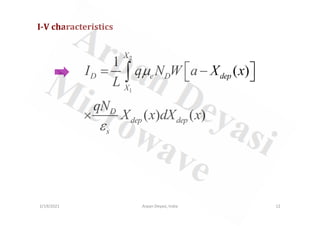
1
( )
( ) ( )
X
D e D dep
X
D
I q N W a X x
L
qN
X x dX x
µ  
= −
 
×
∫
2/19/2021 12
Arpan Deyasi, India
( ) ( )
D
dep dep
s
qN
X x dX x
ε
×
I-V characteristics
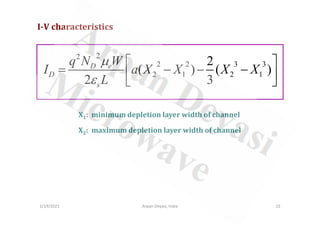
2
2
2 2 3 3
2 1 2 1
2
( ) ( )
2 3
D e
D
s
q N W
I a X X X X
L
µ
ε
 
= − − −
 
 
X : minimum depletion layer width of channel
2/19/2021 13
Arpan Deyasi, India
X1: minimum depletion layer width of channel
X2: maximum depletion layer width of channel
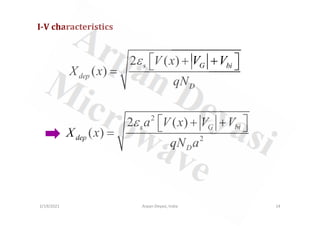
2 ( )
( )
s G bi
dep
D
V x V V
X x
qN
ε  + + 
 
=
I-V characteristics
2/19/2021 14
Arpan Deyasi, India
2
2
2 ( )
( )
s G bi
dep
D
a V x V V
X x
qN a
ε  + + 
 
=
I-V characteristics
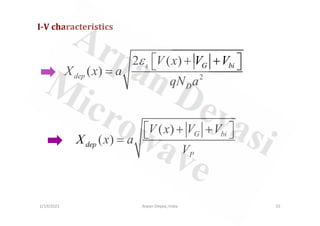
2
2 ( )
( )
s G bi
dep
D
V x V V
X x a
qN a
ε  + + 
 
=
2/19/2021 15
Arpan Deyasi, India
( )
( )
G bi
dep
P
V x V V
X x a
V
 + + 
 
=
I-V characteristics
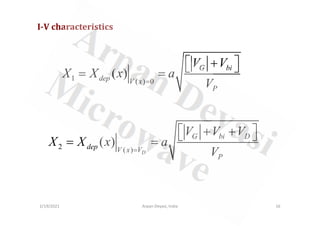
1 ( ) 0
( )
G bi
dep V x
P
V V
X X x a
V
=
 + 
 
= =
2/19/2021 16
Arpan Deyasi, India
2 ( )
( )
D
G bi D
dep V x V
P
V V V
X X x a
V
=
 + + 
 
= =
I-V characteristics
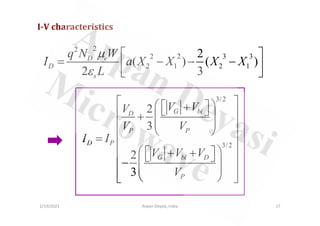
2
2
2 2 3 3
2 1 2 1
2
( ) ( )
2 3
D e
D
s
q N W
I a X X X X
L
µ
ε
 
= − − −
 
 
3/2
2 G bi
D
V V
V
 
 
 + 
 
 
+  
2/19/2021 17
Arpan Deyasi, India
3/2
2
3
2
3
G bi
D
P P
D P
G bi D
P
V V
V
V V
I I
V V V
V
 + 
 
 
+  
 
 
 
 
=
 
 
 + + 
 
 
−  
 
 
 
 
I-V characteristics
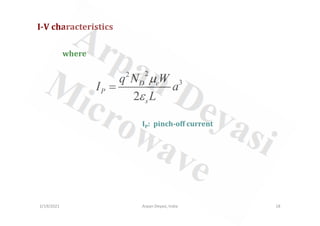
where
2
2
3
2
D e
P
s
q N W
I a
L
µ
ε
=
2/19/2021 18
Arpan Deyasi, India
IP: pinch-off current
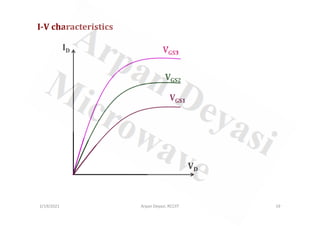
ID
VGS1
VGS2
VGS3
I-V characteristics
2/19/2021 19
Arpan Deyasi, RCCIIT
VD
Features of MESFET
As the drain current can be varied by introducing small
variations in the gate potential, so the MESFET can be
modelled as a voltage-controlled-current-source (VCCS)
It may be used to increase the power level of a
microwave signal
2/19/2021 20
Arpan Deyasi, India
microwave signal
Cut-off Frequency
2 4
m s
co
GS
g v
f
C L
π π
= =
2/19/2021 Arpan Deyasi, India 21
Cut-off frequency depends on
[i] gate length
[ii] saturated drift velocity
Maximum Frequency of Oscillation
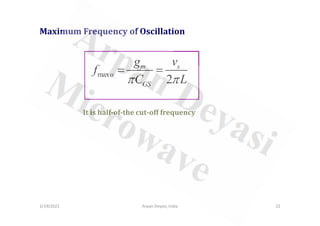
max
2
m s
o
GS
g v
f
C L
π π
= =
It is half-of-the cut-off frequency
2/19/2021 Arpan Deyasi, India 22
It is half-of-the cut-off frequency
Maximum Frequency of Oscillation
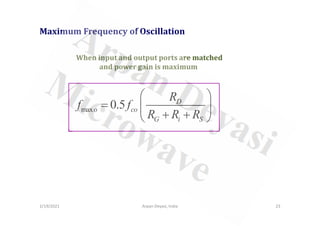
When input and output ports are matched
and power gain is maximum
max 0.5 D
o co
R
f f
R R R
 
=  
+ +
 
2/19/2021 Arpan Deyasi, India 23
maxo co
G i S
R R R
 
+ +
 
Advantages of GaAs MESFETs over other Transistors
high level of electron mobility which is required for
high performance RF applications
Schottky diode gate structure results in very low stray
capacitance levels which lend themselves to excellent
RF and microwave performance
2/19/2021 24
Arpan Deyasi, India
RF and microwave performance
MESFET has a very much higher input when compared
to bipolar transistors as a result of the non-conducting
diode junction
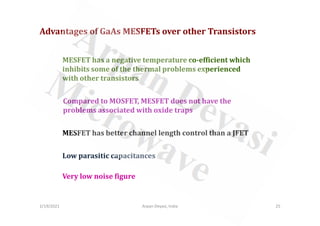
Advantages of GaAs MESFETs over other Transistors
MESFET has a negative temperature co-efficient which
inhibits some of the thermal problems experienced
with other transistors
Compared to MOSFET, MESFET does not have the
problems associated with oxide traps
2/19/2021 Arpan Deyasi, India 25
Low parasitic capacitances
Very low noise figure
problems associated with oxide traps
MESFET has better channel length control than a JFET
Application
RF amplifier
Satellite communications
RADAR
Cell Phones
2/19/2021 26
Arpan Deyasi, India
Switching circuit in microwave region

MESFET

  • 1.
    MESFET Course coordinator: ArpanDeyasi 2/19/2021 1 Arpan Deyasi, India
  • 2.
    MESFET = MEtal SemiconductorField Effect Transistor = Schottky gate FET Schottky gate p n - Source n -Drain Back contact semi-insulating substrate Depletion region channel 2/19/2021 2 Arpan Deyasi, India
  • 3.
    MESFET consists ofa conducting channel positioned between a source and drain contact region Structure carrier flow from source to drain is controlled by a Schottky metal gate 2/19/2021 3 Arpan Deyasi, India base material on which the transistor is fabricated is semi-insulting substrate (at present GaAs is used)
  • 4.
    buffer layer isepitaxially grown over the substrate to isolate defects in the substrate from the transistor Structure lightly doped (n) conducting layer of semiconducting material is developed for channel formation 2/19/2021 4 Arpan Deyasi, India two Ohmic contacts, the source and drain, are fabricated on the highly doped layer to provide access to the external circuit Schottky contact is fabricated as gate contact
  • 5.
    depletion region iswide enough to pinch off the channel without applied voltage, so the enhancement-mode MESFET is naturally "OFF“ When a positive voltage is applied between the gate and source, the depletion region shrinks, and the channel becomes conductive Enhancement-mode MESFET 2/19/2021 5 Arpan Deyasi, India becomes conductive a positive gate-to-source voltage puts the Schottky diode in forward bias, where a large current can flow
  • 6.
    If the depletionregion does not extend all the way to the p-type substrate, the MESFET is a depletion-mode MESFET A depletion-mode MESFET is conductive or "ON" when VGS is not applied and is turned "OFF" upon the application of a -V , which increases the width of the Depletion mode MESFET 2/19/2021 6 Arpan Deyasi, India application of a -VGS, which increases the width of the depletion region such that it "pinches off" the channel
  • 7.
  • 8.
    I-V characteristics Resistance ofthe channel e D L L R A q N A ρ µ = = L 2/19/2021 8 Arpan Deyasi, India ( ) e D dep L R q N W a X x µ =   −   Xdep(x): width of depletion layer of Schottky barrier at x along the channel
  • 9.
    I-V characteristics ( ) D D eD dep I dx dV I dR q N W a X x µ = =   −   voltage drop across elemental section ‘dx’ of the channel 2/19/2021 9 Arpan Deyasi, India ( ) D e D dep I dx q N W a X x dV µ   = −  
  • 10.
    I-V characteristics where 2 () ( ) s G bi dep D V x V V X x qN ε  + +    = 2/19/2021 10 Arpan Deyasi, India ( ) ( ) D dep dep s qN dV X x dX x ε =
  • 11.
    I-V characteristics 2 2 11 ( ) X X D e D dep X X I dx q N W a X x dV µ   = −   ∫ ∫ Integrating, we get 2/19/2021 Arpan Deyasi, India 11 1 1 X1 X2 S D
  • 12.
    I-V characteristics 2 1 1 ( ) () ( ) X D e D dep X D I q N W a X x L qN X x dX x µ   = −   × ∫ 2/19/2021 12 Arpan Deyasi, India ( ) ( ) D dep dep s qN X x dX x ε ×
  • 13.
    I-V characteristics 2 2 2 23 3 2 1 2 1 2 ( ) ( ) 2 3 D e D s q N W I a X X X X L µ ε   = − − −     X : minimum depletion layer width of channel 2/19/2021 13 Arpan Deyasi, India X1: minimum depletion layer width of channel X2: maximum depletion layer width of channel
  • 14.
    2 ( ) () s G bi dep D V x V V X x qN ε  + +    = I-V characteristics 2/19/2021 14 Arpan Deyasi, India 2 2 2 ( ) ( ) s G bi dep D a V x V V X x qN a ε  + +    =
  • 15.
    I-V characteristics 2 2 () ( ) s G bi dep D V x V V X x a qN a ε  + +    = 2/19/2021 15 Arpan Deyasi, India ( ) ( ) G bi dep P V x V V X x a V  + +    =
  • 16.
    I-V characteristics 1 () 0 ( ) G bi dep V x P V V X X x a V =  +    = = 2/19/2021 16 Arpan Deyasi, India 2 ( ) ( ) D G bi D dep V x V P V V V X X x a V =  + +    = =
  • 17.
    I-V characteristics 2 2 2 23 3 2 1 2 1 2 ( ) ( ) 2 3 D e D s q N W I a X X X X L µ ε   = − − −     3/2 2 G bi D V V V      +      +   2/19/2021 17 Arpan Deyasi, India 3/2 2 3 2 3 G bi D P P D P G bi D P V V V V V I I V V V V  +      +           =      + +      −          
  • 18.
    I-V characteristics where 2 2 3 2 D e P s qN W I a L µ ε = 2/19/2021 18 Arpan Deyasi, India IP: pinch-off current
  • 19.
  • 20.
    Features of MESFET Asthe drain current can be varied by introducing small variations in the gate potential, so the MESFET can be modelled as a voltage-controlled-current-source (VCCS) It may be used to increase the power level of a microwave signal 2/19/2021 20 Arpan Deyasi, India microwave signal
  • 21.
    Cut-off Frequency 2 4 ms co GS g v f C L π π = = 2/19/2021 Arpan Deyasi, India 21 Cut-off frequency depends on [i] gate length [ii] saturated drift velocity
  • 22.
    Maximum Frequency ofOscillation max 2 m s o GS g v f C L π π = = It is half-of-the cut-off frequency 2/19/2021 Arpan Deyasi, India 22 It is half-of-the cut-off frequency
  • 23.
    Maximum Frequency ofOscillation When input and output ports are matched and power gain is maximum max 0.5 D o co R f f R R R   =   + +   2/19/2021 Arpan Deyasi, India 23 maxo co G i S R R R   + +  
  • 24.
    Advantages of GaAsMESFETs over other Transistors high level of electron mobility which is required for high performance RF applications Schottky diode gate structure results in very low stray capacitance levels which lend themselves to excellent RF and microwave performance 2/19/2021 24 Arpan Deyasi, India RF and microwave performance MESFET has a very much higher input when compared to bipolar transistors as a result of the non-conducting diode junction
  • 25.
    Advantages of GaAsMESFETs over other Transistors MESFET has a negative temperature co-efficient which inhibits some of the thermal problems experienced with other transistors Compared to MOSFET, MESFET does not have the problems associated with oxide traps 2/19/2021 Arpan Deyasi, India 25 Low parasitic capacitances Very low noise figure problems associated with oxide traps MESFET has better channel length control than a JFET
  • 26.
    Application RF amplifier Satellite communications RADAR CellPhones 2/19/2021 26 Arpan Deyasi, India Switching circuit in microwave region