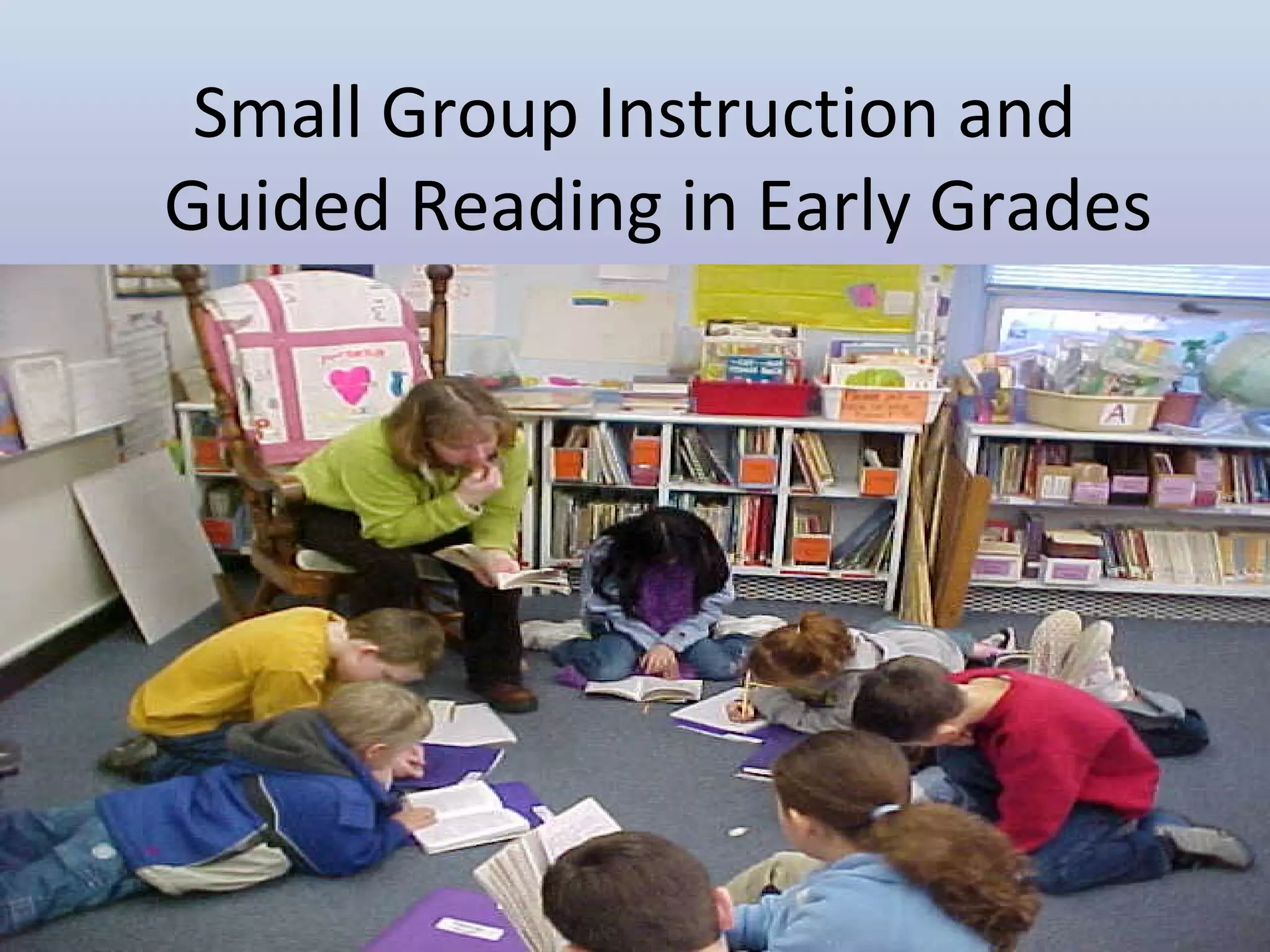
Small Group Instruction and
Guided Reading in Early Grades
What I want
to Know
• Text Selection
• Literacy Centers
• Guided Reading Framework
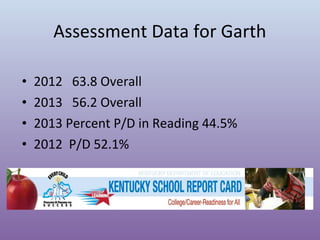
Assessment Data for Garth
•
•
•
•

2012 63.8 Overall
2013 56.2 Overall
2013 Percent P/D in Reading 44.5%
2012 P/D 52.1%
Steps for Improving Reading Scores
at Garth
• Instruction will align with KCAS
• All Classrooms 1-5 will use the Guided Reading
Framework
• During the Reading Block, teachers will
implement Literacy Centers for independent
practice of skills
Support Plan for Garth
• Literacy Consultant and Principal will…..
– Guided Reading foundations professional
development
– Literacy Centers professional development
– Follow-up coaching and observations
Learning Targets
• Teachers will understand how Guided Reading
looks for emergent and early readers.
• Teachers will understand how to select text
and plan story orientations.
• Teachers will understand how to select a
focus and plan for Guided Reading based on
student data.
What Do We know About Effective Reading
Instruction?
Scientifically Based Reading Instruction (SBRI)
Quality Initial Instruction
Instruction Based on Data
Intervention for Struggling Readers
Differentiation

8
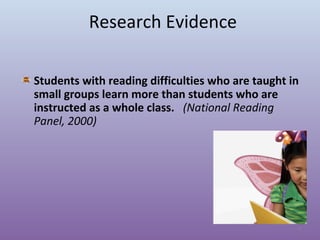
Research Evidence
Students with reading difficulties who are taught in
small groups learn more than students who are
instructed as a whole class. (National Reading
Panel, 2000)

9
Essential Components
•
•
•
•

Small Group
Differentiated based on data
Structured framework
Variety of research based strategies
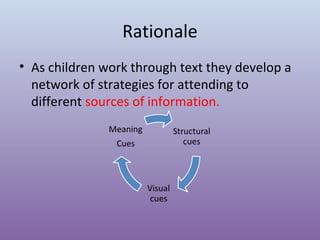
Rationale
• As children work through text they develop a
network of strategies for attending to
different sources of information.
Essential Elements of Guided
Reading
• Small group of students with similar needs
and processing
• Scaffolding/ Supporting their learning
• Enable students to use and develop reading
strategies on continuous text
• Ultimate goal: students learn to use
independent reading strategies successfully
Goal of Guided Reading
Strengthen students’ processing power
across increasingly challenging texts
Form Flexible Groups Based on
Assessment
• Keep group size small (5-8 students)
• Limit number of groups to three if possible
• Base small groups on instructional need with specific
instructional strategies in mind
• Monitor progress of high risk students more
frequently to make instructional changes, small
group changes, and to accelerate learning

15
How do you assess your
students?
Currently:
• What tools do you use to collect data?
• What data do you use to make instructional
decisions?
• How often do you assess your students?
What data
can you
use to put
students
in groups
for Guided
Reading?
Essential Components of Guided
Reading
•
•
•
•
•
•
•
•

Fluent Rereading
Introducing the text
Reading the text
Revisiting and Discussing the text
Teaching for processing strategies
Extending the meaning of the text
Working with words
Writing
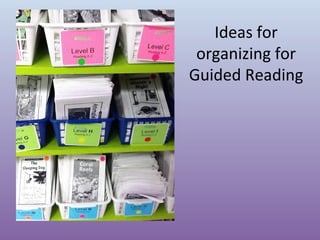
Ideas for
organizing for
Guided Reading
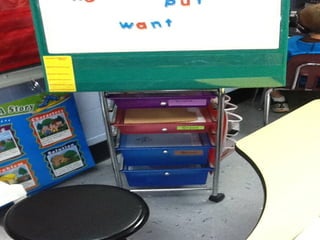
Planning for Guided Reading
• Materials we couldn’t live without:
– Kidney shaped table
– Whiteboard and markers
– Magnetic board and letters
– Easel
– Sticky notes
– Book sets
– Reader’s Notebook
Teaching for Strategies
*What are the learning opportunities presented
in beginning and early text?
*What will you have to teach them to do?
*Compare the Fiction and Nonfiction text. What
are the different demands of Fiction and NonFiction?
Transitional Readers
• Cognitive actions essentially the same while
processing print but readers are applying
them to more complex text.
– Require more background knowledge
– More variety of genre
– More mature ideas and themes, perspectives
– Sustain Comprehension
– Higher level decoding and fluency
*What are the learning opportunities presented
in transitional text?
*What will you have to teach them to do?
*Compare the Fiction and Nonfiction text. What
are the different demands of Fiction and NonFiction?
Strategies for Sustaining Reading
•
•
•
•
•

Detecting and Correcting Error (monitoring)
Searching for and Using Information
Problem Solving New Words
Adjusting to different types of text
Maintaining Fluency
Strategies for Expanding Meaning
•
•
•
•
•
•

Predicting
Making Connections
Inferring
Synthesizing
Analyzing
Critiquing
Prompt and Teach
• I do, we do, you do
• Call to action
Planning a lesson
• Know the reading level of the group
• Choose your focus based on data
• Pick a book that matches reading level and
focus
• Plan the lesson
• Teach
• reflect
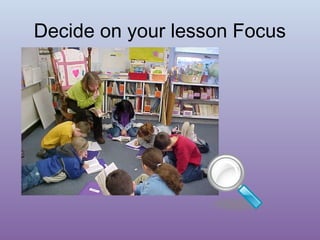
Decide on your lesson Focus
The Shape of the Lesson
•
•
•
•
•
•
•
•

Select your Book.
What will you address in the intro?
How will you solicit BK?
What text features will be pointed out?
What concepts or vocabulary will you cover?
What word work will you need to do?
How will you chunk the reading?
What will your writing prompt be?
Most Important Decisions in GR?

Text
Selection
Reading Levels
Independent
Level

Instructional
Level

Frustration
Level

Text

Text

Text

Relatively easy
text for the
reader, with no
more than
approximately
one error in
twenty words
with good
comprehension.
(95% success)

Challenging but
manageable text
for the reader,
with no more
than
approximately
one error in ten
words with good
comprehension.
(90% success)

Problematic text
for the reader,
with more than
one in ten words
difficult for the
reader (less
than 90%
success)
Selecting and introducing the text
• The right level of support and challenge for
the child’s current processing ability
• The teacher must provide the appropriate
introduction
Text Selection
Choose books that:

• Provide opportunities for students to work on
focus skills and strategies
• Builds on students’ background knowledge
• Are suitable for students’ language level and
conceptual understanding
• Are at students’ instructional level (accuracy
90%-94%)
Introducing text to Readers
• Introduce whole text and read whole text in
one day
• Introduce whole text and read sections each
day with discussions of each
• Introduce and read part by part
• Introduce beginning and read/ discuss. Then
introduce rest of text and students read
independently.
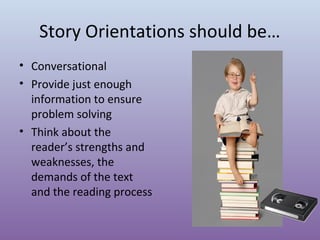
Story Orientations should be…
• Conversational
• Provide just enough
information to ensure
problem solving
• Think about the
reader’s strengths and
weaknesses, the
demands of the text
and the reading process
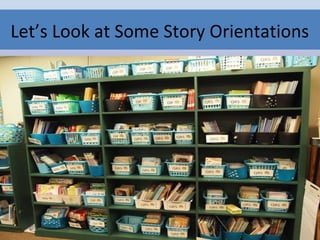
Let’s Look at Some Story Orientations
Plan a Story Orientation
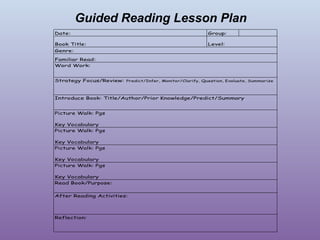
Guided Reading Lesson Plan
Date:

Group:

Book Title:

Level:

Genre:
Familiar Read:
Word Work:
Strategy Focus/Review:

Predict/Infer, Monitor/Clarify, Question, Evaluate, Summarize

Introduce Book: Title/Author/Prior Knowledge/Predict/Summary
Picture Walk: Pgs
Key Vocabulary
Picture Walk: Pgs
Key Vocabulary
Picture Walk: Pgs
Key Vocabulary
Picture Walk: Pgs
Key Vocabulary
Read Book/Purpose:
After Reading Activities:

Reflection:
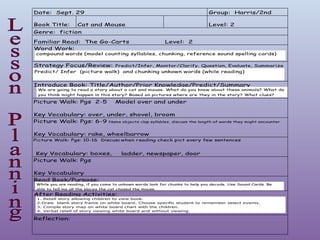
Date: Sept. 29

Group: Harris/2nd

Book Title:

Level: 2

Cat and Mouse

Genre: fiction
Familiar Read: The Go-Carts
Word Work:

Level: 2

compound words (model counting syllables, chunking, reference sound spelling cards)

Strategy Focus/Review:

Predict/Infer, Monitor/Clarify, Question, Evaluate, Summarize

Predict/ Infer (picture walk) and chunking unkown words (while reading)

Introduce Book: Title/Author/Prior Knowledge/Predict/Summary

We are going to read a story about a cat and mouse. What do you know about these animals? What do
you think might happen in this story? Based on pictures where are they in the story? What clues?

Picture Walk: Pgs 2-5

Model over and under

Key Vocabulary: over, under, shovel, broom
Picture Walk: Pgs: 6-9 Name objects clap syllables, discuss the length of words they might encounter
Key Vocabulary: rake, wheelbarrow
Picture Walk: Pgs: 10-16 Discuss- when reading check pict every few sentences
when reading check pict every few sentences

Key Vocabulary: boxes,
Picture Walk: Pgs

ladder, newspaper, door

Key Vocabulary
Read Book/Purpose:

While you are reading, if you come to unkown words look for chunks to help you decode. Use Sound Cards. Be
able to tell me all the places the cat chased the mouse.

After Reading Activities:

1. Retell story allowing children to view book.
2.Draw blank story frame on white board. Choose specific student to remember select events.
3. Comple story map on white board chart with the children.
4. Verbal retell of story viewing white board and without viewing.

Reflection:
What does teacher do during reading?
☺Observes students’ fluency and reading
strategies used during reading
☺Teaching points to emphasize
☺Listens and coaches students to use reading
strategies
☺Listens for strong points to praise
Working with Words
Learning About Letters and Words
• “Reading for meaning with divided attention”
(Clay)
• Help students develop flexible strategies for
solving words
• Must be able to decode words in text
• Locate, Read and Write many times/ Anchors
• Known words can help decode unknown
words
Word Work in Guided Reading
• Before
• During
• After
Make a plan for word work
Turn and Talk
Closing Questions and Comments
Lisa Shaw
Literacy Consultant, CKSEC
859-227-9932
lisa@cksec.org

Guided reading in the Elementary

  • 1.
    Small Group Instructionand Guided Reading in Early Grades
  • 2.
    What I want toKnow • Text Selection • Literacy Centers • Guided Reading Framework
  • 3.
    Assessment Data forGarth • • • • 2012 63.8 Overall 2013 56.2 Overall 2013 Percent P/D in Reading 44.5% 2012 P/D 52.1%
  • 4.
    Steps for ImprovingReading Scores at Garth • Instruction will align with KCAS • All Classrooms 1-5 will use the Guided Reading Framework • During the Reading Block, teachers will implement Literacy Centers for independent practice of skills
  • 5.
    Support Plan forGarth • Literacy Consultant and Principal will….. – Guided Reading foundations professional development – Literacy Centers professional development – Follow-up coaching and observations
  • 6.
    Learning Targets • Teacherswill understand how Guided Reading looks for emergent and early readers. • Teachers will understand how to select text and plan story orientations. • Teachers will understand how to select a focus and plan for Guided Reading based on student data.
  • 7.
    What Do Weknow About Effective Reading Instruction? Scientifically Based Reading Instruction (SBRI) Quality Initial Instruction Instruction Based on Data Intervention for Struggling Readers Differentiation 8
  • 8.
    Research Evidence Students withreading difficulties who are taught in small groups learn more than students who are instructed as a whole class. (National Reading Panel, 2000) 9
  • 9.
    Essential Components • • • • Small Group Differentiatedbased on data Structured framework Variety of research based strategies
  • 10.
    Rationale • As childrenwork through text they develop a network of strategies for attending to different sources of information.
  • 11.
    Essential Elements ofGuided Reading • Small group of students with similar needs and processing • Scaffolding/ Supporting their learning • Enable students to use and develop reading strategies on continuous text • Ultimate goal: students learn to use independent reading strategies successfully
  • 12.
    Goal of GuidedReading Strengthen students’ processing power across increasingly challenging texts
  • 13.
    Form Flexible GroupsBased on Assessment • Keep group size small (5-8 students) • Limit number of groups to three if possible • Base small groups on instructional need with specific instructional strategies in mind • Monitor progress of high risk students more frequently to make instructional changes, small group changes, and to accelerate learning 15
  • 14.
    How do youassess your students? Currently: • What tools do you use to collect data? • What data do you use to make instructional decisions? • How often do you assess your students?
  • 15.
    What data can you useto put students in groups for Guided Reading?
  • 16.
    Essential Components ofGuided Reading • • • • • • • • Fluent Rereading Introducing the text Reading the text Revisiting and Discussing the text Teaching for processing strategies Extending the meaning of the text Working with words Writing
  • 17.
  • 18.
    Planning for GuidedReading • Materials we couldn’t live without: – Kidney shaped table – Whiteboard and markers – Magnetic board and letters – Easel – Sticky notes – Book sets – Reader’s Notebook
  • 20.
  • 21.
    *What are thelearning opportunities presented in beginning and early text? *What will you have to teach them to do? *Compare the Fiction and Nonfiction text. What are the different demands of Fiction and NonFiction?
  • 22.
    Transitional Readers • Cognitiveactions essentially the same while processing print but readers are applying them to more complex text. – Require more background knowledge – More variety of genre – More mature ideas and themes, perspectives – Sustain Comprehension – Higher level decoding and fluency
  • 23.
    *What are thelearning opportunities presented in transitional text? *What will you have to teach them to do? *Compare the Fiction and Nonfiction text. What are the different demands of Fiction and NonFiction?
  • 24.
    Strategies for SustainingReading • • • • • Detecting and Correcting Error (monitoring) Searching for and Using Information Problem Solving New Words Adjusting to different types of text Maintaining Fluency
  • 25.
    Strategies for ExpandingMeaning • • • • • • Predicting Making Connections Inferring Synthesizing Analyzing Critiquing
  • 26.
    Prompt and Teach •I do, we do, you do • Call to action
  • 27.
    Planning a lesson •Know the reading level of the group • Choose your focus based on data • Pick a book that matches reading level and focus • Plan the lesson • Teach • reflect
  • 28.
    Decide on yourlesson Focus
  • 29.
    The Shape ofthe Lesson • • • • • • • • Select your Book. What will you address in the intro? How will you solicit BK? What text features will be pointed out? What concepts or vocabulary will you cover? What word work will you need to do? How will you chunk the reading? What will your writing prompt be?
  • 30.
    Most Important Decisionsin GR? Text Selection
  • 31.
    Reading Levels Independent Level Instructional Level Frustration Level Text Text Text Relatively easy textfor the reader, with no more than approximately one error in twenty words with good comprehension. (95% success) Challenging but manageable text for the reader, with no more than approximately one error in ten words with good comprehension. (90% success) Problematic text for the reader, with more than one in ten words difficult for the reader (less than 90% success)
  • 32.
    Selecting and introducingthe text • The right level of support and challenge for the child’s current processing ability • The teacher must provide the appropriate introduction
  • 33.
    Text Selection Choose booksthat: • Provide opportunities for students to work on focus skills and strategies • Builds on students’ background knowledge • Are suitable for students’ language level and conceptual understanding • Are at students’ instructional level (accuracy 90%-94%)
  • 34.
    Introducing text toReaders • Introduce whole text and read whole text in one day • Introduce whole text and read sections each day with discussions of each • Introduce and read part by part • Introduce beginning and read/ discuss. Then introduce rest of text and students read independently.
  • 35.
    Story Orientations shouldbe… • Conversational • Provide just enough information to ensure problem solving • Think about the reader’s strengths and weaknesses, the demands of the text and the reading process
  • 36.
    Let’s Look atSome Story Orientations
  • 37.
    Plan a StoryOrientation
  • 38.
    Guided Reading LessonPlan Date: Group: Book Title: Level: Genre: Familiar Read: Word Work: Strategy Focus/Review: Predict/Infer, Monitor/Clarify, Question, Evaluate, Summarize Introduce Book: Title/Author/Prior Knowledge/Predict/Summary Picture Walk: Pgs Key Vocabulary Picture Walk: Pgs Key Vocabulary Picture Walk: Pgs Key Vocabulary Picture Walk: Pgs Key Vocabulary Read Book/Purpose: After Reading Activities: Reflection:
  • 39.
    Date: Sept. 29 Group:Harris/2nd Book Title: Level: 2 Cat and Mouse Genre: fiction Familiar Read: The Go-Carts Word Work: Level: 2 compound words (model counting syllables, chunking, reference sound spelling cards) Strategy Focus/Review: Predict/Infer, Monitor/Clarify, Question, Evaluate, Summarize Predict/ Infer (picture walk) and chunking unkown words (while reading) Introduce Book: Title/Author/Prior Knowledge/Predict/Summary We are going to read a story about a cat and mouse. What do you know about these animals? What do you think might happen in this story? Based on pictures where are they in the story? What clues? Picture Walk: Pgs 2-5 Model over and under Key Vocabulary: over, under, shovel, broom Picture Walk: Pgs: 6-9 Name objects clap syllables, discuss the length of words they might encounter Key Vocabulary: rake, wheelbarrow Picture Walk: Pgs: 10-16 Discuss- when reading check pict every few sentences when reading check pict every few sentences Key Vocabulary: boxes, Picture Walk: Pgs ladder, newspaper, door Key Vocabulary Read Book/Purpose: While you are reading, if you come to unkown words look for chunks to help you decode. Use Sound Cards. Be able to tell me all the places the cat chased the mouse. After Reading Activities: 1. Retell story allowing children to view book. 2.Draw blank story frame on white board. Choose specific student to remember select events. 3. Comple story map on white board chart with the children. 4. Verbal retell of story viewing white board and without viewing. Reflection:
  • 40.
    What does teacherdo during reading? ☺Observes students’ fluency and reading strategies used during reading ☺Teaching points to emphasize ☺Listens and coaches students to use reading strategies ☺Listens for strong points to praise
  • 41.
  • 42.
    Learning About Lettersand Words • “Reading for meaning with divided attention” (Clay) • Help students develop flexible strategies for solving words • Must be able to decode words in text • Locate, Read and Write many times/ Anchors • Known words can help decode unknown words
  • 43.
    Word Work inGuided Reading • Before • During • After
  • 44.
    Make a planfor word work
  • 45.
  • 46.
  • 47.
    Lisa Shaw Literacy Consultant,CKSEC 859-227-9932 lisa@cksec.org

Editor's Notes

  • #2 {"38":"View video Essential Elements of “Guided Reading” Introducing Text\nAlso look at Eggs Transcript\n","27":"Look at your observation sheet.\nWhere would you observe these behaviors?\nHow would you collect data? When could you use this? How would it be helpful?\n","16":"Make a T Chart. List What you need to know to teach your students.\nList with your table all the assessments you use. \n","33":"This chart illustrates the three reading levels. (Review chart with participants)\nOur goal is to have students working with instructional level text during small group instruction. I always think of this as “Baby Bear Text”. It is not too hard or too easy. It is just right! This will result in optimal reading growth for our students because it affords students the opportunity to apply the skills they are learning to text that they can handle. Texts at a student’s instructional level are used when teachers or others provide assistance and support before, during, and after reading.\nIndependent-level and instructional-level texts are most often used to build fluency. In addition, students can work with frustration level text as they listen to the teacher read aloud or when they participate in listening centers. \n","11":"Clay\nMay use them in isolation but more difficult to do embedded in text\n","39":"Watch video clips of Seedfolk and Elephants from Fountas and Pinnell\nDo one with group\nSelect a text\nList demands on comprehending that students will need to meet\nTalk about what you will address in the book introduction with your partner.\nTable Sharing 15 minutes.\n","28":"Handout with prompting\n","45":"Jigsaw\nKey points\n","34":"Know your students, their text level, vocabulary, sentence structure\nStudents should be able to read the guided reading text with 90% with support. \nThe teacher can provide scaffolding in the introduction that makes the book accessible to the reader.\nYou have to read the book and know your students. The orientation for the same book may look different between groups\n","23":"Teachers in pairs look at fiction and non fiction text and make a list of learning opportunities and demands. Share at table then chart your thoughts.\nExample: “The Guinea Pig” \n30 minutes for activity\n","12":"Grouped and regrouped based on need\nText continues to increase in difficulty and child reads whole text\n","1":"Fountas and Pinnell excellent resource\nHandout packet\nLittle books or Basal text \nOne part of a balanced literacy classroom\nWhole group reading, silent reading, word work, writing, oral language developement\n","29":"Handout from diller on Focus\n","18":"Video from Guided Reading Section 2 Inside the Guided reading Lesson\n","46":"Use the book you selected for Story Orientation and plan word work……..May use Scott Foresman text\n","24":"Flashback from Taste of Blackberries\nInferring setting\nDescriptive language to visualize\nNew vocabulary\n","2":"Fountas and Pinnell excellent resource\nHandout packet\nLittle books or Basal text \nOne part of a balanced literacy classroom\nWhole group reading, silent reading, word work, writing, oral language developement\n","30":"Pg. 165 from diller\nLook at it together\n","8":"We know that scientifically based reading instruction includes:\nQuality initial instruction in the five essential components of reading that we just discussed\nThis instruction should be based on assessment data.\nIntervention for struggling readers should be provided in addition to the minimum 90 minutes of core reading instruction, and\nInstruction should be differentiated so that we meet the diverse needs of the students in our classrooms.\n","47":"5 minutes\n","36":"When would you use each one?\nPick a text from the center of the table. First decide which intro you would use.\n","25":"Teachers in pairs look at fiction and non fiction text and make a list of learning opportunities and demands. Share at table then chart your thoughts.\nExample: “The Grand CanyoN” \n30 minutes for activity\n","3":"What do I know…..what am I wondering\n","31":"15 Minutes\nRefer participants to Elements of Guided reading\n","9":"The research supports incorporating various instructional grouping formats into our reading block including small group instruction. \nResearch shows students with reading difficulties who are taught in small groups learn more than students who are instructed as a whole class. Small group instruction gives students more opportunities to respond and to get immediate corrective feedback. Students are not able to “hide” in the small group setting when the teacher is sitting “eyeball to eyeball” with each student.\nStudents benefit from working in a variety of grouping formats that change to reflect their knowledge, skills, interests, and progress. These groups are flexible and change according to the varying needs of the students.\n","37":"Handout page 242 Insects from Fountas and Pinnell \nDon’t problem solve everything!\nHoldaway says: brief, lively discussion in which teacher interests child in the story and produces an appropriate set for reading it.\nHandout packet “focus points for book introductions”\nTitle, how book is organized\nPlot or gist of story, unusual words or phrases or anchor words for early readers\nFlip through book with talking points at important intervals of story…….\nWatch video clip from Fountas and Pinnell: Guided Reading Intro to text.\n","26":"Handout systems of strategic action\nEarly readers first monitor with what they know. These are their anchors in print. It is ok and often necessary to tell and demonstrate. \nWhere would you observe these behaviors?\nOn handout, how to fill out the observational notes. You can get your information from RR or anecdotal notes. \n","15":"When thinking about grouping students for small group instruction in your classroom, you may want to consider these things.\n(Go over bullets on the slide.)\n","43":"Build Hi Frequency Words\nTeach students how words work\nVocabulary building\n","10":"A teacher works with a small group.\nChildren in the group are similar in their development of a reading process and are able to read about the same level of text.\n"}