Powerful Co Teaching in the
Literacy Classroom
Summer 2015
Lisa King, Literacy Consultant
lisa@cksec.org
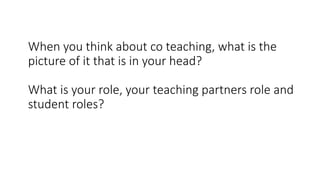
When you think about co teaching, what is the
picture of it that is in your head?
What is your role, your teaching partners role and
student roles?
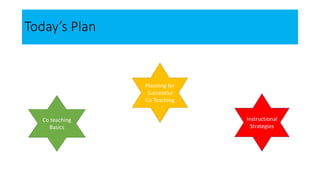
Today’s Plan
Co teaching
Basics
Planning for
Successful
Co Teaching
Instructional
Strategies
Photo by -Reji - Creative Commons Attribution-NonCommercial-ShareAlike License https://www.flickr.com/photos/27365066@N02 Created with Haiku Deck
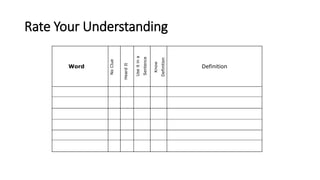
Rate Your Understanding
Word Definition
NoClue
HeardIt
Useitina
Sentence
Know
Definition
Rate Your Knowledge
• Collaboration
• Co teaching
• Parity
• Least Restrictive Environment
• Teaming
• Alternative teaching
• Liability
• Station teaching
Photo by lumaxart - Creative Commons Attribution-ShareAlike License https://www.flickr.com/photos/22177648@N06 Created with Haiku Deck
Photo by 臺中市頭家國民小學 Tuojia Elementary Scho - Creative Commons Attribution-NonCommercial-ShareAlike License https://www.flickr.com/photos/20107251@N00Created with Haiku Deck
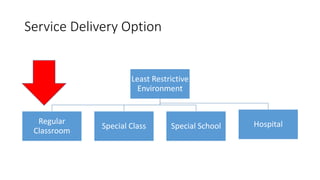
Service Delivery Option
Least Restrictive
Environment
Regular
Classroom
Special Class Special School Hospital
Not an All-or-Nothing Approach
•Co-teaching is one option for serving

students.
•Students with disabilities may be in a

co-taught classroom for only part of
the day.
Murawski, 2005
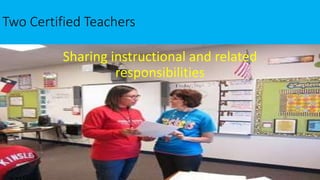
Two Certified Teachers
Sharing instructional and related
responsibilities
Co-teaching
Approaches
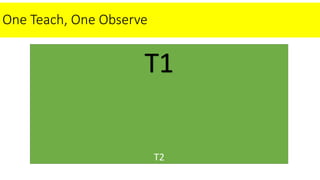
One Teach, One Observe
T1
T2
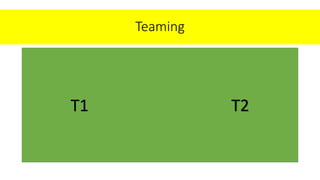
Teaming
T1 T2
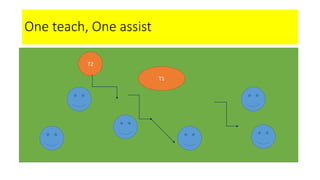
One teach, One assist
T1
T2
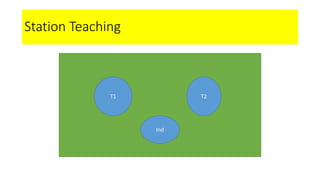
Station Teaching
T1 T2
Ind
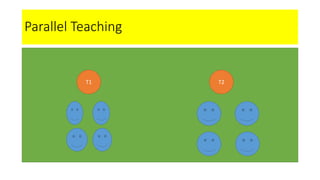
Parallel Teaching
T1 T2
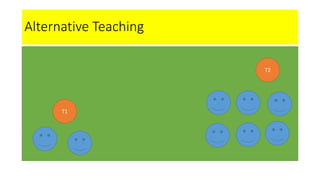
Alternative Teaching
T2
T1
Numbered Heads Together
Rate Your Knowledge
• Collaboration
• Co teaching
• Parity
• Least Restrictive Environment
• Teaming
• Alternative teaching
• Liability
• Station teaching
Using Strategies in a Co taught Classroom
• Numbered Heads Together
• Rate Your Knowledge
• Word Sorting
80% of students
with disabilities
_______________
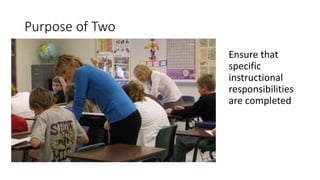
Purpose of Two
Ensure that
specific
instructional
responsibilities
are completed
Know Your Students
Differentiation Accommodations
Classroom Instruction
Examples of Specially Designed Instruction
• Explicit Instruction
• Scaffolded Instruction
• Structured Overview
• Strategy Instruction
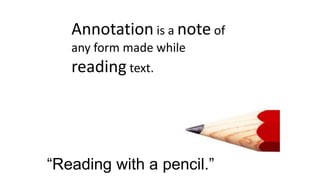
Annotation is a note of
any form made while
reading text.
“Reading with a pencil.”
Annotation slows
down the
reader in order to
deepen
understanding.
Students use literacy more than ever before!
Using Strategies in a Co taught Classroom
• Two Column Notes
• Annotation
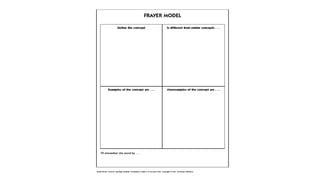
• Frayer Model
41
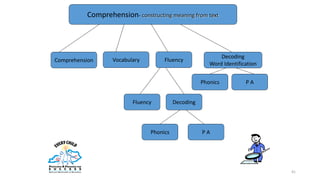
Comprehension- constructing meaning from text
Phonics
Decoding
Word Identification
VocabularyComprehension
P A
Phonics
Fluency
DecodingFluency
P A
Text Resources
Vocabulary
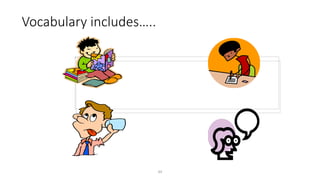
Vocabulary includes…..
44
What We Know From Research
• Students learn new words by learning strategies for understanding
unfamiliar words (Blaschowicz and Fisher 2004)
• Knowing a word means more than knowing a definition (Scott and
Nagy 1997)
• Discussion leads to vocabulary learning (Stahl and Clark 1987)
Mess
“disorderly mass”
• “A mess of fish”
• “You’re a mess!”
• “This is a mess!”
Floozy
• “ A slovenly or vulgar woman”
remissible
• “Capable of being remitted”
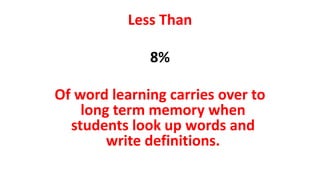
Less Than
8%
Of word learning carries over to
long term memory when
students look up words and
write definitions.
51
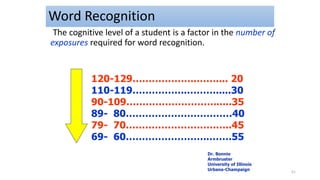
Word Recognition
The cognitive level of a student is a factor in the number of
exposures required for word recognition.
120-129………………..…….... 20
110-119……………..……….....30
90-109………………………......35
89- 80……………………………40
79- 70……………………….…..45
69- 60……………………..…….55
Dr. Bonnie
Armbruster
University of Illinois
Urbana-Champaign
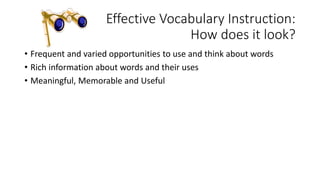
Effective Vocabulary Instruction:
How does it look?
• Frequent and varied opportunities to use and think about words
• Rich information about words and their uses
• Meaningful, Memorable and Useful
53Beck, McKeown, and Kucan, 2002
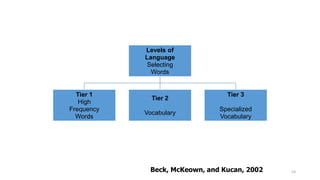
Levels of
Language
Selecting
Words
Tier 1
High
Frequency
Words
Tier 2
Vocabulary
Tier 3
Specialized
Vocabulary
Introducing New Vocabulary
• Step 1: Introduce the word
• Write the word on the overhead or board
• Read and have students repeat the word
• “This word is construct. What word?”
Introducing New Vocabulary
• Step 2: Introduce the meaning
• using a “student friendly definition” or
• have them locate the word in text or glossary and break it into critical
attributes or
• Word relatives or parts
Introducing New Vocabulary
• Step 3: Illustrate with examples
• Concrete
• Verbal
• Visual
Introduce New Vocabulary
• Step 4: Check for deep understanding
• Ask deep processing questions
• Examples/Non-examples
• Generate their own examples
“Six for the Price of One”
agitate
Agitation agitating agitational
Agitates agitated
Strategy
• Students pair up with a partner. They will create a sentence from the
starter the teacher gives them with at least seven words. One
student makes up the sentence and the other counts the words.
Then they switch.
•Let’s Give It a Try!
agitate
A gi tate
Let’s Review
• _______ the word
• ________ friendly explanation
• Illustrate with _____________
• Check for _________________
Let’s Review
• Introduce the word
• Student friendly explanation
• Illustrate with examples
• Check for deep understanding
Prior knowledge
and experience
supports
increased
vocabulary
knowledge.
- Marzano 2004
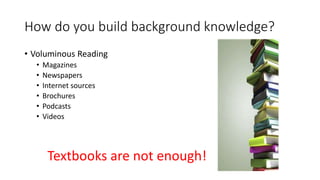
How do you build background knowledge?
• Voluminous Reading
• Magazines
• Newspapers
• Internet sources
• Brochures
• Podcasts
• Videos
Textbooks are not enough!
Word Storming
Using Strategies in a Co taught Classroom
• KIM
• Seven Up
• Word Storming
Building my Own Background Knowledge
• Read the title and ask yourself what do you know
• Read first and last paragraphs
• Tell a partner everything you learned
• Jot down what you learned
• Set a purpose for reading
Read With a Question in Mind
Let them do the work!
1.Find out 4 things you didn’t know about the civil rights movement.
• http://www.history.com/topics/black-history/civil-rights-movement
2.Find out 4 things you didn’t know about cloning.
• http://science.howstuffworks.com/life/genetic/cloning.htm
3.Find out 4 things you didn’t know about polynomials
• http://www.mathsisfun.com/algebra/polynomials.html
Writing 6 and 7
• Use internet to present ideas and information clearly
• Conduct short research projects to answer questions, may be self
generated
Put it in my Pocket
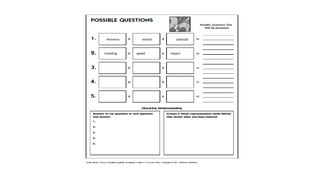
Possible Questions
• Student generated questions support comprehension (Martin 1985)
• Use specialized vocabulary to generate questions they think will
appear in text before reading.
• Answer or revise the questions during reading.
dinosaurs extinct asteroid
traveling speed impact
Sum It Up
Using Strategies in a Co taught Classroom
• Building BK
• Reading with a Question in Mind
• Possible Question
• Sum It Up
Best Idea of
the Day!!!

Powerful co teaching in the literacy classroom