What percentage of class time do students
spend reading text (pictures, graphs included)?
•Less than 5 minutes a day
•5-10 minutes a day
•11-20 minutes a day
•More than 20 minutes a day
Close Reading, So What?
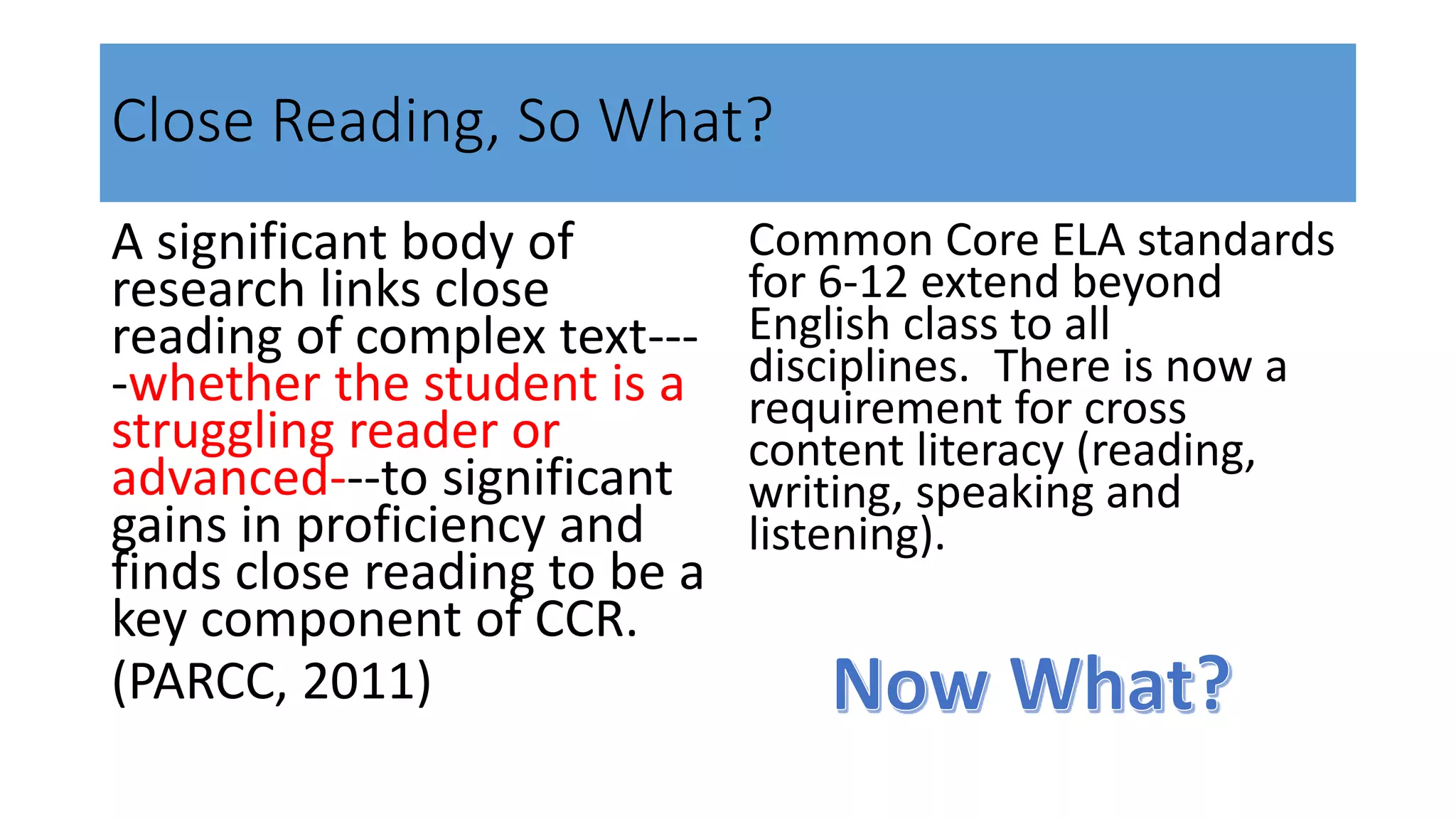
A significant body of
research links close
reading of complex text---
-whether the student is a
struggling reader or
advanced---to significant
gains in proficiency and
finds close reading to be a
key component of CCR.
(PARCC, 2011)
Common Core ELA standards
for 6-12 extend beyond
English class to all
disciplines. There is now a
requirement for cross
content literacy (reading,
writing, speaking and
listening).
Deep Understanding of
Content
Direct
instruction
discussion
Close
reading
writing
Text
reading
Hands on
manipulatives
Define Close Reading…….
• Underline key details that support the definition of close reading and
identify the defining characteristics of close reading.
• Jot in the margin, any questions you have while you are reading.
What is Close Reading?
An approach to the text which enables
readers to uncover, engage with and
understand the information and ideas it
contains.
HO
Why Add Close Reading Instruction?
• Reading Standard 10 : read and
understand increasingly complex text
• Build reading skills leading to strength and
stamina
• Text complexity gap
• Opportunity to acquire content knowledge
Literacy is the gateway to
your content!
How is Close Reading
Different?
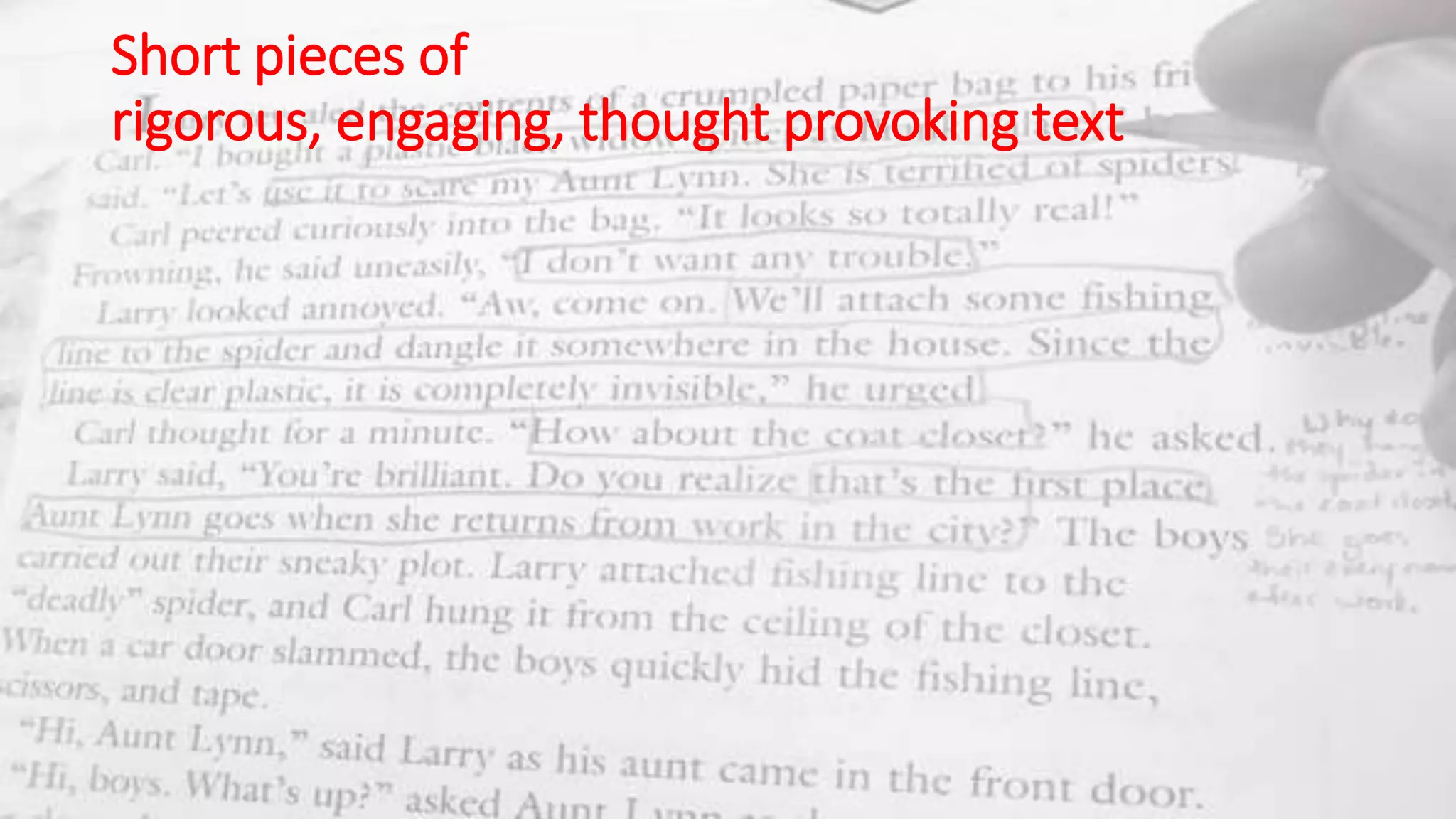
Short pieces of
rigorous, engaging, thought provoking text
Limit before reading activities
Multiple readings guided
by text dependent
questions
Gain insight to in order to critically and ethically
evaluate the text message.
Real World Connections, Sharing New
Understandings
Habit of Practice
Jot Top 3
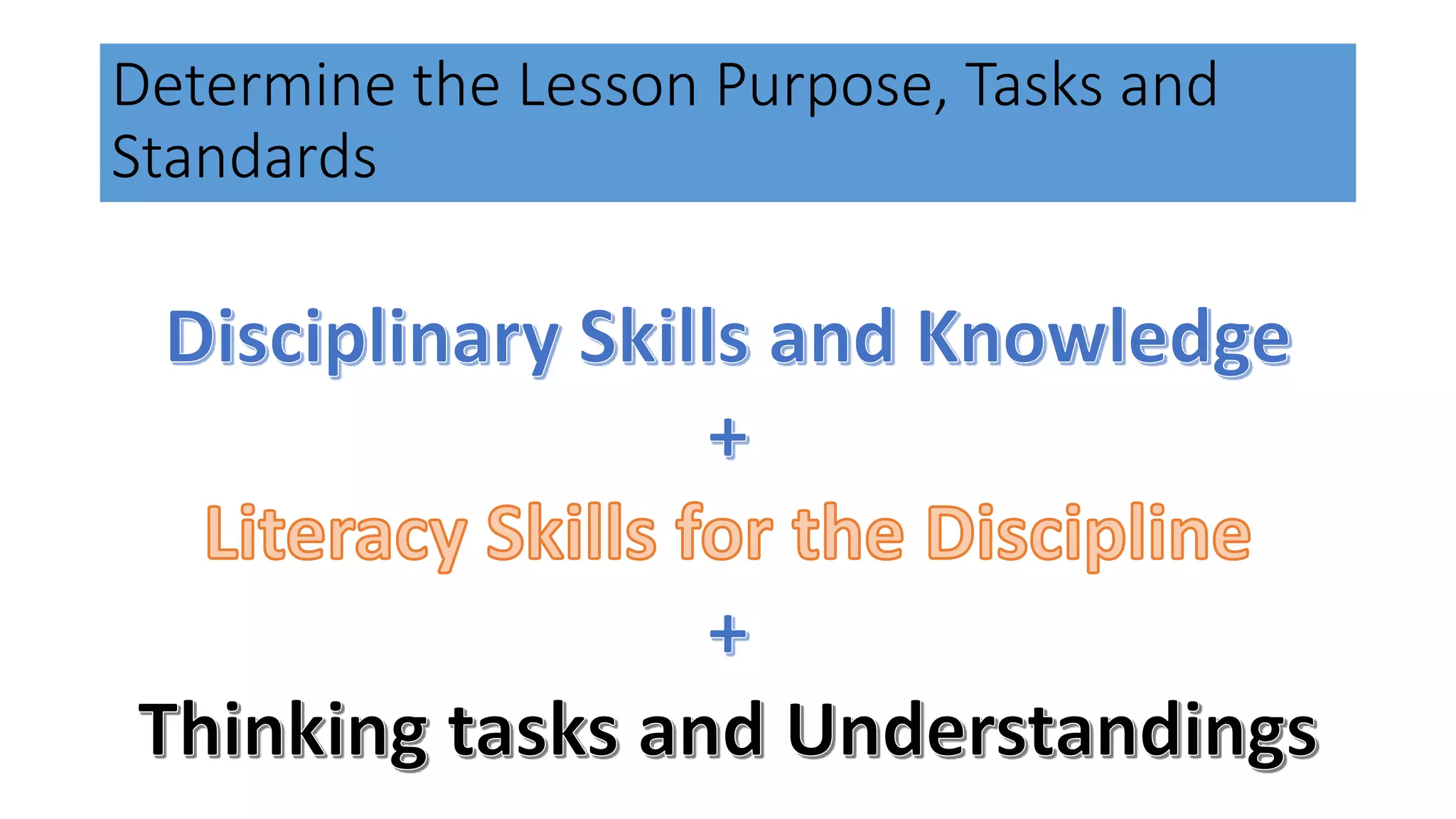
Determine the Lesson Purpose, Tasks and
Standards
Selecting an Appropriate Text
Reading Information Standards
Social Studies and History
Science and Technical Disciplines
Determine the potential problem areas
Plan for after reading task
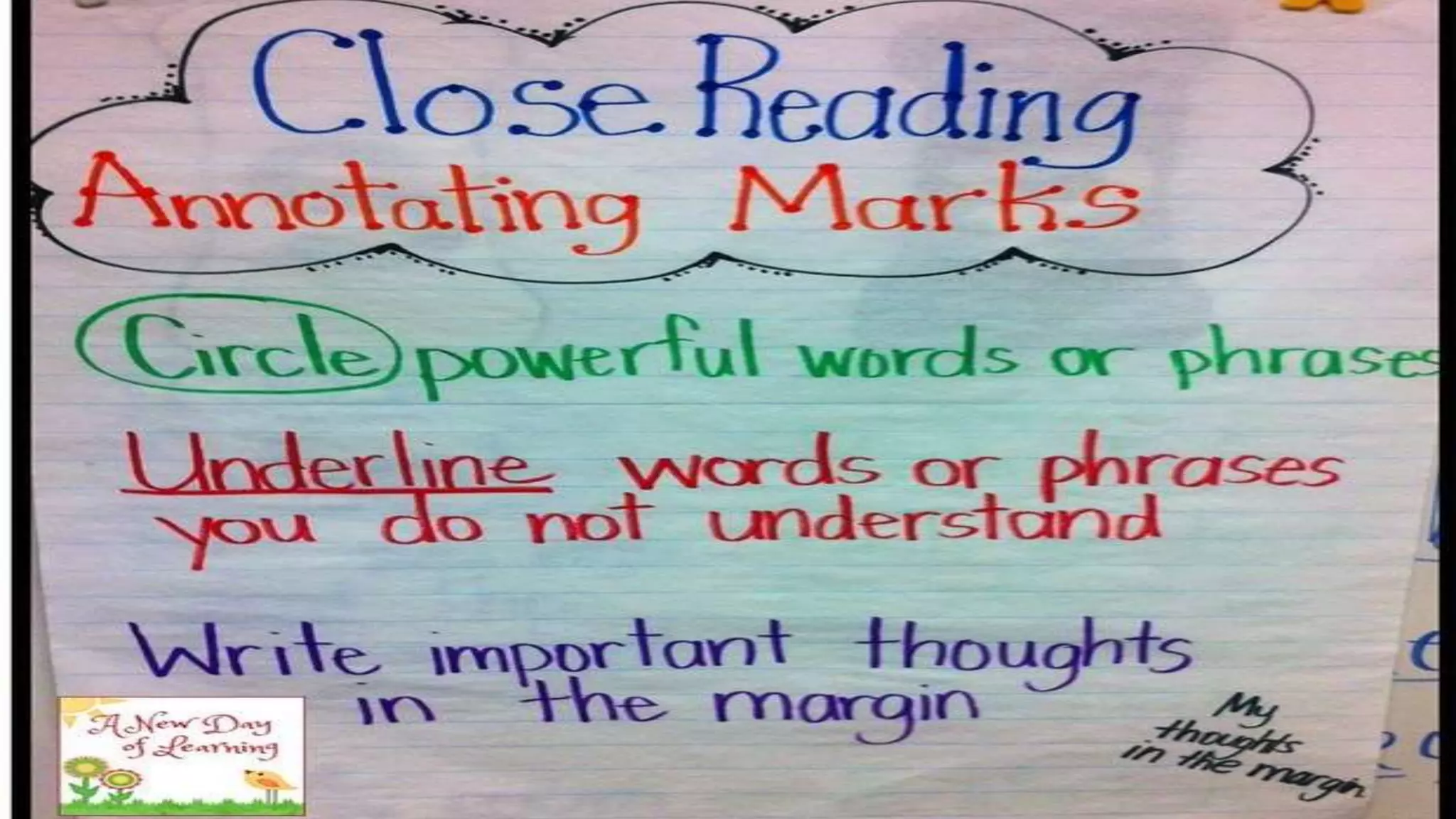
Provide instruction and modeling on Text
Annotation
Supporting Struggling Learners
• Use sentence, language or paragraph frames
• “I notice that on page____, the author used the word(s) _____________ to
help us see _____________.”
• Gradual Release: I do it, We do it together, You do it together and You
do it)
• Paired reading to independent reading
• Read Aloud for first read but read independently on second and third
reads
Key Points to Remember When Planning
• Determine the _____________--, _____________- and _______.
• Select an appropriate ______________--.
• Look for ______________ ______________.
• Plan the after reading _______________.
• Teach p_________________ a___________________.
• D____________________ for struggling learners.
Text-
Dependent
Questions
Text-Dependent Questions
• can only be answered correctly by close reading of the text
• require an understanding that extends beyond recalling facts
• require students to infer
• allow students to gather evidence and build knowledge
• provide access to increasing levels of complex text
• call for careful and thoughtful teacher preparation
Key Advances Build Toward
Readiness for All Students
34
Four Cognitive Phases
• What does the text say? [literal]
• How does the text work?
[structural]
• What does the text mean?
[implicit]
• What does the text inspire
me/you to do? (e.g., writing,
speaking, exploring other texts)
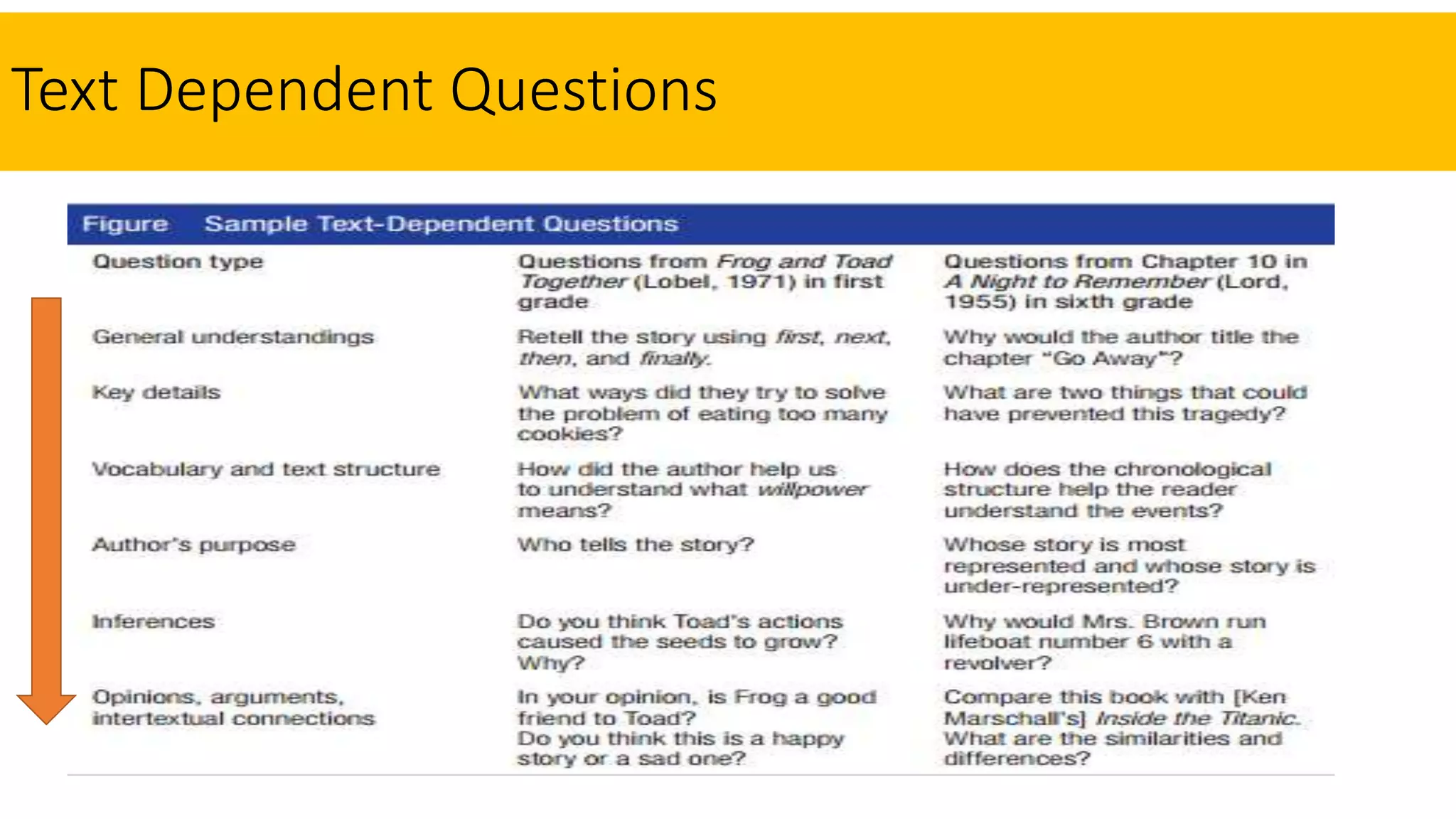
Relationship of Phases
- Opinions/arguments
- Intertextual
connections
- Inferences
- Authors’ craft & response
- Vocabulary & text structure
- Key details
- General understanding
Text Dependent Questions
Goals of TDQ
• Rich and rigorous evidence-based
conversations
• Discussions that stay deeply
connected to the text
• Students revisiting text for evidence
to support their argument in a
thoughtful, careful, and precise way
• Students slowing down to explore
and learn from the evidence
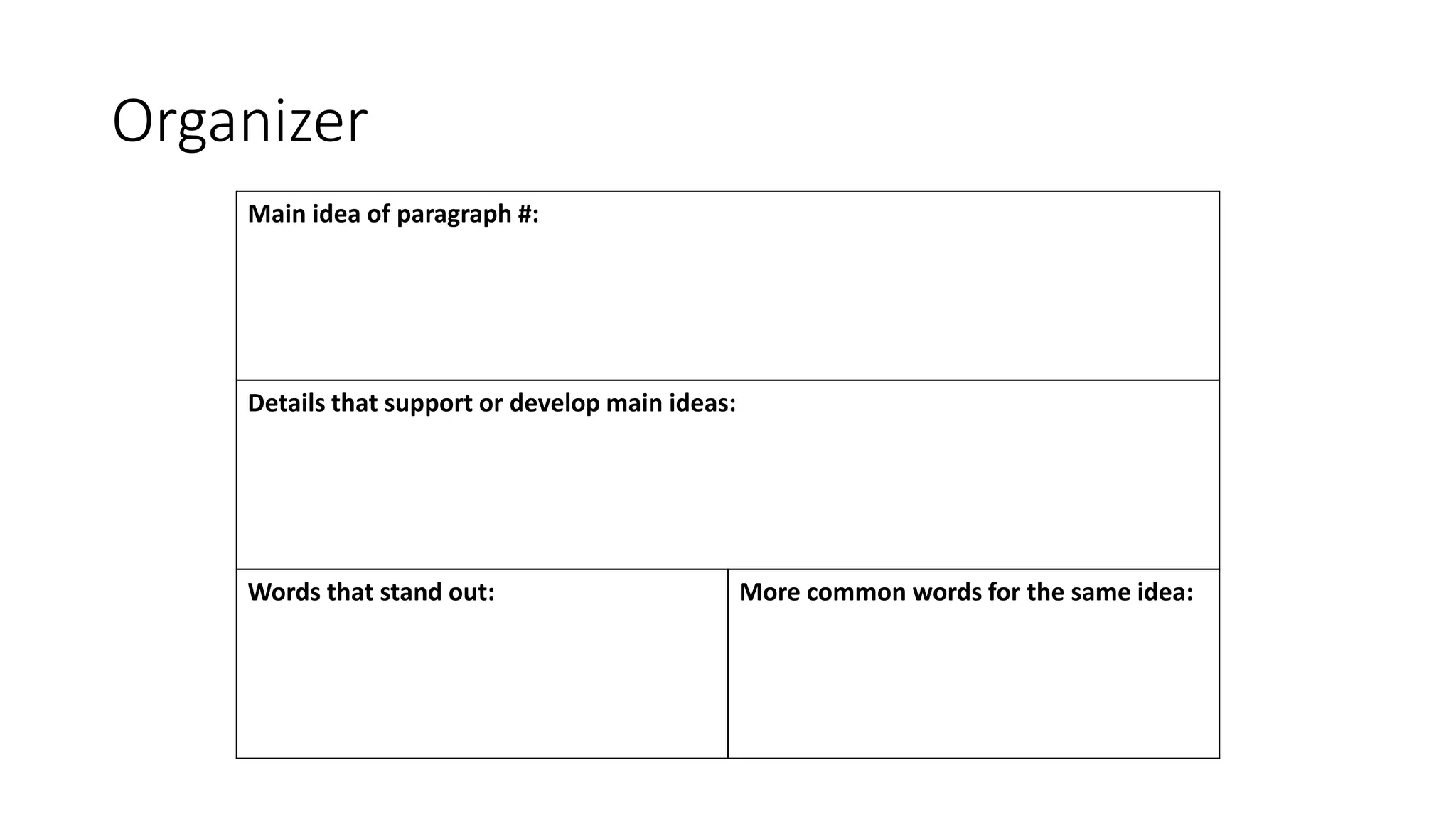
Organizer
Main idea of paragraph #:
Details that support or develop main ideas:
Words that stand out: More common words for the same idea:
Question Builders
Such as
Explain
TDQ – Partner Practice
Evaluate the Questions
• Does the student have to read the text to answer?
• Does the question provide the opportunity to determine the meaning
of academic vocabulary?
• Are the inferences grounded logically in the text?
• Does the question stay focused on the text?
• Is the question aligned to the standard(s)?
• Are the students gaining knowledge as a result of the question?
Planning
a Close
Reading
Well???
“The Gist of the Day”

Close reading

  • 3.
    What percentage ofclass time do students spend reading text (pictures, graphs included)? •Less than 5 minutes a day •5-10 minutes a day •11-20 minutes a day •More than 20 minutes a day
  • 4.
    Close Reading, SoWhat? A significant body of research links close reading of complex text--- -whether the student is a struggling reader or advanced---to significant gains in proficiency and finds close reading to be a key component of CCR. (PARCC, 2011) Common Core ELA standards for 6-12 extend beyond English class to all disciplines. There is now a requirement for cross content literacy (reading, writing, speaking and listening).
  • 5.
  • 6.
    Define Close Reading……. •Underline key details that support the definition of close reading and identify the defining characteristics of close reading. • Jot in the margin, any questions you have while you are reading.
  • 7.
    What is CloseReading? An approach to the text which enables readers to uncover, engage with and understand the information and ideas it contains. HO
  • 8.
    Why Add CloseReading Instruction? • Reading Standard 10 : read and understand increasingly complex text • Build reading skills leading to strength and stamina • Text complexity gap • Opportunity to acquire content knowledge
  • 9.
    Literacy is thegateway to your content!
  • 11.
    How is CloseReading Different?
  • 12.
    Short pieces of rigorous,engaging, thought provoking text
  • 13.
  • 14.
    Multiple readings guided bytext dependent questions
  • 15.
    Gain insight toin order to critically and ethically evaluate the text message.
  • 16.
    Real World Connections,Sharing New Understandings
  • 17.
  • 18.
  • 20.
    Determine the LessonPurpose, Tasks and Standards
  • 21.
  • 22.
  • 23.
  • 24.
  • 25.
  • 26.
    Plan for afterreading task
  • 27.
    Provide instruction andmodeling on Text Annotation
  • 28.
    Supporting Struggling Learners •Use sentence, language or paragraph frames • “I notice that on page____, the author used the word(s) _____________ to help us see _____________.” • Gradual Release: I do it, We do it together, You do it together and You do it) • Paired reading to independent reading • Read Aloud for first read but read independently on second and third reads
  • 30.
    Key Points toRemember When Planning • Determine the _____________--, _____________- and _______. • Select an appropriate ______________--. • Look for ______________ ______________. • Plan the after reading _______________. • Teach p_________________ a___________________. • D____________________ for struggling learners.
  • 31.
  • 32.
    Text-Dependent Questions • canonly be answered correctly by close reading of the text • require an understanding that extends beyond recalling facts • require students to infer • allow students to gather evidence and build knowledge • provide access to increasing levels of complex text • call for careful and thoughtful teacher preparation
  • 33.
    Key Advances BuildToward Readiness for All Students 34
  • 34.
    Four Cognitive Phases •What does the text say? [literal] • How does the text work? [structural] • What does the text mean? [implicit] • What does the text inspire me/you to do? (e.g., writing, speaking, exploring other texts)
  • 35.
    Relationship of Phases -Opinions/arguments - Intertextual connections - Inferences - Authors’ craft & response - Vocabulary & text structure - Key details - General understanding
  • 36.
  • 37.
    Goals of TDQ •Rich and rigorous evidence-based conversations • Discussions that stay deeply connected to the text • Students revisiting text for evidence to support their argument in a thoughtful, careful, and precise way • Students slowing down to explore and learn from the evidence
  • 38.
    Organizer Main idea ofparagraph #: Details that support or develop main ideas: Words that stand out: More common words for the same idea:
  • 39.
  • 40.
  • 42.
    Evaluate the Questions •Does the student have to read the text to answer? • Does the question provide the opportunity to determine the meaning of academic vocabulary? • Are the inferences grounded logically in the text? • Does the question stay focused on the text? • Is the question aligned to the standard(s)? • Are the students gaining knowledge as a result of the question?
  • 43.
  • 44.
  • 45.
    “The Gist ofthe Day”