Good Morning!
• Did you sign in and get refreshed?
• Are you sitting at a table marked with your
Grade Level? ( if work across grades pick one)
• Did you pick up you learning packet for the
day?
• Did you greet your table mates?
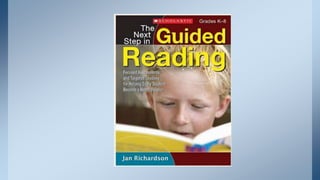
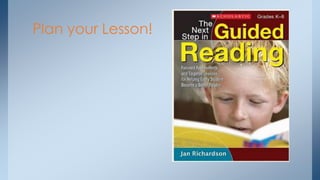
• Do you have your Jan Richardson Book?
Using Small Group Guided Reading to
Differentiate Instruction
The Next Step in
Guided Reading
Road Map for the Day
Preparing for DI in
Guided Reading
Assessments and
grouping
for
Guided Reading
Strategic Teaching in
Groups
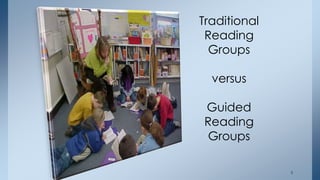
Traditional
Reading
Groups
versus
Guided
Reading
Groups
5
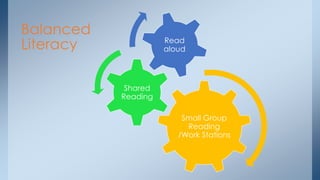
Small Group
Reading
/Work Stations
Shared
Reading
Read
aloud
Balanced
Literacy
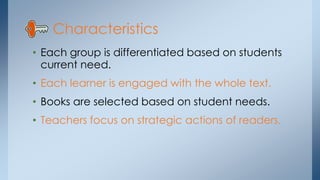
Characteristics
• Each group is differentiated based on students
current need.
• Each learner is engaged with the whole text.
• Books are selected based on student needs.
• Teachers focus on strategic actions of readers.
• Focus is critical thinking, comprehension and is
grounded in the text
• Writing or discussing text
• Explicit instruction in vocabulary, phonics or
word work. (Reading Foundational Skills
Standards)
Characteristics
Road Map for the Day
Preparing for DI in
Guided Reading
I _ d_ _e n_ _n _ _
Teach students to work independently
• Scheduled
• Transitions
• Organized
• Practiced
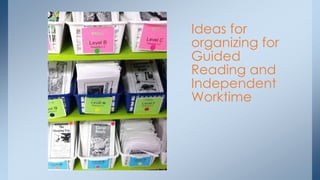
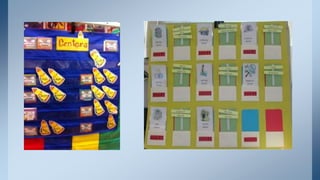
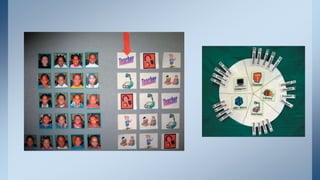
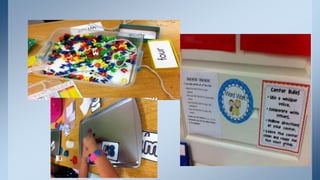
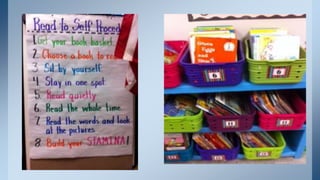
Ideas for
organizing for
Guided
Reading and
Independent
Worktime
ImplementBehaviorManagementSystem
Students need to know how to problem
solve what to do when:
– something doesn’t work
– they don’t understand an activity
– they complete an activity
19
Students need to know:
– who to go to for help
– how to clean up
– how to decide who goes first
when working with a partner
20
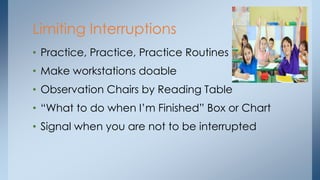
• Practice, Practice, Practice Routines
• Make workstations doable
• Observation Chairs by Reading Table
• “What to do when I’m Finished” Box or Chart
• Signal when you are not to be interrupted
Limiting Interruptions
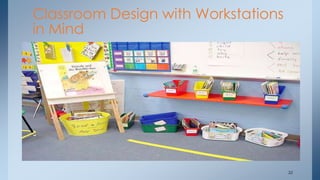
Classroom Design with Workstations
in Mind
22
Road Map for the Day
Preparing for DI in
Guided Reading
Assessments and
grouping
for
Guided Reading
Research EvidenceStudents with reading difficulties who are
taught in small groups learn _______than
students who are instructed as a whole class.
(National Reading Panel, 2000)
24
a.More
b.The same
c.Less
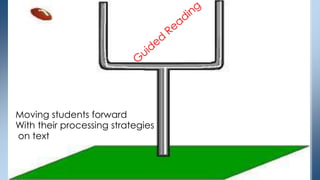
Moving students forward
With their processing strategies
on text
“ The Learning Zone”
What they can
do independently
With support of an
expert
Learning Zone
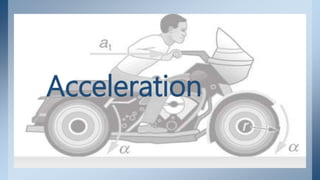
Acceleration
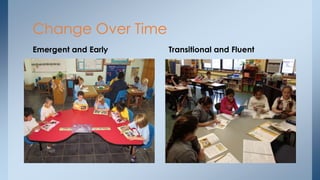
Change Over Time
Emergent and Early Transitional and Fluent
• How should I group students?
• What text should I use with each group?
• What strategy should I teach next?
Jan Richardson “The Next
Step in GR”
Begin with Assessment
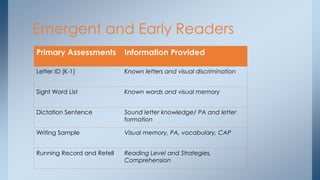
Emergent and Early Readers
Primary Assessments Information Provided
Letter ID (K-1) Known letters and visual discrimination
Sight Word List Known words and visual memory
Dictation Sentence Sound letter knowledge/ PA and letter
formation
Writing Sample Visual memory, PA, vocabulary, CAP
Running Record and Retell Reading Level and Strategies,
Comprehension
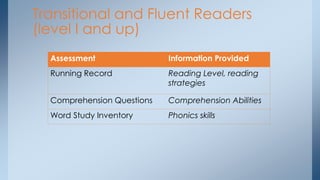
Transitional and Fluent Readers
(level I and up)
Assessment Information Provided
Running Record Reading Level, reading
strategies
Comprehension Questions Comprehension Abilities
Word Study Inventory Phonics skills
Form Differentiated Groups Based
on Assessment
• Keep group size small (5-8 students)
• Base small groups on instructional need with specific
instructional strategies in mind
• Be Flexible!
35
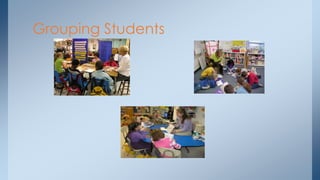
Grouping Students
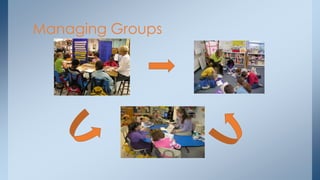
Managing Groups
Road Map for the Day
Preparing for DI in
Guided Reading
Assessments and
grouping
for
Guided Reading
Strategic Teaching in
Groups
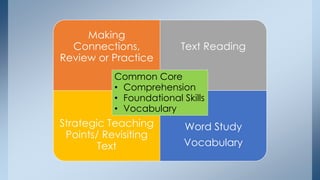
Making
Connections,
Review or Practice
Text Reading
Strategic Teaching
Points/ Revisiting
Text
Word Study
Vocabulary
Guided
Reading
Common Core
• Comprehension
• Foundational Skills
• Vocabulary
Strategies for Sustaining Reading
Reading Foundational Skills
• Emergent behaviors under control
– 1 to 1, Directionality, Concepts about Print, Letter Knowledge, Word
Knowledge
• Detecting and Correcting Error (monitoring)
• Searching for and Using Information
• Problem Solving New Words
• Adjusting to different types of text
• Maintaining Fluency
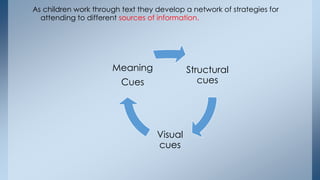
As children work through text they develop a network of strategies for
attending to different sources of information.
Structural
cues
Visual
cues
Meaning
Cues
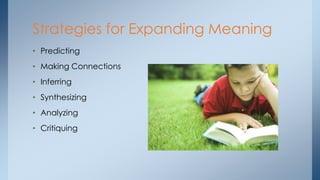
Strategies for Expanding Meaning
• Predicting
• Making Connections
• Inferring
• Synthesizing
• Analyzing
• Critiquing
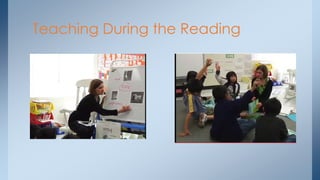
Teaching During the Reading
Planning a lesson
• Know the reading level of the group
• Choose your focus based on data
• Pick a book that matches reading level and will build
on processing strengths ( may be shared for Pre A)
• Read through the lens of your students
• Plan intro, word work or phonemic awareness and
teaching points
• Reflect: What did the students learn to do today that
they couldn’t do yesterday?
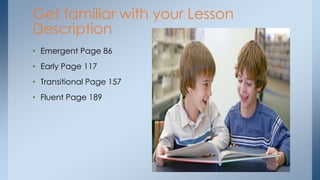
• Emergent Page 86
• Early Page 117
• Transitional Page 157
• Fluent Page 189
Get familiar with your Lesson
Description
Knowing how text change and support
your focus
Text Selection
Focus: Emergent A-C
• Concepts About Print
• Phonemic Awareness
• Building letter and sound
knowledge
• Building Sight word
knowledge
• Repetitive Patterns
• Strong picture support
• Sight words and letters
• Familiar concepts
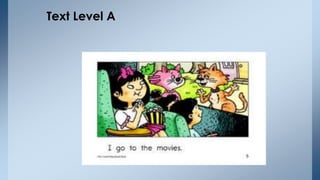
Text Level A
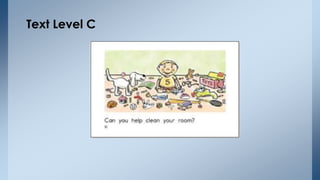
Text Level C
Focus: Early D-I
• Monitoring and Decoding
• Searching for Information
• Fluency
• Retelling/Comprehension
• Language is familiar
• More text per page
• Dialogue
• Opportunities for word
analysis and decoding
• Some new vocabulary
• Story structure advance in
complexity
Transitional Readers
• Cognitive actions essentially the same while processing print but
readers are applying them to more complex text.
– Require more background knowledge
– More variety of genre
– More mature ideas and themes, perspectives
– Sustain Comprehension
– Higher level decoding and fluency
Focus: Transitional: Above Level I (k-
1), J-M (2nd), J-P (3rd)
• Decoding
• Fluency
• Many multisyllabic and
unknown words
• Words should be in their
listening vocabulary
• Prefixes, Suffixes
• Few decoding challenges
• Interesting dialogue/fiction
Focus: Transitional: Above I
• Vocabulary
• Comprehension
• New concepts
• Fiction
• Few new or unfamiliar
concepts, ideas
• Comprehension Strategies
Focus: Fluent ( above Level N)
• Comprehension Strategies for
complex text
• Predicting
• Visualizing
• Questioning
• Connecting
• Determining Importance
• Summarizing
• Inferring
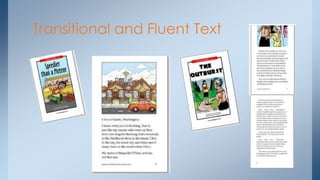
Transitional and Fluent Text
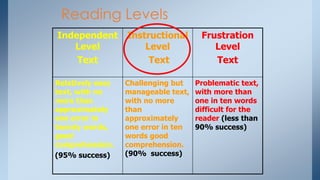
Reading Levels
Independent
Level
Text
Instructional
Level
Text
Frustration
Level
Text
Relatively easy
text, with no
more than
approximately
one error in
twenty words,
good
comprehension.
(95% success)
Challenging but
manageable text,
with no more
than
approximately
one error in ten
words good
comprehension.
(90% success)
Problematic text,
with more than
one in ten words
difficult for the
reader (less than
90% success)
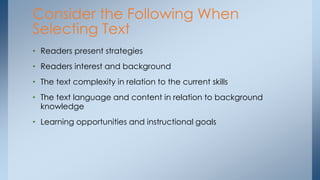
• Readers present strategies
• Readers interest and background
• The text complexity in relation to the current skills
• The text language and content in relation to background
knowledge
• Learning opportunities and instructional goals
Consider the Following When
Selecting Text
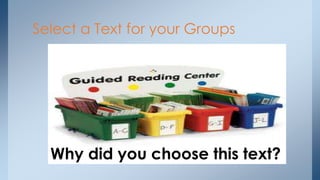
Select a Text for your Groups
Why did you choose this text?
“As a child approaches new
text he is entitled to an
introduction s that when he
reads, the gist of the whole or
partly revealed story can
provide some guide for fluent
reading.”
Marie Clay
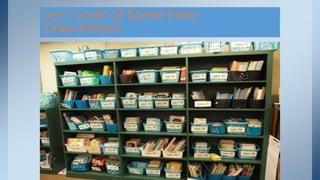
Let’s Look at Some Story
Orientations
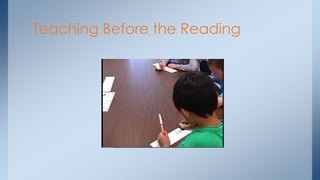
Teaching Before the Reading
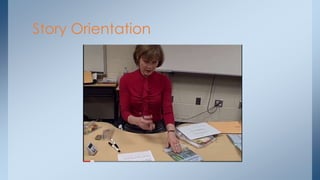
Story Orientation
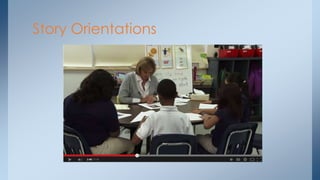
Story Orientations
Orientation to Story
Your book introduction is the KEY
to the child accessing the book
Plan your Lesson!
We have arrived!
Teaching and Prompting for
Strategic Action
Strategies are
• Unobservable
• In the head processes
• A complex “network”
• They allow the learner to use, transform,
relate, interpret and reproduce information
for communication
Increase processing power across
increasingly complex text
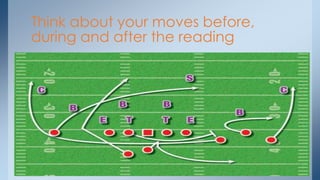
Think about your moves before,
during and after the reading
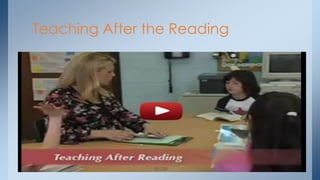
Teaching After the Reading
Teacher Prompts are a Call to
Action
Sight Word Review and Working
with Words
Share
CKEC Summer2014 guided readingbreckenridge

CKEC Summer2014 guided readingbreckenridge

  • 1.
    Good Morning! • Didyou sign in and get refreshed? • Are you sitting at a table marked with your Grade Level? ( if work across grades pick one) • Did you pick up you learning packet for the day? • Did you greet your table mates? • Do you have your Jan Richardson Book?
  • 2.
    Using Small GroupGuided Reading to Differentiate Instruction The Next Step in Guided Reading
  • 4.
    Road Map forthe Day Preparing for DI in Guided Reading Assessments and grouping for Guided Reading Strategic Teaching in Groups
  • 5.
  • 6.
  • 7.
    Characteristics • Each groupis differentiated based on students current need. • Each learner is engaged with the whole text. • Books are selected based on student needs. • Teachers focus on strategic actions of readers.
  • 8.
    • Focus iscritical thinking, comprehension and is grounded in the text • Writing or discussing text • Explicit instruction in vocabulary, phonics or word work. (Reading Foundational Skills Standards) Characteristics
  • 9.
    Road Map forthe Day Preparing for DI in Guided Reading
  • 10.
    I _ d__e n_ _n _ _
  • 11.
    Teach students towork independently
  • 12.
    • Scheduled • Transitions •Organized • Practiced
  • 13.
  • 19.
    ImplementBehaviorManagementSystem Students need toknow how to problem solve what to do when: – something doesn’t work – they don’t understand an activity – they complete an activity 19
  • 20.
    Students need toknow: – who to go to for help – how to clean up – how to decide who goes first when working with a partner 20
  • 21.
    • Practice, Practice,Practice Routines • Make workstations doable • Observation Chairs by Reading Table • “What to do when I’m Finished” Box or Chart • Signal when you are not to be interrupted Limiting Interruptions
  • 22.
    Classroom Design withWorkstations in Mind 22
  • 23.
    Road Map forthe Day Preparing for DI in Guided Reading Assessments and grouping for Guided Reading
  • 24.
    Research EvidenceStudents withreading difficulties who are taught in small groups learn _______than students who are instructed as a whole class. (National Reading Panel, 2000) 24 a.More b.The same c.Less
  • 25.
    Moving students forward Withtheir processing strategies on text
  • 26.
  • 27.
    What they can doindependently With support of an expert Learning Zone
  • 28.
  • 29.
    Change Over Time Emergentand Early Transitional and Fluent
  • 30.
    • How shouldI group students? • What text should I use with each group? • What strategy should I teach next? Jan Richardson “The Next Step in GR” Begin with Assessment
  • 31.
    Emergent and EarlyReaders Primary Assessments Information Provided Letter ID (K-1) Known letters and visual discrimination Sight Word List Known words and visual memory Dictation Sentence Sound letter knowledge/ PA and letter formation Writing Sample Visual memory, PA, vocabulary, CAP Running Record and Retell Reading Level and Strategies, Comprehension
  • 32.
    Transitional and FluentReaders (level I and up) Assessment Information Provided Running Record Reading Level, reading strategies Comprehension Questions Comprehension Abilities Word Study Inventory Phonics skills
  • 35.
    Form Differentiated GroupsBased on Assessment • Keep group size small (5-8 students) • Base small groups on instructional need with specific instructional strategies in mind • Be Flexible! 35
  • 36.
  • 37.
  • 38.
    Road Map forthe Day Preparing for DI in Guided Reading Assessments and grouping for Guided Reading Strategic Teaching in Groups
  • 39.
    Making Connections, Review or Practice TextReading Strategic Teaching Points/ Revisiting Text Word Study Vocabulary Guided Reading Common Core • Comprehension • Foundational Skills • Vocabulary
  • 40.
    Strategies for SustainingReading Reading Foundational Skills • Emergent behaviors under control – 1 to 1, Directionality, Concepts about Print, Letter Knowledge, Word Knowledge • Detecting and Correcting Error (monitoring) • Searching for and Using Information • Problem Solving New Words • Adjusting to different types of text • Maintaining Fluency
  • 41.
    As children workthrough text they develop a network of strategies for attending to different sources of information. Structural cues Visual cues Meaning Cues
  • 42.
    Strategies for ExpandingMeaning • Predicting • Making Connections • Inferring • Synthesizing • Analyzing • Critiquing
  • 43.
  • 44.
    Planning a lesson •Know the reading level of the group • Choose your focus based on data • Pick a book that matches reading level and will build on processing strengths ( may be shared for Pre A) • Read through the lens of your students • Plan intro, word work or phonemic awareness and teaching points • Reflect: What did the students learn to do today that they couldn’t do yesterday?
  • 45.
    • Emergent Page86 • Early Page 117 • Transitional Page 157 • Fluent Page 189 Get familiar with your Lesson Description
  • 49.
    Knowing how textchange and support your focus Text Selection
  • 50.
    Focus: Emergent A-C •Concepts About Print • Phonemic Awareness • Building letter and sound knowledge • Building Sight word knowledge • Repetitive Patterns • Strong picture support • Sight words and letters • Familiar concepts
  • 51.
  • 52.
  • 53.
    Focus: Early D-I •Monitoring and Decoding • Searching for Information • Fluency • Retelling/Comprehension • Language is familiar • More text per page • Dialogue • Opportunities for word analysis and decoding • Some new vocabulary • Story structure advance in complexity
  • 55.
    Transitional Readers • Cognitiveactions essentially the same while processing print but readers are applying them to more complex text. – Require more background knowledge – More variety of genre – More mature ideas and themes, perspectives – Sustain Comprehension – Higher level decoding and fluency
  • 56.
    Focus: Transitional: AboveLevel I (k- 1), J-M (2nd), J-P (3rd) • Decoding • Fluency • Many multisyllabic and unknown words • Words should be in their listening vocabulary • Prefixes, Suffixes • Few decoding challenges • Interesting dialogue/fiction
  • 57.
    Focus: Transitional: AboveI • Vocabulary • Comprehension • New concepts • Fiction • Few new or unfamiliar concepts, ideas • Comprehension Strategies
  • 58.
    Focus: Fluent (above Level N) • Comprehension Strategies for complex text • Predicting • Visualizing • Questioning • Connecting • Determining Importance • Summarizing • Inferring
  • 59.
  • 60.
    Reading Levels Independent Level Text Instructional Level Text Frustration Level Text Relatively easy text,with no more than approximately one error in twenty words, good comprehension. (95% success) Challenging but manageable text, with no more than approximately one error in ten words good comprehension. (90% success) Problematic text, with more than one in ten words difficult for the reader (less than 90% success)
  • 61.
    • Readers presentstrategies • Readers interest and background • The text complexity in relation to the current skills • The text language and content in relation to background knowledge • Learning opportunities and instructional goals Consider the Following When Selecting Text
  • 62.
    Select a Textfor your Groups Why did you choose this text?
  • 63.
    “As a childapproaches new text he is entitled to an introduction s that when he reads, the gist of the whole or partly revealed story can provide some guide for fluent reading.” Marie Clay
  • 64.
    Let’s Look atSome Story Orientations
  • 65.
  • 66.
  • 67.
  • 68.
    Orientation to Story Yourbook introduction is the KEY to the child accessing the book
  • 69.
  • 70.
  • 71.
    Teaching and Promptingfor Strategic Action
  • 72.
    Strategies are • Unobservable •In the head processes • A complex “network” • They allow the learner to use, transform, relate, interpret and reproduce information for communication
  • 73.
    Increase processing poweracross increasingly complex text
  • 75.
    Think about yourmoves before, during and after the reading
  • 76.
  • 77.
    Teacher Prompts area Call to Action
  • 78.
    Sight Word Reviewand Working with Words
  • 79.