



Guided Reading
“No student is too
  anything to be
   able to read
     and write”
David Yoder, DJI-AbleNet
 Literacy Lecture, ISAAC
           2000
Our National Curriculum
“We need to give greater attention to the
 general capabilities of Literacy as being
core to the learning needs of students with
  significant intellectual disability and the
ways in which these can be taught through
 age appropriate contexts drawn from the
               learning areas ”
                (ACARA, 2012)
Red light, Green light
Accommodating Struggles
      physical demands
      cognitive demands
      sensory demands
   communication demands
     experience demands
       affect demands
Conventional Literacy
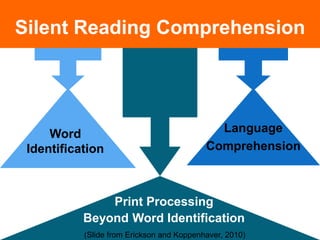
Silent Reading Comprehension


     Word                                    Language
 Identification                            Comprehension


               Print Processing
           Beyond Word Identification
           (Slide from Erickson and Koppenhaver, 2010)
Beginning To Read
Phonological awareness, letter recognition
  facility, familiarity with spelling patterns,
  spelling-sound relations, and individual
 words must be developed in concert with
   read reading and real writing and with
     deliberate reflection on the forms,
     functions, and meanings of texts.
                  (Adams, 1990)
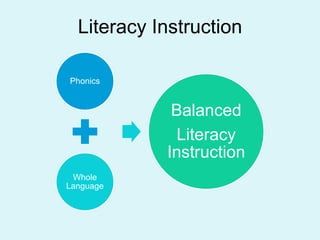
Literacy Instruction

Phonics


             Balanced
             Literacy
            Instruction
 Whole
Language
Balanced Literacy Instruction
• Uses all valid parts of literacy instruction –
  not one approach;
• Works for students all along the literacy
  continuum – from emergent to formal;
• Four Blocks is balanced literacy
  instruction.
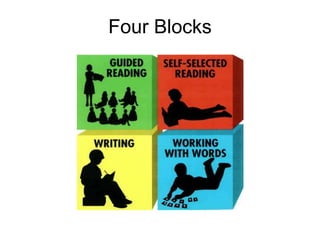
Four Blocks
Four Blocks
• Created by Patricia Cunningham and
  Dorothy Hall;
• www.fourblocks.com;
• Four Blocks in Special Ed wiki
  https://fourblock.wikispaces.com/.
Four Blocks
• Centre for Literacy and Disability Studies,
  North Carolina
  http://www.med.unc.edu/ahs/clds;
• Big thank-you to them for teaching me
  about Four Blocks, sharing their resources
  and being awesome!
• Have a good look at their resources
  section.
Guided Reading
• Primary purposes are to assist students to:
  – Understand that reading involves thinking and
    meaning-making;
  – Become more strategic in their own reading.
• Must use a wide variety of books and
  other print materials.
Self-Selected Reading
• Primary purposes are to assist students to:
  – Understand why they might want to learn;
  – Become automatic in skill application;
  – Choose to read after they learn how.
• It isn’t self-directed if you don’t choose it
  yourself;
• You can’t get good at it if it is too difficult.
Writing
• Students who write become better
  readers, writers and thinkers;
• Learning in classroom writing
  communities:
  – Write for real reasons;
  – See others do so;
  – Interact with peers and teacher about written
    content, use and form.
Working with Words
• Primary purpose is to help students become
  strategic in reading words;
• Make words instruction:
  – Words based;
  – Experience based;
  – Age appropriate;
• Should results in students who read and
  write:
  – More;
  – More successfully and independently;
  – With greater enjoyment.
If All Children Are To
  Learn, All Teachers
       Must Teach
       Everything
(Koppenhaver, Erickson & Clendon,
              2008)
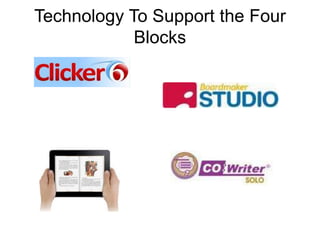
Technology To Support the Four
            Blocks
But remember.....


ICT = It Can’t
    Teach
Guided Reading
Guided Reading
• Help students to understand that:
  – Reading involves thinking and meaning making;
  – They can use a range of strategies in their
    reading to collect information, understand text,
    etc.
• Must use a wide variety of books and other
  print materials:
  – Commercial books;
  – Personal experience books;
  – Custom books.
• NOT listening comprehension.
Purposes for Reading
• Need to set a purpose every time you do
  guided reading;
• If you don’t set a purpose students think
  they have to remember everything – or
  become passive;
• Purpose needs to be broad enough to
  motivate processing of entire text.
Purposes for Reading
• Developing readers have not learned to
  set their own purposes for reading.
• If a purpose is not set, the implied purpose
  is:
  – Read this to remember everything
  – Read this to guess what I am going to ask you
• Purpose should be broad enough to
  motivate processing of entire text:
  – Yes: Read to make up a new title for this story
  – No: Read to tell me where the story takes
    place
3 Characteristics of Good
              Purposes:
       “Read so that you can...”
• Requires processing of entire text, at least
  initially:
  – Yes: tell in 10 words or less what this story is
    about
  – No: tell where the hero lived
• Requires search for main idea:
  – Yes: tell how you think the story will end
  – No: tell which words on pg7 have a short /i/ sound
• Helps the reader focus attention:
  – Yes: tell which of these adjectives describe the
    boy and which describe the girl in the story
  – No: answer the questions at the end of the
Guided Reading
• 1 book per week;
• Different purpose each day;
• Build confidence;
• Some students will participate in the
  repeated readings or in setting purposes
  as they become more skilled;
• Help students become independent.
Types of Guided Reading
•   Picture walk;
•   Before-During-After (Three Part);
•   Directed Reading-Thinking Activity;
•   KWL (What do I Know, what do I Want to
    know, what have I Learned).
Guided Reading Follow-Ups
• Action purposes – Reader’s Theatre,
  Drawing, etc;
• Linguistic purposes – sentence ordering,
  word ordering, write our own version.
Picture Walk
• Walk students through the book and get
  them to guess the content;
• They can use any strategy:
  – Prior knowledge;
  – Knowledge of text structures;
  – Some word knowledge;
  – Picture as supports.
5 part Guided Reading
• Before reading:
   1. Build or activate background knowledge
   2. Purpose “Read so that you can”
• During reading:
   3. Read/listen
• After reading:
   4. Task directly related to the purpose
   5. Feedback/Discussion (typically woven into follow-up)
      • What makes you say that? How do you know? Why do you
        think so?
      • Help students gain cognitive clarity so they can be successful
        again or next time
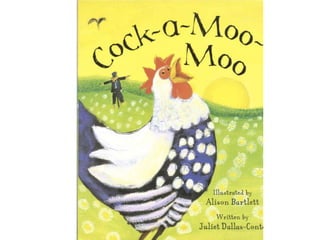
Cock-A-Moo-Moo
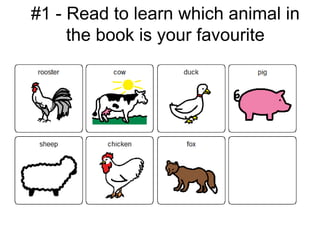
1. Read to learn which animal in the book is
   your favourite (before reading, list the
   animals in the book)
#1 - Read to learn which animal in
     the book is your favourite
Participation for students with
               CCN
• If they have a comprehensive
  communication system (egg PODD) then
  they can use that to participate across the
  day;
• If they don’t then we need to provide ways
  for them to participate;
• AND we need to work towards getting
  them a comprehensive communication
  system.
Cock-A-Moo-Moo Purposes
1. Read to learn which animal in the book is your
   favourite (before reading, list the animals in the
   book)
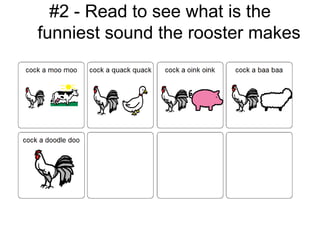
2. Read to see what is the funniest sound the
   rooster makes (before reading, list the sounds
   the rooster makes)
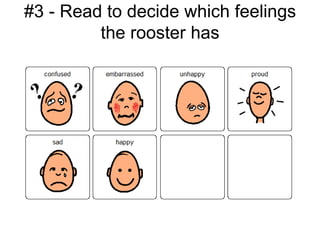
3. Read to decide which feelings the rooster has
   (before reading, list some feelings you know)
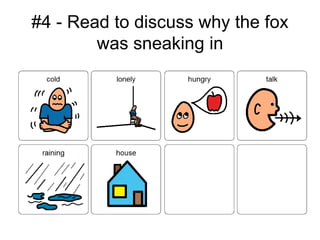
4. Read to discuss why the fox was sneaking in
   (before reading discuss reasons he might sneak
   into a barn)
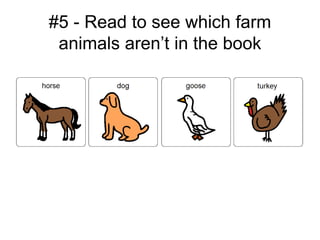
5. Read to see which farm animals aren’t in the
   book (before reading list the farm animals you
#2 - Read to see what is the
funniest sound the rooster makes
#3 - Read to decide which feelings
         the rooster has
#4 - Read to discuss why the fox
        was sneaking in
#5 - Read to see which farm
 animals aren’t in the book
Repetition with Variety
To learn a skill and generalise it across
    contexts, instruction must provide
repetition of the skills in a variety of ways
Variety
• Variety of purposes;
• Variety of approaches;
• Variety of texts;
Directed Reading-Thinking Activity
         DR-TA (Stauffer)
• Students LOOK at title or pictures and
  predict story;
• Students READ to a predetermined
  stopping point;
• Students PROVE the accuracy of their
  predictions and modify them or make new
  predictions.
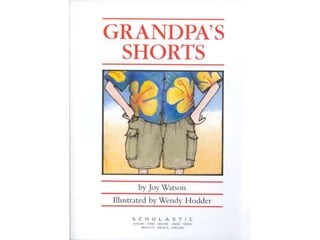
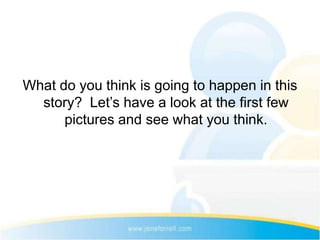
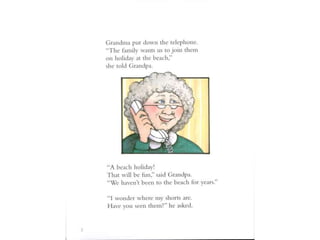
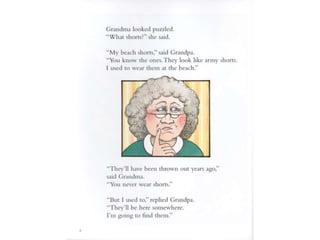
What do you think is going to happen in this
  story? Let’s have a look at the first few
      pictures and see what you think.
What do you think is going to happen in this
                   story?
Check Predictions
     Changes?
     Deletions?
     Additions?
How did your predictions match the
              text?
KWL (Ogle, 1986)
• Know – what do I know?
  – Identify key concept in text and ask students
    to tell you what they know about it
• Want – what do I want to know?
• Learn – what have I learned?
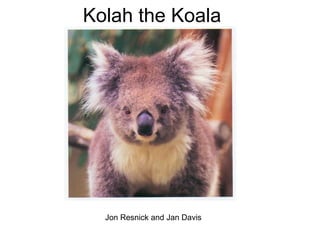
Kolah the Koala


  Jon Resnick and Jan Davis
Variety of texts
• Commercial books;
• Fiction and non-fiction;
• Language Experience/custom texts;
• Created texts about class/individual
  experiences;
• Personal alphabet books;
• TarHeel Reader books.
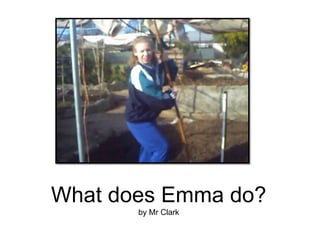
What does Emma do?
       by Mr Clark
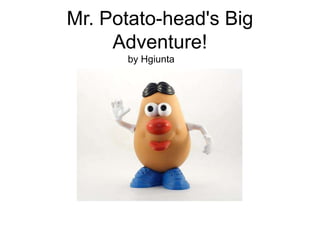
Mr. Potato-head's Big
     Adventure!
      by Hgiunta
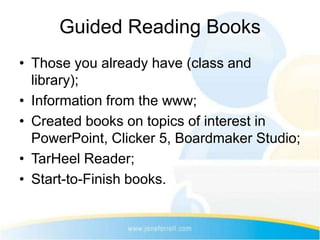
Guided Reading Books
• Those you already have (class and
  library);
• Information from the www;
• Created books on topics of interest in
  PowerPoint, Clicker 5, Boardmaker Studio;
• TarHeel Reader;
• Start-to-Finish books.
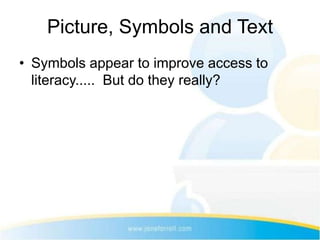
Picture, Symbols and Text
• Symbols appear to improve access to
  literacy..... But do they really?
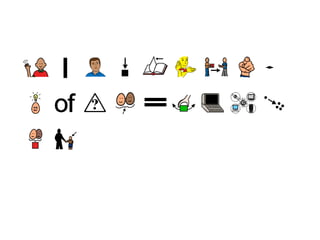
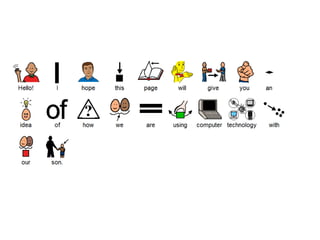
Why no picture-supported text
      when teaching reading?
• Pictographs can be distracting for developing
  readers who may pay more attention to the
  pictures than the text they are learning to
  read/decode
• After a review of literature Hatch (2009) found “the
  outcomes of several research studies that
  investigated the use of pictures to support the
  development of word identification in readers with
  and without disabilities indicated that children
  learned more words in fewer trials when words
  were presented alone than when paired with
  pictures (Pufpaff, Blischak & Lloyd, 2000;
  Samuels, 1967; Samuels et al, 1974)
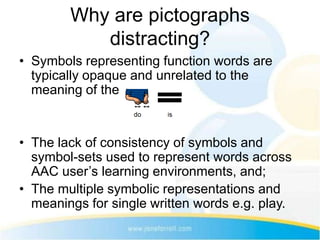
Why are pictographs
           distracting?
• Symbols representing function words are
  typically opaque and unrelated to the
  meaning of the text.


• The lack of consistency of symbols and
  symbol-sets used to represent words across
  AAC user’s learning environments, and;
• The multiple symbolic representations and
  meanings for single written words e.g. play.
When should we use symbols?
• To support COMMUNICATION
  – All day, every day
  – During reading instruction
  – During writing instruction
• To support behaviour and self-regulation
  – Visual supports
  – Visual schedules

Introduction to Guided Reading

  • 1.
  • 2.
    “No student istoo anything to be able to read and write” David Yoder, DJI-AbleNet Literacy Lecture, ISAAC 2000
  • 3.
    Our National Curriculum “Weneed to give greater attention to the general capabilities of Literacy as being core to the learning needs of students with significant intellectual disability and the ways in which these can be taught through age appropriate contexts drawn from the learning areas ” (ACARA, 2012)
  • 4.
  • 5.
    Accommodating Struggles physical demands cognitive demands sensory demands communication demands experience demands affect demands
  • 6.
  • 7.
    Silent Reading Comprehension Word Language Identification Comprehension Print Processing Beyond Word Identification (Slide from Erickson and Koppenhaver, 2010)
  • 8.
    Beginning To Read Phonologicalawareness, letter recognition facility, familiarity with spelling patterns, spelling-sound relations, and individual words must be developed in concert with read reading and real writing and with deliberate reflection on the forms, functions, and meanings of texts. (Adams, 1990)
  • 9.
    Literacy Instruction Phonics Balanced Literacy Instruction Whole Language
  • 10.
    Balanced Literacy Instruction •Uses all valid parts of literacy instruction – not one approach; • Works for students all along the literacy continuum – from emergent to formal; • Four Blocks is balanced literacy instruction.
  • 11.
  • 12.
    Four Blocks • Createdby Patricia Cunningham and Dorothy Hall; • www.fourblocks.com; • Four Blocks in Special Ed wiki https://fourblock.wikispaces.com/.
  • 13.
    Four Blocks • Centrefor Literacy and Disability Studies, North Carolina http://www.med.unc.edu/ahs/clds; • Big thank-you to them for teaching me about Four Blocks, sharing their resources and being awesome! • Have a good look at their resources section.
  • 14.
    Guided Reading • Primarypurposes are to assist students to: – Understand that reading involves thinking and meaning-making; – Become more strategic in their own reading. • Must use a wide variety of books and other print materials.
  • 15.
    Self-Selected Reading • Primarypurposes are to assist students to: – Understand why they might want to learn; – Become automatic in skill application; – Choose to read after they learn how. • It isn’t self-directed if you don’t choose it yourself; • You can’t get good at it if it is too difficult.
  • 16.
    Writing • Students whowrite become better readers, writers and thinkers; • Learning in classroom writing communities: – Write for real reasons; – See others do so; – Interact with peers and teacher about written content, use and form.
  • 17.
    Working with Words •Primary purpose is to help students become strategic in reading words; • Make words instruction: – Words based; – Experience based; – Age appropriate; • Should results in students who read and write: – More; – More successfully and independently; – With greater enjoyment.
  • 18.
    If All ChildrenAre To Learn, All Teachers Must Teach Everything (Koppenhaver, Erickson & Clendon, 2008)
  • 19.
    Technology To Supportthe Four Blocks
  • 20.
    But remember..... ICT =It Can’t Teach
  • 21.
  • 22.
    Guided Reading • Helpstudents to understand that: – Reading involves thinking and meaning making; – They can use a range of strategies in their reading to collect information, understand text, etc. • Must use a wide variety of books and other print materials: – Commercial books; – Personal experience books; – Custom books. • NOT listening comprehension.
  • 23.
    Purposes for Reading •Need to set a purpose every time you do guided reading; • If you don’t set a purpose students think they have to remember everything – or become passive; • Purpose needs to be broad enough to motivate processing of entire text.
  • 24.
    Purposes for Reading •Developing readers have not learned to set their own purposes for reading. • If a purpose is not set, the implied purpose is: – Read this to remember everything – Read this to guess what I am going to ask you • Purpose should be broad enough to motivate processing of entire text: – Yes: Read to make up a new title for this story – No: Read to tell me where the story takes place
  • 25.
    3 Characteristics ofGood Purposes: “Read so that you can...” • Requires processing of entire text, at least initially: – Yes: tell in 10 words or less what this story is about – No: tell where the hero lived • Requires search for main idea: – Yes: tell how you think the story will end – No: tell which words on pg7 have a short /i/ sound • Helps the reader focus attention: – Yes: tell which of these adjectives describe the boy and which describe the girl in the story – No: answer the questions at the end of the
  • 26.
    Guided Reading • 1book per week; • Different purpose each day; • Build confidence; • Some students will participate in the repeated readings or in setting purposes as they become more skilled; • Help students become independent.
  • 27.
    Types of GuidedReading • Picture walk; • Before-During-After (Three Part); • Directed Reading-Thinking Activity; • KWL (What do I Know, what do I Want to know, what have I Learned).
  • 28.
    Guided Reading Follow-Ups •Action purposes – Reader’s Theatre, Drawing, etc; • Linguistic purposes – sentence ordering, word ordering, write our own version.
  • 29.
    Picture Walk • Walkstudents through the book and get them to guess the content; • They can use any strategy: – Prior knowledge; – Knowledge of text structures; – Some word knowledge; – Picture as supports.
  • 31.
    5 part GuidedReading • Before reading: 1. Build or activate background knowledge 2. Purpose “Read so that you can” • During reading: 3. Read/listen • After reading: 4. Task directly related to the purpose 5. Feedback/Discussion (typically woven into follow-up) • What makes you say that? How do you know? Why do you think so? • Help students gain cognitive clarity so they can be successful again or next time
  • 32.
    Cock-A-Moo-Moo 1. Read tolearn which animal in the book is your favourite (before reading, list the animals in the book)
  • 34.
    #1 - Readto learn which animal in the book is your favourite
  • 35.
    Participation for studentswith CCN • If they have a comprehensive communication system (egg PODD) then they can use that to participate across the day; • If they don’t then we need to provide ways for them to participate; • AND we need to work towards getting them a comprehensive communication system.
  • 36.
    Cock-A-Moo-Moo Purposes 1. Readto learn which animal in the book is your favourite (before reading, list the animals in the book) 2. Read to see what is the funniest sound the rooster makes (before reading, list the sounds the rooster makes) 3. Read to decide which feelings the rooster has (before reading, list some feelings you know) 4. Read to discuss why the fox was sneaking in (before reading discuss reasons he might sneak into a barn) 5. Read to see which farm animals aren’t in the book (before reading list the farm animals you
  • 37.
    #2 - Readto see what is the funniest sound the rooster makes
  • 38.
    #3 - Readto decide which feelings the rooster has
  • 39.
    #4 - Readto discuss why the fox was sneaking in
  • 40.
    #5 - Readto see which farm animals aren’t in the book
  • 41.
    Repetition with Variety Tolearn a skill and generalise it across contexts, instruction must provide repetition of the skills in a variety of ways
  • 42.
    Variety • Variety ofpurposes; • Variety of approaches; • Variety of texts;
  • 43.
    Directed Reading-Thinking Activity DR-TA (Stauffer) • Students LOOK at title or pictures and predict story; • Students READ to a predetermined stopping point; • Students PROVE the accuracy of their predictions and modify them or make new predictions.
  • 45.
    What do youthink is going to happen in this story? Let’s have a look at the first few pictures and see what you think.
  • 50.
    What do youthink is going to happen in this story?
  • 51.
    Check Predictions Changes? Deletions? Additions?
  • 52.
    How did yourpredictions match the text?
  • 53.
    KWL (Ogle, 1986) •Know – what do I know? – Identify key concept in text and ask students to tell you what they know about it • Want – what do I want to know? • Learn – what have I learned?
  • 54.
    Kolah the Koala Jon Resnick and Jan Davis
  • 55.
    Variety of texts •Commercial books; • Fiction and non-fiction; • Language Experience/custom texts; • Created texts about class/individual experiences; • Personal alphabet books; • TarHeel Reader books.
  • 56.
    What does Emmado? by Mr Clark
  • 57.
    Mr. Potato-head's Big Adventure! by Hgiunta
  • 59.
    Guided Reading Books •Those you already have (class and library); • Information from the www; • Created books on topics of interest in PowerPoint, Clicker 5, Boardmaker Studio; • TarHeel Reader; • Start-to-Finish books.
  • 60.
    Picture, Symbols andText • Symbols appear to improve access to literacy..... But do they really?
  • 63.
    Why no picture-supportedtext when teaching reading? • Pictographs can be distracting for developing readers who may pay more attention to the pictures than the text they are learning to read/decode • After a review of literature Hatch (2009) found “the outcomes of several research studies that investigated the use of pictures to support the development of word identification in readers with and without disabilities indicated that children learned more words in fewer trials when words were presented alone than when paired with pictures (Pufpaff, Blischak & Lloyd, 2000; Samuels, 1967; Samuels et al, 1974)
  • 64.
    Why are pictographs distracting? • Symbols representing function words are typically opaque and unrelated to the meaning of the text. • The lack of consistency of symbols and symbol-sets used to represent words across AAC user’s learning environments, and; • The multiple symbolic representations and meanings for single written words e.g. play.
  • 65.
    When should weuse symbols? • To support COMMUNICATION – All day, every day – During reading instruction – During writing instruction • To support behaviour and self-regulation – Visual supports – Visual schedules