How to Teach
Reading
Yenny Cadena
Diego Acuña
Lorena Peña
Hugo Serrano
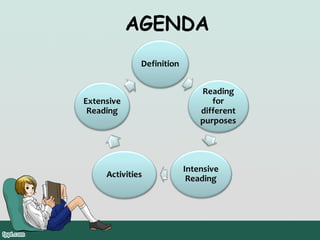
AGENDA
The Nature of Reading
We were never born to read. Humans beings
invented reading only a few thousand of years
ago. And with this invention, we rearranged
the very organization of our brain, which in
turn expanded the ways we were able to
think, which altered the intellectual evolution
of our species. (Wolf, 2007:3)
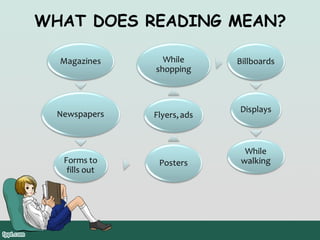
WHAT DOES READING MEAN?
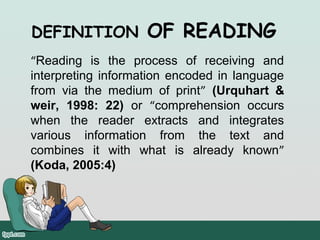
DEFINITION

OF READING

“Reading is the process of receiving and
interpreting information encoded in language
from via the medium of print” (Urquhart &
weir, 1998: 22) or “comprehension occurs
when the reader extracts and integrates
various information from the text and
combines it with what is already known”
(Koda, 2005:4)
Video by Dr. Richard
Alligton
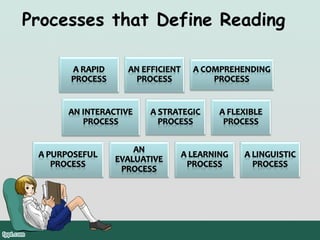
Processes that Define Reading
READING FOR DIFFERENT
PURPOSES
Reading ability can be improved by
teaching how to read for particular
purposes. (Anderson, 2000 a: 397)
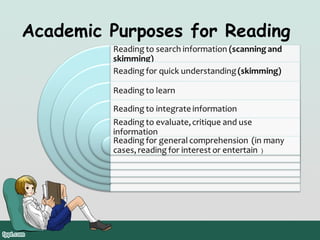
Academic Purposes for Reading
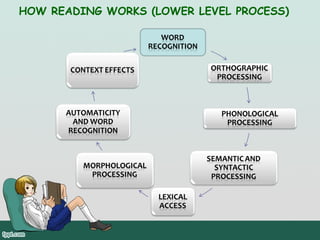
HOW READING WORKS (LOWER LEVEL PROCESS)
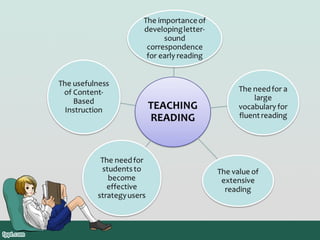
The importance of
teaching reading.
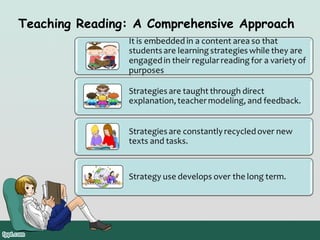
Teaching Reading: A Comprehensive Approach
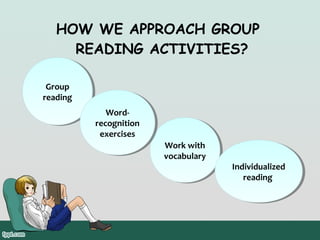
HOW WE APPROACH GROUP
READING ACTIVITIES?
Group
Group
reading
reading
WordWordrecognition
recognition
exercises
exercises

Work with
Work with
vocabulary
vocabulary

Individualized
Individualized
reading
reading
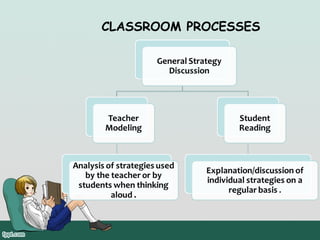
CLASSROOM PROCESSES
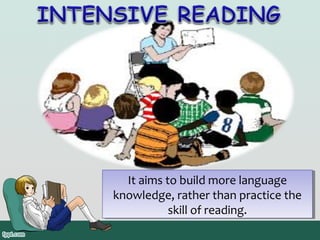
It aims to build more language
knowledge, rather than practice the
skill of reading.
skill of reading.
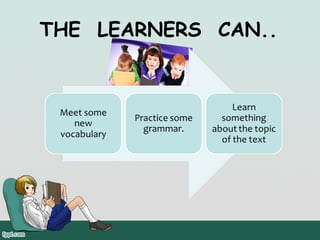
THE LEARNERS CAN..
Activity
Do you like the text?
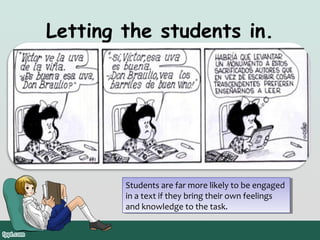
Letting the students in.

Students are far more likely to be engaged
in a text if they bring their own feelings
and knowledge to the task.
The Vocabulary Question.

“It seems contradictory to insist that students
“ read for meaning” while simultaneously
discouraging them from trying to understand
the text at a deeper level than merely gist”.
By Carol Walker (1998).
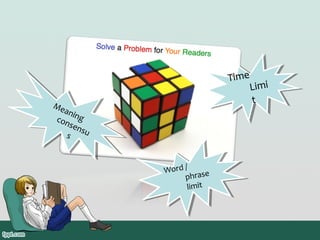
Time
Time
Limii
Lim
tt

Mee
Ma
ann
ni in
cco g
ons g
nse
ens
nsu
ss u
Worrd/ / se
Wo d
phrrase
ph a
lilmitt
imi
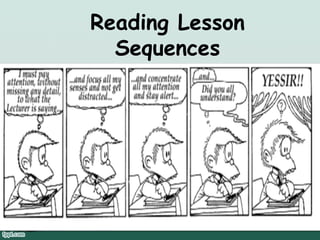
Reading Lesson
Sequences
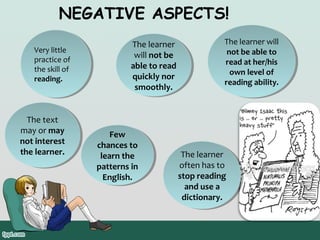
NEGATIVE ASPECTS!
Very little
Very little
practice of
practice of
the skill of
the skill of
reading.
reading.

The text
The text
may or may
may or may
not interest
not interest
the learner.
the learner.

The learner
The learner
will not be
will not be
able to read
able to read
quickly nor
quickly nor
smoothly.
smoothly.

Few
Few
chances to
chances to
learn the
learn the
patterns in
patterns in
English.
English.

The learner will
The learner will
not be able to
not be able to
read at her/his
read at her/his
own level of
own level of
reading ability.
reading ability.

The learner
The learner
often has to
often has to
stop reading
stop reading
and use a
and use a
dictionary.
dictionary.
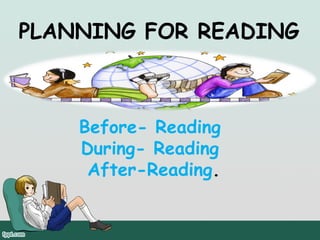
PLANNING FOR READING

Before- Reading
During- Reading
After-Reading.
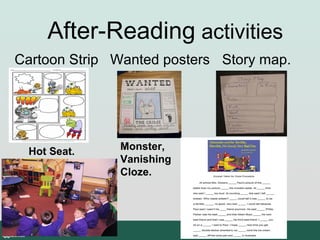
After-Reading activities
Cartoon Strip Wanted posters Story map.

Hot Seat.

Monster,
Vanishing
Cloze.
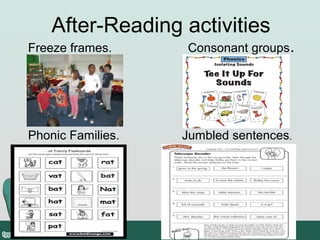
After-Reading activities
Freeze frames.

Phonic Families.

Consonant groups .

Jumbled sentences.
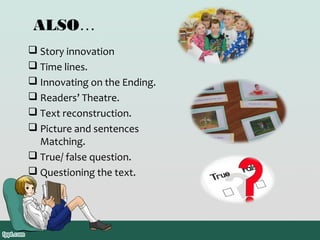
ALSO…
 Story innovation
 Time lines.
 Innovating on the Ending.
 Readers’ Theatre.
 Text reconstruction.
 Picture and sentences
Matching.
 True/ false question.
 Questioning the text.
EXTENSIVE READING
io
o
effnitti
e i ini
D
D
n
n

Pur
Pur
pos
pos
ee
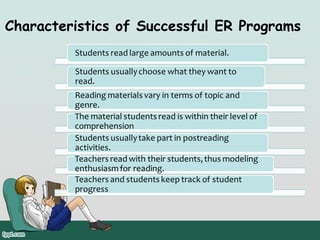
Characteristics of Successful ER Programs
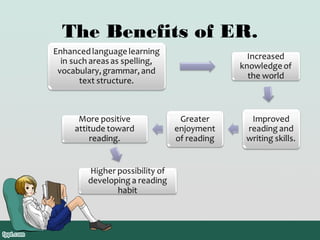
The Benefits of ER.
HOW DO WE ASSESS THE STUDENTS’
EXTENSIVE READING?

Since each learner is reading different
books, the teacher does not have
enough time to test each Students’
reading.
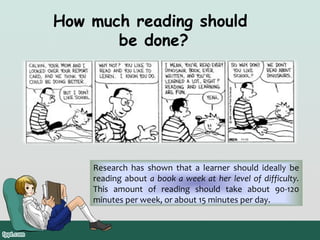
How much reading should
be done?

Research has shown that a learner should ideally be
reading about a book a week at her level of difficulty.
This amount of reading should take about 90-120
minutes per week, or about 15 minutes per day.
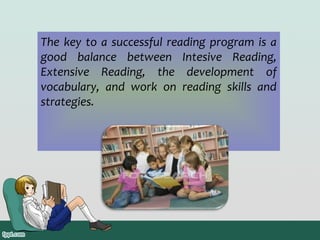
The key to a successful reading program is a
good balance between Intesive Reading,
Extensive Reading, the development of
vocabulary, and work on reading skills and
strategies.
Bibliography
Richards, Jack C and Willy A. Renandya. 2002. Methodology in
Language Teaching. Cambridge University Press.
Grabe, W.(2009) Reading in a Second Language: Moving from Theory
to Practice. USA. Cambridge Applied Linguistics.
Gibbons, Pauline. 2002. Scaffolding language, Scaffolding learning.
Waring, Rob. Oxford Graded Readers. Oxford University press.
How to teach reading

How to teach reading

  • 1.
    How to Teach Reading YennyCadena Diego Acuña Lorena Peña Hugo Serrano
  • 2.
  • 3.
    The Nature ofReading We were never born to read. Humans beings invented reading only a few thousand of years ago. And with this invention, we rearranged the very organization of our brain, which in turn expanded the ways we were able to think, which altered the intellectual evolution of our species. (Wolf, 2007:3)
  • 4.
  • 5.
    DEFINITION OF READING “Reading isthe process of receiving and interpreting information encoded in language from via the medium of print” (Urquhart & weir, 1998: 22) or “comprehension occurs when the reader extracts and integrates various information from the text and combines it with what is already known” (Koda, 2005:4)
  • 6.
    Video by Dr.Richard Alligton
  • 7.
  • 8.
    READING FOR DIFFERENT PURPOSES Readingability can be improved by teaching how to read for particular purposes. (Anderson, 2000 a: 397)
  • 9.
  • 10.
    HOW READING WORKS(LOWER LEVEL PROCESS)
  • 11.
  • 13.
    Teaching Reading: AComprehensive Approach
  • 14.
    HOW WE APPROACHGROUP READING ACTIVITIES? Group Group reading reading WordWordrecognition recognition exercises exercises Work with Work with vocabulary vocabulary Individualized Individualized reading reading
  • 15.
  • 17.
    It aims tobuild more language It aims to build more language knowledge, rather than practice the knowledge, rather than practice the skill of reading. skill of reading.
  • 18.
  • 19.
  • 20.
    Do you likethe text?
  • 21.
    Letting the studentsin. Students are far more likely to be engaged Students are far more likely to be engaged in a text if they bring their own feelings in a text if they bring their own feelings and knowledge to the task. and knowledge to the task.
  • 23.
    The Vocabulary Question. “Itseems contradictory to insist that students “ read for meaning” while simultaneously discouraging them from trying to understand the text at a deeper level than merely gist”. By Carol Walker (1998).
  • 24.
    Time Time Limii Lim tt Mee Ma ann ni in cco g onsg nse ens nsu ss u Worrd/ / se Wo d phrrase ph a lilmitt imi
  • 25.
  • 27.
    NEGATIVE ASPECTS! Very little Verylittle practice of practice of the skill of the skill of reading. reading. The text The text may or may may or may not interest not interest the learner. the learner. The learner The learner will not be will not be able to read able to read quickly nor quickly nor smoothly. smoothly. Few Few chances to chances to learn the learn the patterns in patterns in English. English. The learner will The learner will not be able to not be able to read at her/his read at her/his own level of own level of reading ability. reading ability. The learner The learner often has to often has to stop reading stop reading and use a and use a dictionary. dictionary.
  • 28.
    PLANNING FOR READING Before-Reading During- Reading After-Reading.
  • 31.
    After-Reading activities Cartoon StripWanted posters Story map. Hot Seat. Monster, Vanishing Cloze.
  • 32.
    After-Reading activities Freeze frames. PhonicFamilies. Consonant groups . Jumbled sentences.
  • 33.
    ALSO…  Story innovation Time lines.  Innovating on the Ending.  Readers’ Theatre.  Text reconstruction.  Picture and sentences Matching.  True/ false question.  Questioning the text.
  • 34.
    EXTENSIVE READING io o effnitti e iini D D n n Pur Pur pos pos ee
  • 35.
  • 36.
  • 37.
    HOW DO WEASSESS THE STUDENTS’ EXTENSIVE READING? Since each learner is reading different books, the teacher does not have enough time to test each Students’ reading.
  • 38.
    How much readingshould be done? Research has shown that a learner should ideally be reading about a book a week at her level of difficulty. This amount of reading should take about 90-120 minutes per week, or about 15 minutes per day.
  • 39.
    The key toa successful reading program is a good balance between Intesive Reading, Extensive Reading, the development of vocabulary, and work on reading skills and strategies.
  • 40.
    Bibliography Richards, Jack Cand Willy A. Renandya. 2002. Methodology in Language Teaching. Cambridge University Press. Grabe, W.(2009) Reading in a Second Language: Moving from Theory to Practice. USA. Cambridge Applied Linguistics. Gibbons, Pauline. 2002. Scaffolding language, Scaffolding learning. Waring, Rob. Oxford Graded Readers. Oxford University press.