



GUIDED READING
101
U S I N G S M A L L G R O U P S TO D I F F E R E N T I AT E
I N S T R U C T I O N
W E B S I T E : W W W . C K E C . O R G
T W I T T E R : @ C K Y E C
F A C E B O O K : C E N T R A L K E N T U C K Y
E D U C AT I O N A L C O O P E R AT I V E
I N S T A G R A M :
C E N T R A L _ K Y _ E D U C AT I O N A L _ C O O P
P I N T E R E S T : C E N T R A L K E N T U C K Y
E D U C AT I O N A L C O O P E R AT I V E
Connect with
CKEC
#CKECSI2016
1.On a scale of 0-5, rate your
knowledge of guided reading.
2. What is something that you find
challenging when implementing
small groups in your classroom?
3. What is one thing you would like
to learn from this training?
Getting to Know You
Skim your chapter.
3 things to learn more
about
2 key ideas
1 resource
WHAT IS GUIDED READING?
“Guided reading is a --------- approach designed to help ---------- students learn
how to process a variety of ------------ challenging texts with ------------ and
fluency.”
-Fountas and Pinnell
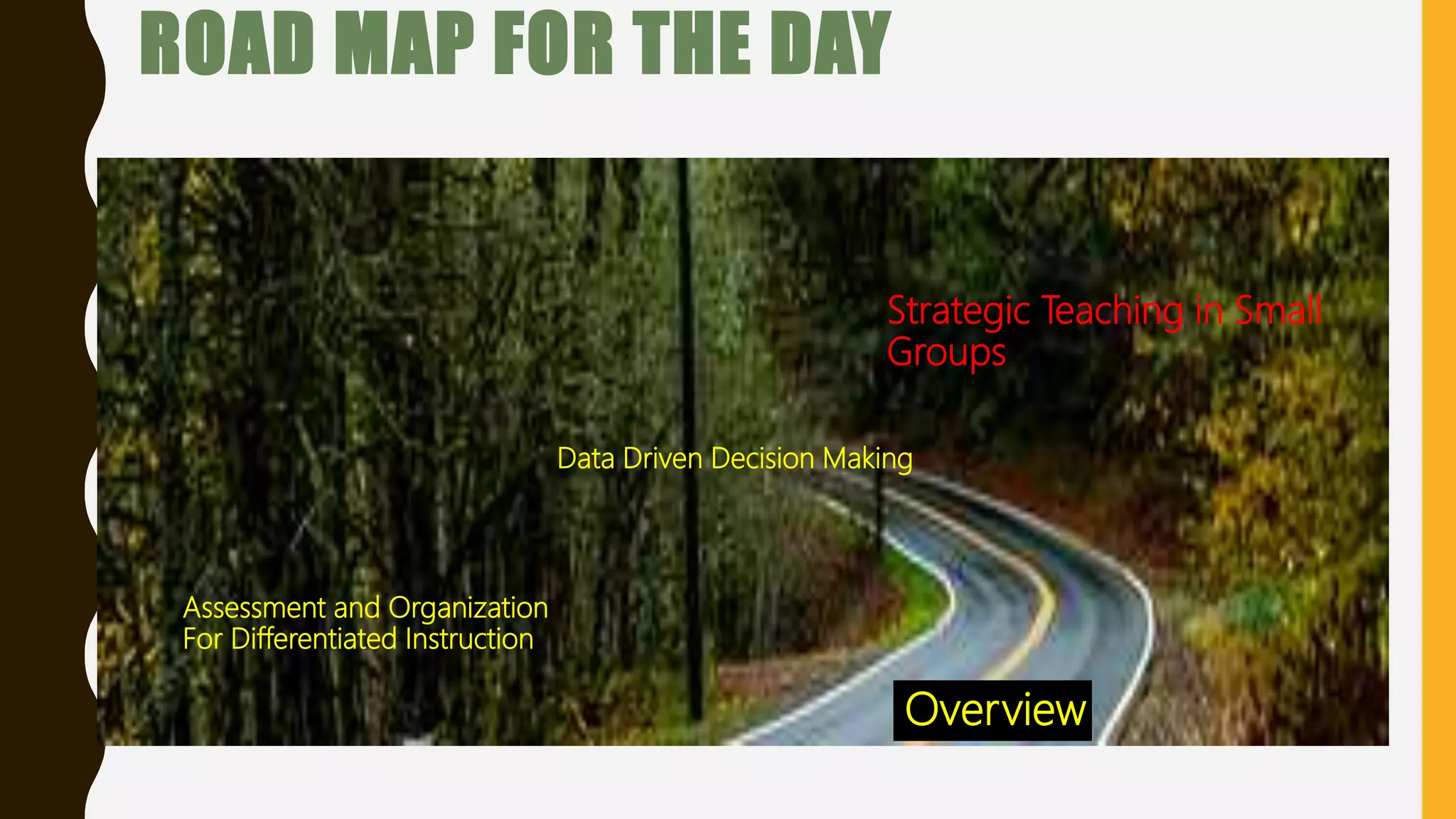
ROAD MAP FOR THE DAY
Assessment and Organization
For Differentiated Instruction
Data Driven Decision Making
Strategic Teaching in Small
Groups
Overview
Traditional
Reading Groups
versus
Guided Reading
Groups
10
Let’s Take Our Temperature!
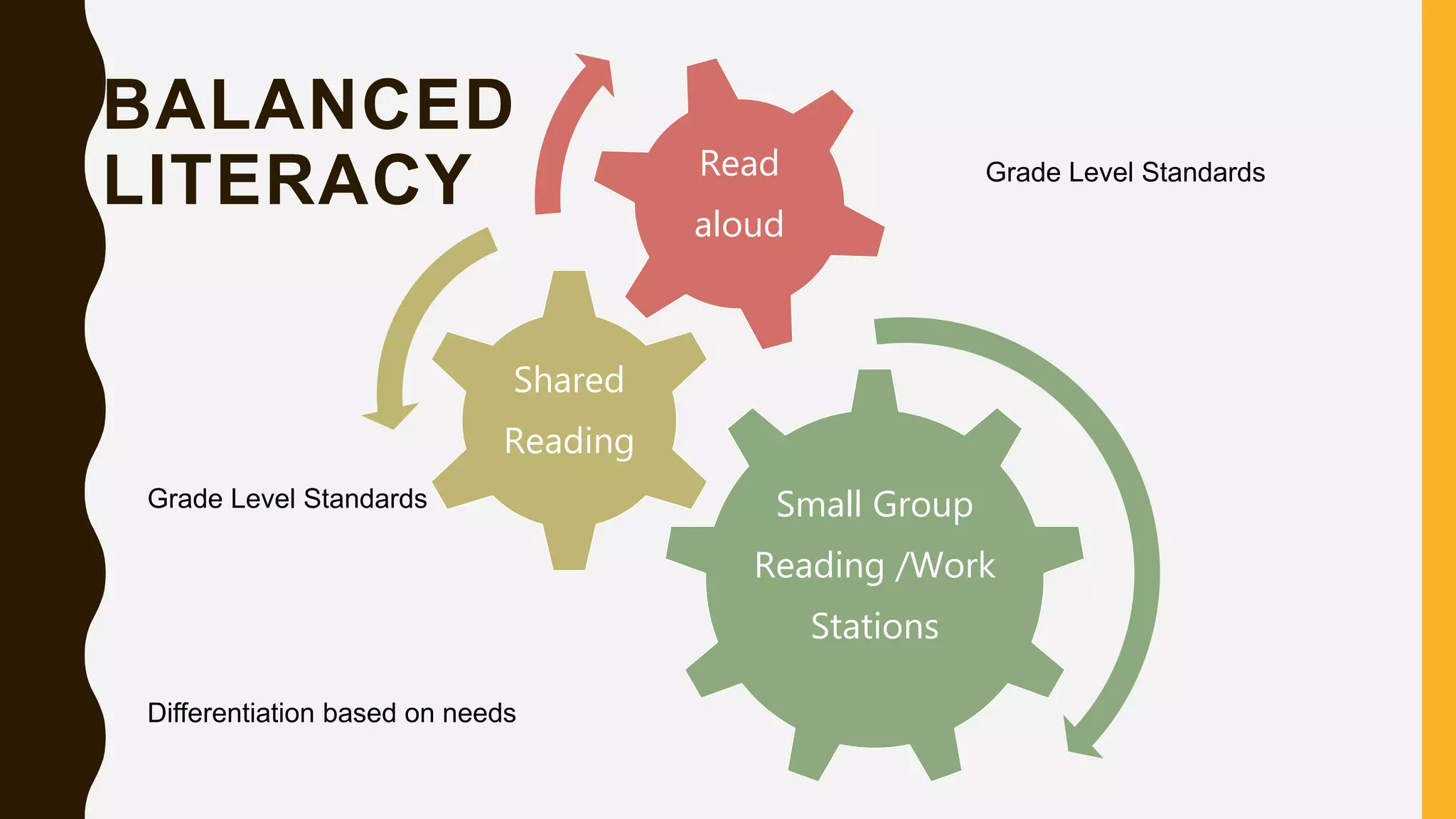
Small Group
Reading /Work
Stations
Shared
Reading
Read
aloud
BALANCED
LITERACY
Grade Level Standards
Differentiation based on needs
CHARACTERISTICS
• Each group is differentiated based on students current
need.
• Each learner is engaged with the whole text.
• Books are selected based on student needs.
• Teachers focus on strategic actions of readers.
CHARACTERISTICS
• Focus is critical thinking, comprehension and is grounded
in the text
• Writing or discussing text
• Explicit instruction in vocabulary, phonics or word work.
(Reading Foundational Skills Standards)
What is the magic number?
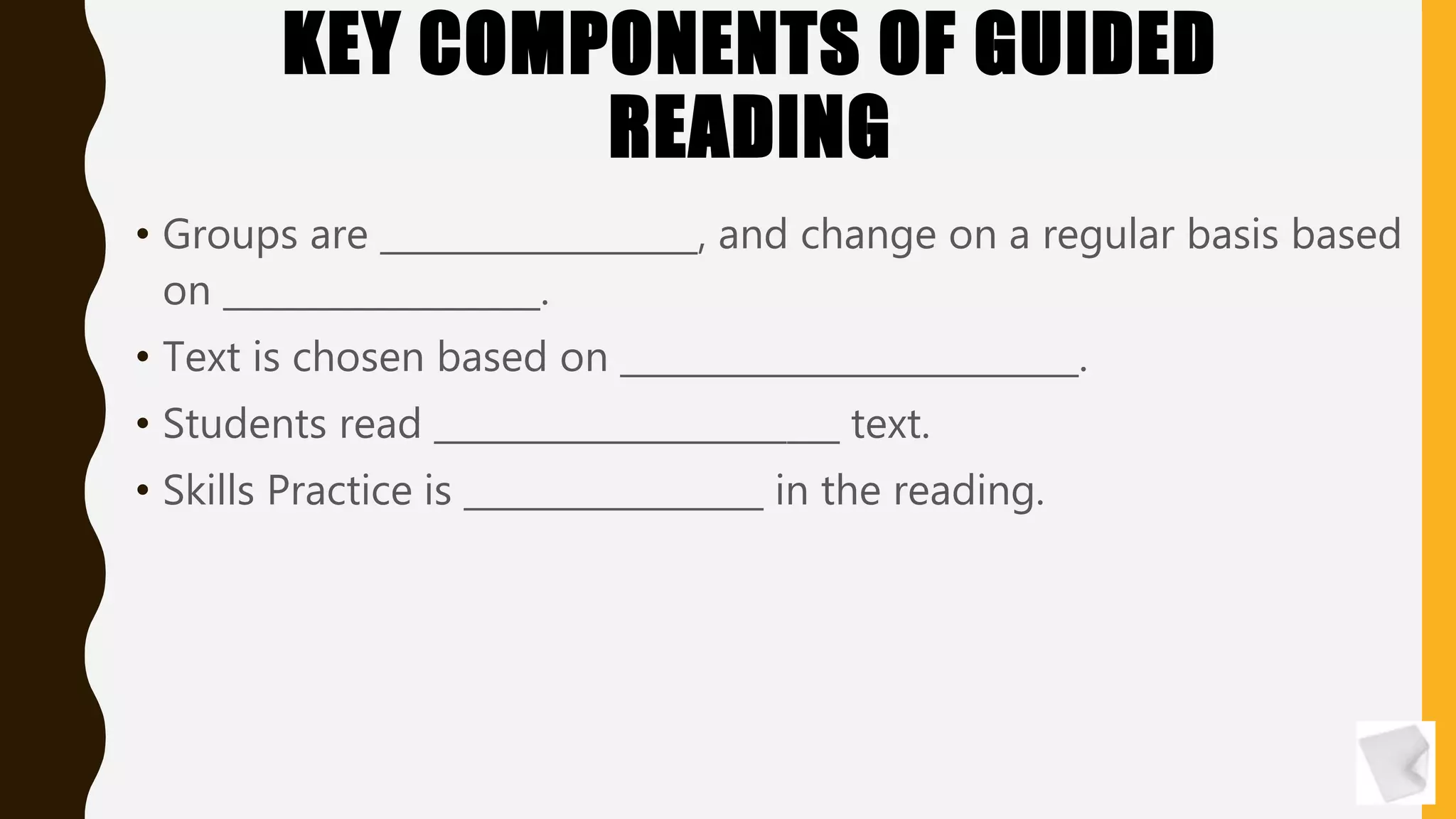
KEY COMPONENTS OF GUIDED
READING
• Groups are __________________, and change on a regular basis based
on __________________.
• Text is chosen based on __________________________.
• Students read _______________________ text.
• Skills Practice is _________________ in the reading.
GUIDED READING VS LIT CIRCLES
Small Group
Reading /Work
Stations
Shared
Reading
Read
aloud
BALANCED
LITERACY
Grade Level Standards
Differentiation based on needs
Lit
circles
ROAD MAP FOR THE DAY
Assessment and Organization
For Differentiated Instruction
Data Driven Decision Making
Strategic Teaching in Small
Groups
Overview
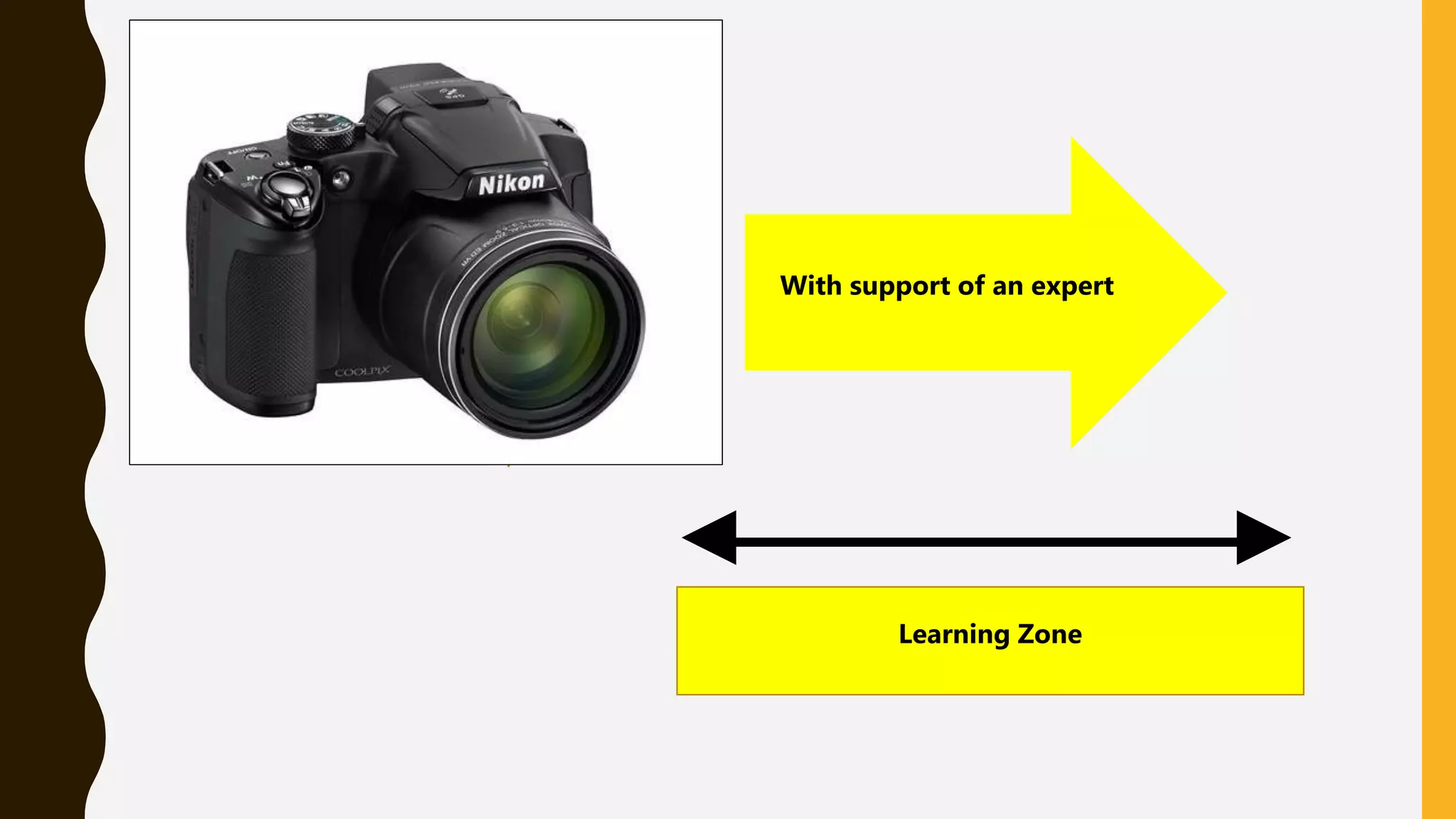
“ THE LEARNING ZONE”
What they can do
independently
With support of an expert
Learning Zone
Acceleration
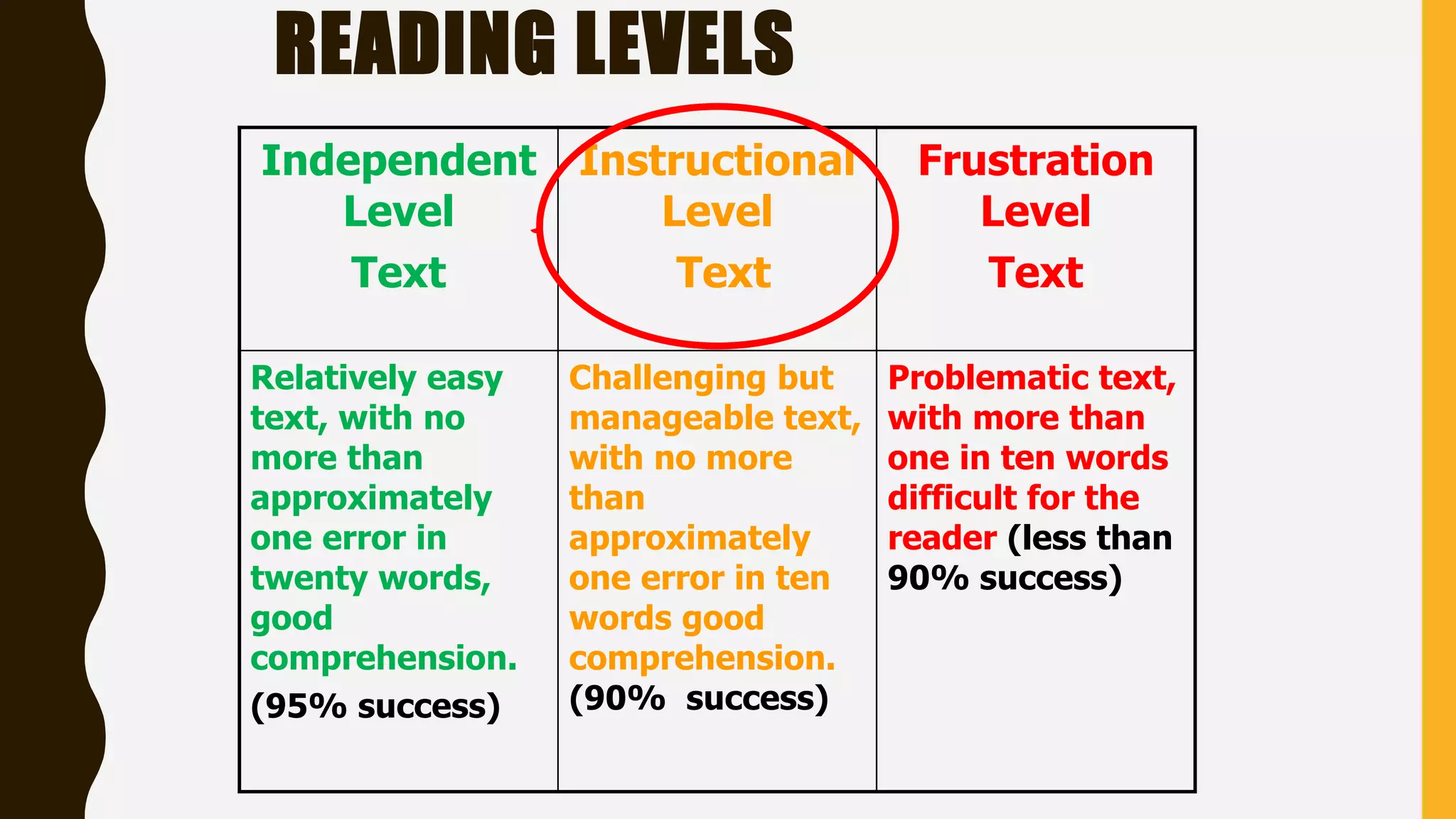
READING LEVELS
Independent
Level
Text
Instructional
Level
Text
Frustration
Level
Text
Relatively easy
text, with no
more than
approximately
one error in
twenty words,
good
comprehension.
(95% success)
Challenging but
manageable text,
with no more
than
approximately
one error in ten
words good
comprehension.
(90% success)
Problematic text,
with more than
one in ten words
difficult for the
reader (less than
90% success)
BEGIN WITH ASSESSMENT
•How should I group students?
•What text should I use with each group?
•What strategy should I teach next?
Jan Richardson “The Next Step in GR”
Pgs. 38-55
EMERGENT AND EARLY READERS
Primary Assessments Information Provided
Letter ID (K-1)
Sight Word List
Dictation Sentence
Writing Sample
Running Record and Retell
Pg. 39
PAST: PHONOLOGICAL AWARENESS
SCREENING TEST
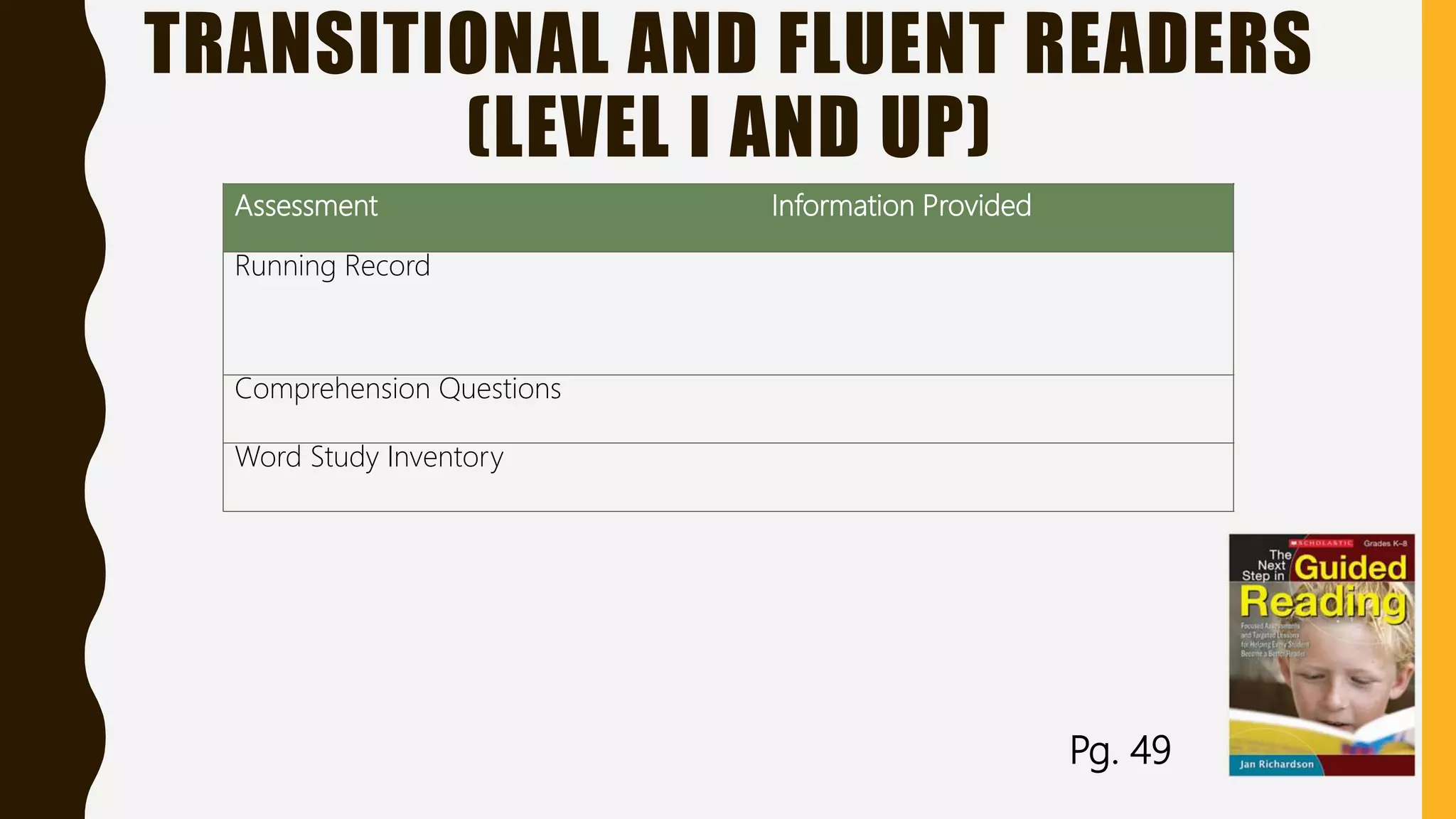
TRANSITIONAL AND FLUENT READERS
(LEVEL I AND UP)
Assessment Information Provided
Running Record
Comprehension Questions
Word Study Inventory
Pg. 49
Page 41
ANALYZING A RUNNING RECORD
Pgs. 41- 46
AS CHILDREN WORK THROUGH TEXT THEY DEVELOP A NETWORK
OF STRATEGIES FOR ATTENDING TO DIFFERENT SOURCES OF
INFORMATION.
Structural
cues
Visual
cues
Meaning
Cues
MORE QUESTIONS ABOUT
ASSESSMENT???
Pgs. 54-55
90 Second Speed Date
ROAD MAP FOR THE DAY
Assessment and Organization
For Differentiated Instruction
Data Driven Decision Making
Strategic Teaching in Small
Groups
Overview
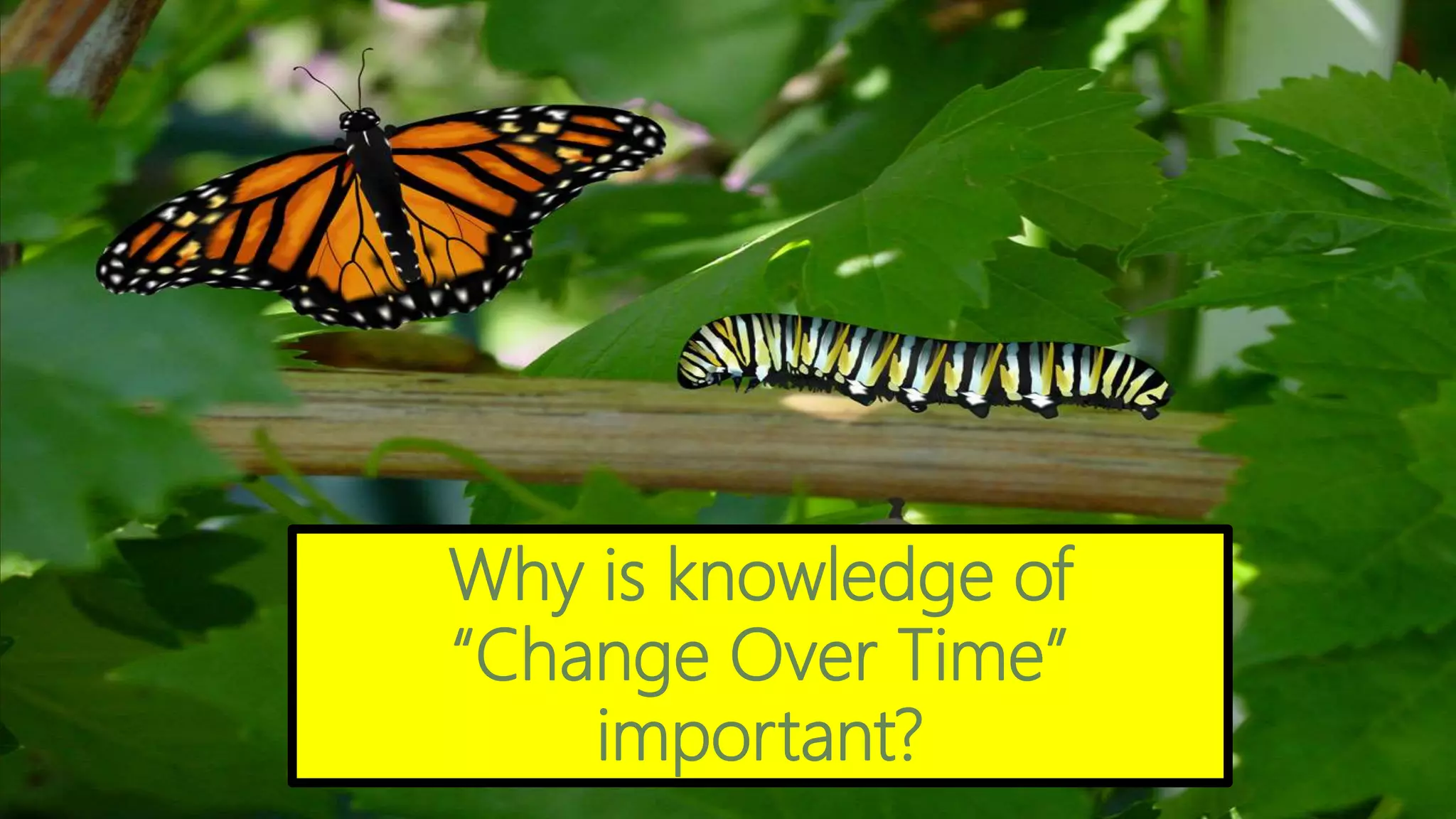
Why is knowledge of
“Change Over Time”
important?
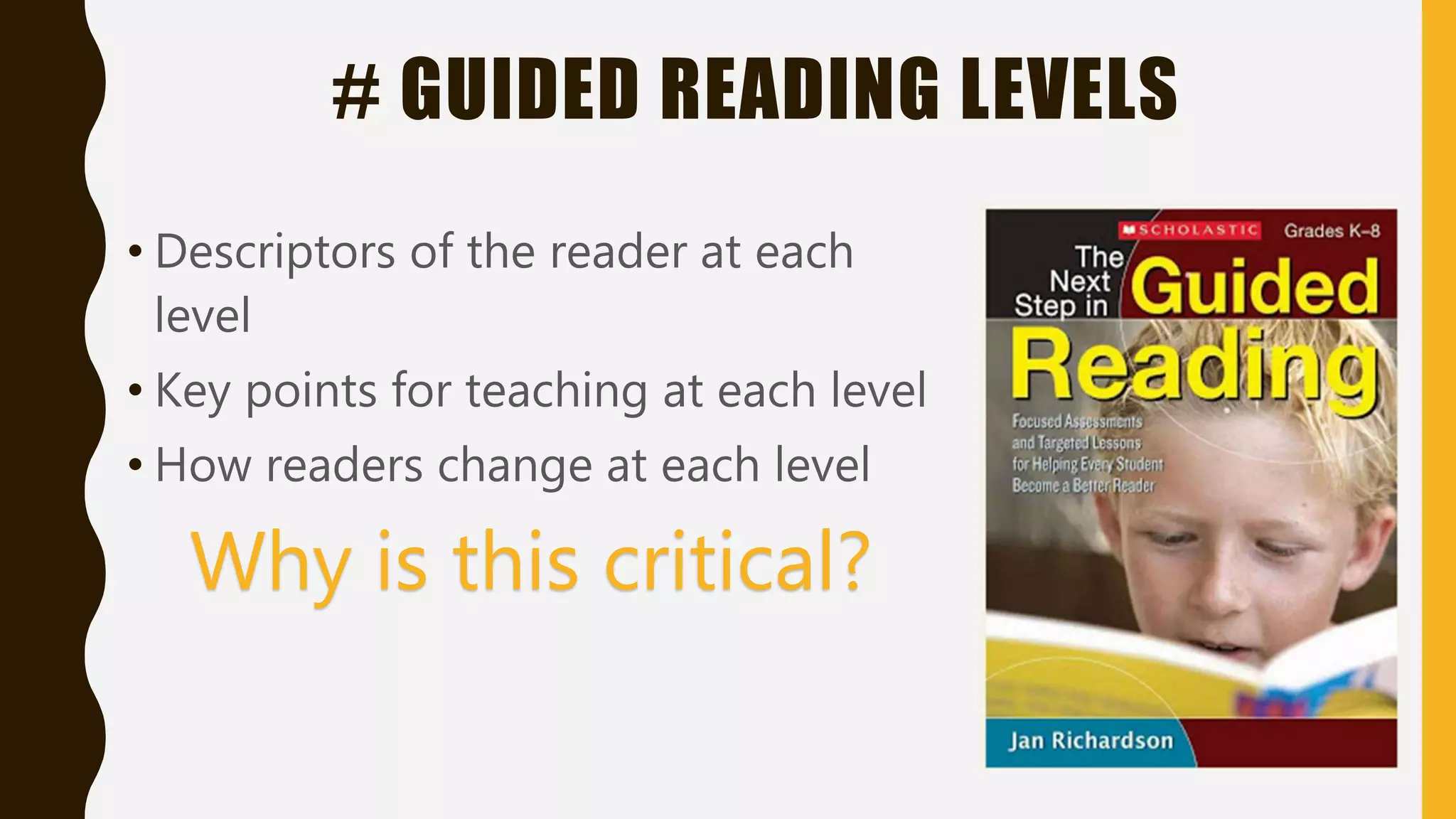
# GUIDED READING LEVELS
• Descriptors of the reader at each
level
• Key points for teaching at each level
• How readers change at each level
Why is this critical?
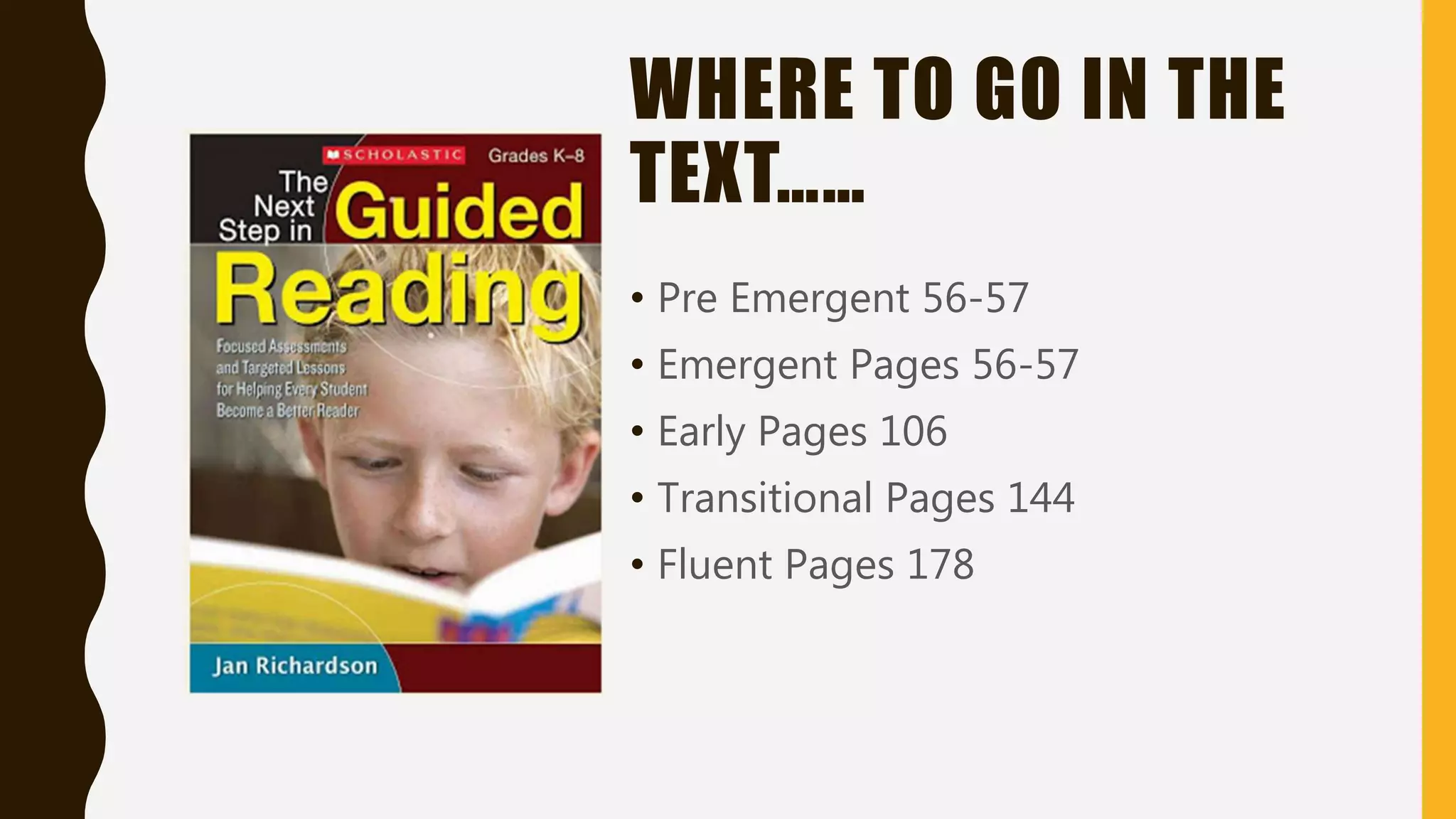
WHERE TO GO IN THE
TEXT……
• Pre Emergent 56-57
• Emergent Pages 56-57
• Early Pages 106
• Transitional Pages 144
• Fluent Pages 178
HOW DO I GROUP STUDENTS
FOR GUIDED READING?
•Keep group size small (5-8 students)
•Base small groups on instructional need
with specific instructional strategies in mind
•Be Flexible!
45
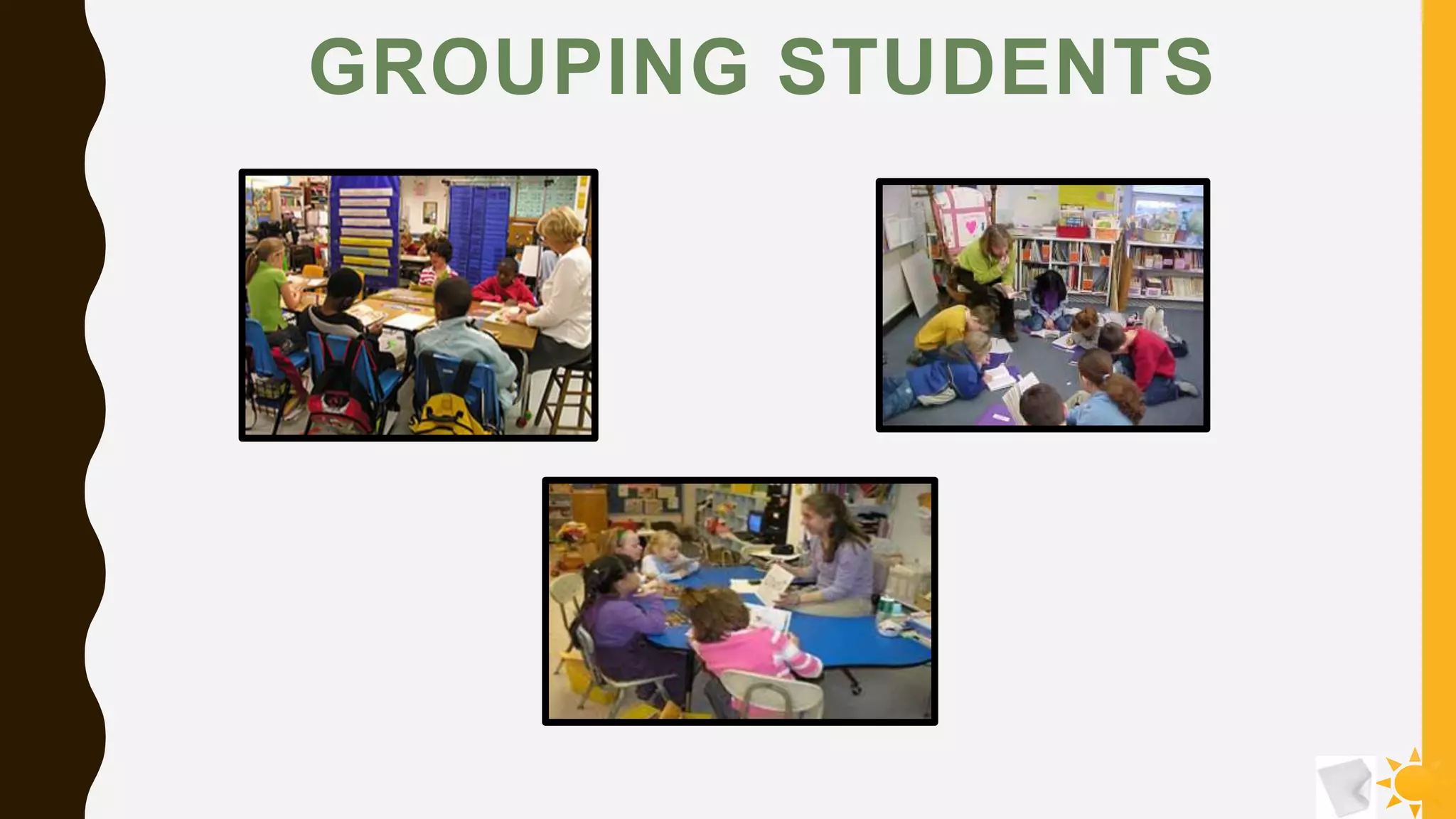
GROUPING STUDENTS
THINGS TO CONSIDER
•Place students on similar levels with similar
needs together.
•Students may go into more than one group
•Try to keep it to 4 groups or less for
management purposes.
COMMON THREADS
ROAD MAP FOR THE DAY
Assessment and Organization
For Differentiated Instruction
Data Driven Decision Making
Strategic Teaching in Small
Groups
Overview
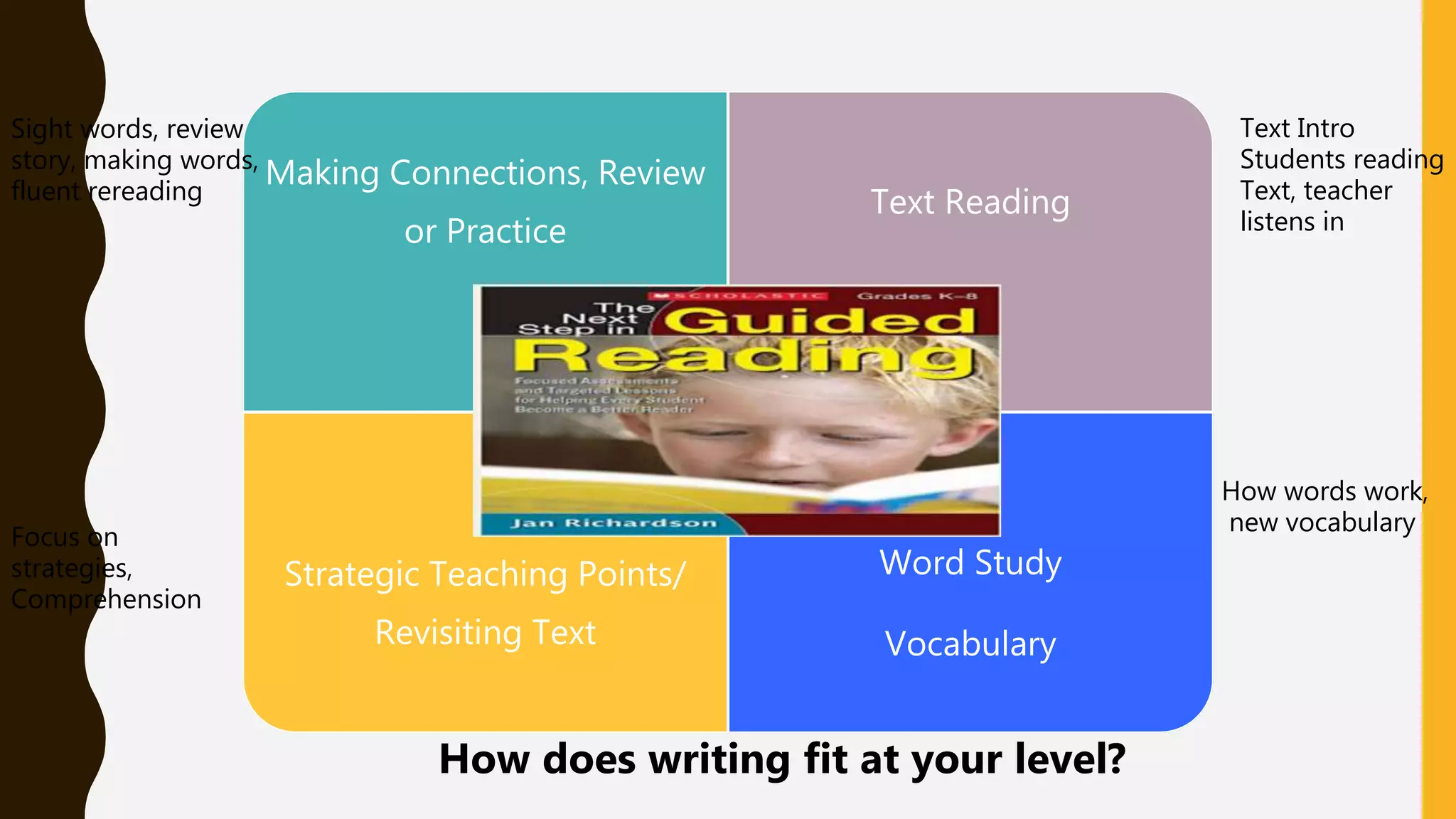
Making Connections, Review
or Practice
Text Reading
Strategic Teaching Points/
Revisiting Text
Word Study
Vocabulary
Guided Reading
Common Core
• Comprehension
• Foundational Skills
• Vocabulary
Sight words, review
story, making words,
fluent rereading
Text Intro
Students reading
Text, teacher
listens in
How words work,
new vocabulary
Focus on
strategies,
Comprehension
How does writing fit at your level?
PARTS OF THE GUIDED
READING LESSON
Page 96: The Emergent
Reader
Page 173: The Transitional Reader
GET FAMILIAR WITH EACH GUIDED
READING LEVEL
• Pre Emergent 56-57, 63
• Emergent Pages56-57, 86
• Early Pages 106 and 117
• Transitional Pages 144 and 157
• Fluent Pages 178 and 189
FOR YOUR LEVEL……
• What materials?
• Preview the Lesson Plan….
• Preview the rubric
• Key things to remember when
– introducing the text
– Planning teaching points
– Selecting word work
– Selecting the text
SUMMARY FOR PLANNING A
LESSON
• Know the reading level of the group
• Choose your focus based on data
– Emergent page 57
– Early page 106
– Transitional page 145
– Fluent page 180-181
• Pick a book that matches reading level and will build on
processing strengths ( may be shared for Pre A)
• Read through the lens of your students
• Plan intro, word work or phonemic awareness and teaching
points
• Reflect: What did the students learn to do today that they
couldn’t do yesterday?
TEXT SELECTION
K N O W I N G H O W T E X T C H A N G E A N D
S U P P O R T YO U R F O C U S
SET A FOCUS AND SELECT A TEXT FOR
YOUR GROUPS
How is planning a
lesson using the “Jan
Plan”
similar and different
from how you planned
in the past?
I _ D_ _E N_ _N _ _
INDEPENDENCE
Before you can begin small-group
instruction, your students must be able to
work independently for sustained periods of
time.
-Jan Richardson
READING
WORKSHOP
• Whole Group Mini-Lesson- 20 minutes
• Guided Reading Group (1)- 20 minutes
• Guided Reading Group (2)- 20 minutes
• Guided Reading Group (3)- 20 minutes
• Guided Reading Group (4)- 20 minutes
• Whole Group- Closure- 20 minutes
• Whole Group Options: Shared Reading, Read Aloud with emphasis on
standard, Interactive Writing, Phonemic Awareness or Word Work
instruction
•Scheduled
•Transitions
•Organized
•Practiced
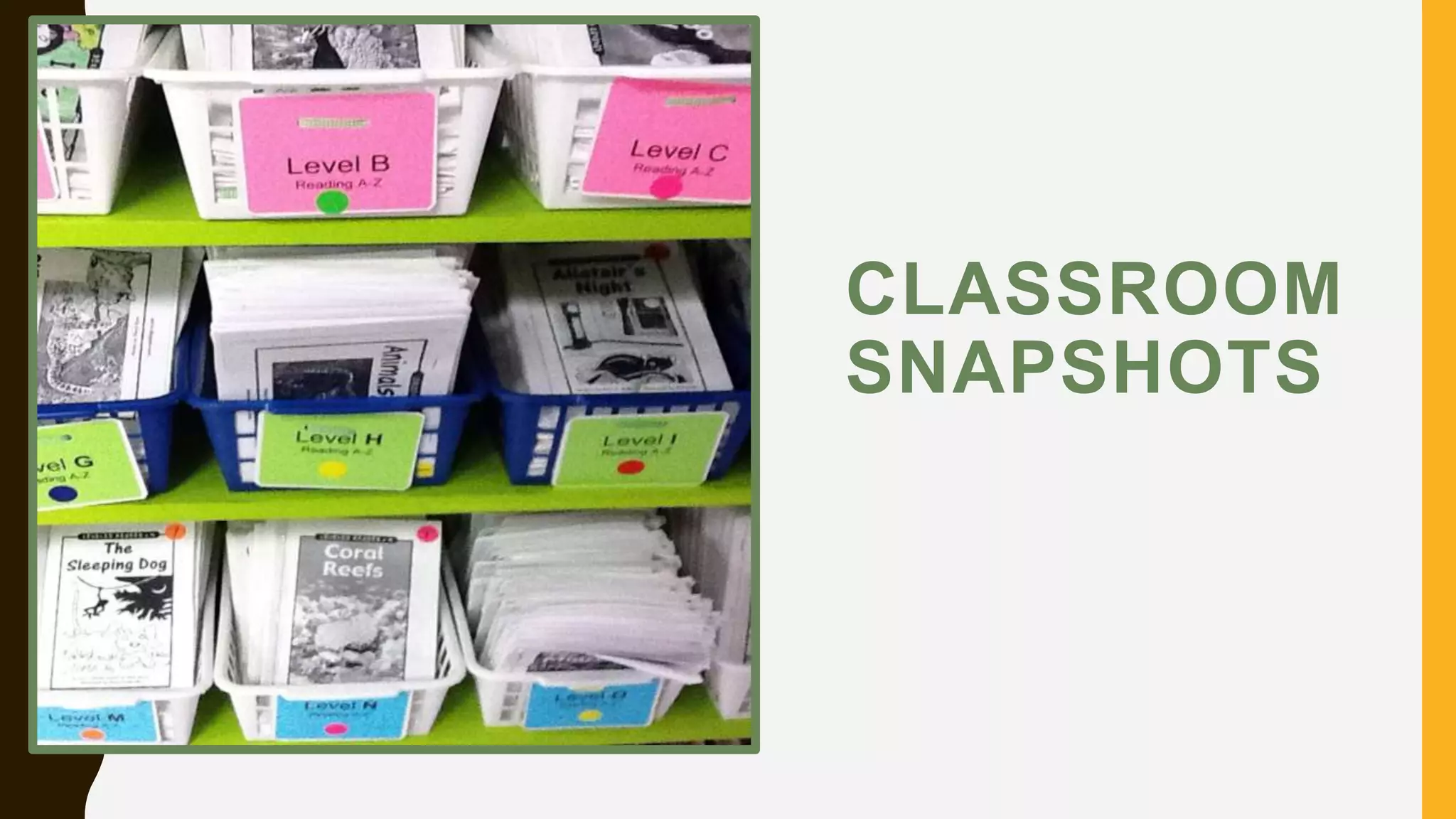
CLASSROOM
SNAPSHOTS
ANCHOR CHARTS- THE HEART
OF TEACHING STRUCTURE
Learning Targets
Strategic Teaching
Stations
Independent
Book Boxes
CLASSROOM DESIGN WITH
WORKSTATIONS IN MIND
80
More questions about
CLASSROOM MANAGEMENT?
Pgs. 29-31
PGES CONNECTION DOMAIN 1 AND 2
WE HAVE ARRIVED!
•1 thing that you will
do to get started
•1 thing that will be
challenging
HOMEWORK
#CKECGUIDEDREADING

Guided reading day 1 2016 lisa

  • 1.
    GUIDED READING 101 U SI N G S M A L L G R O U P S TO D I F F E R E N T I AT E I N S T R U C T I O N
  • 2.
    W E BS I T E : W W W . C K E C . O R G T W I T T E R : @ C K Y E C F A C E B O O K : C E N T R A L K E N T U C K Y E D U C AT I O N A L C O O P E R AT I V E I N S T A G R A M : C E N T R A L _ K Y _ E D U C AT I O N A L _ C O O P P I N T E R E S T : C E N T R A L K E N T U C K Y E D U C AT I O N A L C O O P E R AT I V E Connect with CKEC #CKECSI2016
  • 3.
    1.On a scaleof 0-5, rate your knowledge of guided reading. 2. What is something that you find challenging when implementing small groups in your classroom? 3. What is one thing you would like to learn from this training? Getting to Know You
  • 4.
    Skim your chapter. 3things to learn more about 2 key ideas 1 resource
  • 5.
    WHAT IS GUIDEDREADING? “Guided reading is a --------- approach designed to help ---------- students learn how to process a variety of ------------ challenging texts with ------------ and fluency.” -Fountas and Pinnell
  • 6.
    ROAD MAP FORTHE DAY Assessment and Organization For Differentiated Instruction Data Driven Decision Making Strategic Teaching in Small Groups Overview
  • 7.
  • 8.
    Small Group Reading /Work Stations Shared Reading Read aloud BALANCED LITERACY GradeLevel Standards Grade Level Standards Differentiation based on needs
  • 10.
    CHARACTERISTICS • Each groupis differentiated based on students current need. • Each learner is engaged with the whole text. • Books are selected based on student needs. • Teachers focus on strategic actions of readers.
  • 11.
    CHARACTERISTICS • Focus iscritical thinking, comprehension and is grounded in the text • Writing or discussing text • Explicit instruction in vocabulary, phonics or word work. (Reading Foundational Skills Standards)
  • 13.
    What is themagic number?
  • 15.
    KEY COMPONENTS OFGUIDED READING • Groups are __________________, and change on a regular basis based on __________________. • Text is chosen based on __________________________. • Students read _______________________ text. • Skills Practice is _________________ in the reading.
  • 16.
    GUIDED READING VSLIT CIRCLES
  • 17.
    Small Group Reading /Work Stations Shared Reading Read aloud BALANCED LITERACY GradeLevel Standards Grade Level Standards Differentiation based on needs Lit circles
  • 18.
    ROAD MAP FORTHE DAY Assessment and Organization For Differentiated Instruction Data Driven Decision Making Strategic Teaching in Small Groups Overview
  • 19.
  • 20.
    What they cando independently With support of an expert Learning Zone
  • 21.
  • 22.
    READING LEVELS Independent Level Text Instructional Level Text Frustration Level Text Relatively easy text,with no more than approximately one error in twenty words, good comprehension. (95% success) Challenging but manageable text, with no more than approximately one error in ten words good comprehension. (90% success) Problematic text, with more than one in ten words difficult for the reader (less than 90% success)
  • 24.
    BEGIN WITH ASSESSMENT •Howshould I group students? •What text should I use with each group? •What strategy should I teach next? Jan Richardson “The Next Step in GR” Pgs. 38-55
  • 25.
    EMERGENT AND EARLYREADERS Primary Assessments Information Provided Letter ID (K-1) Sight Word List Dictation Sentence Writing Sample Running Record and Retell Pg. 39
  • 26.
  • 27.
    TRANSITIONAL AND FLUENTREADERS (LEVEL I AND UP) Assessment Information Provided Running Record Comprehension Questions Word Study Inventory Pg. 49
  • 28.
  • 29.
    ANALYZING A RUNNINGRECORD Pgs. 41- 46
  • 30.
    AS CHILDREN WORKTHROUGH TEXT THEY DEVELOP A NETWORK OF STRATEGIES FOR ATTENDING TO DIFFERENT SOURCES OF INFORMATION. Structural cues Visual cues Meaning Cues
  • 31.
  • 33.
  • 34.
    ROAD MAP FORTHE DAY Assessment and Organization For Differentiated Instruction Data Driven Decision Making Strategic Teaching in Small Groups Overview
  • 35.
    Why is knowledgeof “Change Over Time” important?
  • 36.
    # GUIDED READINGLEVELS • Descriptors of the reader at each level • Key points for teaching at each level • How readers change at each level Why is this critical?
  • 37.
    WHERE TO GOIN THE TEXT…… • Pre Emergent 56-57 • Emergent Pages 56-57 • Early Pages 106 • Transitional Pages 144 • Fluent Pages 178
  • 38.
    HOW DO IGROUP STUDENTS FOR GUIDED READING? •Keep group size small (5-8 students) •Base small groups on instructional need with specific instructional strategies in mind •Be Flexible! 45
  • 39.
  • 40.
    THINGS TO CONSIDER •Placestudents on similar levels with similar needs together. •Students may go into more than one group •Try to keep it to 4 groups or less for management purposes.
  • 41.
  • 42.
    ROAD MAP FORTHE DAY Assessment and Organization For Differentiated Instruction Data Driven Decision Making Strategic Teaching in Small Groups Overview
  • 43.
    Making Connections, Review orPractice Text Reading Strategic Teaching Points/ Revisiting Text Word Study Vocabulary Guided Reading Common Core • Comprehension • Foundational Skills • Vocabulary Sight words, review story, making words, fluent rereading Text Intro Students reading Text, teacher listens in How words work, new vocabulary Focus on strategies, Comprehension How does writing fit at your level?
  • 44.
    PARTS OF THEGUIDED READING LESSON Page 96: The Emergent Reader Page 173: The Transitional Reader
  • 45.
    GET FAMILIAR WITHEACH GUIDED READING LEVEL • Pre Emergent 56-57, 63 • Emergent Pages56-57, 86 • Early Pages 106 and 117 • Transitional Pages 144 and 157 • Fluent Pages 178 and 189
  • 46.
    FOR YOUR LEVEL…… •What materials? • Preview the Lesson Plan…. • Preview the rubric • Key things to remember when – introducing the text – Planning teaching points – Selecting word work – Selecting the text
  • 47.
    SUMMARY FOR PLANNINGA LESSON • Know the reading level of the group • Choose your focus based on data – Emergent page 57 – Early page 106 – Transitional page 145 – Fluent page 180-181
  • 48.
    • Pick abook that matches reading level and will build on processing strengths ( may be shared for Pre A) • Read through the lens of your students • Plan intro, word work or phonemic awareness and teaching points • Reflect: What did the students learn to do today that they couldn’t do yesterday?
  • 49.
    TEXT SELECTION K NO W I N G H O W T E X T C H A N G E A N D S U P P O R T YO U R F O C U S
  • 50.
    SET A FOCUSAND SELECT A TEXT FOR YOUR GROUPS
  • 52.
    How is planninga lesson using the “Jan Plan” similar and different from how you planned in the past?
  • 55.
    I _ D__E N_ _N _ _ INDEPENDENCE
  • 56.
    Before you canbegin small-group instruction, your students must be able to work independently for sustained periods of time. -Jan Richardson
  • 57.
    READING WORKSHOP • Whole GroupMini-Lesson- 20 minutes • Guided Reading Group (1)- 20 minutes • Guided Reading Group (2)- 20 minutes • Guided Reading Group (3)- 20 minutes • Guided Reading Group (4)- 20 minutes • Whole Group- Closure- 20 minutes • Whole Group Options: Shared Reading, Read Aloud with emphasis on standard, Interactive Writing, Phonemic Awareness or Word Work instruction
  • 59.
  • 60.
  • 61.
    ANCHOR CHARTS- THEHEART OF TEACHING STRUCTURE
  • 62.
  • 63.
  • 64.
  • 65.
  • 66.
    More questions about CLASSROOMMANAGEMENT? Pgs. 29-31
  • 67.
  • 68.
  • 69.
    •1 thing thatyou will do to get started •1 thing that will be challenging
  • 70.
  • 71.