A Guide to
Guided Reading
Bonnie Reyes
What is Guided Reading?
A reading strategy that helps students becomeA reading strategy that helps students become
strong independent readersstrong independent readers
Requires small group instructionRequires small group instruction
Students learn to use various reading skills andStudents learn to use various reading skills and
strategies with teacher supportstrategies with teacher support
2
Why Guided Reading?
Students have a high accuracy rate in reading whenStudents have a high accuracy rate in reading when
the proper text is selected for them.the proper text is selected for them.
Students are provided with the necessary strategiesStudents are provided with the necessary strategies
to overcome “reading road blocks.”to overcome “reading road blocks.”
The focus of reading shifts to meaning rather thanThe focus of reading shifts to meaning rather than
decoding; the construction of meaning is imperative.decoding; the construction of meaning is imperative.
Independent reading and the application ofIndependent reading and the application of
independent reading strategies is the goal of Guidedindependent reading strategies is the goal of Guided
Reading.Reading.
3
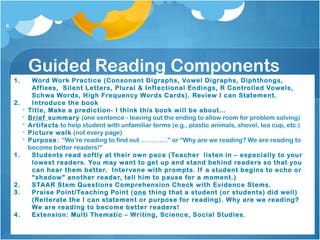
Guided Reading Components
1. Word Work Practice (Consonant Digraphs, Vowel Digraphs, Diphthongs,
Affixes, Silent Letters, Plural & Inflectional Endings, R Controlled Vowels,
Schwa Words, High Frequency Words Cards). Review I can Statement.
2. Introduce the book
 Title, Make a prediction- I think this book will be about…
 Brief summary (one sentence - leaving out the ending to allow room for problem solving)
 Artifacts to help student with unfamiliar terms (e.g., plastic animals, shovel, tea cup, etc.)
 Picture walk (not every page)
 Purpose: “We’re reading to find out ………….” or “Why are we reading? We are reading to
become better readers!”
1. Students read softly at their own pace (Teacher listen in – especially to your
lowest readers. You may want to get up and stand behind readers so that you
can hear them better. Intervene with prompts. If a student begins to echo or
“shadow” another reader, tell him to pause for a moment.)
2. STAAR Stem Questions Comprehension Check with Evidence Stems.
3. Praise Point/Teaching Point (one thing that a student (or students) did well)
(Reiterate the I can statement or purpose for reading). Why are we reading?
We are reading to become better readers!
4. Extension: Multi Thematic – Writing, Science, Social Studies.
4
Guided Reading I Can’s
I can support my thoughts with facts and detailI can support my thoughts with facts and detail
evidence from the story.evidence from the story.
I can make and analyze predictions about a text.I can make and analyze predictions about a text.
I can explain the events in a story.I can explain the events in a story.
I can explain the plot (problem and solution) of aI can explain the plot (problem and solution) of a
story.story.
5
How Do I Start ?: The Initial
Framework for Every Classroom
Students are divided into small groups (ideally,Students are divided into small groups (ideally,
4-6 students per group)4-6 students per group)
Lessons will run between 10-20 minutesLessons will run between 10-20 minutes
Determine appropriate level of groupsDetermine appropriate level of groups
Provide a text for each childProvide a text for each child
6
Pre-Planning/Pre-Reading:
The Teacher
From Fountas and Pinnell
Select an appropriate text, one that will be supportive butSelect an appropriate text, one that will be supportive but
with a few problems to solve. Have a text selection ready forwith a few problems to solve. Have a text selection ready for
each day of the week.each day of the week.
Prepare an introduction to the storyPrepare an introduction to the story
Use Think Aloud Stems (TA)Use Think Aloud Stems (TA)
Briefly introduces the story, keeping in mind the meaning,Briefly introduces the story, keeping in mind the meaning,
language, and visual information in the text, and thelanguage, and visual information in the text, and the
knowledge, experience, and skills of the readerknowledge, experience, and skills of the reader
Preplan some questionsPreplan some questions
Preplan some evidence stems. Ask students to show youPreplan some evidence stems. Ask students to show you
where they find the answer or what page the evidence is on.where they find the answer or what page the evidence is on.
7
Takes place at least 3 days prior to the actualTakes place at least 3 days prior to the actual
event.event.
Teacher decides where to meet with the guidedTeacher decides where to meet with the guided
reading group and makes available all necessaryreading group and makes available all necessary
materials.materials.
Determines a focus, strategy, or skills based onDetermines a focus, strategy, or skills based on
students’ needs.students’ needs.
Selects a text that provides support andSelects a text that provides support and
manageable challenges.manageable challenges.
8
Pre-Planning/Pre-Reading
Source: Guided Reading in Grades 3-6 by Mary Browning Schulman. Scholastic.
Chooses a purpose for the reading.Chooses a purpose for the reading.
Preview the text to plan the introduction,Preview the text to plan the introduction,
reading, and discussion.reading, and discussion.
Determines if text will be read straight throughDetermines if text will be read straight through
or chunked in a few portions to improveor chunked in a few portions to improve
comprehension.comprehension.
Plans for further reading or follow-up activities.Plans for further reading or follow-up activities.
Tie lessons to centers/ worksations/ mini-lesson,Tie lessons to centers/ worksations/ mini-lesson,
etc.etc.
9
Pre-Planning/Pre-Reading cont.
Source: Guided Reading in Grades 3-6 by Mary Browning Schulman. Scholastic.
What Does Guided
Reading Look Like ?
The teacher may start with word work (Phonics Sounds, HFWThe teacher may start with word work (Phonics Sounds, HFW
or Vocabulary)or Vocabulary)
The teacher introduces the text to the small groupThe teacher introduces the text to the small group
As the students read the text, the teacher briefly worksAs the students read the text, the teacher briefly works
with students; each child reads the whole text.with students; each child reads the whole text.
The teacher may select one or two teaching points toThe teacher may select one or two teaching points to
address after readingaddress after reading
The students resume reading and apply the teachingThe students resume reading and apply the teaching
points presented by the teacherpoints presented by the teacher
10
Levels A-B
What are some things I can teach my students during small group?
Concepts of Print (COP)Concepts of Print (COP)
Understanding left to right directionalityUnderstanding left to right directionality
Matching on-to-one speech to printMatching on-to-one speech to print
PointingPointing underunder the wordsthe words
Begin rereading at point of difficultyBegin rereading at point of difficulty
Attending to initial letter in a wordAttending to initial letter in a word
Using picture cuesUsing picture cues
Making connections to background knowledgeMaking connections to background knowledge
Making personal connections to text (Text to Self)Making personal connections to text (Text to Self)
Mastery of High Frequency Words / FluencyMastery of High Frequency Words / Fluency
11
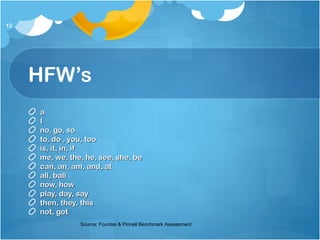
HFW’s
aa
II
no, go, sono, go, so
to, do , you, tooto, do , you, too
is, it, in, ifis, it, in, if
me, we, the, he, see, she, beme, we, the, he, see, she, be
can, an, am, and, atcan, an, am, and, at
all, ballall, ball
now, hownow, how
play, day, sayplay, day, say
then, they, thisthen, they, this
not, gotnot, got
12
Source: Fountas & Pinnell Benchmark Assessment
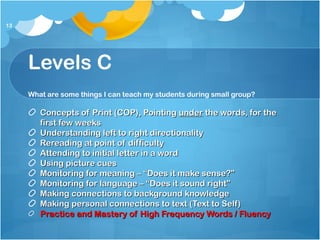
Levels C
What are some things I can teach my students during small group?
Concepts of Print (COP), PointingConcepts of Print (COP), Pointing underunder the words, for thethe words, for the
first few weeksfirst few weeks
Understanding left to right directionalityUnderstanding left to right directionality
Rereading at point of difficultyRereading at point of difficulty
Attending to initial letter in a wordAttending to initial letter in a word
Using picture cuesUsing picture cues
Monitoring for meaning – “Does it make sense?”Monitoring for meaning – “Does it make sense?”
Monitoring for language – “Does it sound right”Monitoring for language – “Does it sound right”
Making connections to background knowledgeMaking connections to background knowledge
Making personal connections to text (Text to Self)Making personal connections to text (Text to Self)
Practice and Mastery of High Frequency Words / FluencyPractice and Mastery of High Frequency Words / Fluency
13
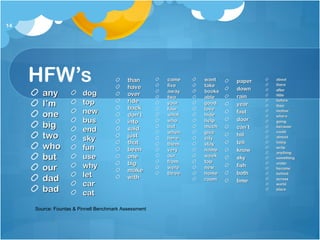
HFW’s
anyany
I’mI’m
oneone
bigbig
twotwo
whowho
butbut
ourour
daddad
badbad
14
dogdog
toptop
newnew
busbus
endend
skysky
funfun
useuse
whywhy
letlet
carcar
catcat
thanthan
havehave
overover
rideride
backback
don’tdon’t
intointo
saidsaid
justjust
thatthat
beenbeen
oneone
bigbig
makemake
withwith
camecame
fivefive
awayaway
twotwo
youryour
fourfour
whatwhat
whowho
butbut
whenwhen
herehere
themthem
veryvery
ourour
fromfrom
werewere
threethree
wantwant
taketake
booksbooks
ableable
goodgood
lovelove
hidehide
helphelp
muchmuch
givegive
citycity
staystay
namename
weekweek
toptop
newnew
homehome
roomroom
paperpaper
downdown
rainrain
yearyear
fastfast
doordoor
can’tcan’t
hillhill
telltell
knowknow
skysky
fishfish
bothboth
timetime
aboutabout
therethere
afterafter
littlelittle
beforebefore
theirtheir
mothermother
wherewhere
goinggoing
becausebecause
couldcould
almostalmost
todaytoday
writewrite
anythinganything
somethingsomething
underunder
becomebecome
behindbehind
acrossacross
worldworld
placeplace
Source: Fountas & Pinnell Benchmark Assessment
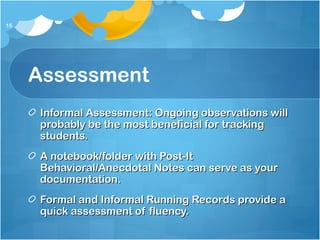
Assessment
Informal Assessment: Ongoing observations willInformal Assessment: Ongoing observations will
probably be the most beneficial for trackingprobably be the most beneficial for tracking
students.students.
A notebook/folder with Post-ItA notebook/folder with Post-It
Behavioral/Anecdotal Notes can serve as yourBehavioral/Anecdotal Notes can serve as your
documentation.documentation.
Formal and Informal Running Records provide aFormal and Informal Running Records provide a
quick assessment of fluency.quick assessment of fluency.
15
Teacher Self-Assessment
MaterialsMaterials
ManagementManagement
GroupingGrouping
Lesson ManagementLesson Management
Text SelectionsText Selections
Text VariationsText Variations
Text IntroductionsText Introductions
Teaching for Processing StrategiesTeaching for Processing Strategies
16
17
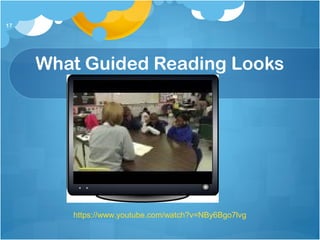
What Guided Reading Looks
Like
https://www.youtube.com/watch?v=NBy6Bgo7lvg
Resources
Fountas, I.C. & Pinnell, G.S. (1996).Fountas, I.C. & Pinnell, G.S. (1996). GuidedGuided
Reading.Reading. Heinemann: Portsmouth, NH.Heinemann: Portsmouth, NH.
http://olc.spsd.sk.ca/DE/PD/instr/strats/guided/guihttp://olc.spsd.sk.ca/DE/PD/instr/strats/guided/gui
ded.htmlded.html
18

A guide to Guided Reading for Professional Development

  • 1.
    A Guide to GuidedReading Bonnie Reyes
  • 2.
    What is GuidedReading? A reading strategy that helps students becomeA reading strategy that helps students become strong independent readersstrong independent readers Requires small group instructionRequires small group instruction Students learn to use various reading skills andStudents learn to use various reading skills and strategies with teacher supportstrategies with teacher support 2
  • 3.
    Why Guided Reading? Studentshave a high accuracy rate in reading whenStudents have a high accuracy rate in reading when the proper text is selected for them.the proper text is selected for them. Students are provided with the necessary strategiesStudents are provided with the necessary strategies to overcome “reading road blocks.”to overcome “reading road blocks.” The focus of reading shifts to meaning rather thanThe focus of reading shifts to meaning rather than decoding; the construction of meaning is imperative.decoding; the construction of meaning is imperative. Independent reading and the application ofIndependent reading and the application of independent reading strategies is the goal of Guidedindependent reading strategies is the goal of Guided Reading.Reading. 3
  • 4.
    Guided Reading Components 1.Word Work Practice (Consonant Digraphs, Vowel Digraphs, Diphthongs, Affixes, Silent Letters, Plural & Inflectional Endings, R Controlled Vowels, Schwa Words, High Frequency Words Cards). Review I can Statement. 2. Introduce the book  Title, Make a prediction- I think this book will be about…  Brief summary (one sentence - leaving out the ending to allow room for problem solving)  Artifacts to help student with unfamiliar terms (e.g., plastic animals, shovel, tea cup, etc.)  Picture walk (not every page)  Purpose: “We’re reading to find out ………….” or “Why are we reading? We are reading to become better readers!” 1. Students read softly at their own pace (Teacher listen in – especially to your lowest readers. You may want to get up and stand behind readers so that you can hear them better. Intervene with prompts. If a student begins to echo or “shadow” another reader, tell him to pause for a moment.) 2. STAAR Stem Questions Comprehension Check with Evidence Stems. 3. Praise Point/Teaching Point (one thing that a student (or students) did well) (Reiterate the I can statement or purpose for reading). Why are we reading? We are reading to become better readers! 4. Extension: Multi Thematic – Writing, Science, Social Studies. 4
  • 5.
    Guided Reading ICan’s I can support my thoughts with facts and detailI can support my thoughts with facts and detail evidence from the story.evidence from the story. I can make and analyze predictions about a text.I can make and analyze predictions about a text. I can explain the events in a story.I can explain the events in a story. I can explain the plot (problem and solution) of aI can explain the plot (problem and solution) of a story.story. 5
  • 6.
    How Do IStart ?: The Initial Framework for Every Classroom Students are divided into small groups (ideally,Students are divided into small groups (ideally, 4-6 students per group)4-6 students per group) Lessons will run between 10-20 minutesLessons will run between 10-20 minutes Determine appropriate level of groupsDetermine appropriate level of groups Provide a text for each childProvide a text for each child 6
  • 7.
    Pre-Planning/Pre-Reading: The Teacher From Fountasand Pinnell Select an appropriate text, one that will be supportive butSelect an appropriate text, one that will be supportive but with a few problems to solve. Have a text selection ready forwith a few problems to solve. Have a text selection ready for each day of the week.each day of the week. Prepare an introduction to the storyPrepare an introduction to the story Use Think Aloud Stems (TA)Use Think Aloud Stems (TA) Briefly introduces the story, keeping in mind the meaning,Briefly introduces the story, keeping in mind the meaning, language, and visual information in the text, and thelanguage, and visual information in the text, and the knowledge, experience, and skills of the readerknowledge, experience, and skills of the reader Preplan some questionsPreplan some questions Preplan some evidence stems. Ask students to show youPreplan some evidence stems. Ask students to show you where they find the answer or what page the evidence is on.where they find the answer or what page the evidence is on. 7
  • 8.
    Takes place atleast 3 days prior to the actualTakes place at least 3 days prior to the actual event.event. Teacher decides where to meet with the guidedTeacher decides where to meet with the guided reading group and makes available all necessaryreading group and makes available all necessary materials.materials. Determines a focus, strategy, or skills based onDetermines a focus, strategy, or skills based on students’ needs.students’ needs. Selects a text that provides support andSelects a text that provides support and manageable challenges.manageable challenges. 8 Pre-Planning/Pre-Reading Source: Guided Reading in Grades 3-6 by Mary Browning Schulman. Scholastic.
  • 9.
    Chooses a purposefor the reading.Chooses a purpose for the reading. Preview the text to plan the introduction,Preview the text to plan the introduction, reading, and discussion.reading, and discussion. Determines if text will be read straight throughDetermines if text will be read straight through or chunked in a few portions to improveor chunked in a few portions to improve comprehension.comprehension. Plans for further reading or follow-up activities.Plans for further reading or follow-up activities. Tie lessons to centers/ worksations/ mini-lesson,Tie lessons to centers/ worksations/ mini-lesson, etc.etc. 9 Pre-Planning/Pre-Reading cont. Source: Guided Reading in Grades 3-6 by Mary Browning Schulman. Scholastic.
  • 10.
    What Does Guided ReadingLook Like ? The teacher may start with word work (Phonics Sounds, HFWThe teacher may start with word work (Phonics Sounds, HFW or Vocabulary)or Vocabulary) The teacher introduces the text to the small groupThe teacher introduces the text to the small group As the students read the text, the teacher briefly worksAs the students read the text, the teacher briefly works with students; each child reads the whole text.with students; each child reads the whole text. The teacher may select one or two teaching points toThe teacher may select one or two teaching points to address after readingaddress after reading The students resume reading and apply the teachingThe students resume reading and apply the teaching points presented by the teacherpoints presented by the teacher 10
  • 11.
    Levels A-B What aresome things I can teach my students during small group? Concepts of Print (COP)Concepts of Print (COP) Understanding left to right directionalityUnderstanding left to right directionality Matching on-to-one speech to printMatching on-to-one speech to print PointingPointing underunder the wordsthe words Begin rereading at point of difficultyBegin rereading at point of difficulty Attending to initial letter in a wordAttending to initial letter in a word Using picture cuesUsing picture cues Making connections to background knowledgeMaking connections to background knowledge Making personal connections to text (Text to Self)Making personal connections to text (Text to Self) Mastery of High Frequency Words / FluencyMastery of High Frequency Words / Fluency 11
  • 12.
    HFW’s aa II no, go, sono,go, so to, do , you, tooto, do , you, too is, it, in, ifis, it, in, if me, we, the, he, see, she, beme, we, the, he, see, she, be can, an, am, and, atcan, an, am, and, at all, ballall, ball now, hownow, how play, day, sayplay, day, say then, they, thisthen, they, this not, gotnot, got 12 Source: Fountas & Pinnell Benchmark Assessment
  • 13.
    Levels C What aresome things I can teach my students during small group? Concepts of Print (COP), PointingConcepts of Print (COP), Pointing underunder the words, for thethe words, for the first few weeksfirst few weeks Understanding left to right directionalityUnderstanding left to right directionality Rereading at point of difficultyRereading at point of difficulty Attending to initial letter in a wordAttending to initial letter in a word Using picture cuesUsing picture cues Monitoring for meaning – “Does it make sense?”Monitoring for meaning – “Does it make sense?” Monitoring for language – “Does it sound right”Monitoring for language – “Does it sound right” Making connections to background knowledgeMaking connections to background knowledge Making personal connections to text (Text to Self)Making personal connections to text (Text to Self) Practice and Mastery of High Frequency Words / FluencyPractice and Mastery of High Frequency Words / Fluency 13
  • 14.
    HFW’s anyany I’mI’m oneone bigbig twotwo whowho butbut ourour daddad badbad 14 dogdog toptop newnew busbus endend skysky funfun useuse whywhy letlet carcar catcat thanthan havehave overover rideride backback don’tdon’t intointo saidsaid justjust thatthat beenbeen oneone bigbig makemake withwith camecame fivefive awayaway twotwo youryour fourfour whatwhat whowho butbut whenwhen herehere themthem veryvery ourour fromfrom werewere threethree wantwant taketake booksbooks ableable goodgood lovelove hidehide helphelp muchmuch givegive citycity staystay namename weekweek toptop newnew homehome roomroom paperpaper downdown rainrain yearyear fastfast doordoor can’tcan’t hillhill telltell knowknow skysky fishfish bothboth timetime aboutabout therethere afterafter littlelittle beforebefore theirtheir mothermother wherewhere goinggoing becausebecause couldcould almostalmost todaytoday writewrite anythinganything somethingsomething underunder becomebecome behindbehind acrossacross worldworld placeplace Source: Fountas &Pinnell Benchmark Assessment
  • 15.
    Assessment Informal Assessment: Ongoingobservations willInformal Assessment: Ongoing observations will probably be the most beneficial for trackingprobably be the most beneficial for tracking students.students. A notebook/folder with Post-ItA notebook/folder with Post-It Behavioral/Anecdotal Notes can serve as yourBehavioral/Anecdotal Notes can serve as your documentation.documentation. Formal and Informal Running Records provide aFormal and Informal Running Records provide a quick assessment of fluency.quick assessment of fluency. 15
  • 16.
    Teacher Self-Assessment MaterialsMaterials ManagementManagement GroupingGrouping Lesson ManagementLessonManagement Text SelectionsText Selections Text VariationsText Variations Text IntroductionsText Introductions Teaching for Processing StrategiesTeaching for Processing Strategies 16
  • 17.
    17 What Guided ReadingLooks Like https://www.youtube.com/watch?v=NBy6Bgo7lvg
  • 18.
    Resources Fountas, I.C. &Pinnell, G.S. (1996).Fountas, I.C. & Pinnell, G.S. (1996). GuidedGuided Reading.Reading. Heinemann: Portsmouth, NH.Heinemann: Portsmouth, NH. http://olc.spsd.sk.ca/DE/PD/instr/strats/guided/guihttp://olc.spsd.sk.ca/DE/PD/instr/strats/guided/gui ded.htmlded.html 18

Editor's Notes

  • #18 Before video: We will now watch a video with guided reading groups. As you watch the video, look at your guided reading format page to see if all the elements are being met. Look at your handout, “Guided Reading Lesson Cycle: Note Taking” and make notes on the activities used during the lesson. After video debrief: What were some of the elements you saw that were being met in the video.