













Literacy Coaching for High 
Impact Instruction 
So I have the Target on the board…….
Today we will focus on…… 
• Setting Clear Instructional Improvement Targets with 
Teachers 
• Planning for Teaching and Learning for Understanding 
• Unpacking the Standards 
• Congruent Planning 
• High Leverage Instructional Practices 
• Effective Questions 
• Thinking Prompts
Table Jobs 
• Supply Manager 
•Summarizer 
• Logistics 
• Director
What is the single most important factor in 
moving schools forward? 
• Having a Curriculum Map or Pacing Guide 
• Utilizing formative assessments effectively 
• Having a clear and concise instructional goal 
• Having a principal that is a learner as well as a leader 
Michael Fullan , 2010
How does this support what 
we already do? 
What will this 
practice replace?
Improving Student Learning Begins With…..
Let’s Get Focused 
Does your CSIP impact instruction?
Developing a One Pager with Instructional 
Targets for Literacy 
• Clear, Simple, easily understood and doable 
• Clearly states the schools goals for instructional improvement that 
describes critical teaching behaviors 
• May be more specific (Literacy Improvement, Math Improvement) 
• What will the teachers do and what will the students do in each 
heading 
• May organize by Danielson Framework, Knight framework (Big 4) or 
other
Sorting activity 
• Color Code Strategies on the your CSIP in these four categories: 
• Pink=Instruction 
• Yellow= assessment for learning 
• Green= Climate/ Environment 
• Orange= Content Planning 
Summarize your strategies on post its and sort into the above 
headings 
What big themes do you see?
Sorting activity 
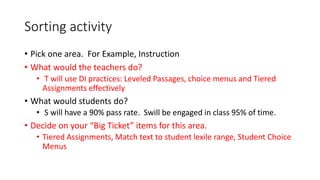
• Pick one area. For Example, Instruction 
• What would the teachers do? 
• T will use DI practices: Leveled Passages, choice menus and Tiered 
Assignments effectively 
• What would students do? 
• S will have a 90% pass rate. Swill be engaged in class 95% of time. 
• Decide on your “Big Ticket” items for this area. 
• Tiered Assignments, Match text to student lexile range, Student Choice 
Menus
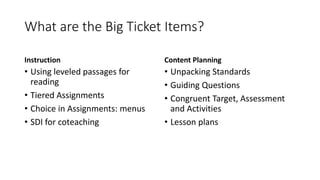
What are the Big Ticket Items? 
Instruction 
• Using leveled passages for 
reading 
• Tiered Assignments 
• Choice in Assignments: menus 
• SDI for coteaching 
Content Planning 
• Unpacking Standards 
• Guiding Questions 
• Congruent Target, Assessment 
and Activities 
• Lesson plans
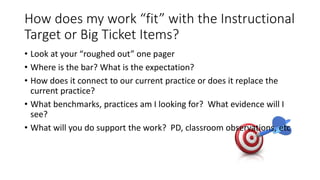
How does my work “fit” with the Instructional 
Target or Big Ticket Items? 
• Look at your “roughed out” one pager 
• Where is the bar? What is the expectation? 
• How does it connect to our current practice or does it replace the 
current practice? 
• What benchmarks, practices am I looking for? What evidence will I 
see? 
• What will you do support the work? PD, classroom observations, etc
Get Reacquainted with the 
standards 
A deeper look at what students need to know and understand
In order for student learning to increase we 
must _____________. 
• Cover all standards in KCAS for the grade level 
• Teach to the test 
• Teach for meaning and understanding 
• Include writing across the content areas
How have teachers in your building/district 
changed instructional practices post KCAS?
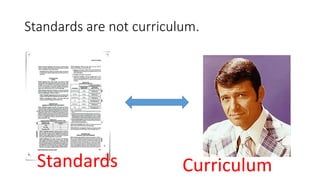
Standards are not curriculum. 
Standards Curriculum
College and Career Readiness 
Standards 
Domain headings and Cluster 
headings 
Text at each grade level 
Individual statements
Understanding the intent and the structure 
• Begin with the “front matter” not grade level 
standards 
• Look at the components. 
• Don’t neglect the Appendices. 
• Wiggins and Mctighe, “From Common Core to Curriculum”
Ask your Teachers 
•What is the instructional emphases called for by the 
standards and their implications? What are the shifts?
#1 Complex Text and Academic Language
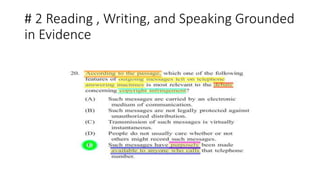
# 2 Reading , Writing, and Speaking Grounded 
in Evidence
#3 Content Rich Nonfiction
So your 
noticing a 
mismatch
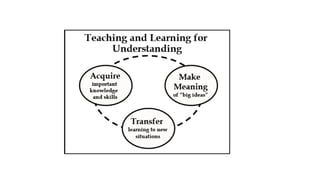
Understanding By design 
McTighe and Wiggins
1.Unpacking: Knowledge, Skill and 
Understanding
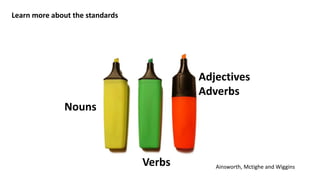
Learn more about the standards 
Nouns 
Verbs 
Adjectives 
Adverbs 
Ainsworth, Mctighe and Wiggins
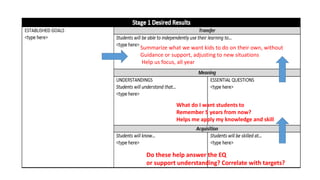
Summarize what we want kids to do on their own, without 
Guidance or support, adjusting to new situations 
Help us focus, all year 
What do I want students to 
Remember 5 years from now? 
Helps me apply my knowledge and skill 
Do these help answer the EQ 
or support understanding? Correlate with targets?
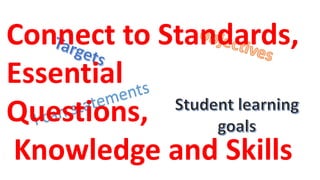
Connect to Standards, 
Essential 
Questions, 
Knowledge and Skills
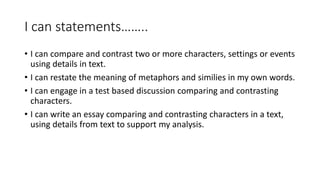
I can statements…….. 
• I can compare and contrast two or more characters, settings or events 
using details in text. 
• I can restate the meaning of metaphors and similies in my own words. 
• I can engage in a test based discussion comparing and contrasting 
characters. 
• I can write an essay comparing and contrasting characters in a text, 
using details from text to support my analysis.
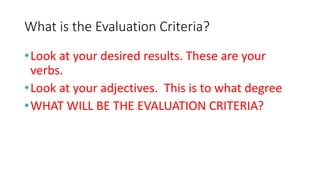
What is the Evaluation Criteria? 
•Look at your desired results. These are your 
verbs. 
•Look at your adjectives. This is to what degree 
•WHAT WILL BE THE EVALUATION CRITERIA?
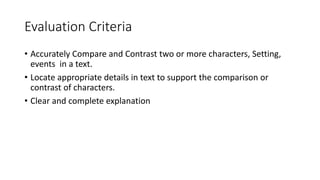
Evaluation Criteria 
• Accurately Compare and Contrast two or more characters, Setting, 
events in a text. 
• Locate appropriate details in text to support the comparison or 
contrast of characters. 
• Clear and complete explanation
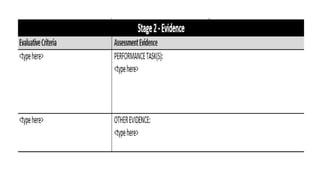
What Evidence will support the 
learning?
What’s The Evidence? 
• Written essay comparing and contrasting characters, setting, events 
• Character maps 
• Story map of events in story 
• Group discussion 
• Reading log H diagram
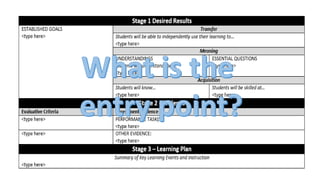
Stage 3 Learning Plan 
•What would be some key learning events and 
instruction that would lead to desired student 
learning results?
Learning Plan Day 1-3 
• Character Maps for each character as they read Chapters 1- 
3 
• Annotate specific details in text about each character 
• Engage in small group discussion comparing and 
contrasting the two main characters 
• Chapter 4-5 locate similies and metaphors and discuss 
what they mean, how do they help us visualize what the 
author is saying 
• Answer comprehension questions for chapter 1-5
Let’s Review How to Plan for Instruction Using 
UBD 
• Select a few standards which will be the primary learning targets for 
the unit of learning . These should connect easily. 
• Unpack them using color coding 
• What is the Understanding? What is the skill and knowledge? 
• What is my target? 
• Decide on evaluation criteria and evidence of the student learning. 
• Decide which activities will occur to support the student learning
It Stuck With Me!
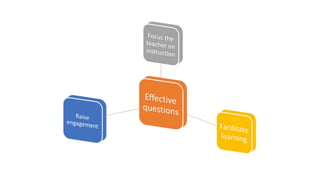
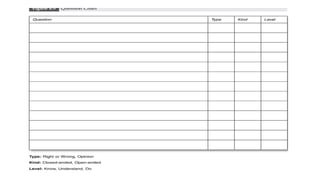
Effective Questions
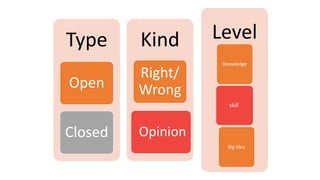
Type 
Open 
Closed 
Kind 
Right/ 
Wrong 
Opinion 
Level 
Knowledge 
skill 
Big Idea
How to use questions effectively 
with students
Looking at teacher questions 
• Video or Question Chart for collecting evidence 
• Help teachers identify what kind of learning they are involved in and 
do they have the kind of questions appropriate for that kind of 
learning 
• When collaborating around questions, set a student goal related to 
engagement and teacher goals for themselves
Coaching Conversation Starters for 
Questioning 
• When thinking about engagement, where would you rate this lesson on a 
scale of 1-10? 
• What types, kind, level of questions did you ask most frequently? 
• What was your learning goal for the lesson? How did your questions 
support that goal? 
• Did your questions move the discussion forward? 
• Did your questions check for understanding? 
• What was the ideal outcome? 
• What are you seeing that indicates that your questioning was successful? 
• What can we do to resolve this issue?
Thinking Prompts
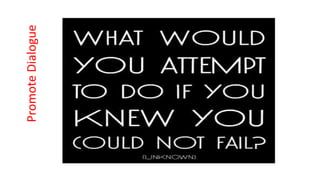
Promote Dialogue
Engage Learners 
At least 60% of students in classroom are not 
auditory or text based learners. Because of 
digital bombardment, they think graphically. 
More visual kinesthetic learners. (Jensen)
What are the attributes of effective thinking 
prompts?
What Coaches Can Do 
• Create a bank and help teachers find them. 
• Observe engagement (time on task, teacher talk vs student talk) 
• Go back to your coaching questions.
My Plan of Action 
• On an index card, write your email address. 
• Jot down one or two things that you plan to do as a result of today. 
• Exchange with your learning partners. 
• Have a quick conversation. 
• In one week, email your learning partner.

Literacy coaching for high impact Instruction

  • 1.
    Literacy Coaching forHigh Impact Instruction So I have the Target on the board…….
  • 3.
    Today we willfocus on…… • Setting Clear Instructional Improvement Targets with Teachers • Planning for Teaching and Learning for Understanding • Unpacking the Standards • Congruent Planning • High Leverage Instructional Practices • Effective Questions • Thinking Prompts
  • 4.
    Table Jobs •Supply Manager •Summarizer • Logistics • Director
  • 5.
    What is thesingle most important factor in moving schools forward? • Having a Curriculum Map or Pacing Guide • Utilizing formative assessments effectively • Having a clear and concise instructional goal • Having a principal that is a learner as well as a leader Michael Fullan , 2010
  • 6.
    How does thissupport what we already do? What will this practice replace?
  • 7.
  • 8.
    Let’s Get Focused Does your CSIP impact instruction?
  • 9.
    Developing a OnePager with Instructional Targets for Literacy • Clear, Simple, easily understood and doable • Clearly states the schools goals for instructional improvement that describes critical teaching behaviors • May be more specific (Literacy Improvement, Math Improvement) • What will the teachers do and what will the students do in each heading • May organize by Danielson Framework, Knight framework (Big 4) or other
  • 10.
    Sorting activity •Color Code Strategies on the your CSIP in these four categories: • Pink=Instruction • Yellow= assessment for learning • Green= Climate/ Environment • Orange= Content Planning Summarize your strategies on post its and sort into the above headings What big themes do you see?
  • 11.
    Sorting activity •Pick one area. For Example, Instruction • What would the teachers do? • T will use DI practices: Leveled Passages, choice menus and Tiered Assignments effectively • What would students do? • S will have a 90% pass rate. Swill be engaged in class 95% of time. • Decide on your “Big Ticket” items for this area. • Tiered Assignments, Match text to student lexile range, Student Choice Menus
  • 12.
    What are theBig Ticket Items? Instruction • Using leveled passages for reading • Tiered Assignments • Choice in Assignments: menus • SDI for coteaching Content Planning • Unpacking Standards • Guiding Questions • Congruent Target, Assessment and Activities • Lesson plans
  • 13.
    How does mywork “fit” with the Instructional Target or Big Ticket Items? • Look at your “roughed out” one pager • Where is the bar? What is the expectation? • How does it connect to our current practice or does it replace the current practice? • What benchmarks, practices am I looking for? What evidence will I see? • What will you do support the work? PD, classroom observations, etc
  • 15.
    Get Reacquainted withthe standards A deeper look at what students need to know and understand
  • 16.
    In order forstudent learning to increase we must _____________. • Cover all standards in KCAS for the grade level • Teach to the test • Teach for meaning and understanding • Include writing across the content areas
  • 17.
    How have teachersin your building/district changed instructional practices post KCAS?
  • 18.
    Standards are notcurriculum. Standards Curriculum
  • 19.
    College and CareerReadiness Standards Domain headings and Cluster headings Text at each grade level Individual statements
  • 20.
    Understanding the intentand the structure • Begin with the “front matter” not grade level standards • Look at the components. • Don’t neglect the Appendices. • Wiggins and Mctighe, “From Common Core to Curriculum”
  • 21.
    Ask your Teachers •What is the instructional emphases called for by the standards and their implications? What are the shifts?
  • 22.
    #1 Complex Textand Academic Language
  • 23.
    # 2 Reading, Writing, and Speaking Grounded in Evidence
  • 24.
    #3 Content RichNonfiction
  • 26.
    So your noticinga mismatch
  • 28.
    Understanding By design McTighe and Wiggins
  • 29.
  • 30.
    Learn more aboutthe standards Nouns Verbs Adjectives Adverbs Ainsworth, Mctighe and Wiggins
  • 32.
    Summarize what wewant kids to do on their own, without Guidance or support, adjusting to new situations Help us focus, all year What do I want students to Remember 5 years from now? Helps me apply my knowledge and skill Do these help answer the EQ or support understanding? Correlate with targets?
  • 33.
    Connect to Standards, Essential Questions, Knowledge and Skills
  • 34.
    I can statements…….. • I can compare and contrast two or more characters, settings or events using details in text. • I can restate the meaning of metaphors and similies in my own words. • I can engage in a test based discussion comparing and contrasting characters. • I can write an essay comparing and contrasting characters in a text, using details from text to support my analysis.
  • 35.
    What is theEvaluation Criteria? •Look at your desired results. These are your verbs. •Look at your adjectives. This is to what degree •WHAT WILL BE THE EVALUATION CRITERIA?
  • 36.
    Evaluation Criteria •Accurately Compare and Contrast two or more characters, Setting, events in a text. • Locate appropriate details in text to support the comparison or contrast of characters. • Clear and complete explanation
  • 38.
    What Evidence willsupport the learning?
  • 39.
    What’s The Evidence? • Written essay comparing and contrasting characters, setting, events • Character maps • Story map of events in story • Group discussion • Reading log H diagram
  • 40.
    Stage 3 LearningPlan •What would be some key learning events and instruction that would lead to desired student learning results?
  • 41.
    Learning Plan Day1-3 • Character Maps for each character as they read Chapters 1- 3 • Annotate specific details in text about each character • Engage in small group discussion comparing and contrasting the two main characters • Chapter 4-5 locate similies and metaphors and discuss what they mean, how do they help us visualize what the author is saying • Answer comprehension questions for chapter 1-5
  • 42.
    Let’s Review Howto Plan for Instruction Using UBD • Select a few standards which will be the primary learning targets for the unit of learning . These should connect easily. • Unpack them using color coding • What is the Understanding? What is the skill and knowledge? • What is my target? • Decide on evaluation criteria and evidence of the student learning. • Decide which activities will occur to support the student learning
  • 46.
  • 47.
  • 50.
    Type Open Closed Kind Right/ Wrong Opinion Level Knowledge skill Big Idea
  • 51.
    How to usequestions effectively with students
  • 52.
    Looking at teacherquestions • Video or Question Chart for collecting evidence • Help teachers identify what kind of learning they are involved in and do they have the kind of questions appropriate for that kind of learning • When collaborating around questions, set a student goal related to engagement and teacher goals for themselves
  • 53.
    Coaching Conversation Startersfor Questioning • When thinking about engagement, where would you rate this lesson on a scale of 1-10? • What types, kind, level of questions did you ask most frequently? • What was your learning goal for the lesson? How did your questions support that goal? • Did your questions move the discussion forward? • Did your questions check for understanding? • What was the ideal outcome? • What are you seeing that indicates that your questioning was successful? • What can we do to resolve this issue?
  • 60.
  • 61.
  • 63.
    Engage Learners Atleast 60% of students in classroom are not auditory or text based learners. Because of digital bombardment, they think graphically. More visual kinesthetic learners. (Jensen)
  • 64.
    What are theattributes of effective thinking prompts?
  • 66.
    What Coaches CanDo • Create a bank and help teachers find them. • Observe engagement (time on task, teacher talk vs student talk) • Go back to your coaching questions.
  • 67.
    My Plan ofAction • On an index card, write your email address. • Jot down one or two things that you plan to do as a result of today. • Exchange with your learning partners. • Have a quick conversation. • In one week, email your learning partner.

Editor's Notes

  • #2 8:30-9:45 How many years experience at your table? Total from all tables…. Establishing equality and status by acknowledging their expertise. Decide who is partner 1 and who is partner 2
  • #3 Overview of their folder Tag something that looks interesting to you
  • #4 Why are you here? What is your objective by being here today? Look through the lens of your work. How could you adapt, adopt and apply what you hear today Touch five chairs and stop. Share you objective after introducing yourself,.
  • #5 Go over group norms and facilities information
  • #6 Why are you here? What is your objective by being here today? Look through the lens of your work. How could you adapt, adopt and apply what you hear today
  • #8 Change matrix handout Peter Senghe
  • #9 Goal is for students to receive excellent instruction every day in every class. Start with your CSIP Often this does not address the nuts and bolts of instruction Clear description of teaching behaviors that are most important for our students and teachers.
  • #10 School improvement plans should impact instruction…. Or is yours a binder that decorates the principals office Too Long for us to understand or use To complex to understand for coordinated pd, different people responsible for different pieces, different interpretations, etc Don’t address the nuts and bolts of instruction Ensures that our professional development is aligned to support implementation of the target?
  • #11 Every educator fully understands the target, what it means and the teaching practices it embodies All professional learning is focused around the Instructional Targets so principal and coach partnerships are formed around the target
  • #12 Do this with your learning partner. Demonstrate the process using Adair County CDIP. Each table writes their strategies on index cards and sorts them into categories. Label the categories. Can you combine some of the strategies if they overlap? Handout for recording the information notes page 2
  • #13  Notes page 2-3 Demonstrate the process using Adair County CDIP. Each table writes their strategies on index cards and sorts them into categories. Label the categories. Can you combine some of the strategies if they overlap? Share out Ah Ha Moments Handout for recording the information
  • #14 nOtes page 4 and fill in on back of page 2
  • #15 One take away from this session
  • #16 What is your take away from this section?
  • #19 Think Pair Share Do any of your teachers focus soley on their grade level Standards Don’t zero in with out careful examination of the goals and structures of the document
  • #20 Buidling code and house architect analogy
  • #21 Pull up an electronic copy of the standards to show them important pieces
  • #22 Go back and look at the preface, the beginning Do you need to go back and revisit
  • #23 Implications that we must shift Look at Achieve the Core shifts as we go through next slides and discuss challenges at your school.
  • #24 Appendix B Regular practice Scaffodling Text dependent questions Multiple readings, read aloud, chunking
  • #26 Read aloud above grade level 50/50 70/30 Appendix B
  • #27 Go back to front material, Appendices and think about what your teachers may need….. With your learning partner: What are some key things students need: Read Closely, critically, variety of text, textual evidence Look at shifts activity with coaches
  • #28 Effective uses of content understandings and knowledge and skill In order to Transfer learning into new situations ELA CCR anchor standards specify the long term transfer goals
  • #29 What if any work is to be done here? Connect to your one pager? How could you use the Shifts with your teachers?
  • #30 What is your take away from this section?
  • #31 9:45-11:45 Building the plane while in the air video on my pinterest How do we get a coherent curriculum?
  • #32 What is it we want kids to know, understand and be able to do?
  • #33 Verb –HOW you are to assess student mastery of the standard, what students do Nouns – WHAT students are key concept or process Adjectives – To what LEVEL students are to demonstrate understanding: traits of the performance Handout: Modified Mctighe Knowledge, Skill Understanding Use ELA RL5.1, 5.3 RL5.4 and W5.9, SL 5.1 for group practice on elmo projector Handout: Modified Mctighe Knowledge, Skill Understanding
  • #34 Use ELA RL 5.3 for group practice Each table group will draw from a bag and do one at table. RI 2, RL 9, W2, W3
  • #35 Start with ELA Anchor Standards for Transfer, can we consolidate them into a few…… Why are we learning knowledge and skills Teachers complete based on their unpacking PD360 Lumi book Chapter 2 Wiggins and Mctighe Transfer Look at your anchor standards
  • #36 The aim is to ensure that students understand goals and how current activities support those goals. Ideally, then, the student has perspective and sees value in the work: they understand the why of the current work in order to find it more meaningful and to facilitate purposeful learning, and they have a touchstone for gauging progress (and thus use of time). Write I can statements for RL5.3 with group
  • #37 Participants develop I can statements for the standard they selected. This should help with congruency. How will you evaluate those I can statements?
  • #38 Go back to standards and plan. Answer question at table Look at p. 15-17 in Coaching Toolbox On PD 360 Click on lumibooks and select Core Learning: Assessing What Matters Most Knowledge is assessed by straightforward manner, question answer Skills and Processes more involved complex actions: tying a shoe, writing a piece, problem solving, critical thinking require that they perform the skill to demonstrate competence, not a right answer but progress from novice to proficient Understanding: writers adjust their style based on purpose and audience, concepts such as friendship, bravery, etc Apply learning and explain the rationale and process: Why? , analogies, justify their conclusion, Defend their position
  • #41 This should help with congruent expectations and assessments.
  • #42 Chart Group standard then individual standard at table.
  • #43 Ways of showing that you understand Provide indicators for assessments Helps us think about what assessments we need to judge understanding explain provide thorough and justifiable accounts of phenomena, facts, and data interpret — tell meaningful stories, offer apt translations, provide a revealing historical or personal dimension to ideas and events; make subjects personal or accessible through images, anecdotes, analogies, and models apply — effectively use and adapt what they know in diverse contexts have perspective — see and hear points of view through critical eyes and ears; see the big picture empathize — find value in what others might find odd, alien, or implausible; perceive sensitively on the basis of prior indirect experience have self-knowledge — perceive the personal style, prejudices, projections, and habits of mind that both shape and impede our own understanding; they are aware of what they do not understand and why understanding is so hard
  • #45 After modeling and charting with RL5.3, Table group use their standard to practice process.
  • #47 Turn and tell your partner about 3 key points from Understanding by Design based on Knight, Mctighe and Wiggins
  • #48 Different Entry Points for coaching Look at a Favorite Activity 5% chance of implementation without coaching 95% of implementation with coaching Have a discussion with your learning partner Step by step handout for doing this Good questions for this process
  • #49 What is your take away from this section? What would complement or replace something you already do? Does it connect to your one page instructional target?
  • #50 Show evian baby commercial when they return. Something that makes you smile or laugh…..
  • #51 Participants have different colored post it Jot what stuck with them and have a 90 second discussion with their group
  • #52 Turn and Talk What would you see if teachers are asking effective questions?
  • #53 What is my instruction really doing? How can I facilitate student learning? Does my level of questioning push my students to the level of learning thinking necessary? Many of our teachers have habituated asking low level questions
  • #54 How would you describe the cafeteria conversations at your school? We want questions to prompt the same level of engagement, though and ultimately learning that take place in the cafeteria; High energy
  • #55 Open unlimited number of responses What do you like about the Beatles? Closed finite number of possible answers, may not be a short answer: What are the counties in Kentucky? What are the regions of KY? Most effective when used to check understanding, verbal practice One is not superior to the other, but if you observe a dull classroom that lacks energy, it may be that Teacher is trying to move conversation forward with closed questions. Right type for right instructional goal Gall research 1984, 80% of questions low level recall facts Opinion : good for conversation starters When thinking of level look back to Unit Template? Are your questions congruent with your skills and knowledge?
  • #56 No opt out Wait time Cold call 100 percent participation Turn and Talk
  • #57 Teachers need a clear picture of current reality See questions from new perspectives 95% engagement 85% proficiency on exit slip 90% open, opinion during discussion Would this connect to your CSIP
  • #58 Handout
  • #59 Handout with coaching questions to get conversation going
  • #60 Script questions Decide who is alligator and who is zebra. Zebra is coach. Alligator is teacher. Have a quick coaching conversation
  • #61 Zebra is teacher Alligator is coach
  • #62 Gradual Release Think about when coaching teachers
  • #63 What is your take away from this section? What would complement or replace something you already do? Does it connect to your one page instructional target?
  • #64 Key learning from this section….. Take away Table talk break
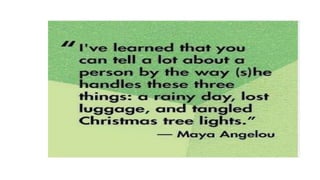
  • #65 Provocative devices Videos, work of art, newspaper clipping rich in dialogue
  • #66 Touch five chairs and have a conversation
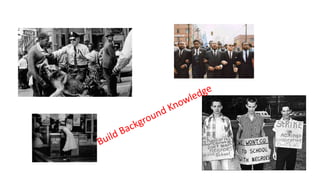
  • #67 Before we read Watson’s Go to Birmingham Direct correlation with background and acheivement
  • #68 How does this impact your teaching?
  • #69 Table conversation Make a list Complex, evoke more than one response Positive Concise Provocative Right prompt for learning event, if it is explicit instruction more closed questions constructing thinking more open questions
  • #70 Evaluate the thinking prompt. Table conversation.
  • #71 Pinterest Would this connect to your CSIP? When might you suggest thinking prompts. Is engagement a focus on your CSIP?