Professional Learning Network:
effective learning in inclusive
classrooms
Brighouse
February 14, 2020
Faye Brownlie
slideshare.net/fayebrownlie.Richmond.Feb 2020
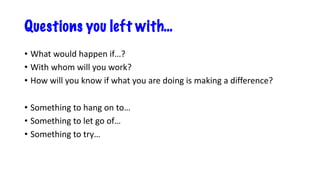
Questions you left with…
• What would happen if…?
• With whom will you work?
• How will you know if what you are doing is making a difference?
• Something to hang on to…
• Something to let go of…
• Something to try…
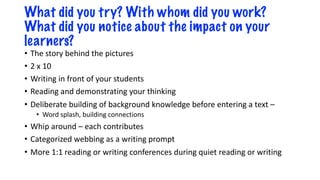
What did you try? With whom did you work?
What did you notice about the impact on your
learners?
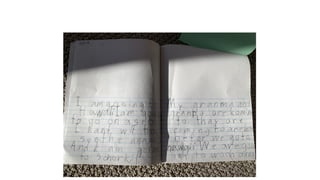
• The story behind the pictures
• 2 x 10
• Writing in front of your students
• Reading and demonstrating your thinking
• Deliberate building of background knowledge before entering a text –
• Word splash, building connections
• Whip around – each contributes
• Categorized webbing as a writing prompt
• More 1:1 reading or writing conferences during quiet reading or writing
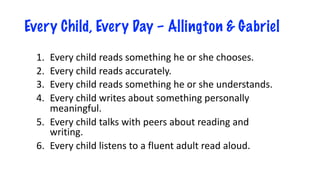
Every Child, Every Day – Allington & Gabriel
1. Every child reads something he or she chooses.
2. Every child reads accurately.
3. Every child reads something he or she understands.
4. Every child writes about something personally
meaningful.
5. Every child talks with peers about reading and
writing.
6. Every child listens to a fluent adult read aloud.
Teachers’ Reflections
• What made a difference for vulnerable learners
(CR4YR, 2012-2013)
• 1:1 support
• Relationship
• Choice
• Focus on meaning
Some NOT best practices in literacy
-no research support for decades!
-over-used, under-supportedL
• Teaching grammar in isolation
• Friday spelling lists
• Assigning topics in writing, with no 1:1 no conferencing,
just collecting the work
• Too much teacher-talk
• Fill in the blanks, MC, closed thinking exercises
• Children identifying themselves by their reading level
• Round robin reading – even in guided reading groups!!!
• Lack of consistency in the programming for vulnerable
learners
Learning Intentions
• I have a better understanding of effective literacy practices.

• I have a better understanding of what the research says counts for
struggling readers.

• I have a plan for teaching spelling that is more effective than a weekly
spelling list.
• I have a new purposeful, strategy sequence to try.
Guided Reading Group: the pattern
• Purpose or goal for the reading
• Connecting with background knowledge
• Word work
• Independent reading
• Oral reading – fluency check and 1:1 conference
• Reading for meaning
• Responding to reading
Strategy Sequence
• Connecting
• Building motivation, accessing and building background knowledge, asking
questions, setting a purpose for reading
• Processing
• Making sense of new text, linking old information to new
• Transforming and personalizing
• Showing what you know
No round robin reading, even in guided reading
groups! – a more skilled group
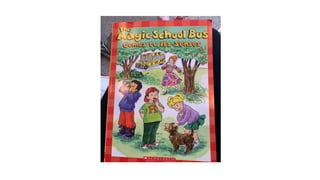
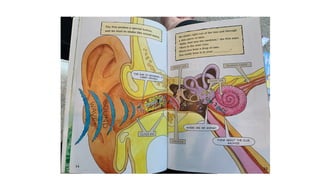
• Connecting: What do you remember about the senses? Words
describing the ear and how we hear?
• Eardrum, inner, outer, middle ear, hear, sounds
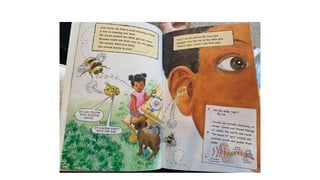
• Processing - close reading (goal for this group)
• What is a word that means waves?
• Where can sound travel?
• What is the eardrum made of?
• Transforming/Personalizing: Draw and label how we hear
• While I read with each
No round robin reading, even in guided reading
groups! – an emerging group
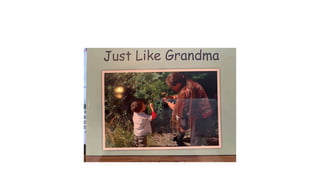
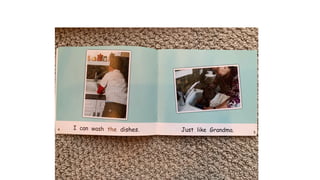
• Connecting: Title – What might they do together? What do you do
with your Grandma or another adult?
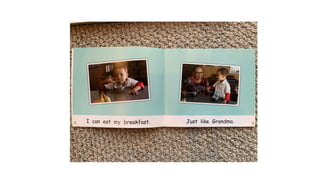
• Processing – picture walk (goal: build background knowledge and
hear the language)
• Say the words as you turn the pages, but do not read the text word for word.
• See what words we already know – ‘I can, Just like, Grandma’
• What do they do together? Collect the words.
• Can you find me the word ‘like, boots, pick…’ How did you know?
• Transforming/Personalizing: Reread the book. Write one thing you do
that is ‘Just Like Grandma’.
• While I read with each
“...the design of reading lessons differs for
good and poor readers in that poor readers
get more work on skills in isolation, whereas
good readers get assigned more reading
activity.”
(Allington, 1980; 1983; 2002; Allington & McGill-Franzen, 1989; Collins, 1986; Cummins, 2007; Valli &
Chambliss, 2007; Vaughn & Linan-Thompson, 2003).
Children Experiencing Reading Difficulties – What
We Know and What We Can Do
Literacy Leadership Brief, ILA, Dec2019/Jan2020
In short, skilled reading is about more than reading the
words correctly. It involves both reading the words
correctly and making sense of the text ideas while
confirming and building knowledge about the world.
Appropriate Instruction
• High expectations for ALL students
• Comprehensive reading instruction addressing all dimensions of reading
• Word reading
• Oral language development
• Writing
• Comprehension
• Self-regulation
• Learn, practice and apply these skills and strategies while engaged in meaningful
reading and writing
• Includes a flexible range of instructional tactics
• Teacher-directed and independent work
• In large group and small group settings
• Focuses on strengths and needs of individual students
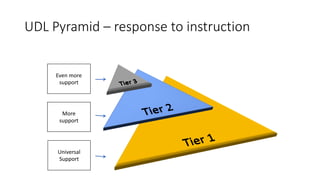
UDL Pyramid – response to instruction
Even more
support
More
support
Universal
Support
•Since the early First-Grade Studies of the 1960s, and in
many studies since, we have known that teachers are
likely to make a bigger difference in students’ progress
than any specific program of instruction.
•Meanwhile, there is little evidence to support the
effectiveness of one of the most pervasive English
language arts approaches—grouping students based
on reading level for Tier-1 reading instruction
(Shanahan, 2017; Sparks, 2018).
• Cited in ‘A District Leader’s Education in Early Reading’ – Myracle, EL,
Feb 2020, Vol 77, #5
Spelling
• Orthographic stages:
• Sound - matching with letters and sounds
• Pattern - matching in words
• Meaning
• From No More Phonics and Spelling Worksheets –
Palmer & Invernizzi. not this, but that – Duke & Keene,
ed., Heinemann
Sound - matching with letters and sounds
• Beginning and ending consonants
• Short vowels
• Consonant blends
• CVC, CVCC…
• Digraphs
Pattern – in words
• Short vs long vowels
• Common long vowel patterns
• Less common
• complex
• Homophones and homographs
• Syllable patterns
• Plural, past tense
Meaning
• Suffixes and prefixes
• Root words
• Greek and Latin roots
• Predictable changes in related words
• Explain – explanation; exclaim - exclamation
Practices
• Teach for transfer
• Ask, don’t tell
• Look for linguistic patterns.
• How many letters are right? In what order? Are they stretching out the word?
• Link to reading and writing
• 1:1 writing conferences
• Risk words in your writing
• Work toward fluency and flexibility, self regulation
• Model how you remember how to spell the word
• Consider what the learner needs to hear to move them forward
• Model with content words
• Model with words that come from students’ writing
• Use word walls
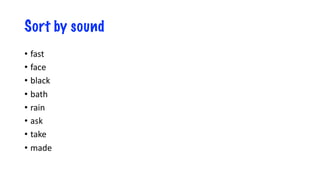
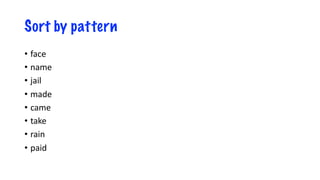
• Word sorts
• Sight, sound, meaning
• Use words they can read. NO nonsense words.
• Compare words that do with words that don’t
Sort by sound
• fast
• face
• black
• bath
• rain
• ask
• take
• made
Sort by pattern
• face
• name
• jail
• made
• came
• take
• rain
• paid
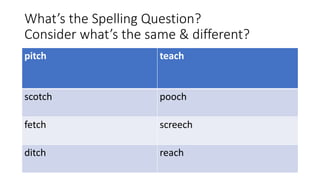
What’s the Spelling Question?
Consider what’s the same & different?
pitch teach
scotch pooch
fetch screech
ditch reach
Building Accuracy: Whole Class Lessons
Using Big Books
• Work with one or two pages (5-10 Minutes).
• Cover up one or two words.
• Read the sentence together leaving out the missing
word.
• Ask for all of the possibilities for the missing word.
• Record the suggestions.
• Try each word suggested crossing out words that don’t
make sense.
• Notice and name the strategies that were used to
determine the author’s words.
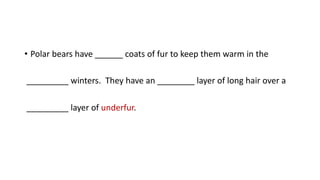
• Polar bears have ______ coats of fur to keep them warm in the
_________ winters. They have an ________ layer of long hair over a
_________ layer of underfur.
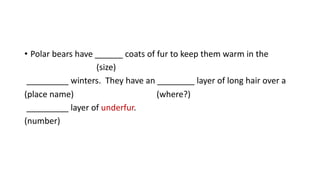
• Polar bears have ______ coats of fur to keep them warm in the
(size)
_________ winters. They have an ________ layer of long hair over a
(place name) (where?)
_________ layer of underfur.
(number)
• Polar bears have th______ coats of fur to keep them warm in the
A_________ winters. They have an o________ layer of long hair over
a s_________ layer of underfur.
• thick
• Arctic
• outer
• second
Strong Readers – Northern Series,
Strong Nations Publishing
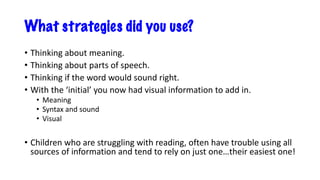
What strategies did you use?
• Thinking about meaning.
• Thinking about parts of speech.
• Thinking if the word would sound right.
• With the ‘initial’ you now had visual information to add in.
• Meaning
• Syntax and sound
• Visual
• Children who are struggling with reading, often have trouble using all
sources of information and tend to rely on just one…their easiest one!
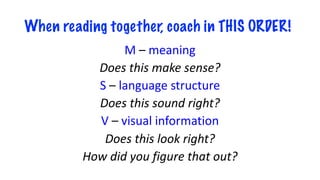
When reading together, coach in THIS ORDER!
M – meaning
Does this make sense?
S – language structure
Does this sound right?
V – visual information
Does this look right?
How did you figure that out?
A grade 4 sequence to encourage thinking about
decoding unknown words, building fluency,
deepening understanding, personal le:er wri;ng
Thanks to Janet Smith, teacher librarian
c̓əsqənelə Elementary
Maple Ridge, BC
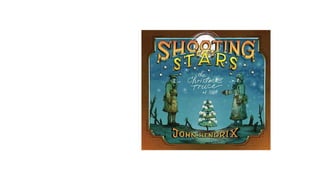
Shooting at
the Stars
A follow-up to
Remembrance Day in
preparation for writing
Christmas cards to our
Canadian Armed Forces
overseas.
Plan for Grade 4
• Using 1 page
• Covering 5 words
1. Read it with a partner showing missing words
2. Read it out loud whole class
3. Partners record possible words they can think of
4. Whole group recording of possible words
5. Try each word suggested crossing out words that don’t
make sense.
6. Notice and name the strategies that were used to
determine the author’s words
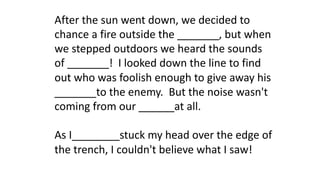
After the sun went down, we decided to
chance a fire outside the _______, but when
we stepped outdoors we heard the sounds
of _______! I looked down the line to find
out who was foolish enough to give away his
_______to the enemy. But the noise wasn't
coming from our ______at all.
As I________stuck my head over the edge of
the trench, I couldn't believe what I saw!
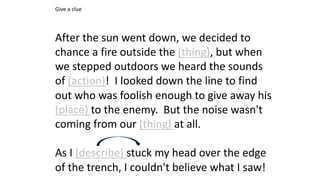
After the sun went down, we decided to
chance a fire outside the (thing), but when
we stepped outdoors we heard the sounds
of (action)! I looked down the line to find
out who was foolish enough to give away his
(place) to the enemy. But the noise wasn't
coming from our (thing) at all.
As I (describe) stuck my head over the edge
of the trench, I couldn't believe what I saw!
Give a clue
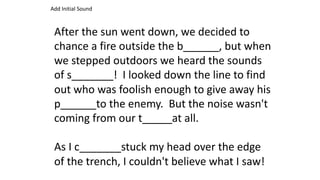
After the sun went down, we decided to
chance a fire outside the b______, but when
we stepped outdoors we heard the sounds
of s_______! I looked down the line to find
out who was foolish enough to give away his
p______to the enemy. But the noise wasn't
coming from our t_____at all.
As I c_______stuck my head over the edge
of the trench, I couldn't believe what I saw!
Add Initial Sound
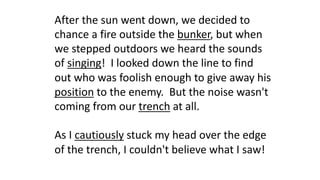
After the sun went down, we decided to
chance a fire outside the bunker, but when
we stepped outdoors we heard the sounds
of singing! I looked down the line to find
out who was foolish enough to give away his
position to the enemy. But the noise wasn't
coming from our trench at all.
As I cautiously stuck my head over the edge
of the trench, I couldn't believe what I saw!
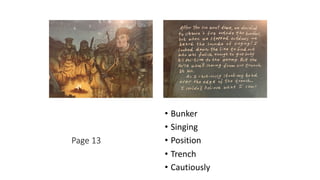
Page 13
• Bunker
• Singing
• Position
• Trench
• Cautiously
AAS
wePart 2
Intro the
writing
activity:
Focus on what the soldier has
written to his mother
What are soldiers feeling
while they are away? What
would they most like? What
would they most like at
Christmas 9me?
Read the rest of the book
using the document camera
Part 3
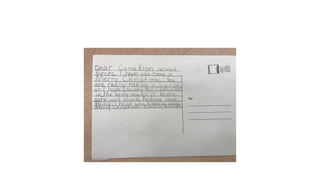
Write a
Christmas
postcard to
members of
the armed
forces.
Who is in the armed forces?
What are possible roles in the
armed forces
What is peace keeping?
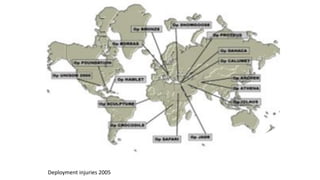
Where are our armed forces
stationed in the world?
Deployment injuries 2005
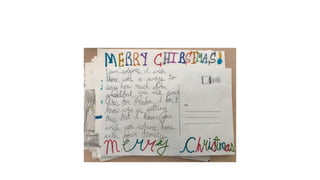
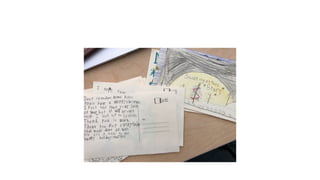
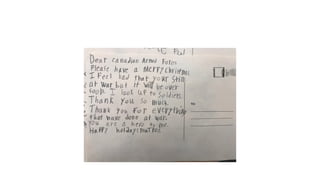
Part 3: Wri*ng
• Draft copy
• Conference
• Good copy for the post
• Draw/decorate the front of the
postcard
Teacher reflections:
• High student engagement
• Individual conferences were possible, supportive, connection-based
with 2 teachers in the room
• Students who needed more support were easily supported within the
context of rich classroom literacy work
•The surest way to improve students' comprehension is
to increase their reading of knowledge-based texts
and their writing about such texts (Steiner et al.,
2019).
• Cited in ‘A District Leader’s Education in Early Reading’ – Myracle, EL,
Feb 2020, Vol 77, #5
A Sequence on Global Issues
• Grade 6/7 with Sara Maher, November
• Context:
• Read class novel, The Breadwinner
• Strengths:
• Class as a community
• Reading for information
• Stretches:
• Connecting to reading
• Risk-taking and sharing opinions
• 6 students with an IEP
• Goals:
• All writing
• Make personal connections and share an opinion
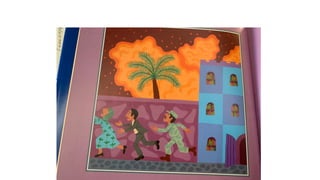
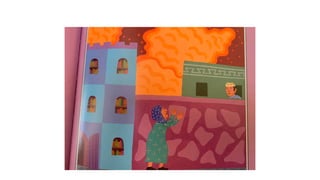
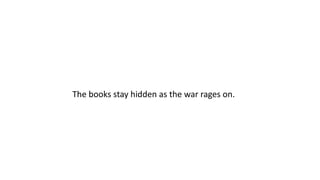
The books stay hidden as the war rages on.
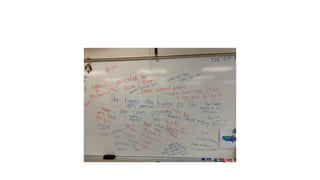
• Connec&ng
• ‘say something’ that you know, think, or wonder about a picture
• Repeat twice, include all voices
• Processing
• Explode the sentence
• “The books stay hidden as they war rages on.”
• Connect this to what you know and to the pictures you saw.
• All voices.
• Transforming and Personalizing
• Quick write by teachers – 90 seconds
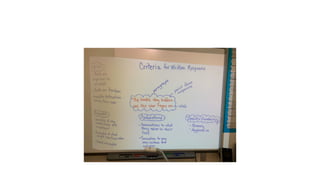
• “What did you no&ce?” – create criteria
• Opinion – ‘because’
• Connec&on
• $500 words – in the vaultJ
• Students wrote in response – 5 minutes, then marked up their wri&ng
Reflections
• All had an access point and wanted to participate.
• 2 boys who had their hands up the most were those with ‘behaviour
plans’
• Both students with ‘dysgraphia’ wrote, without scribing.
• Students were able to meet the criteria.
• The time flew.
Questions to leave with…
• What would happen if…?
• With whom will you work?
• How will you know if what you are doing is making a difference?
• Something to hang on to…
• Something to let go of…
• Something to try…

Richmond Feb 2020

  • 1.
    Professional Learning Network: effectivelearning in inclusive classrooms Brighouse February 14, 2020 Faye Brownlie slideshare.net/fayebrownlie.Richmond.Feb 2020
  • 2.
    Questions you leftwith… • What would happen if…? • With whom will you work? • How will you know if what you are doing is making a difference? • Something to hang on to… • Something to let go of… • Something to try…
  • 3.
    What did youtry? With whom did you work? What did you notice about the impact on your learners? • The story behind the pictures • 2 x 10 • Writing in front of your students • Reading and demonstrating your thinking • Deliberate building of background knowledge before entering a text – • Word splash, building connections • Whip around – each contributes • Categorized webbing as a writing prompt • More 1:1 reading or writing conferences during quiet reading or writing
  • 4.
    Every Child, EveryDay – Allington & Gabriel 1. Every child reads something he or she chooses. 2. Every child reads accurately. 3. Every child reads something he or she understands. 4. Every child writes about something personally meaningful. 5. Every child talks with peers about reading and writing. 6. Every child listens to a fluent adult read aloud.
  • 5.
    Teachers’ Reflections • Whatmade a difference for vulnerable learners (CR4YR, 2012-2013) • 1:1 support • Relationship • Choice • Focus on meaning
  • 6.
    Some NOT bestpractices in literacy -no research support for decades! -over-used, under-supportedL • Teaching grammar in isolation • Friday spelling lists • Assigning topics in writing, with no 1:1 no conferencing, just collecting the work • Too much teacher-talk • Fill in the blanks, MC, closed thinking exercises • Children identifying themselves by their reading level • Round robin reading – even in guided reading groups!!! • Lack of consistency in the programming for vulnerable learners
  • 7.
    Learning Intentions • Ihave a better understanding of effective literacy practices. • I have a better understanding of what the research says counts for struggling readers. • I have a plan for teaching spelling that is more effective than a weekly spelling list. • I have a new purposeful, strategy sequence to try.
  • 8.
    Guided Reading Group:the pattern • Purpose or goal for the reading • Connecting with background knowledge • Word work • Independent reading • Oral reading – fluency check and 1:1 conference • Reading for meaning • Responding to reading
  • 9.
    Strategy Sequence • Connecting •Building motivation, accessing and building background knowledge, asking questions, setting a purpose for reading • Processing • Making sense of new text, linking old information to new • Transforming and personalizing • Showing what you know
  • 10.
    No round robinreading, even in guided reading groups! – a more skilled group • Connecting: What do you remember about the senses? Words describing the ear and how we hear? • Eardrum, inner, outer, middle ear, hear, sounds • Processing - close reading (goal for this group) • What is a word that means waves? • Where can sound travel? • What is the eardrum made of? • Transforming/Personalizing: Draw and label how we hear • While I read with each
  • 14.
    No round robinreading, even in guided reading groups! – an emerging group • Connecting: Title – What might they do together? What do you do with your Grandma or another adult? • Processing – picture walk (goal: build background knowledge and hear the language) • Say the words as you turn the pages, but do not read the text word for word. • See what words we already know – ‘I can, Just like, Grandma’ • What do they do together? Collect the words. • Can you find me the word ‘like, boots, pick…’ How did you know? • Transforming/Personalizing: Reread the book. Write one thing you do that is ‘Just Like Grandma’. • While I read with each
  • 18.
    “...the design ofreading lessons differs for good and poor readers in that poor readers get more work on skills in isolation, whereas good readers get assigned more reading activity.” (Allington, 1980; 1983; 2002; Allington & McGill-Franzen, 1989; Collins, 1986; Cummins, 2007; Valli & Chambliss, 2007; Vaughn & Linan-Thompson, 2003).
  • 19.
    Children Experiencing ReadingDifficulties – What We Know and What We Can Do Literacy Leadership Brief, ILA, Dec2019/Jan2020 In short, skilled reading is about more than reading the words correctly. It involves both reading the words correctly and making sense of the text ideas while confirming and building knowledge about the world.
  • 20.
    Appropriate Instruction • Highexpectations for ALL students • Comprehensive reading instruction addressing all dimensions of reading • Word reading • Oral language development • Writing • Comprehension • Self-regulation • Learn, practice and apply these skills and strategies while engaged in meaningful reading and writing • Includes a flexible range of instructional tactics • Teacher-directed and independent work • In large group and small group settings • Focuses on strengths and needs of individual students
  • 21.
    UDL Pyramid –response to instruction Even more support More support Universal Support
  • 22.
    •Since the earlyFirst-Grade Studies of the 1960s, and in many studies since, we have known that teachers are likely to make a bigger difference in students’ progress than any specific program of instruction.
  • 23.
    •Meanwhile, there islittle evidence to support the effectiveness of one of the most pervasive English language arts approaches—grouping students based on reading level for Tier-1 reading instruction (Shanahan, 2017; Sparks, 2018). • Cited in ‘A District Leader’s Education in Early Reading’ – Myracle, EL, Feb 2020, Vol 77, #5
  • 24.
    Spelling • Orthographic stages: •Sound - matching with letters and sounds • Pattern - matching in words • Meaning • From No More Phonics and Spelling Worksheets – Palmer & Invernizzi. not this, but that – Duke & Keene, ed., Heinemann
  • 25.
    Sound - matchingwith letters and sounds • Beginning and ending consonants • Short vowels • Consonant blends • CVC, CVCC… • Digraphs
  • 26.
    Pattern – inwords • Short vs long vowels • Common long vowel patterns • Less common • complex • Homophones and homographs • Syllable patterns • Plural, past tense
  • 27.
    Meaning • Suffixes andprefixes • Root words • Greek and Latin roots • Predictable changes in related words • Explain – explanation; exclaim - exclamation
  • 28.
    Practices • Teach fortransfer • Ask, don’t tell • Look for linguistic patterns. • How many letters are right? In what order? Are they stretching out the word? • Link to reading and writing • 1:1 writing conferences • Risk words in your writing • Work toward fluency and flexibility, self regulation • Model how you remember how to spell the word • Consider what the learner needs to hear to move them forward • Model with content words • Model with words that come from students’ writing • Use word walls • Word sorts • Sight, sound, meaning • Use words they can read. NO nonsense words. • Compare words that do with words that don’t
  • 29.
    Sort by sound •fast • face • black • bath • rain • ask • take • made
  • 30.
    Sort by pattern •face • name • jail • made • came • take • rain • paid
  • 31.
    What’s the SpellingQuestion? Consider what’s the same & different? pitch teach scotch pooch fetch screech ditch reach
  • 34.
    Building Accuracy: WholeClass Lessons Using Big Books • Work with one or two pages (5-10 Minutes). • Cover up one or two words. • Read the sentence together leaving out the missing word. • Ask for all of the possibilities for the missing word. • Record the suggestions. • Try each word suggested crossing out words that don’t make sense. • Notice and name the strategies that were used to determine the author’s words.
  • 35.
    • Polar bearshave ______ coats of fur to keep them warm in the _________ winters. They have an ________ layer of long hair over a _________ layer of underfur.
  • 36.
    • Polar bearshave ______ coats of fur to keep them warm in the (size) _________ winters. They have an ________ layer of long hair over a (place name) (where?) _________ layer of underfur. (number)
  • 37.
    • Polar bearshave th______ coats of fur to keep them warm in the A_________ winters. They have an o________ layer of long hair over a s_________ layer of underfur.
  • 38.
    • thick • Arctic •outer • second
  • 39.
    Strong Readers –Northern Series, Strong Nations Publishing
  • 40.
    What strategies didyou use? • Thinking about meaning. • Thinking about parts of speech. • Thinking if the word would sound right. • With the ‘initial’ you now had visual information to add in. • Meaning • Syntax and sound • Visual • Children who are struggling with reading, often have trouble using all sources of information and tend to rely on just one…their easiest one!
  • 41.
    When reading together,coach in THIS ORDER! M – meaning Does this make sense? S – language structure Does this sound right? V – visual information Does this look right? How did you figure that out?
  • 42.
    A grade 4sequence to encourage thinking about decoding unknown words, building fluency, deepening understanding, personal le:er wri;ng Thanks to Janet Smith, teacher librarian c̓əsqənelə Elementary Maple Ridge, BC
  • 43.
    Shooting at the Stars Afollow-up to Remembrance Day in preparation for writing Christmas cards to our Canadian Armed Forces overseas.
  • 44.
    Plan for Grade4 • Using 1 page • Covering 5 words 1. Read it with a partner showing missing words 2. Read it out loud whole class 3. Partners record possible words they can think of 4. Whole group recording of possible words 5. Try each word suggested crossing out words that don’t make sense. 6. Notice and name the strategies that were used to determine the author’s words
  • 45.
    After the sunwent down, we decided to chance a fire outside the _______, but when we stepped outdoors we heard the sounds of _______! I looked down the line to find out who was foolish enough to give away his _______to the enemy. But the noise wasn't coming from our ______at all. As I________stuck my head over the edge of the trench, I couldn't believe what I saw!
  • 46.
    After the sunwent down, we decided to chance a fire outside the (thing), but when we stepped outdoors we heard the sounds of (action)! I looked down the line to find out who was foolish enough to give away his (place) to the enemy. But the noise wasn't coming from our (thing) at all. As I (describe) stuck my head over the edge of the trench, I couldn't believe what I saw! Give a clue
  • 47.
    After the sunwent down, we decided to chance a fire outside the b______, but when we stepped outdoors we heard the sounds of s_______! I looked down the line to find out who was foolish enough to give away his p______to the enemy. But the noise wasn't coming from our t_____at all. As I c_______stuck my head over the edge of the trench, I couldn't believe what I saw! Add Initial Sound
  • 48.
    After the sunwent down, we decided to chance a fire outside the bunker, but when we stepped outdoors we heard the sounds of singing! I looked down the line to find out who was foolish enough to give away his position to the enemy. But the noise wasn't coming from our trench at all. As I cautiously stuck my head over the edge of the trench, I couldn't believe what I saw!
  • 49.
    Page 13 • Bunker •Singing • Position • Trench • Cautiously
  • 50.
    AAS wePart 2 Intro the writing activity: Focuson what the soldier has written to his mother What are soldiers feeling while they are away? What would they most like? What would they most like at Christmas 9me? Read the rest of the book using the document camera
  • 51.
    Part 3 Write a Christmas postcardto members of the armed forces. Who is in the armed forces? What are possible roles in the armed forces What is peace keeping? Where are our armed forces stationed in the world?
  • 53.
  • 55.
    Part 3: Wri*ng •Draft copy • Conference • Good copy for the post • Draw/decorate the front of the postcard
  • 60.
    Teacher reflections: • Highstudent engagement • Individual conferences were possible, supportive, connection-based with 2 teachers in the room • Students who needed more support were easily supported within the context of rich classroom literacy work
  • 61.
    •The surest wayto improve students' comprehension is to increase their reading of knowledge-based texts and their writing about such texts (Steiner et al., 2019). • Cited in ‘A District Leader’s Education in Early Reading’ – Myracle, EL, Feb 2020, Vol 77, #5
  • 62.
    A Sequence onGlobal Issues • Grade 6/7 with Sara Maher, November • Context: • Read class novel, The Breadwinner • Strengths: • Class as a community • Reading for information • Stretches: • Connecting to reading • Risk-taking and sharing opinions • 6 students with an IEP • Goals: • All writing • Make personal connections and share an opinion
  • 65.
    The books stayhidden as the war rages on.
  • 74.
    • Connec&ng • ‘saysomething’ that you know, think, or wonder about a picture • Repeat twice, include all voices • Processing • Explode the sentence • “The books stay hidden as they war rages on.” • Connect this to what you know and to the pictures you saw. • All voices. • Transforming and Personalizing • Quick write by teachers – 90 seconds • “What did you no&ce?” – create criteria • Opinion – ‘because’ • Connec&on • $500 words – in the vaultJ • Students wrote in response – 5 minutes, then marked up their wri&ng
  • 75.
    Reflections • All hadan access point and wanted to participate. • 2 boys who had their hands up the most were those with ‘behaviour plans’ • Both students with ‘dysgraphia’ wrote, without scribing. • Students were able to meet the criteria. • The time flew.
  • 76.
    Questions to leavewith… • What would happen if…? • With whom will you work? • How will you know if what you are doing is making a difference? • Something to hang on to… • Something to let go of… • Something to try…