





Two types of Reading Activities
Stamina: Less Complex Text
Strength: More Complex Text
Read like a Detective
HO
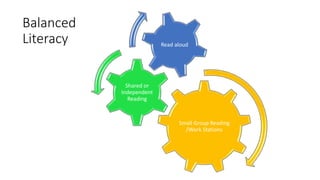
Small Group Reading
/Work Stations
Shared or
Independent
Reading
Read aloud
Balanced
Literacy
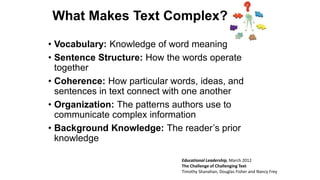
What Makes Text Complex?
• Vocabulary: Knowledge of word meaning
• Sentence Structure: How the words operate
together
• Coherence: How particular words, ideas, and
sentences in text connect with one another
• Organization: The patterns authors use to
communicate complex information
• Background Knowledge: The reader’s prior
knowledge
Educational Leadership, March 2012
The Challenge of Challenging Text
Timothy Shanahan, Douglas Fisher and Nancy Frey
Not all books are worthy!
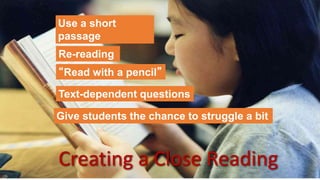
Creating a Close Reading
Use a short
passage
Re-reading
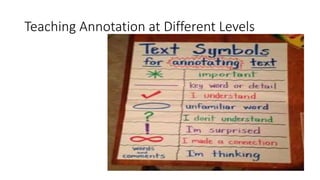
“Read with a pencil”
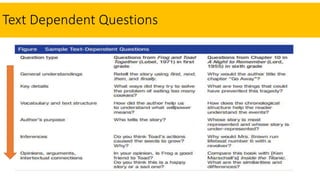
Text-dependent questions
Give students the chance to struggle a bit
Close Reading in Action
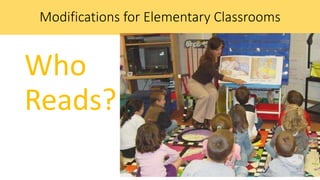
Modifications for Elementary Classrooms
Who
Reads?
Modifications for Elementary Classrooms
Frontloading
Background
Knowledge
Need to read
text
Text Dependent Questions
Teaching Annotation at Different Levels
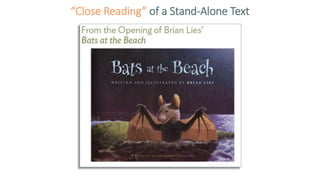
“Close Reading” of a Stand-Alone Text
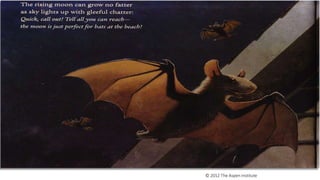
© 2012 The Aspen Institute
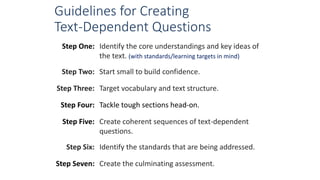
Guidelines for Creating
Text-Dependent Questions
Step One: Identify the core understandings and key ideas of
the text. (with standards/learning targets in mind)
Step Two: Start small to build confidence.
Step Three: Target vocabulary and text structure.
Step Four: Tackle tough sections head-on.
Step Five: Create coherent sequences of text-dependent
questions.
Step Six: Identify the standards that are being addressed.
Step Seven: Create the culminating assessment.
Planning a Close
Read for you Grade
Level
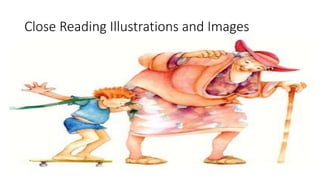
Close Reading Illustrations and Images
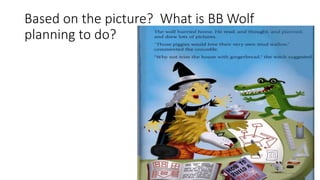
Based on the picture? What is BB Wolf
planning to do?
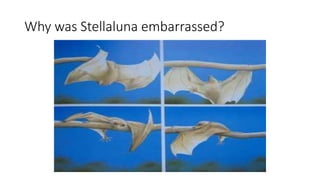
Why was Stellaluna embarrassed?
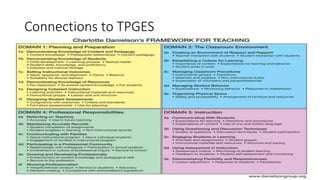
Connections to TPGES
We have arrived!

Close reading elementary