“Developing effective and
meaningful communicative tasks”
     Teacher-training workshop
                          by
                      Carlos Barragán
                       Cristina Barón
                      Rodrigo Molina
                     Claudia Mosquera
                       Tatiana Olmos
                     Salvador Jiménez
                    Maria Isabel Romero
COMMUNICATIVE ACTIVITIES
• Communicative activities include any activity that
  encourages and requires a learner to speak with
  and listen to other learners, as well as with
  people in the program and community.
• Communicative activities have real purposes:
 Find information
 Break down barriers
 Talk about self
 Learn about the culture.
Very Important!
• Even when a lesson is focused on developing reading
  or writing skills, communicative activities should be
  integrated into the lesson. Furthermore, research on
  second language acquisition (SLA) suggests that
  more learning takes place when students are
  engaged in relevant tasks within a dynamic learning
  environment rather than in traditional teacher-led
  classes (Moss & Ross-Feldman, 2003)
TEACHER-TRAINING WORKSHOP
           PREPARATION
1. Aspect to improve: IMPLEMENTATION OF
   COMMUNICATIVE TASKS.
2. Target population: 25 state school teachers with
   average English level of A2
3. Possible tasks to be carried out: Taking into account
   that the average English level reached by this group of
   teachers is A2, activities for beginners would be the
   most suitable. Information gap, a survey or a game
   would fit with teachers communicative skills.
4. Goal: Training teachers in the effective and
   meaningful implementation of communicative tasks.
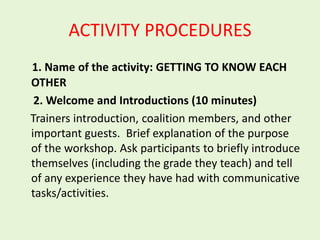
ACTIVITY PROCEDURES
1. Name of the activity: GETTING TO KNOW EACH
OTHER
 2. Welcome and Introductions (10 minutes)
Trainers introduction, coalition members, and other
important guests. Brief explanation of the purpose
of the workshop. Ask participants to briefly introduce
themselves (including the grade they teach) and tell
of any experience they have had with communicative
tasks/activities.
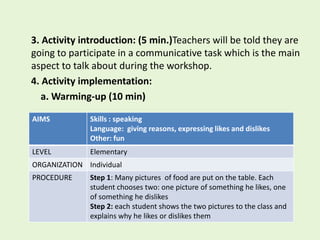
3. Activity introduction: (5 min.)Teachers will be told they are
going to participate in a communicative task which is the main
aspect to talk about during the workshop.
4. Activity implementation:
   a. Warming-up (10 min)

AIMS          Skills : speaking
              Language: giving reasons, expressing likes and dislikes
              Other: fun
LEVEL         Elementary
ORGANIZATION Individual
PROCEDURE     Step 1: Many pictures of food are put on the table. Each
              student chooses two: one picture of something he likes, one
              of something he dislikes
              Step 2: each student shows the two pictures to the class and
              explains why he likes or dislikes them
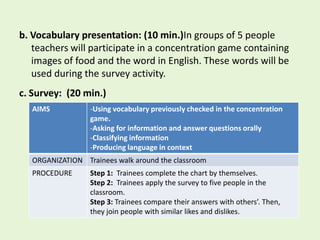
b. Vocabulary presentation: (10 min.)In groups of 5 people
   teachers will participate in a concentration game containing
   images of food and the word in English. These words will be
   used during the survey activity.
c. Survey: (20 min.)
   AIMS           -Using vocabulary previously checked in the concentration
                  game.
                  -Asking for information and answer questions orally
                  -Classifying information
                  -Producing language in context
   ORGANIZATION Trainees walk around the classroom
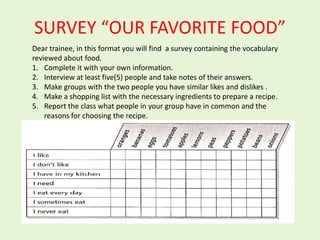
   PROCEDURE      Step 1: Trainees complete the chart by themselves.
                  Step 2: Trainees apply the survey to five people in the
                  classroom.
                  Step 3: Trainees compare their answers with others’. Then,
                  they join people with similar likes and dislikes.
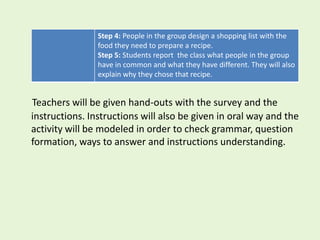
Step 4: People in the group design a shopping list with the
                food they need to prepare a recipe.
                Step 5: Students report the class what people in the group
                have in common and what they have different. They will also
                explain why they chose that recipe.


Teachers will be given hand-outs with the survey and the
instructions. Instructions will also be given in oral way and the
activity will be modeled in order to check grammar, question
formation, ways to answer and instructions understanding.
SURVEY “OUR FAVORITE FOOD”
Dear trainee, in this format you will find a survey containing the vocabulary
reviewed about food.
1. Complete it with your own information.
2. Interview at least five(5) people and take notes of their answers.
3. Make groups with the two people you have similar likes and dislikes .
4. Make a shopping list with the necessary ingredients to prepare a recipe.
5. Report the class what people in your group have in common and the
    reasons for choosing the recipe.
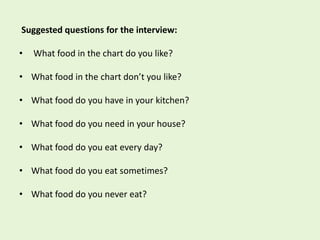
Suggested questions for the interview:

•   What food in the chart do you like?

• What food in the chart don’t you like?

• What food do you have in your kitchen?

• What food do you need in your house?

• What food do you eat every day?

• What food do you eat sometimes?

• What food do you never eat?
ANALYSIS OF THE ACTIVITY PROCEDURE
              (25 min.)
As our master’s aim is to implement self-directed learning, the
 trainees will live the experience of being learners and they
 will analyze the task from that position.
- How they felt
- What they found difficult
- What was easy
- What problems they had during the activity
- How effective communication was.

Then, they will be encouraged to take teacher’s position to
infer what the procedure for a communicative task is. In
groups of five people teachers will present their analysis.
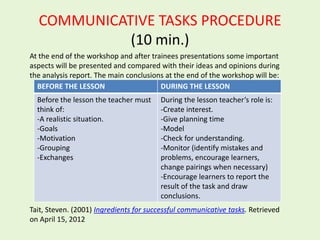
COMMUNICATIVE TASKS PROCEDURE
            (10 min.)
At the end of the workshop and after trainees presentations some important
aspects will be presented and compared with their ideas and opinions during
the analysis report. The main conclusions at the end of the workshop will be:
  BEFORE THE LESSON                     DURING THE LESSON
  Before the lesson the teacher must    During the lesson teacher’s role is:
  think of:                             -Create interest.
  -A realistic situation.               -Give planning time
  -Goals                                -Model
  -Motivation                           -Check for understanding.
  -Grouping                             -Monitor (identify mistakes and
  -Exchanges                            problems, encourage learners,
                                        change pairings when necessary)
                                        -Encourage learners to report the
                                        result of the task and draw
                                        conclusions.
Tait, Steven. (2001) Ingredients for successful communicative tasks. Retrieved
on April 15, 2012
COMMUNICATIVE ACTIVITY PROPOSAL
          (30 min.)
  Finally, after reflecting and analyzing the
 communicative task used during the
 workshop trainees will propose their
 own activity for their particular learners.
 Teachers will make groups of five people
 taking into account the level they teach
 in.
 Each group will present the suggested
 activities explaining the procedures they
 would use in order to have an effective
 and meaningful communicative task.

Conclusions will be drawn at the end of
 the workshop.
REFERENCES
- Tait, Steven. (2001) Ingredients for successful
  communicative tasks. Retrieved on April 15, 2012
- (n. g.) (n. d.) Elements of communicative activities

English teachers - training workshop

  • 1.
    “Developing effective and meaningfulcommunicative tasks” Teacher-training workshop by Carlos Barragán Cristina Barón Rodrigo Molina Claudia Mosquera Tatiana Olmos Salvador Jiménez Maria Isabel Romero
  • 2.
    COMMUNICATIVE ACTIVITIES • Communicativeactivities include any activity that encourages and requires a learner to speak with and listen to other learners, as well as with people in the program and community. • Communicative activities have real purposes:  Find information  Break down barriers  Talk about self  Learn about the culture.
  • 3.
    Very Important! • Evenwhen a lesson is focused on developing reading or writing skills, communicative activities should be integrated into the lesson. Furthermore, research on second language acquisition (SLA) suggests that more learning takes place when students are engaged in relevant tasks within a dynamic learning environment rather than in traditional teacher-led classes (Moss & Ross-Feldman, 2003)
  • 4.
    TEACHER-TRAINING WORKSHOP PREPARATION 1. Aspect to improve: IMPLEMENTATION OF COMMUNICATIVE TASKS. 2. Target population: 25 state school teachers with average English level of A2 3. Possible tasks to be carried out: Taking into account that the average English level reached by this group of teachers is A2, activities for beginners would be the most suitable. Information gap, a survey or a game would fit with teachers communicative skills. 4. Goal: Training teachers in the effective and meaningful implementation of communicative tasks.
  • 5.
    ACTIVITY PROCEDURES 1. Nameof the activity: GETTING TO KNOW EACH OTHER 2. Welcome and Introductions (10 minutes) Trainers introduction, coalition members, and other important guests. Brief explanation of the purpose of the workshop. Ask participants to briefly introduce themselves (including the grade they teach) and tell of any experience they have had with communicative tasks/activities.
  • 6.
    3. Activity introduction:(5 min.)Teachers will be told they are going to participate in a communicative task which is the main aspect to talk about during the workshop. 4. Activity implementation: a. Warming-up (10 min) AIMS Skills : speaking Language: giving reasons, expressing likes and dislikes Other: fun LEVEL Elementary ORGANIZATION Individual PROCEDURE Step 1: Many pictures of food are put on the table. Each student chooses two: one picture of something he likes, one of something he dislikes Step 2: each student shows the two pictures to the class and explains why he likes or dislikes them
  • 7.
    b. Vocabulary presentation:(10 min.)In groups of 5 people teachers will participate in a concentration game containing images of food and the word in English. These words will be used during the survey activity. c. Survey: (20 min.) AIMS -Using vocabulary previously checked in the concentration game. -Asking for information and answer questions orally -Classifying information -Producing language in context ORGANIZATION Trainees walk around the classroom PROCEDURE Step 1: Trainees complete the chart by themselves. Step 2: Trainees apply the survey to five people in the classroom. Step 3: Trainees compare their answers with others’. Then, they join people with similar likes and dislikes.
  • 8.
    Step 4: Peoplein the group design a shopping list with the food they need to prepare a recipe. Step 5: Students report the class what people in the group have in common and what they have different. They will also explain why they chose that recipe. Teachers will be given hand-outs with the survey and the instructions. Instructions will also be given in oral way and the activity will be modeled in order to check grammar, question formation, ways to answer and instructions understanding.
  • 9.
    SURVEY “OUR FAVORITEFOOD” Dear trainee, in this format you will find a survey containing the vocabulary reviewed about food. 1. Complete it with your own information. 2. Interview at least five(5) people and take notes of their answers. 3. Make groups with the two people you have similar likes and dislikes . 4. Make a shopping list with the necessary ingredients to prepare a recipe. 5. Report the class what people in your group have in common and the reasons for choosing the recipe.
  • 10.
    Suggested questions forthe interview: • What food in the chart do you like? • What food in the chart don’t you like? • What food do you have in your kitchen? • What food do you need in your house? • What food do you eat every day? • What food do you eat sometimes? • What food do you never eat?
  • 11.
    ANALYSIS OF THEACTIVITY PROCEDURE (25 min.) As our master’s aim is to implement self-directed learning, the trainees will live the experience of being learners and they will analyze the task from that position. - How they felt - What they found difficult - What was easy - What problems they had during the activity - How effective communication was. Then, they will be encouraged to take teacher’s position to infer what the procedure for a communicative task is. In groups of five people teachers will present their analysis.
  • 12.
    COMMUNICATIVE TASKS PROCEDURE (10 min.) At the end of the workshop and after trainees presentations some important aspects will be presented and compared with their ideas and opinions during the analysis report. The main conclusions at the end of the workshop will be: BEFORE THE LESSON DURING THE LESSON Before the lesson the teacher must During the lesson teacher’s role is: think of: -Create interest. -A realistic situation. -Give planning time -Goals -Model -Motivation -Check for understanding. -Grouping -Monitor (identify mistakes and -Exchanges problems, encourage learners, change pairings when necessary) -Encourage learners to report the result of the task and draw conclusions. Tait, Steven. (2001) Ingredients for successful communicative tasks. Retrieved on April 15, 2012
  • 13.
    COMMUNICATIVE ACTIVITY PROPOSAL (30 min.) Finally, after reflecting and analyzing the communicative task used during the workshop trainees will propose their own activity for their particular learners. Teachers will make groups of five people taking into account the level they teach in. Each group will present the suggested activities explaining the procedures they would use in order to have an effective and meaningful communicative task. Conclusions will be drawn at the end of the workshop.
  • 14.
    REFERENCES - Tait, Steven.(2001) Ingredients for successful communicative tasks. Retrieved on April 15, 2012 - (n. g.) (n. d.) Elements of communicative activities