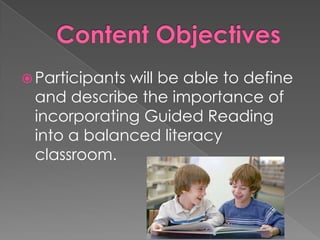
 Participants will be able to define
and describe the importance of
incorporating Guided Reading
into a balanced literacy
classroom.
Today I will learn…
 to identify the components that
are essential in a Guided Reading
lesson
 to thoughtfully plan for a Guided
Reading lesson
In Reading Essentials, Regie Routman
describes Guided Reading as:
“meeting with a small group of students, and
guiding and supporting them through a
manageable text. Students are grouped
with others at a similar reading level and
supported to use effective reading
strategies. Often, there are „before, during,
and after‟ activities and discussion in which
students talk about, think about, and read
through the text.”
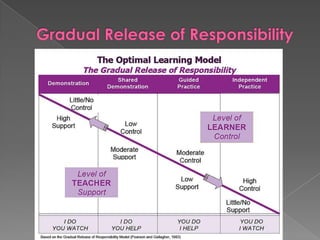
“Guided Reading changes as readers
progress…At first, students depend heavily
on the teacher but gradually, they assume
more responsibility for their own reading as
they learn strategies they can use to
problem solve on a variety of text.”
Payne & Schulman (2000)
 Students should be reading AND
comprehending on about the
same reading level (no more than
one level apart)
 Groups should contain no more
than 6 students
 Groups will change frequently as
students progress
 Know your students‟ strengths and needs
(abilities to decode, comprehend, read
with fluency, write etc.)
 Instructional Reading Level allows
students to be successful while still
providing appropriate challenge (90-
94%)
 Be aware of your students‟ interests to
increase engagement
 Texts can include leveled readers
(little books), basals,
magazines/newspapers, journal
articles, reading passages on a
handout, etc
 On the appropriate level
 Picture support
 Print features and layout
 Running Records and TRC progress
monitoring …in order to monitor change
over time
 Sight Words … in order to build automaticity
 Book Introductions … in order to build
background knowledge, concepts and
vocabulary
 Teaching and Prompting for Strategies… in
order to release responsibility and develop
independence
 Book Discussion … in order to build
comprehension and language
development
 Letter and Word Work … in order to
develop phonic awareness and phonics
 Re-reading yesterday’s Book … in order
to develop fluency and critical thinking
 Writing … in order to build reciprocity
with oral and written language
 Enables teachers to use time more
efficiently
 Helps students develop higher order
thinking skills
 Allows for differentiated word work that
will strengthen students‟ phonemic
awareness and decoding
 Builds reciprocity between reading and
writing
After selecting an appropriate text, you
must „debug‟ the book to make it
accessible to the reader (pg 91, Clay,
2005) .
 Preview and discuss illustrations
 Give the gist and “hook” the reader
 Introduce new vocabulary/concepts
 Discuss unfamiliar language structures
 Locate unfamiliar and more difficult words in the
text
 Make predictions
 Make connections
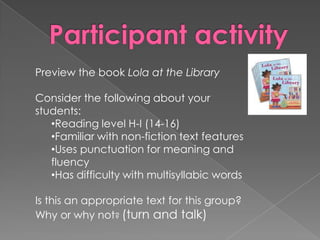
Preview the book Lola at the Library
Consider the following about your
students:
•Reading level H-I (14-16)
•Familiar with non-fiction text features
•Uses punctuation for meaning and
fluency
•Has difficulty with multisyllabic words
Is this an appropriate text for this group?
Why or why not? (turn and talk)
 Using Lola at the Library,
independently plan an appropriate
book introduction
 Share book introductions in small
groups
 As each child reads the text quietly to
himself, the teacher dips in to listen,
look for and support strategic
processing (strategies).
 “Strategies are mental operations, the
in-the-head processes that readers
use to read text.” Payne & Schulman (2000)
 Discussing the text after reading is an
important time to provoke thought—to
take readers to a new depth of
understanding about what they read.
 The post-reading discussion is not meant
to be a question-answer session.
 A Guided Reading lesson is also an
opportunity to introduce your students to
story elements and literacy devices: plot,
character, setting, etc.
 Remember that “strategies are mental
operations, the in-the-head processes
that readers use to read text.” Payne &
Schulman (2000)
 Discuss an appropriate strategy to
teach for in Lola at the Library
 Verbalizing the process the student used
while reading fosters metacognition and
provides feedback and encouragement: “I
like the way you reread that sentence and
thought about what would make sense.”
 Providing specific prompts encourages the
reader to think and behave a certain way:
“That sounds right, but does it look right? Go
back and reread to see if it looks right.”
 Interactive Writing (Levels PreA-A)
 Teacher gives the sentence and shares the
pen with students to model and guide
 Dictated or Open Ended (Levels A-E)
 Teacher tells the sentence(s) and the
students write with some guidance
 Guided Writing (Levels F+)
 Usually to a prompt and is sometimes open-
ended
 After today‟s session, I learned…
 After today‟s session, I still wonder…
 Clay, M. (2005). Literacy lessons: Designed for
individuals. Portsmouth, NH: Heinemann.
 Fountas, I. & Pinnell, G.S. (2001). Guiding
readers and writers grades 3-6: Teaching
comprehension, genre and content literacy.
Portsmouth, NH: Heinemann.
 Payne, C.D & Schulman, M.B. (2000). Guided
reading: Making it work. New York, NY:
Scholastic Inc.
 Routman, R. (2003). Reading essentials: The
specifics you need to teach reading well.
Portsmouth, NH: Heinemann.

Guided Reading

  • 2.
     Participants willbe able to define and describe the importance of incorporating Guided Reading into a balanced literacy classroom.
  • 3.
    Today I willlearn…  to identify the components that are essential in a Guided Reading lesson  to thoughtfully plan for a Guided Reading lesson
  • 4.
    In Reading Essentials,Regie Routman describes Guided Reading as: “meeting with a small group of students, and guiding and supporting them through a manageable text. Students are grouped with others at a similar reading level and supported to use effective reading strategies. Often, there are „before, during, and after‟ activities and discussion in which students talk about, think about, and read through the text.”
  • 6.
    “Guided Reading changesas readers progress…At first, students depend heavily on the teacher but gradually, they assume more responsibility for their own reading as they learn strategies they can use to problem solve on a variety of text.” Payne & Schulman (2000)
  • 7.
     Students shouldbe reading AND comprehending on about the same reading level (no more than one level apart)  Groups should contain no more than 6 students  Groups will change frequently as students progress
  • 8.
     Know yourstudents‟ strengths and needs (abilities to decode, comprehend, read with fluency, write etc.)  Instructional Reading Level allows students to be successful while still providing appropriate challenge (90- 94%)  Be aware of your students‟ interests to increase engagement
  • 9.
     Texts caninclude leveled readers (little books), basals, magazines/newspapers, journal articles, reading passages on a handout, etc  On the appropriate level  Picture support  Print features and layout
  • 10.
     Running Recordsand TRC progress monitoring …in order to monitor change over time  Sight Words … in order to build automaticity  Book Introductions … in order to build background knowledge, concepts and vocabulary  Teaching and Prompting for Strategies… in order to release responsibility and develop independence
  • 11.
     Book Discussion… in order to build comprehension and language development  Letter and Word Work … in order to develop phonic awareness and phonics  Re-reading yesterday’s Book … in order to develop fluency and critical thinking  Writing … in order to build reciprocity with oral and written language
  • 12.
     Enables teachersto use time more efficiently  Helps students develop higher order thinking skills  Allows for differentiated word work that will strengthen students‟ phonemic awareness and decoding  Builds reciprocity between reading and writing
  • 13.
    After selecting anappropriate text, you must „debug‟ the book to make it accessible to the reader (pg 91, Clay, 2005) .  Preview and discuss illustrations  Give the gist and “hook” the reader  Introduce new vocabulary/concepts  Discuss unfamiliar language structures  Locate unfamiliar and more difficult words in the text  Make predictions  Make connections
  • 14.
    Preview the bookLola at the Library Consider the following about your students: •Reading level H-I (14-16) •Familiar with non-fiction text features •Uses punctuation for meaning and fluency •Has difficulty with multisyllabic words Is this an appropriate text for this group? Why or why not? (turn and talk)
  • 15.
     Using Lolaat the Library, independently plan an appropriate book introduction  Share book introductions in small groups
  • 16.
     As eachchild reads the text quietly to himself, the teacher dips in to listen, look for and support strategic processing (strategies).  “Strategies are mental operations, the in-the-head processes that readers use to read text.” Payne & Schulman (2000)
  • 17.
     Discussing thetext after reading is an important time to provoke thought—to take readers to a new depth of understanding about what they read.  The post-reading discussion is not meant to be a question-answer session.  A Guided Reading lesson is also an opportunity to introduce your students to story elements and literacy devices: plot, character, setting, etc.
  • 18.
     Remember that“strategies are mental operations, the in-the-head processes that readers use to read text.” Payne & Schulman (2000)  Discuss an appropriate strategy to teach for in Lola at the Library
  • 19.
     Verbalizing theprocess the student used while reading fosters metacognition and provides feedback and encouragement: “I like the way you reread that sentence and thought about what would make sense.”  Providing specific prompts encourages the reader to think and behave a certain way: “That sounds right, but does it look right? Go back and reread to see if it looks right.”
  • 20.
     Interactive Writing(Levels PreA-A)  Teacher gives the sentence and shares the pen with students to model and guide  Dictated or Open Ended (Levels A-E)  Teacher tells the sentence(s) and the students write with some guidance  Guided Writing (Levels F+)  Usually to a prompt and is sometimes open- ended
  • 21.
     After today‟ssession, I learned…  After today‟s session, I still wonder…
  • 22.
     Clay, M.(2005). Literacy lessons: Designed for individuals. Portsmouth, NH: Heinemann.  Fountas, I. & Pinnell, G.S. (2001). Guiding readers and writers grades 3-6: Teaching comprehension, genre and content literacy. Portsmouth, NH: Heinemann.  Payne, C.D & Schulman, M.B. (2000). Guided reading: Making it work. New York, NY: Scholastic Inc.  Routman, R. (2003). Reading essentials: The specifics you need to teach reading well. Portsmouth, NH: Heinemann.

Editor's Notes

  • #8 Use information from TRC on Read 3D, progress monitoring, and running records performed on a regular basis. Research shows that the best ratio for small groups, especially struggling readers is 1:3Results from progress monitoring and running records should help determine when to move students into other groups… (give forms for monitoring student progress as a sample)
  • #18 Frequent discussion ensures students will understand the text and gives the teacher lots of opportunity to model and practice thinking strategies.
  • #21 Interactive Writing: Teacher gives the sentence and shares the pen with students to model and guideDictated Sentence: Teacher tells the sentence(s) and the students write with some guidanceGuided Writing: Usually to a prompt and is sometimes open-ended