The Reading Process –
from understanding to teaching
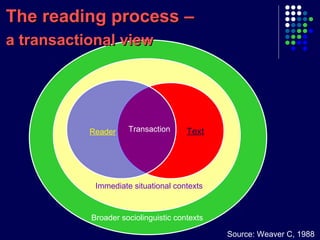
Broader sociolinguistic contexts
Immediate situational contexts
The reading process –The reading process –
a transactional viewa transactional view
TextReader Transaction
Source: Weaver C, 1988
Reading Behaviours of aReading Behaviours of a
Proficient ReaderProficient Reader
 Develops anticipation; activates prior
knowledge
 Decodes and samples with sufficient
speed
 Predicts as he reads
 Reads on, re-reads, confirms or
corrects
 Develops anticipation; activates prior
knowledge
 Decodes and samples with sufficient
speed
 Predicts as he reads
 Reads on, re-reads, confirms or
corrects
Reading problems of ourReading problems of our
students as novice readersstudents as novice readers
 Little anticipation
 Read word by word
 Got stuck with a difficult word and give up
reading
 Skip difficult words and read on despite
loss of meaning
 Seldom re-read and self-correct
 Little anticipation
 Read word by word
 Got stuck with a difficult word and give up
reading
 Skip difficult words and read on despite
loss of meaning
 Seldom re-read and self-correct
The Cueing Systems of theThe Cueing Systems of the
English LanguageEnglish Language
1. Graphophonic cues
2. Semantic cues
3. Syntactic cues
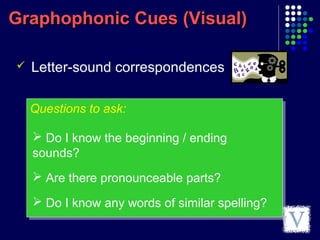
Graphophonic Cues (Visual)Graphophonic Cues (Visual)
Questions to ask:Questions to ask:
 Letter-sound correspondences
 Do I know the beginning / ending
sounds?
 Are there pronounceable parts?
 Do I know any words of similar spelling?
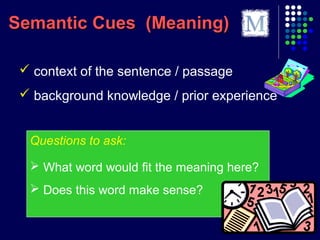
Semantic Cues (Meaning)Semantic Cues (Meaning)
 context of the sentence / passage
 background knowledge / prior experience
Questions to ask:
 What word would fit the meaning here?
 Does this word make sense?
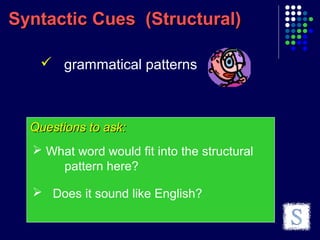
Syntactic Cues (Structural)Syntactic Cues (Structural)
 grammatical patterns
Questions to ask:Questions to ask:
 What word would fit into the structural
pattern here?
 Does it sound like English?
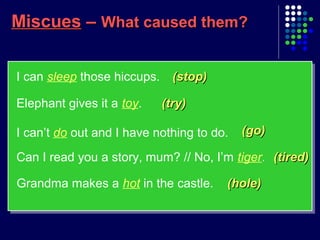
MiscuesMiscues –– What caused them?What caused them?
I can sleep those hiccups.
Elephant gives it a toy.
I can’t do out and I have nothing to do.
Can I read you a story, mum? // No, I’m tiger.
Grandma makes a hot in the castle.
(stop)(stop)
(try)(try)
(go)(go)
(tired)(tired)
(hole)(hole)
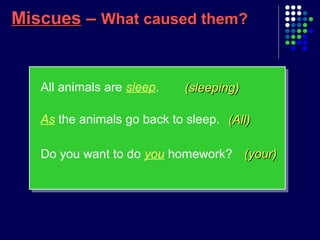
MiscuesMiscues –– What caused them?What caused them?
(sleeping)(sleeping)
(All)(All)
All animals are sleep.
As the animals go back to sleep.
Do you want to do you homework? (your)(your)
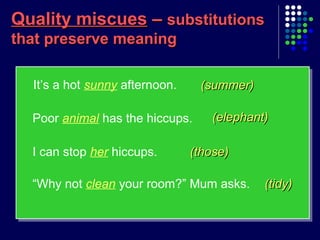
Quality miscuesQuality miscues –– substitutionssubstitutions
that preserve meaningthat preserve meaning
(summer)(summer)
(elephant)(elephant)
“Why not clean your room?” Mum asks.
It’s a hot sunny afternoon.
Poor animal has the hiccups.
I can stop her hiccups. (those)(those)
(tidy)(tidy)
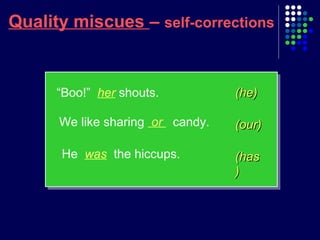
(has(has
))
Quality miscues – self-corrections
(he)(he)
(our)(our)
“Boo!” her shouts.
We like sharing or candy.
He was the hiccups.
 Explicit and planned instruction for
reading skills
 Emphasis on interactiveness of reading
process – anticipation, prediction,
personal responses, critical and reflective
thinking, etc.
 Wide reading of easy and interesting
materials
 Explicit and planned instruction for
reading skills
 Emphasis on interactiveness of reading
process – anticipation, prediction,
personal responses, critical and reflective
thinking, etc.
 Wide reading of easy and interesting
materials
Implications for teachersImplications for teachers
A balanced reading program
–5 essential components
1. Phonological awareness
2. Phonics
3. Sight words & vocabulary development
4. Reading fluency
5. Comprehension strategies
- Phonological awareness &
phonics skills
A balanced reading programme
Phonological awareness ---Phonological awareness ---
Phonological awareness &Phonological awareness &
phonics skillsphonics skills
 awareness of constituent sounds of written words in learning
to read and spell
 knowledge of phonemes, onsets and rimes and syllables
 influences the development of word decoding & reading
Phonics skills instruction ---Phonics skills instruction ---
 a way of teaching reading that stresses learning how letters
correspond to sounds and how to use this knowledge in reading
and spelling through various skills like decoding and blending
Phonics skillsPhonics skills
Phonics skills are means to the end of
successful reading ---- ‘a catalyst which
triggers the process of learning to read’
---- Maclean (1998)
Phonics skills are means to the end of
successful reading ---- ‘a catalyst which
triggers the process of learning to read’
---- Maclean (1998)
Teaching phonics in our contextTeaching phonics in our context
Questions to ask:
Why do we teach phonics to our very young
learners?
What should we teach? (knowledge of sounds or
skills)
How can we teach phonics effectively?
Who is the best person to teach phonics in school?
………..
Teaching phonics in our contextTeaching phonics in our context
 Characteristics of our learners
 inadequate language environment, limited prior
knowledge and repertoire of words
Q: What can we base on? Where should we start?
 Different approaches e.g. part-to-whole, whole-to-
part, phoneme-by-phoneme, onsets & rimes
Q: What are the rationale & purposes? How effective are
they? How should the teachers and learners make their
choice?
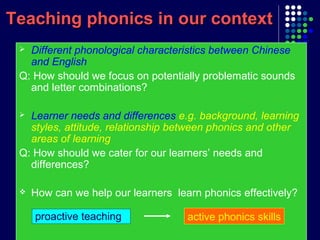
 Different phonological characteristics between Chinese
and English
Q: How should we focus on potentially problematic sounds
and letter combinations?
 Learner needs and differences e.g. background, learning
styles, attitude, relationship between phonics and other
areas of learning
Q: How should we cater for our learners’ needs and
differences?
 How can we help our learners learn phonics effectively?
Teaching phonics in our contextTeaching phonics in our context
active phonics skillsproactive teaching
Implications for teachersImplications for teachers
 Phonics should be a meaningful and integrated
part of our curriculum (reading program), with
ample opportunities for learning, application and
solving learning problems.
 Teaching must build on what students already
know and give them space to see patterns and
draw inferences.
Implications for teachersImplications for teachers
Q: Is it advisable for teachers to use a separate
package to help students learn phonics and
tackle their learning problems?
Q: Should phonics be treated in isolation and
handled by one teacher alone e.g. NET?
What are the problems?
1. Unfamiliar vocabulary --- difficult to draw analogy
2. Unrelated to their studies --- extra burden & can’t
help to solve learning problems
3. No application --- no explicit teaching of skills and
how to apply them in new texts
4. No feedback or assessment
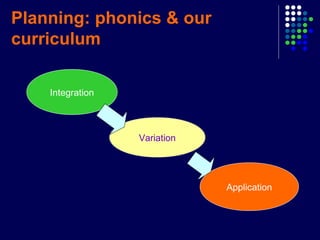
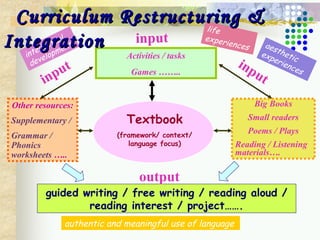
Integration
Planning: phonics & our
curriculum
Variation
Application
Textbook
(framework/ context/
language focus)
Activities / tasks
Games ……..
Other resources:
Supplementary /
Grammar /
Phonics
worksheets …..
Big Books
Small readers
Poems / Plays
Reading / Listening
materials….
input input
input
guided writing / free writing / reading aloud /
reading interest / project…….
output
intellectual
development
life
experiences aesthetic
experiences
authentic and meaningful use of language
Curriculum Restructuring &Curriculum Restructuring &
IntegrationIntegration
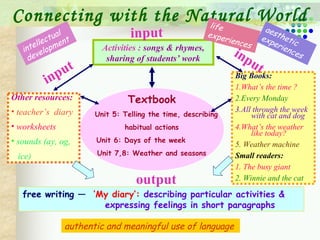
Textbook
Unit 5: Telling the time, describing
habitual actions
Unit 6: Days of the week
Unit 7,8: Weather and seasons
Activities : songs & rhymes,
sharing of students’ work
Other resources:
• teacher’s diary
• worksheets
• sounds (ay, og,
ice)
Big Books:
1.What’s the time ?
2.Every Monday
3.All through the week
with cat and dog
4.What’s the weather
like today?
5. Weather machine
Small readers:
1. The busy giant
2. Winnie and the cat
free writing — ‘My diary’: describing particular activities &
expressing feelings in short paragraphs
output
authentic and meaningful use of language
Connecting with the Natural Worldlife
experiences
input
input
input
intellectual
development
aesthetic
experiences
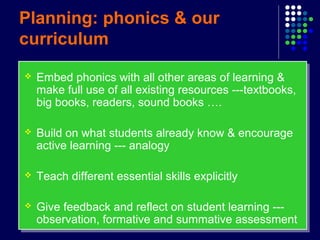
Planning: phonics & our
curriculum
 Embed phonics with all other areas of learning &
make full use of all existing resources ---textbooks,
big books, readers, sound books ….
 Build on what students already know & encourage
active learning --- analogy
 Teach different essential skills explicitly
 Give feedback and reflect on student learning ---
observation, formative and summative assessment
A balanced reading programme
-- Sight words
Words that are recognized
as wholes, on sight
What are sight words?What are sight words?
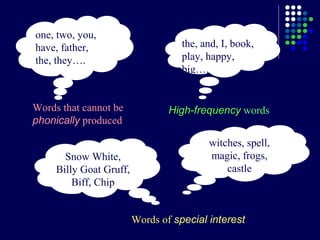
one, two, you,
have, father,
the, they….
Words that cannot be
phonically produced
the, and, I, book,
play, happy,
big….
High-frequencyHigh-frequency words
Words of special interest
witches, spell,
magic, frogs,
castle
Snow White,
Billy Goat Gruff,
Biff, Chip
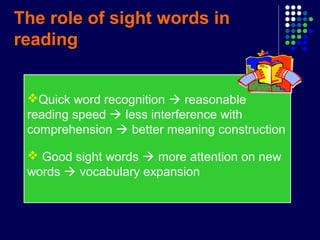
The role of sight words in
reading
Quick word recognition  reasonable
reading speed  less interference with
comprehension  better meaning construction
 Good sight words  more attention on new
words  vocabulary expansion
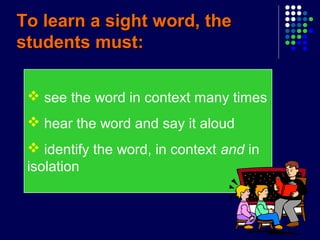
 see the word in context many times
 hear the word and say it aloud
 identify the word, in context and in
isolation
To learn a sight word, theTo learn a sight word, the
students must:students must:
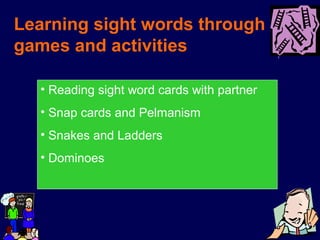
Learning sight words through
games and activities
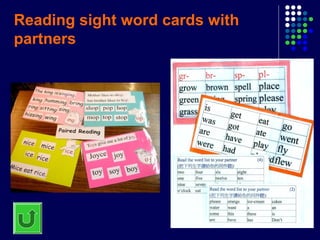
• Reading sight word cards with partner
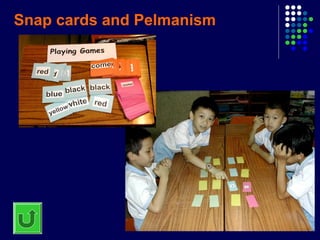
• Snap cards and Pelmanism
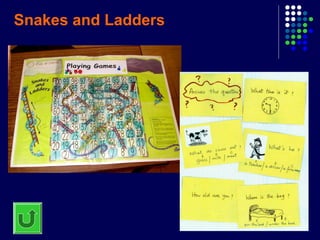
• Snakes and Ladders
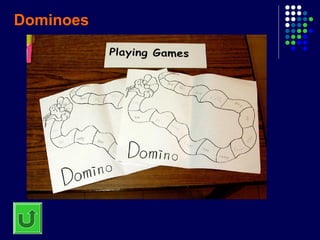
• Dominoes
Useful ways to ‘anchor’ words:
 word walls / semantic mapping
 class dictionary / personal vocabulary
books
 word building /word analysis (tied in with
phonics)
 using words in writing
Vocabulary Development
through intensive and extensive reading
-- Reading Fluency
A balanced reading programme
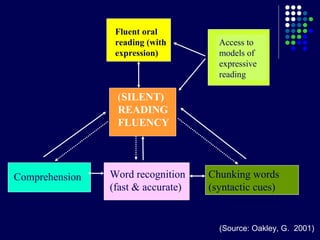
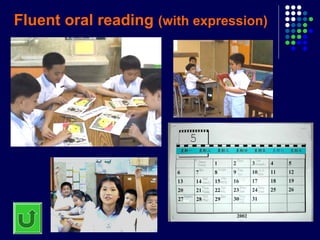
Fluent oral
reading (with
expression)
(SILENT)
READING
FLUENCY
Access to
models of
expressive
reading
Comprehension Word recognition
(fast & accurate)
Chunking words
(syntactic cues)
(Source: Oakley, G. 2001)
Repeated ReadingRepeated Reading
 reading of short, easy & interesting texts over
and over again
 well-researched method to improve fluency
(Samuels 1979, 2002)
 often results in improved comprehension
(Hasbrouch, Ihnot, & Rogers 1999)
 most students enjoy it; a favoured activity
among low-progress readers
(Lipson & Wixson 1997)
-- comprehension strategies
A balanced reading programme
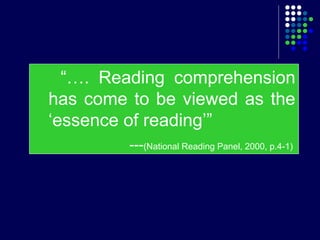
“…. Reading comprehension
has come to be viewed as the
‘essence of reading’”
---(National Reading Panel, 2000, p.4-1)
Different approaches
 linear approach (comprehension takes place
through progressive analysis of small units,
beginning with the word and ending in the
sentence) v.s.
 psycholinguistic approach (emphasizing the
paragraph as basic text unit and focus on
mental process leading to global
comprehension)
Transactional view of reading:
 Meaning is constructed through multiple & evolving complex
transactions between the reader, text and context
 Reading is a ‘psycholinguistic guessing game’
--- from hypotheses to confirmation/rejection
--- a ‘cyclical process of sampling, predicting, confirming
& correcting’
--- K.S. Goodman
 Comprehension is not just the by-product of accurate word
recognition… comprehension is a complex process which
requires active and intentional cognitive effort on the part of
the reader.
Transactional view of reading:
Both the outcomes of comprehension and the
process itself are interactive and dynamic.
Q: How can students work actively to integrate
textual information with preexisting knowledge
structure / schemata?
Current practice
 ‘Teachers taught comprehension less than one
percent of the time, and that this instruction was
more than a matter of ‘mentioning’ than actual
explanation or demonstration’ ------ Dolores Durkin
(1978-79)
 Comprehension instruction remains inadequate in
our classrooms. ---- Michael Pressley (1998)
Current practiceCurrent practice
 Reading ---- ‘the most thoroughly studied and least
understood process in education today’
 Reading has been sorely neglected in foreign
language classrooms, and most recent
methodological innovations have little to say about
the development of reading comprehension.
 Comprehension of text is not a visible act, nor is it
audible.
Current practiceCurrent practice
 A typical comprehension lesson:
1. Start with word-by-word decoding and translation (using
controlled vocabulary)
2. Followed by comprehension questions (who, what,
when, where etc) most of which involve direct-lifting
answers (literal comprehension)
3. End with checking answers with little/no explanation
Repeated practice = teaching=good performance
in comprehension??
Current practiceCurrent practice
Problems:
 no training of higher-order comprehension skills:
interpretive (read between the lines)
critical (read for evaluation)
creative (read beyond the lines)
 no development of students’ skills in syntactical,
semantic, lexical, stylistic analysis and making
excursion to their knowledge of the world to confirm
meaning
 loss of contextual focus, overview, and immediate
frustration as soon as the reader encounters an
unknown word
What do our students think?What do our students think?
 ‘I used to believe that I have to know all the words in the
English readings in order to understand the readings.
Therefore, I read in English with the dictionary beside me all
the time. I read English readings only for homework before I
came to this reading class. I never read any English readings
because I wanted to read them….. I like to read in my first
language, but I just could not read in English with the same
feeling as I read in Chinese. The belief that I have to know
all the words in order to understand the reading made
me lose interest…..’ ---- Li, an ESL student
 ‘Younger and poorer readers often rely on a single criterion
for textual understanding: Understanding of individual
words’ ---- Garner & Alexander (1989)
What affect comprehension?What affect comprehension?
 students’ experiential background
 students’ sensory & perceptual abilities
 students’ thinking abilities
 students’ affective aspects (self-concepts,
attitudes & interest)
 word recognition strategies
 comprehension strategies
* greatest obstacles to comprehension are
students’ dispositions towards reading---- Villaume
& Edna
Transactional strategiesTransactional strategies
instructioninstruction
Help students to
 activate their prior knowledge
 make predictions
 generate questions, answer questions and draw
inferences
 monitor their comprehension & seek clarification
when confused
 create pictorial mental imagery & mnemonic
imagery
 create summaries of what they have read
 evaluate what they have read
Transactional strategiesTransactional strategies
instructioninstruction
Predict:
think about the title, the illustrations, and what you have read so far;
Tell what you think will happen next or what you will learn
Question:
Ask yourself questions as you read
Monitor/clarify:
Ask yourself if what you are reading make sense
If you don’t understand something, reread, read aloud, or use the illustrations
Summarize:
Think about the main ideas or the important part of the story
Tell the important things in your own words
Evaluate:
Ask yourself
Do I like what I have read?
Do I agree or disagree with it?
Am I learning what I wanted to know?
How good a job has the author done?
Explicit teachingExplicit teaching
 Direct explanation (describe what the strategy is and
explain why the strategy should be learned and used)
 Modeling (model it and provide examples of the
circumstances under which the strategy should be used)
 Guided practice & scaffolding
 Feedback
 Application
* increase students’ metacognitive awareness and use of
reading strategies
Implications for teachersImplications for teachers
Issues to consider:
 comprehension or psycholinguistic guessing
skill can & should be taught
 students’ comprehension is developmental
 reading comprehension should be a dynamic
interactive exchange between teacher &
students
 students can compensate for a lack of English
proficiency by increasing their awareness of
reading strategies
 extensive reading practice is essential in
building both fluency & knowledge (extensive
v.s. intensive reading practice)
Implications for teachersImplications for teachers
Things to do:
 draw in / activate students’ prior knowledge
 develop students’ awareness of clue-searching
strategies
 select text based on students’ interests and
knowledge and make comprehension an
integrated part of the curriculum
 use different reading materials (including
readers) and design a variety of tasks for
different purposes
Not so ‘typical’ comprehensionNot so ‘typical’ comprehension
exercises ---exercises ---
 guessing game & confirmation / correction
 brainstorming & mind-mapping
 semantic webbing & story mapping
 cloze --- with specific purposes focusing on particular skills
e.g. reference skills, using semantic or syntactic clues
 matching e.g. vocabulary skill
 proof-reading questions
 personal response
 reading-writing connection
ConclusionConclusion
It is important that a full range of
instructional approaches be considered
within a variety of contexts that address
both developmental and cultural differences
in how children best learn to comprehend.
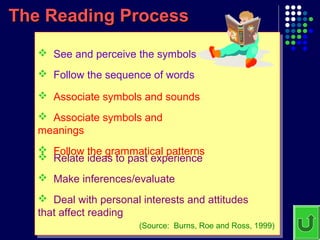
The Reading ProcessThe Reading Process
(Source: Burns, Roe and Ross, 1999)
 See and perceive the symbols
 Follow the sequence of words
 Relate ideas to past experience
 Make inferences/evaluate
 Deal with personal interests and attitudes
that affect reading
 Associate symbols and sounds
 Associate symbols and
meanings
 Follow the grammatical patterns
TransactionTransaction
 Putting everything together to construct a
personal meaning for the text
 Communicating thoughts and emotions
between reader and writer
 Putting everything together to construct a
personal meaning for the text
 Communicating thoughts and emotions
between reader and writer
Reading sight word cards with
partners
Snap cards and Pelmanism
Snakes and Ladders
Dominoes
Fluent oral reading (with expression)
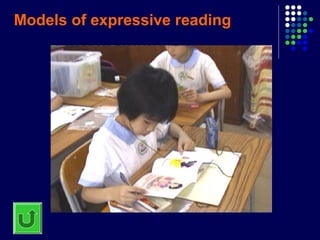
Models of expressive reading
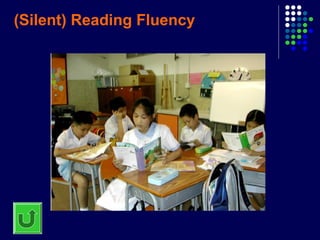
(Silent) Reading Fluency

Reading process

  • 1.
    The Reading Process– from understanding to teaching
  • 2.
    Broader sociolinguistic contexts Immediatesituational contexts The reading process –The reading process – a transactional viewa transactional view TextReader Transaction Source: Weaver C, 1988
  • 3.
    Reading Behaviours ofaReading Behaviours of a Proficient ReaderProficient Reader  Develops anticipation; activates prior knowledge  Decodes and samples with sufficient speed  Predicts as he reads  Reads on, re-reads, confirms or corrects  Develops anticipation; activates prior knowledge  Decodes and samples with sufficient speed  Predicts as he reads  Reads on, re-reads, confirms or corrects
  • 4.
    Reading problems ofourReading problems of our students as novice readersstudents as novice readers  Little anticipation  Read word by word  Got stuck with a difficult word and give up reading  Skip difficult words and read on despite loss of meaning  Seldom re-read and self-correct  Little anticipation  Read word by word  Got stuck with a difficult word and give up reading  Skip difficult words and read on despite loss of meaning  Seldom re-read and self-correct
  • 5.
    The Cueing Systemsof theThe Cueing Systems of the English LanguageEnglish Language 1. Graphophonic cues 2. Semantic cues 3. Syntactic cues
  • 6.
    Graphophonic Cues (Visual)GraphophonicCues (Visual) Questions to ask:Questions to ask:  Letter-sound correspondences  Do I know the beginning / ending sounds?  Are there pronounceable parts?  Do I know any words of similar spelling?
  • 7.
    Semantic Cues (Meaning)SemanticCues (Meaning)  context of the sentence / passage  background knowledge / prior experience Questions to ask:  What word would fit the meaning here?  Does this word make sense?
  • 8.
    Syntactic Cues (Structural)SyntacticCues (Structural)  grammatical patterns Questions to ask:Questions to ask:  What word would fit into the structural pattern here?  Does it sound like English?
  • 9.
    MiscuesMiscues –– Whatcaused them?What caused them? I can sleep those hiccups. Elephant gives it a toy. I can’t do out and I have nothing to do. Can I read you a story, mum? // No, I’m tiger. Grandma makes a hot in the castle. (stop)(stop) (try)(try) (go)(go) (tired)(tired) (hole)(hole)
  • 10.
    MiscuesMiscues –– Whatcaused them?What caused them? (sleeping)(sleeping) (All)(All) All animals are sleep. As the animals go back to sleep. Do you want to do you homework? (your)(your)
  • 11.
    Quality miscuesQuality miscues–– substitutionssubstitutions that preserve meaningthat preserve meaning (summer)(summer) (elephant)(elephant) “Why not clean your room?” Mum asks. It’s a hot sunny afternoon. Poor animal has the hiccups. I can stop her hiccups. (those)(those) (tidy)(tidy)
  • 12.
    (has(has )) Quality miscues –self-corrections (he)(he) (our)(our) “Boo!” her shouts. We like sharing or candy. He was the hiccups.
  • 13.
     Explicit andplanned instruction for reading skills  Emphasis on interactiveness of reading process – anticipation, prediction, personal responses, critical and reflective thinking, etc.  Wide reading of easy and interesting materials  Explicit and planned instruction for reading skills  Emphasis on interactiveness of reading process – anticipation, prediction, personal responses, critical and reflective thinking, etc.  Wide reading of easy and interesting materials Implications for teachersImplications for teachers
  • 14.
    A balanced readingprogram –5 essential components 1. Phonological awareness 2. Phonics 3. Sight words & vocabulary development 4. Reading fluency 5. Comprehension strategies
  • 15.
    - Phonological awareness& phonics skills A balanced reading programme
  • 16.
    Phonological awareness ---Phonologicalawareness --- Phonological awareness &Phonological awareness & phonics skillsphonics skills  awareness of constituent sounds of written words in learning to read and spell  knowledge of phonemes, onsets and rimes and syllables  influences the development of word decoding & reading Phonics skills instruction ---Phonics skills instruction ---  a way of teaching reading that stresses learning how letters correspond to sounds and how to use this knowledge in reading and spelling through various skills like decoding and blending
  • 17.
    Phonics skillsPhonics skills Phonicsskills are means to the end of successful reading ---- ‘a catalyst which triggers the process of learning to read’ ---- Maclean (1998) Phonics skills are means to the end of successful reading ---- ‘a catalyst which triggers the process of learning to read’ ---- Maclean (1998)
  • 18.
    Teaching phonics inour contextTeaching phonics in our context Questions to ask: Why do we teach phonics to our very young learners? What should we teach? (knowledge of sounds or skills) How can we teach phonics effectively? Who is the best person to teach phonics in school? ………..
  • 19.
    Teaching phonics inour contextTeaching phonics in our context  Characteristics of our learners  inadequate language environment, limited prior knowledge and repertoire of words Q: What can we base on? Where should we start?  Different approaches e.g. part-to-whole, whole-to- part, phoneme-by-phoneme, onsets & rimes Q: What are the rationale & purposes? How effective are they? How should the teachers and learners make their choice?
  • 20.
     Different phonologicalcharacteristics between Chinese and English Q: How should we focus on potentially problematic sounds and letter combinations?  Learner needs and differences e.g. background, learning styles, attitude, relationship between phonics and other areas of learning Q: How should we cater for our learners’ needs and differences?  How can we help our learners learn phonics effectively? Teaching phonics in our contextTeaching phonics in our context active phonics skillsproactive teaching
  • 21.
    Implications for teachersImplicationsfor teachers  Phonics should be a meaningful and integrated part of our curriculum (reading program), with ample opportunities for learning, application and solving learning problems.  Teaching must build on what students already know and give them space to see patterns and draw inferences.
  • 22.
    Implications for teachersImplicationsfor teachers Q: Is it advisable for teachers to use a separate package to help students learn phonics and tackle their learning problems? Q: Should phonics be treated in isolation and handled by one teacher alone e.g. NET?
  • 23.
    What are theproblems? 1. Unfamiliar vocabulary --- difficult to draw analogy 2. Unrelated to their studies --- extra burden & can’t help to solve learning problems 3. No application --- no explicit teaching of skills and how to apply them in new texts 4. No feedback or assessment
  • 24.
    Integration Planning: phonics &our curriculum Variation Application
  • 25.
    Textbook (framework/ context/ language focus) Activities/ tasks Games …….. Other resources: Supplementary / Grammar / Phonics worksheets ….. Big Books Small readers Poems / Plays Reading / Listening materials…. input input input guided writing / free writing / reading aloud / reading interest / project……. output intellectual development life experiences aesthetic experiences authentic and meaningful use of language Curriculum Restructuring &Curriculum Restructuring & IntegrationIntegration
  • 26.
    Textbook Unit 5: Tellingthe time, describing habitual actions Unit 6: Days of the week Unit 7,8: Weather and seasons Activities : songs & rhymes, sharing of students’ work Other resources: • teacher’s diary • worksheets • sounds (ay, og, ice) Big Books: 1.What’s the time ? 2.Every Monday 3.All through the week with cat and dog 4.What’s the weather like today? 5. Weather machine Small readers: 1. The busy giant 2. Winnie and the cat free writing — ‘My diary’: describing particular activities & expressing feelings in short paragraphs output authentic and meaningful use of language Connecting with the Natural Worldlife experiences input input input intellectual development aesthetic experiences
  • 27.
    Planning: phonics &our curriculum  Embed phonics with all other areas of learning & make full use of all existing resources ---textbooks, big books, readers, sound books ….  Build on what students already know & encourage active learning --- analogy  Teach different essential skills explicitly  Give feedback and reflect on student learning --- observation, formative and summative assessment
  • 28.
    A balanced readingprogramme -- Sight words
  • 29.
    Words that arerecognized as wholes, on sight What are sight words?What are sight words?
  • 30.
    one, two, you, have,father, the, they…. Words that cannot be phonically produced the, and, I, book, play, happy, big…. High-frequencyHigh-frequency words Words of special interest witches, spell, magic, frogs, castle Snow White, Billy Goat Gruff, Biff, Chip
  • 31.
    The role ofsight words in reading Quick word recognition  reasonable reading speed  less interference with comprehension  better meaning construction  Good sight words  more attention on new words  vocabulary expansion
  • 32.
     see theword in context many times  hear the word and say it aloud  identify the word, in context and in isolation To learn a sight word, theTo learn a sight word, the students must:students must:
  • 33.
    Learning sight wordsthrough games and activities • Reading sight word cards with partner • Snap cards and Pelmanism • Snakes and Ladders • Dominoes
  • 34.
    Useful ways to‘anchor’ words:  word walls / semantic mapping  class dictionary / personal vocabulary books  word building /word analysis (tied in with phonics)  using words in writing Vocabulary Development through intensive and extensive reading
  • 35.
    -- Reading Fluency Abalanced reading programme
  • 36.
    Fluent oral reading (with expression) (SILENT) READING FLUENCY Accessto models of expressive reading Comprehension Word recognition (fast & accurate) Chunking words (syntactic cues) (Source: Oakley, G. 2001)
  • 37.
    Repeated ReadingRepeated Reading reading of short, easy & interesting texts over and over again  well-researched method to improve fluency (Samuels 1979, 2002)  often results in improved comprehension (Hasbrouch, Ihnot, & Rogers 1999)  most students enjoy it; a favoured activity among low-progress readers (Lipson & Wixson 1997)
  • 38.
    -- comprehension strategies Abalanced reading programme
  • 39.
    “…. Reading comprehension hascome to be viewed as the ‘essence of reading’” ---(National Reading Panel, 2000, p.4-1)
  • 40.
    Different approaches  linearapproach (comprehension takes place through progressive analysis of small units, beginning with the word and ending in the sentence) v.s.  psycholinguistic approach (emphasizing the paragraph as basic text unit and focus on mental process leading to global comprehension)
  • 41.
    Transactional view ofreading:  Meaning is constructed through multiple & evolving complex transactions between the reader, text and context  Reading is a ‘psycholinguistic guessing game’ --- from hypotheses to confirmation/rejection --- a ‘cyclical process of sampling, predicting, confirming & correcting’ --- K.S. Goodman  Comprehension is not just the by-product of accurate word recognition… comprehension is a complex process which requires active and intentional cognitive effort on the part of the reader.
  • 42.
    Transactional view ofreading: Both the outcomes of comprehension and the process itself are interactive and dynamic. Q: How can students work actively to integrate textual information with preexisting knowledge structure / schemata?
  • 43.
    Current practice  ‘Teacherstaught comprehension less than one percent of the time, and that this instruction was more than a matter of ‘mentioning’ than actual explanation or demonstration’ ------ Dolores Durkin (1978-79)  Comprehension instruction remains inadequate in our classrooms. ---- Michael Pressley (1998)
  • 44.
    Current practiceCurrent practice Reading ---- ‘the most thoroughly studied and least understood process in education today’  Reading has been sorely neglected in foreign language classrooms, and most recent methodological innovations have little to say about the development of reading comprehension.  Comprehension of text is not a visible act, nor is it audible.
  • 45.
    Current practiceCurrent practice A typical comprehension lesson: 1. Start with word-by-word decoding and translation (using controlled vocabulary) 2. Followed by comprehension questions (who, what, when, where etc) most of which involve direct-lifting answers (literal comprehension) 3. End with checking answers with little/no explanation Repeated practice = teaching=good performance in comprehension??
  • 46.
    Current practiceCurrent practice Problems: no training of higher-order comprehension skills: interpretive (read between the lines) critical (read for evaluation) creative (read beyond the lines)  no development of students’ skills in syntactical, semantic, lexical, stylistic analysis and making excursion to their knowledge of the world to confirm meaning  loss of contextual focus, overview, and immediate frustration as soon as the reader encounters an unknown word
  • 47.
    What do ourstudents think?What do our students think?  ‘I used to believe that I have to know all the words in the English readings in order to understand the readings. Therefore, I read in English with the dictionary beside me all the time. I read English readings only for homework before I came to this reading class. I never read any English readings because I wanted to read them….. I like to read in my first language, but I just could not read in English with the same feeling as I read in Chinese. The belief that I have to know all the words in order to understand the reading made me lose interest…..’ ---- Li, an ESL student  ‘Younger and poorer readers often rely on a single criterion for textual understanding: Understanding of individual words’ ---- Garner & Alexander (1989)
  • 48.
    What affect comprehension?Whataffect comprehension?  students’ experiential background  students’ sensory & perceptual abilities  students’ thinking abilities  students’ affective aspects (self-concepts, attitudes & interest)  word recognition strategies  comprehension strategies * greatest obstacles to comprehension are students’ dispositions towards reading---- Villaume & Edna
  • 49.
    Transactional strategiesTransactional strategies instructioninstruction Helpstudents to  activate their prior knowledge  make predictions  generate questions, answer questions and draw inferences  monitor their comprehension & seek clarification when confused  create pictorial mental imagery & mnemonic imagery  create summaries of what they have read  evaluate what they have read
  • 50.
    Transactional strategiesTransactional strategies instructioninstruction Predict: thinkabout the title, the illustrations, and what you have read so far; Tell what you think will happen next or what you will learn Question: Ask yourself questions as you read Monitor/clarify: Ask yourself if what you are reading make sense If you don’t understand something, reread, read aloud, or use the illustrations Summarize: Think about the main ideas or the important part of the story Tell the important things in your own words Evaluate: Ask yourself Do I like what I have read? Do I agree or disagree with it? Am I learning what I wanted to know? How good a job has the author done?
  • 51.
    Explicit teachingExplicit teaching Direct explanation (describe what the strategy is and explain why the strategy should be learned and used)  Modeling (model it and provide examples of the circumstances under which the strategy should be used)  Guided practice & scaffolding  Feedback  Application * increase students’ metacognitive awareness and use of reading strategies
  • 52.
    Implications for teachersImplicationsfor teachers Issues to consider:  comprehension or psycholinguistic guessing skill can & should be taught  students’ comprehension is developmental  reading comprehension should be a dynamic interactive exchange between teacher & students  students can compensate for a lack of English proficiency by increasing their awareness of reading strategies  extensive reading practice is essential in building both fluency & knowledge (extensive v.s. intensive reading practice)
  • 53.
    Implications for teachersImplicationsfor teachers Things to do:  draw in / activate students’ prior knowledge  develop students’ awareness of clue-searching strategies  select text based on students’ interests and knowledge and make comprehension an integrated part of the curriculum  use different reading materials (including readers) and design a variety of tasks for different purposes
  • 54.
    Not so ‘typical’comprehensionNot so ‘typical’ comprehension exercises ---exercises ---  guessing game & confirmation / correction  brainstorming & mind-mapping  semantic webbing & story mapping  cloze --- with specific purposes focusing on particular skills e.g. reference skills, using semantic or syntactic clues  matching e.g. vocabulary skill  proof-reading questions  personal response  reading-writing connection
  • 55.
    ConclusionConclusion It is importantthat a full range of instructional approaches be considered within a variety of contexts that address both developmental and cultural differences in how children best learn to comprehend.
  • 56.
    The Reading ProcessTheReading Process (Source: Burns, Roe and Ross, 1999)  See and perceive the symbols  Follow the sequence of words  Relate ideas to past experience  Make inferences/evaluate  Deal with personal interests and attitudes that affect reading  Associate symbols and sounds  Associate symbols and meanings  Follow the grammatical patterns
  • 57.
    TransactionTransaction  Putting everythingtogether to construct a personal meaning for the text  Communicating thoughts and emotions between reader and writer  Putting everything together to construct a personal meaning for the text  Communicating thoughts and emotions between reader and writer
  • 58.
    Reading sight wordcards with partners
  • 59.
    Snap cards andPelmanism
  • 60.
  • 61.
  • 62.
    Fluent oral reading(with expression)
  • 63.
  • 64.