Page 1
Jan 5, 2000
<3rd generation CDMA wireless systems>
<Avneesh Agrawal, Qualcomm>
www.TempusTelcosys.com
Page 2
Jan 5, 2000
Overview
• What is 3G ?
• A brief overview of IS95
• Key design choices for CDMA 3G systems.
– Bandwidth
– Modulation
– Coding
– Power Control
– Transmit Diversity
– Base Station Synchronization.
– Acquisition
– Beam Forming
– Multi-user detection
– Peak To Average Power
• Objective is not to provide detailed justifications, but instead provide
some insight into the level of optimization that went into designing the
physical layer of the next generation wireless systems.
www.TempusTelcosys.com
Page 3
Jan 5, 2000
What is 3G ?
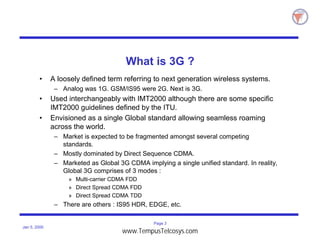
• A loosely defined term referring to next generation wireless systems.
– Analog was 1G. GSM/IS95 were 2G. Next is 3G.
• Used interchangeably with IMT2000 although there are some specific
IMT2000 guidelines defined by the ITU.
• Envisioned as a single Global standard allowing seamless roaming
across the world.
– Market is expected to be fragmented amongst several competing
standards.
– Mostly dominated by Direct Sequence CDMA.
– Marketed as Global 3G CDMA implying a single unified standard. In reality,
Global 3G comprises of 3 modes :
» Multi-carrier CDMA FDD
» Direct Spread CDMA FDD
» Direct Spread CDMA TDD
– There are others : IS95 HDR, EDGE, etc.
www.TempusTelcosys.com
Page 4
Jan 5, 2000
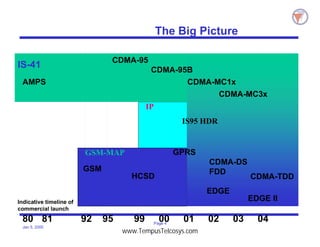
80 81 95 99 00 0201 03 04
Indicative timeline of
commercial launch
92
IS-41
The Big Picture
AMPS
GSM
HCSD
GPRS
EDGE II
EDGE
CDMA-95
CDMA-DS
FDD
CDMA-MC1x
CDMA-MC3x
CDMA-TDD
CDMA-95B
GSM-MAP
IP
IS95 HDR
www.TempusTelcosys.com
Page 5
Jan 5, 2000
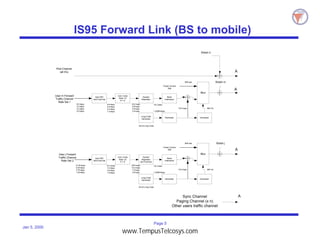
IS95 Forward Link (BS to mobile)
Walsh 0
Pilot Channel
(all 0's)
User m Forward
Traffic Channel
Rate Set 1
Walsh m
Mux
Add CRC
Add 8 tail bits
Conv Code
Rate 1/2
K = 9
Symbol
Repetition
Block
Interleaver
Long Code
Generator
Decimator Decimator
42 bit Long Code
1.2288 Mcps
19.2 ksps 800 Hz
8.6 kbps
4.0 kbps
2.0 kbps
0.8 kbps
9.6 kbps
4.8 kbps
2.4 kbps
1.2 kbps
19.2 ksps
9.6 ksps
4.8 ksps
2.4 ksps
19.2 ksps
Power Control
Bits
800 bps
Walsh j
Mux
Add CRC
Add 8 tail bits
Conv Code
Rate 1/2
K = 9
Symbol
Repetition
and Puncture
Block
Interleaver
Long Code
Generator
Decimator Decimator
42 bit Long Code
1.2288 Mcps
19.2 ksps 800 Hz
13.35 kbps
6.25 kbps
2.75 kbps
1.05 kbps
14.4 kbps
7.2 kbps
3.6 kbps
1.8 kbps
28.8 ksps
14.4 ksps
7.2 ksps
3.6 ksps
19.2 ksps
Power Control
Bits
800 bps
User j Forward
Traffic Channel
Rate Set 2
A
A
A
Sync Channel
Paging Channel (x n)
Other users traffic channel
A
www.TempusTelcosys.com
Page 6
Jan 5, 2000
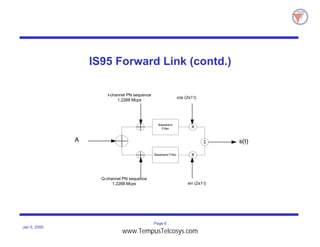
IS95 Forward Link (contd.)
A s(t)Σ
Baseband
Filter X
Baseband Filter X
I-channel PN sequence
1.2288 Mcps
Q-channel PN sequence
1.2288 Mcps
cos (2π f t)
sin (2π f t)
www.TempusTelcosys.com
Page 7
Jan 5, 2000
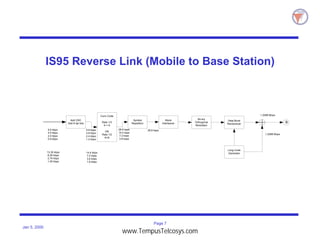
IS95 Reverse Link (Mobile to Base Station)
Add CRC
Add 8 tail bits
Conv Code
Rate 1/3
K = 9
OR
Rate 1/2
K=9
Symbol
Repetition
Block
Interleaver
8.6 kbps
4.0 kbps
2.0 kbps
0.8 kbps
9.6 kbps
4.8 kbps
2.4 kbps
1.2 kbps
28.8 ksps
14.4 ksps
7.2 ksps
3.6 ksps
28.8 ksps
14.4 kbps
7.2 kbps
3.6 kbps
1.8 kbps
13.35 kbps
6.25 kbps
2.75 kbps
1.05 kbps
64-ary
Orthogonal
Modulator
Data Burst
Randomizer
Long Code
Generator
B
1.2288 Mcps
1.2288 Mcps
www.TempusTelcosys.com
Page 8
Jan 5, 2000
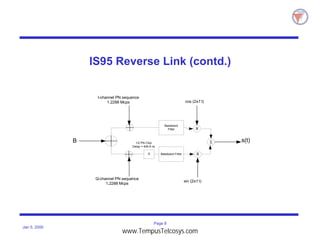
IS95 Reverse Link (contd.)
s(t)B
Baseband
Filter X
I-channel PN sequence
1.2288 Mcps
Q-channel PN sequence
1.2288 Mcps
cos (2π f t)
Baseband Filter X
Σ
sin (2π f t)
D
1/2 PN Chip
Delay = 406.9 ns
www.TempusTelcosys.com
Page 9
Jan 5, 2000
3G CDMA
www.TempusTelcosys.com
Page 10
Jan 5, 2000
3G Standards
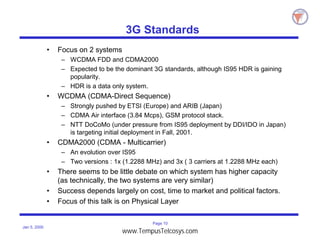
• Focus on 2 systems
– WCDMA FDD and CDMA2000
– Expected to be the dominant 3G standards, although IS95 HDR is gaining
popularity.
– HDR is a data only system.
• WCDMA (CDMA-Direct Sequence)
– Strongly pushed by ETSI (Europe) and ARIB (Japan)
– CDMA Air interface (3.84 Mcps), GSM protocol stack.
– NTT DoCoMo (under pressure from IS95 deployment by DDI/IDO in Japan)
is targeting initial deployment in Fall, 2001.
• CDMA2000 (CDMA - Multicarrier)
– An evolution over IS95
– Two versions : 1x (1.2288 MHz) and 3x ( 3 carriers at 1.2288 MHz each)
• There seems to be little debate on which system has higher capacity
(as technically, the two systems are very similar)
• Success depends largely on cost, time to market and political factors.
• Focus of this talk is on Physical Layer
www.TempusTelcosys.com
Page 11
Jan 5, 2000
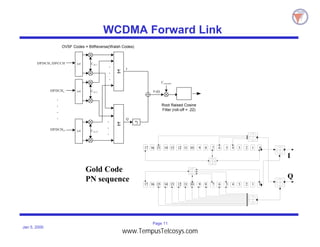
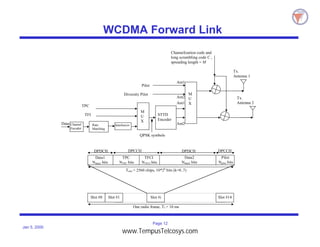
WCDMA Forward Link
S/P Cch ,1
DPDCH1/DPCCH
S/P Cch ,2
DPDCH2
S/P Cch ,N
DPDCHN
Σ
Σ
.
.
.
.
.
.
.
.
.
.
*j
I+jQ
I
Q
Cscramb
OVSF Codes = BitReverse(Walsh Codes)
Root Raised Cosine
Filter (roll-off = .22)
I
Q
1
1 0
02
2
3
3
4
4
5
5
6
6
7
7
8
8
9
9
17
17
16
16
15
15
14
14
13
13
12
12
11
11
10
10
Gold Code
PN sequence
www.TempusTelcosys.com
Page 12
Jan 5, 2000
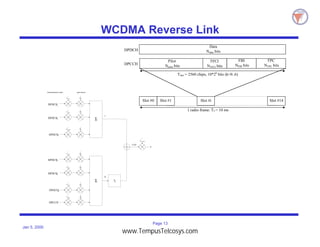
WCDMA Forward Link
Tx.
Antenna 2
M
U
X
Data
Tx.
Antenna 1
Channelization code and
long scrambling code C ,
spreading length = M
Ant1
Ant2
Ant1
Ant2
TPC
TFI
Pilot
M
U
X
Channel
Encoder
Interleaver
STTD
Encoder
Rate
Matching
QPSK symbols
Diversity Pilot
One radio frame, Tf = 10 ms
TPC
NTPC bits
Slot #0 Slot #1 Slot #i Slot #14
Tslot = 2560 chips, 10*2k
bits (k=0..7)
Data2
Ndata2 bits
DPDCH
TFCI
NTFCI bits
Pilot
Npilot bits
Data1
Ndata1 bits
DPDCH DPCCH DPCCH
www.TempusTelcosys.com
Page 13
Jan 5, 2000
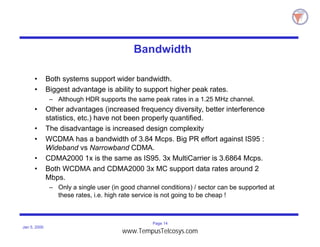
WCDMA Reverse Link
Pilot
Npilot bits
TPC
NTPC bits
Data
Ndata bits
Slot #0 Slot #1 Slot #i Slot #14
Tslot = 2560 chips, 10*2k
bits (k=0..6)
1 radio frame: Tf = 10 ms
DPDCH
DPCCH
FBI
NFBI bits
TFCI
NTFCI bits
Σ
Cch,1
DPDCH1
βd
Cch,3
DPDCH3
βd
Cch,d5
DPDCH5
βd
Channelization codes gain factors
Σ
Cch,2
DPDCH2
βd
Cch,4
DPDCH4
βd
Cch,6
DPDCH6
βd
Cch,0
DPCCH
*j
Cscramb
I+jQ
βc
I
Q
www.TempusTelcosys.com
Page 14
Jan 5, 2000
Bandwidth
• Both systems support wider bandwidth.
• Biggest advantage is ability to support higher peak rates.
– Although HDR supports the same peak rates in a 1.25 MHz channel.
• Other advantages (increased frequency diversity, better interference
statistics, etc.) have not been properly quantified.
• The disadvantage is increased design complexity
• WCDMA has a bandwidth of 3.84 Mcps. Big PR effort against IS95 :
Wideband vs Narrowband CDMA.
• CDMA2000 1x is the same as IS95. 3x MultiCarrier is 3.6864 Mcps.
• Both WCDMA and CDMA2000 3x MC support data rates around 2
Mbps.
– Only a single user (in good channel conditions) / sector can be supported at
these rates, i.e. high rate service is not going to be cheap !
www.TempusTelcosys.com
Page 15
Jan 5, 2000
Modulation
• Reverse Link
– IS95 used 64-ary orthogonal modulation
» This allowed non-coherent demod at the receiver. Coherent demodulation at
receiver was considered risky.
» Peak data rate (I.e. 14.4 kbps) was much lower than the signal bandwidth (1.2288
Mcps).
» Assumed a conventional receiver (I.e single user CDMA receiver) at the base
station. This implies that primary objective is to reduce transmit power at the
mobile.
» So, with this system, objective is to use the best (given the constraints of
implementation complexity) rate 1/p code, where p = processing gain.
» IS95 used a convolutional code (rate 1/2 or 1/3) followed by a (6,64) orthogonal
block code, followed by a repetition code.
www.TempusTelcosys.com
Page 16
Jan 5, 2000
Modulation
• Forward Link
– IS95 used BPSK because
» More tolerant to phase errors. Performance in fast fading channels was a
concern.
» General view was that IS95 was interference limited and hence more efficient
modulation was not necessary.
• Clearly, increased bandwidth would have allowed more powerful lower rate
codes, and hence could have increased capacity.
• In benign channel conditions (e.g. wireless local loop), the number of
available walsh channels was limiting forward link capacity.
www.TempusTelcosys.com
Page 17
Jan 5, 2000
Modulation
• 3G
– WCDMA, CDMA2000 : both are going for QPSK modulation (on both links)
with pilot for phase reference.
» Increased capacity, lower rate codes.
» Coherent demodulation not perceived as a problem. In fact, the overhead of pilot
on the up link more than compensated by improvements in synchronization and
power control.
» Supporting higher data rates. Hence, there is insufficient processing gain for 64-
ary orthogonal modulation.
– HDR is using adaptive modulation (upto 16 QAM) and adaptive processing
gain to improve capacity.
www.TempusTelcosys.com
Page 18
Jan 5, 2000
Coding
• IS95
– Convolutional codes only.
– Rate 1/2 or 1/3 on uplink, K = 9.
– Rate 1/2 or 3/4 on downlink. The rate 3/4 code is used for the highest data
rate (14.4 kbps), and is not a good code …
• 3G
– Same conv codes for CDMA2000, WCDMA and HDR, except that the rate
3/4 code has been removed and a rate 1/3 code on the downlink has been
introduced.
– Turbo Codes for data.
» CDMA2000 and WCDMA use the same parallel Concatenated Codes. K = 4, rate
1/3. The turbo interleavers are different
» HDR : Serial Concatenated codes. K = 5, rate 1/2 outer code followed by K = 3,
rate 1/2 inner code
www.TempusTelcosys.com
Page 19
Jan 5, 2000
Power Control
• IS95
– Fast Reverse Link Power Control at 800 Hz
– Very slow Forward Power Control
» IS95 A forward power control was a few Hz.
» IS95 B increased it to 50 Hz
– Slow Forward Power Control big limitation.
– In order to guarantee voice quality, base station has to put a floor on
minimum transmit power.
– Generally, the forward link is the capacity limiting link.
• 3G
– CDMA2000 uses 800 Hz for both uplink and downlink.
– WCDMA uses 1500 Hz for both links.
– Improved forward power control has a significant improvement on system
capacity.
– HDR uses rate control instead of power control.
www.TempusTelcosys.com
Page 20
Jan 5, 2000
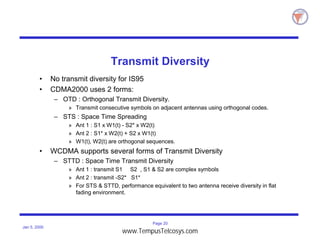
Transmit Diversity
• No transmit diversity for IS95
• CDMA2000 uses 2 forms:
– OTD : Orthogonal Transmit Diversity.
» Transmit consecutive symbols on adjacent antennas using orthogonal codes.
– STS : Space Time Spreading
» Ant 1 : S1 x W1(t) - S2* x W2(t)
» Ant 2 : S1* x W2(t) + S2 x W1(t)
» W1(t), W2(t) are orthogonal sequences.
• WCDMA supports several forms of Transmit Diversity
– STTD : Space Time Transmit Diversity
» Ant 1 : transmit S1 S2 , S1 & S2 are complex symbols
» Ant 2 : transmit -S2* S1*
» For STS & STTD, performance equivalent to two antenna receive diversity in flat
fading environment.
www.TempusTelcosys.com
Page 21
Jan 5, 2000
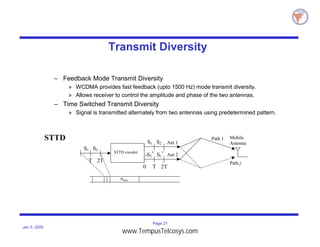
Transmit Diversity
– Feedback Mode Transmit Diversity
» WCDMA provides fast feedback (upto 1500 Hz) mode transmit diversity.
» Allows receiver to control the amplitude and phase of the two antennas.
– Time Switched Transmit Diversity
» Signal is transmitted alternately from two antennas using predetermined pattern.
S1 S2
STTD encoder
S1 S2
-S2
*
S1
*
T 2T
0 T 2T
Ant 1
Ant 2
Mobile
Antenna
Path 1
Path j
Ndata
STTD
www.TempusTelcosys.com
Page 22
Jan 5, 2000
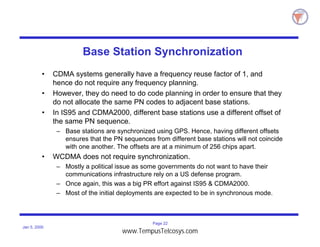
Base Station Synchronization
• CDMA systems generally have a frequency reuse factor of 1, and
hence do not require any frequency planning.
• However, they do need to do code planning in order to ensure that they
do not allocate the same PN codes to adjacent base stations.
• In IS95 and CDMA2000, different base stations use a different offset of
the same PN sequence.
– Base stations are synchronized using GPS. Hence, having different offsets
ensures that the PN sequences from different base stations will not coincide
with one another. The offsets are at a minimum of 256 chips apart.
• WCDMA does not require synchronization.
– Mostly a political issue as some governments do not want to have their
communications infrastructure rely on a US defense program.
– Once again, this was a big PR effort against IS95 & CDMA2000.
– Most of the initial deployments are expected to be in synchronous mode.
www.TempusTelcosys.com
Page 23
Jan 5, 2000
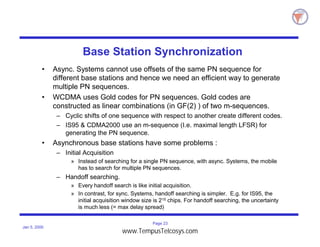
Base Station Synchronization
• Async. Systems cannot use offsets of the same PN sequence for
different base stations and hence we need an efficient way to generate
multiple PN sequences.
• WCDMA uses Gold codes for PN sequences. Gold codes are
constructed as linear combinations (in GF(2) ) of two m-sequences.
– Cyclic shifts of one sequence with respect to another create different codes.
– IS95 & CDMA2000 use an m-sequence (I.e. maximal length LFSR) for
generating the PN sequence.
• Asynchronous base stations have some problems :
– Initial Acquisition
» Instead of searching for a single PN sequence, with async. Systems, the mobile
has to search for multiple PN sequences.
– Handoff searching.
» Every handoff search is like initial acquisition.
» In contrast, for sync. Systems, handoff searching is simpler. E.g. for IS95, the
initial acquisition window size is 215 chips. For handoff searching, the uncertainty
is much less (= max delay spread)
www.TempusTelcosys.com
Page 24
Jan 5, 2000
Acquisition
• Fast acquisition is very important for a mobile user in a multi-cellular
environment.
– Even more important for CDMA systems where minimizing transmit power
to close the link is a key determinant of system capacity.
– So, phone should always try to lock onto the strongest pilot.
• CDMA2000 uses a continuous pilot like IS95.
• WCDMA uses a 3 step hierarchical search process to reduce
acquisition time.
www.TempusTelcosys.com
Page 25
Jan 5, 2000
WCDMA Searching
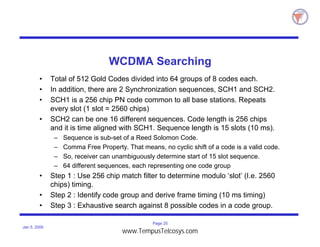
• Total of 512 Gold Codes divided into 64 groups of 8 codes each.
• In addition, there are 2 Synchronization sequences, SCH1 and SCH2.
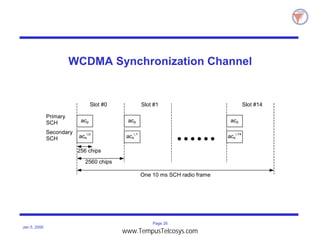
• SCH1 is a 256 chip PN code common to all base stations. Repeats
every slot (1 slot = 2560 chips)
• SCH2 can be one 16 different sequences. Code length is 256 chips
and it is time aligned with SCH1. Sequence length is 15 slots (10 ms).
– Sequence is sub-set of a Reed Solomon Code.
– Comma Free Property. That means, no cyclic shift of a code is a valid code.
– So, receiver can unambiguously determine start of 15 slot sequence.
– 64 different sequences, each representing one code group
• Step 1 : Use 256 chip match filter to determine modulo ‘slot’ (I.e. 2560
chips) timing.
• Step 2 : Identify code group and derive frame timing (10 ms timing)
• Step 3 : Exhaustive search against 8 possible codes in a code group.
www.TempusTelcosys.com
Page 26
Jan 5, 2000
WCDMA Synchronization Channel
Primary
SCH
Secondary
SCH
256 chips
2560 chips
One 10 ms SCH radio frame
acs
i,0
acp
acs
i,1
acp
acs
i,14
acp
Slot #0 Slot #1 Slot #14
www.TempusTelcosys.com
Page 27
Jan 5, 2000
Beam Forming
• IS95 only supports fixed sectorization.
• Beam Forming is considered important for 3G systems.
• All 3G systems (that I am aware of) support beam forming.
• Requirement is simple : Each channel with beam forming should have
a dedicated pilot for phase reference.
• None of the systems provide a mechanism for the phone to provide the
CSI (Channel State Information) to the transmitter (with the exception
of Feedback Mode Transmit Diversity in WCDMA).
– Beam form on remote scatterers
– Have fixed spot beams for high capacity areas.
www.TempusTelcosys.com
Page 28
Jan 5, 2000
Multi-User Detection
• Does not seem to be much interest in multi-user detectors.
• A year ago, NTT was a big proponent of multi-user receivers, but lately
there has been little development on that front.
• Biggest problem is designing multi-user receivers with reasonable
complexity for a multi-cellular environment.
• WCDMA standard supports short spreading codes (256 chips as
opposed to the regular 38400 chips) to aid in multi-user detection.
– With long codes, the correlation matrix of the codes changes every symbol.
• Schemes such as interference cancellation do not require standards
support.
• In IS95 the downlink was the capacity limiting link. With WCDMA &
CDMA2000, the downlink capacity has been improved, but with
asymmetric data rates, downlink may still be the capacity limiting link.
– Having multi-user receivers on the base station would have little impact on
capacity.
www.TempusTelcosys.com
Page 29
Jan 5, 2000
Peak To Average Power
• IS95 uses 2 schemes to reduce Peak To Average Power
– Offset QPSK modulation to reduce Peak to Average.
– Constant power transmission. For lower data rates, transmission is
discontinued for some duration. The Peak to average remains the same;
however, peak to average when the Power Amplifier is on is reduced.
• 3G
– HPSK (Hybrid Phase Shift Keying)
» c = c1 (w0 + j c2*w1)
» c1 = PN sequence changing at chip rate.
» c2 = PN sequence changing at half the chip rate.
» W0 = { 1 1}; W1 = {1 -1}
» phase transitions less than 90 degrees half the time.
– Continuous transmission => worse peak to average
» Compensated by improved power control, time diversity and receiver
synchronization.
www.TempusTelcosys.com
Page 30
Jan 5, 2000
Summary
Forward Link Capacity Improvements
• Fast Forward Power Control
• More spectrally efficient modulation
• Turbo codes and lower rate convolutional codes.
• Transmit diversity
• Dedicated pilots for support of beam forming.
• Support higher peak data rates.
• Protocol improvements to improve packet data transmission.
www.TempusTelcosys.com
Page 31
Jan 5, 2000
Summary
Reverse Link Capacity Improvements
• Coherent Reverse Link
• Improved synchronization and power control because of Reverse Link
Pilot.
• Improved time diversity and power control because of continuous
transmission.
• QPSK modulation
• Turbo codes
• Multi-user detection
• Faster Power Control (for WCDMA)
• Improved Access Channel
– Reservation based schemes as opposed to slotted Aloha in IS95
www.TempusTelcosys.com

3g cdma-qualcom

  • 1.
    Page 1 Jan 5,2000 <3rd generation CDMA wireless systems> <Avneesh Agrawal, Qualcomm> www.TempusTelcosys.com
  • 2.
    Page 2 Jan 5,2000 Overview • What is 3G ? • A brief overview of IS95 • Key design choices for CDMA 3G systems. – Bandwidth – Modulation – Coding – Power Control – Transmit Diversity – Base Station Synchronization. – Acquisition – Beam Forming – Multi-user detection – Peak To Average Power • Objective is not to provide detailed justifications, but instead provide some insight into the level of optimization that went into designing the physical layer of the next generation wireless systems. www.TempusTelcosys.com
  • 3.
    Page 3 Jan 5,2000 What is 3G ? • A loosely defined term referring to next generation wireless systems. – Analog was 1G. GSM/IS95 were 2G. Next is 3G. • Used interchangeably with IMT2000 although there are some specific IMT2000 guidelines defined by the ITU. • Envisioned as a single Global standard allowing seamless roaming across the world. – Market is expected to be fragmented amongst several competing standards. – Mostly dominated by Direct Sequence CDMA. – Marketed as Global 3G CDMA implying a single unified standard. In reality, Global 3G comprises of 3 modes : » Multi-carrier CDMA FDD » Direct Spread CDMA FDD » Direct Spread CDMA TDD – There are others : IS95 HDR, EDGE, etc. www.TempusTelcosys.com
  • 4.
    Page 4 Jan 5,2000 80 81 95 99 00 0201 03 04 Indicative timeline of commercial launch 92 IS-41 The Big Picture AMPS GSM HCSD GPRS EDGE II EDGE CDMA-95 CDMA-DS FDD CDMA-MC1x CDMA-MC3x CDMA-TDD CDMA-95B GSM-MAP IP IS95 HDR www.TempusTelcosys.com
  • 5.
    Page 5 Jan 5,2000 IS95 Forward Link (BS to mobile) Walsh 0 Pilot Channel (all 0's) User m Forward Traffic Channel Rate Set 1 Walsh m Mux Add CRC Add 8 tail bits Conv Code Rate 1/2 K = 9 Symbol Repetition Block Interleaver Long Code Generator Decimator Decimator 42 bit Long Code 1.2288 Mcps 19.2 ksps 800 Hz 8.6 kbps 4.0 kbps 2.0 kbps 0.8 kbps 9.6 kbps 4.8 kbps 2.4 kbps 1.2 kbps 19.2 ksps 9.6 ksps 4.8 ksps 2.4 ksps 19.2 ksps Power Control Bits 800 bps Walsh j Mux Add CRC Add 8 tail bits Conv Code Rate 1/2 K = 9 Symbol Repetition and Puncture Block Interleaver Long Code Generator Decimator Decimator 42 bit Long Code 1.2288 Mcps 19.2 ksps 800 Hz 13.35 kbps 6.25 kbps 2.75 kbps 1.05 kbps 14.4 kbps 7.2 kbps 3.6 kbps 1.8 kbps 28.8 ksps 14.4 ksps 7.2 ksps 3.6 ksps 19.2 ksps Power Control Bits 800 bps User j Forward Traffic Channel Rate Set 2 A A A Sync Channel Paging Channel (x n) Other users traffic channel A www.TempusTelcosys.com
  • 6.
    Page 6 Jan 5,2000 IS95 Forward Link (contd.) A s(t)Σ Baseband Filter X Baseband Filter X I-channel PN sequence 1.2288 Mcps Q-channel PN sequence 1.2288 Mcps cos (2π f t) sin (2π f t) www.TempusTelcosys.com
  • 7.
    Page 7 Jan 5,2000 IS95 Reverse Link (Mobile to Base Station) Add CRC Add 8 tail bits Conv Code Rate 1/3 K = 9 OR Rate 1/2 K=9 Symbol Repetition Block Interleaver 8.6 kbps 4.0 kbps 2.0 kbps 0.8 kbps 9.6 kbps 4.8 kbps 2.4 kbps 1.2 kbps 28.8 ksps 14.4 ksps 7.2 ksps 3.6 ksps 28.8 ksps 14.4 kbps 7.2 kbps 3.6 kbps 1.8 kbps 13.35 kbps 6.25 kbps 2.75 kbps 1.05 kbps 64-ary Orthogonal Modulator Data Burst Randomizer Long Code Generator B 1.2288 Mcps 1.2288 Mcps www.TempusTelcosys.com
  • 8.
    Page 8 Jan 5,2000 IS95 Reverse Link (contd.) s(t)B Baseband Filter X I-channel PN sequence 1.2288 Mcps Q-channel PN sequence 1.2288 Mcps cos (2π f t) Baseband Filter X Σ sin (2π f t) D 1/2 PN Chip Delay = 406.9 ns www.TempusTelcosys.com
  • 9.
    Page 9 Jan 5,2000 3G CDMA www.TempusTelcosys.com
  • 10.
    Page 10 Jan 5,2000 3G Standards • Focus on 2 systems – WCDMA FDD and CDMA2000 – Expected to be the dominant 3G standards, although IS95 HDR is gaining popularity. – HDR is a data only system. • WCDMA (CDMA-Direct Sequence) – Strongly pushed by ETSI (Europe) and ARIB (Japan) – CDMA Air interface (3.84 Mcps), GSM protocol stack. – NTT DoCoMo (under pressure from IS95 deployment by DDI/IDO in Japan) is targeting initial deployment in Fall, 2001. • CDMA2000 (CDMA - Multicarrier) – An evolution over IS95 – Two versions : 1x (1.2288 MHz) and 3x ( 3 carriers at 1.2288 MHz each) • There seems to be little debate on which system has higher capacity (as technically, the two systems are very similar) • Success depends largely on cost, time to market and political factors. • Focus of this talk is on Physical Layer www.TempusTelcosys.com
  • 11.
    Page 11 Jan 5,2000 WCDMA Forward Link S/P Cch ,1 DPDCH1/DPCCH S/P Cch ,2 DPDCH2 S/P Cch ,N DPDCHN Σ Σ . . . . . . . . . . *j I+jQ I Q Cscramb OVSF Codes = BitReverse(Walsh Codes) Root Raised Cosine Filter (roll-off = .22) I Q 1 1 0 02 2 3 3 4 4 5 5 6 6 7 7 8 8 9 9 17 17 16 16 15 15 14 14 13 13 12 12 11 11 10 10 Gold Code PN sequence www.TempusTelcosys.com
  • 12.
    Page 12 Jan 5,2000 WCDMA Forward Link Tx. Antenna 2 M U X Data Tx. Antenna 1 Channelization code and long scrambling code C , spreading length = M Ant1 Ant2 Ant1 Ant2 TPC TFI Pilot M U X Channel Encoder Interleaver STTD Encoder Rate Matching QPSK symbols Diversity Pilot One radio frame, Tf = 10 ms TPC NTPC bits Slot #0 Slot #1 Slot #i Slot #14 Tslot = 2560 chips, 10*2k bits (k=0..7) Data2 Ndata2 bits DPDCH TFCI NTFCI bits Pilot Npilot bits Data1 Ndata1 bits DPDCH DPCCH DPCCH www.TempusTelcosys.com
  • 13.
    Page 13 Jan 5,2000 WCDMA Reverse Link Pilot Npilot bits TPC NTPC bits Data Ndata bits Slot #0 Slot #1 Slot #i Slot #14 Tslot = 2560 chips, 10*2k bits (k=0..6) 1 radio frame: Tf = 10 ms DPDCH DPCCH FBI NFBI bits TFCI NTFCI bits Σ Cch,1 DPDCH1 βd Cch,3 DPDCH3 βd Cch,d5 DPDCH5 βd Channelization codes gain factors Σ Cch,2 DPDCH2 βd Cch,4 DPDCH4 βd Cch,6 DPDCH6 βd Cch,0 DPCCH *j Cscramb I+jQ βc I Q www.TempusTelcosys.com
  • 14.
    Page 14 Jan 5,2000 Bandwidth • Both systems support wider bandwidth. • Biggest advantage is ability to support higher peak rates. – Although HDR supports the same peak rates in a 1.25 MHz channel. • Other advantages (increased frequency diversity, better interference statistics, etc.) have not been properly quantified. • The disadvantage is increased design complexity • WCDMA has a bandwidth of 3.84 Mcps. Big PR effort against IS95 : Wideband vs Narrowband CDMA. • CDMA2000 1x is the same as IS95. 3x MultiCarrier is 3.6864 Mcps. • Both WCDMA and CDMA2000 3x MC support data rates around 2 Mbps. – Only a single user (in good channel conditions) / sector can be supported at these rates, i.e. high rate service is not going to be cheap ! www.TempusTelcosys.com
  • 15.
    Page 15 Jan 5,2000 Modulation • Reverse Link – IS95 used 64-ary orthogonal modulation » This allowed non-coherent demod at the receiver. Coherent demodulation at receiver was considered risky. » Peak data rate (I.e. 14.4 kbps) was much lower than the signal bandwidth (1.2288 Mcps). » Assumed a conventional receiver (I.e single user CDMA receiver) at the base station. This implies that primary objective is to reduce transmit power at the mobile. » So, with this system, objective is to use the best (given the constraints of implementation complexity) rate 1/p code, where p = processing gain. » IS95 used a convolutional code (rate 1/2 or 1/3) followed by a (6,64) orthogonal block code, followed by a repetition code. www.TempusTelcosys.com
  • 16.
    Page 16 Jan 5,2000 Modulation • Forward Link – IS95 used BPSK because » More tolerant to phase errors. Performance in fast fading channels was a concern. » General view was that IS95 was interference limited and hence more efficient modulation was not necessary. • Clearly, increased bandwidth would have allowed more powerful lower rate codes, and hence could have increased capacity. • In benign channel conditions (e.g. wireless local loop), the number of available walsh channels was limiting forward link capacity. www.TempusTelcosys.com
  • 17.
    Page 17 Jan 5,2000 Modulation • 3G – WCDMA, CDMA2000 : both are going for QPSK modulation (on both links) with pilot for phase reference. » Increased capacity, lower rate codes. » Coherent demodulation not perceived as a problem. In fact, the overhead of pilot on the up link more than compensated by improvements in synchronization and power control. » Supporting higher data rates. Hence, there is insufficient processing gain for 64- ary orthogonal modulation. – HDR is using adaptive modulation (upto 16 QAM) and adaptive processing gain to improve capacity. www.TempusTelcosys.com
  • 18.
    Page 18 Jan 5,2000 Coding • IS95 – Convolutional codes only. – Rate 1/2 or 1/3 on uplink, K = 9. – Rate 1/2 or 3/4 on downlink. The rate 3/4 code is used for the highest data rate (14.4 kbps), and is not a good code … • 3G – Same conv codes for CDMA2000, WCDMA and HDR, except that the rate 3/4 code has been removed and a rate 1/3 code on the downlink has been introduced. – Turbo Codes for data. » CDMA2000 and WCDMA use the same parallel Concatenated Codes. K = 4, rate 1/3. The turbo interleavers are different » HDR : Serial Concatenated codes. K = 5, rate 1/2 outer code followed by K = 3, rate 1/2 inner code www.TempusTelcosys.com
  • 19.
    Page 19 Jan 5,2000 Power Control • IS95 – Fast Reverse Link Power Control at 800 Hz – Very slow Forward Power Control » IS95 A forward power control was a few Hz. » IS95 B increased it to 50 Hz – Slow Forward Power Control big limitation. – In order to guarantee voice quality, base station has to put a floor on minimum transmit power. – Generally, the forward link is the capacity limiting link. • 3G – CDMA2000 uses 800 Hz for both uplink and downlink. – WCDMA uses 1500 Hz for both links. – Improved forward power control has a significant improvement on system capacity. – HDR uses rate control instead of power control. www.TempusTelcosys.com
  • 20.
    Page 20 Jan 5,2000 Transmit Diversity • No transmit diversity for IS95 • CDMA2000 uses 2 forms: – OTD : Orthogonal Transmit Diversity. » Transmit consecutive symbols on adjacent antennas using orthogonal codes. – STS : Space Time Spreading » Ant 1 : S1 x W1(t) - S2* x W2(t) » Ant 2 : S1* x W2(t) + S2 x W1(t) » W1(t), W2(t) are orthogonal sequences. • WCDMA supports several forms of Transmit Diversity – STTD : Space Time Transmit Diversity » Ant 1 : transmit S1 S2 , S1 & S2 are complex symbols » Ant 2 : transmit -S2* S1* » For STS & STTD, performance equivalent to two antenna receive diversity in flat fading environment. www.TempusTelcosys.com
  • 21.
    Page 21 Jan 5,2000 Transmit Diversity – Feedback Mode Transmit Diversity » WCDMA provides fast feedback (upto 1500 Hz) mode transmit diversity. » Allows receiver to control the amplitude and phase of the two antennas. – Time Switched Transmit Diversity » Signal is transmitted alternately from two antennas using predetermined pattern. S1 S2 STTD encoder S1 S2 -S2 * S1 * T 2T 0 T 2T Ant 1 Ant 2 Mobile Antenna Path 1 Path j Ndata STTD www.TempusTelcosys.com
  • 22.
    Page 22 Jan 5,2000 Base Station Synchronization • CDMA systems generally have a frequency reuse factor of 1, and hence do not require any frequency planning. • However, they do need to do code planning in order to ensure that they do not allocate the same PN codes to adjacent base stations. • In IS95 and CDMA2000, different base stations use a different offset of the same PN sequence. – Base stations are synchronized using GPS. Hence, having different offsets ensures that the PN sequences from different base stations will not coincide with one another. The offsets are at a minimum of 256 chips apart. • WCDMA does not require synchronization. – Mostly a political issue as some governments do not want to have their communications infrastructure rely on a US defense program. – Once again, this was a big PR effort against IS95 & CDMA2000. – Most of the initial deployments are expected to be in synchronous mode. www.TempusTelcosys.com
  • 23.
    Page 23 Jan 5,2000 Base Station Synchronization • Async. Systems cannot use offsets of the same PN sequence for different base stations and hence we need an efficient way to generate multiple PN sequences. • WCDMA uses Gold codes for PN sequences. Gold codes are constructed as linear combinations (in GF(2) ) of two m-sequences. – Cyclic shifts of one sequence with respect to another create different codes. – IS95 & CDMA2000 use an m-sequence (I.e. maximal length LFSR) for generating the PN sequence. • Asynchronous base stations have some problems : – Initial Acquisition » Instead of searching for a single PN sequence, with async. Systems, the mobile has to search for multiple PN sequences. – Handoff searching. » Every handoff search is like initial acquisition. » In contrast, for sync. Systems, handoff searching is simpler. E.g. for IS95, the initial acquisition window size is 215 chips. For handoff searching, the uncertainty is much less (= max delay spread) www.TempusTelcosys.com
  • 24.
    Page 24 Jan 5,2000 Acquisition • Fast acquisition is very important for a mobile user in a multi-cellular environment. – Even more important for CDMA systems where minimizing transmit power to close the link is a key determinant of system capacity. – So, phone should always try to lock onto the strongest pilot. • CDMA2000 uses a continuous pilot like IS95. • WCDMA uses a 3 step hierarchical search process to reduce acquisition time. www.TempusTelcosys.com
  • 25.
    Page 25 Jan 5,2000 WCDMA Searching • Total of 512 Gold Codes divided into 64 groups of 8 codes each. • In addition, there are 2 Synchronization sequences, SCH1 and SCH2. • SCH1 is a 256 chip PN code common to all base stations. Repeats every slot (1 slot = 2560 chips) • SCH2 can be one 16 different sequences. Code length is 256 chips and it is time aligned with SCH1. Sequence length is 15 slots (10 ms). – Sequence is sub-set of a Reed Solomon Code. – Comma Free Property. That means, no cyclic shift of a code is a valid code. – So, receiver can unambiguously determine start of 15 slot sequence. – 64 different sequences, each representing one code group • Step 1 : Use 256 chip match filter to determine modulo ‘slot’ (I.e. 2560 chips) timing. • Step 2 : Identify code group and derive frame timing (10 ms timing) • Step 3 : Exhaustive search against 8 possible codes in a code group. www.TempusTelcosys.com
  • 26.
    Page 26 Jan 5,2000 WCDMA Synchronization Channel Primary SCH Secondary SCH 256 chips 2560 chips One 10 ms SCH radio frame acs i,0 acp acs i,1 acp acs i,14 acp Slot #0 Slot #1 Slot #14 www.TempusTelcosys.com
  • 27.
    Page 27 Jan 5,2000 Beam Forming • IS95 only supports fixed sectorization. • Beam Forming is considered important for 3G systems. • All 3G systems (that I am aware of) support beam forming. • Requirement is simple : Each channel with beam forming should have a dedicated pilot for phase reference. • None of the systems provide a mechanism for the phone to provide the CSI (Channel State Information) to the transmitter (with the exception of Feedback Mode Transmit Diversity in WCDMA). – Beam form on remote scatterers – Have fixed spot beams for high capacity areas. www.TempusTelcosys.com
  • 28.
    Page 28 Jan 5,2000 Multi-User Detection • Does not seem to be much interest in multi-user detectors. • A year ago, NTT was a big proponent of multi-user receivers, but lately there has been little development on that front. • Biggest problem is designing multi-user receivers with reasonable complexity for a multi-cellular environment. • WCDMA standard supports short spreading codes (256 chips as opposed to the regular 38400 chips) to aid in multi-user detection. – With long codes, the correlation matrix of the codes changes every symbol. • Schemes such as interference cancellation do not require standards support. • In IS95 the downlink was the capacity limiting link. With WCDMA & CDMA2000, the downlink capacity has been improved, but with asymmetric data rates, downlink may still be the capacity limiting link. – Having multi-user receivers on the base station would have little impact on capacity. www.TempusTelcosys.com
  • 29.
    Page 29 Jan 5,2000 Peak To Average Power • IS95 uses 2 schemes to reduce Peak To Average Power – Offset QPSK modulation to reduce Peak to Average. – Constant power transmission. For lower data rates, transmission is discontinued for some duration. The Peak to average remains the same; however, peak to average when the Power Amplifier is on is reduced. • 3G – HPSK (Hybrid Phase Shift Keying) » c = c1 (w0 + j c2*w1) » c1 = PN sequence changing at chip rate. » c2 = PN sequence changing at half the chip rate. » W0 = { 1 1}; W1 = {1 -1} » phase transitions less than 90 degrees half the time. – Continuous transmission => worse peak to average » Compensated by improved power control, time diversity and receiver synchronization. www.TempusTelcosys.com
  • 30.
    Page 30 Jan 5,2000 Summary Forward Link Capacity Improvements • Fast Forward Power Control • More spectrally efficient modulation • Turbo codes and lower rate convolutional codes. • Transmit diversity • Dedicated pilots for support of beam forming. • Support higher peak data rates. • Protocol improvements to improve packet data transmission. www.TempusTelcosys.com
  • 31.
    Page 31 Jan 5,2000 Summary Reverse Link Capacity Improvements • Coherent Reverse Link • Improved synchronization and power control because of Reverse Link Pilot. • Improved time diversity and power control because of continuous transmission. • QPSK modulation • Turbo codes • Multi-user detection • Faster Power Control (for WCDMA) • Improved Access Channel – Reservation based schemes as opposed to slotted Aloha in IS95 www.TempusTelcosys.com