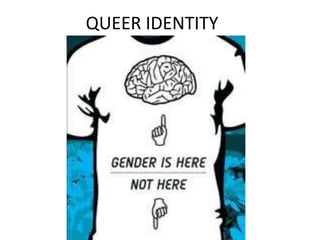
QUEER IDENTITY
A PRESENTATION BY:
RANA MOHAMMED
   2 ND M.A MASS

 COMMUNICATION
Queer is by definition whatever is at odds
 with the normal, the legitimate, the
 dominant. There is nothing in particular
 to which it necessarily refers. It is an
 identity without an essence.
Queer theory is a part of the field of
queer studies whose roots can be found
in women's studies, feminist theory, and
gay and lesbian studies, as well as in
postmodern and post-structuralist
theories.
The term "queer theory" was introduced
in 1990, with Eve Kosofsky
Sedgwick, Judith Butler, Adrienne Rich
and Diana Fuss (all largely following the
work of Michel Foucault) being among its
foundational proponents.
• Queer theory's main project is exploring the
  contesting of the categorisation of gender and
  sexuality; identities are not fixed – they
  cannot be categorised and labeled – because
  identities consist of many varied components
  and that to categorise by one characteristic is
  wrong.
• Queer theory is grounded in gender and
  sexuality. Due to this association, a debate
  emerges as to whether sexual orientation is
  natural or essential to the person, as
  an essentialist believes, or if sexuality is
  a social construction and subject to change.
• The queer theory has two predominant
  strains:
• Radical deconstructionism: interrogates
  categories of sexual orientations.
• Radical rebellion: disrupts the normalizing
  tendencies of the sexual order.
• Queer theory developed out of an
  examination of perceived limitations in the
  traditional identity politics of recognition
  and self-identity. In particular, queer theorists
  identified processes of consolidation or
  stabilization around some other identity labels
  (e.g. gay and lesbian); and construed
  queerness so as to resist this. Queer theory
  attempts to maintain a critique more than
  define a specific identity.
• Queer theory is likened to language because it
  is never static, but is ever-evolving.
• In later years there was an explosion of
  discourse on sexuality and sexual orientations
  with the coming-of-age of the Internet.
• Queer theorists analyze texts and challenge
  the cultural notions of "straight" ideology;
  that is, does "straight" imply heterosexuality
  as normal or is everyone potentially gay?
QUEER THEORY AND INTERNET
• New Media artists have a long history of queer
  theory inspired works, including cyberfeminism
  works using social software to explore queer
  sexualities beyond the male/female binary.
• http://queerocracy.tumblr.com/post/75541422
  52/help-push-facebook-to-recognize-trans-
  identities
• http://plone.ladyfestwien.org/
QUEER IDENTITY AND FACEBOOK
• Another labeling war that still continues—and, one
  could argue, is being lost by those seeking more
  freedom in self-identification—is the
  sex/gender/orientation war. Here Facebook’s
  reliance on discrete quantities is unyieldingly
  absolute: one is strongly encouraged to select one’s
  “Sex” as “male” or “female,” to check either or both
  of the “men” and “women” boxes under “Interested
  in,” and to thus publicly shape one’s sexual identity
  as a totally binary one. This is not at all surprising, in
  a society that reinforces the strict absolutes of male
  and female or gay and straight, but it’s as
  constricting—if not more so—than the limited
  political options ever were.
DELEUZE
• “Accordingly queer is always ready in response
  to a dominant heterosexual matrix: solely
  reactive force of re-signification, mockery,
  disrespect to the dominance of
  heterosexuality, to the power of the norms, a
  force that denies all that it is not and makes
  negation its own essence and the principle of
  its existence.”
REFERENCES
• worthlessdrivel.net/category/essays/
• books.google.com › Literary Criticism› Asian›
  General
THANK YOU

Queer identity

  • 1.
  • 2.
    A PRESENTATION BY: RANAMOHAMMED 2 ND M.A MASS COMMUNICATION
  • 3.
    Queer is bydefinition whatever is at odds with the normal, the legitimate, the dominant. There is nothing in particular to which it necessarily refers. It is an identity without an essence.
  • 4.
    Queer theory isa part of the field of queer studies whose roots can be found in women's studies, feminist theory, and gay and lesbian studies, as well as in postmodern and post-structuralist theories.
  • 5.
    The term "queertheory" was introduced in 1990, with Eve Kosofsky Sedgwick, Judith Butler, Adrienne Rich and Diana Fuss (all largely following the work of Michel Foucault) being among its foundational proponents.
  • 6.
    • Queer theory'smain project is exploring the contesting of the categorisation of gender and sexuality; identities are not fixed – they cannot be categorised and labeled – because identities consist of many varied components and that to categorise by one characteristic is wrong.
  • 7.
    • Queer theoryis grounded in gender and sexuality. Due to this association, a debate emerges as to whether sexual orientation is natural or essential to the person, as an essentialist believes, or if sexuality is a social construction and subject to change. • The queer theory has two predominant strains: • Radical deconstructionism: interrogates categories of sexual orientations. • Radical rebellion: disrupts the normalizing tendencies of the sexual order.
  • 8.
    • Queer theorydeveloped out of an examination of perceived limitations in the traditional identity politics of recognition and self-identity. In particular, queer theorists identified processes of consolidation or stabilization around some other identity labels (e.g. gay and lesbian); and construed queerness so as to resist this. Queer theory attempts to maintain a critique more than define a specific identity.
  • 9.
    • Queer theoryis likened to language because it is never static, but is ever-evolving.
  • 10.
    • In lateryears there was an explosion of discourse on sexuality and sexual orientations with the coming-of-age of the Internet.
  • 11.
    • Queer theoristsanalyze texts and challenge the cultural notions of "straight" ideology; that is, does "straight" imply heterosexuality as normal or is everyone potentially gay?
  • 12.
    QUEER THEORY ANDINTERNET • New Media artists have a long history of queer theory inspired works, including cyberfeminism works using social software to explore queer sexualities beyond the male/female binary. • http://queerocracy.tumblr.com/post/75541422 52/help-push-facebook-to-recognize-trans- identities • http://plone.ladyfestwien.org/
  • 13.
    QUEER IDENTITY ANDFACEBOOK • Another labeling war that still continues—and, one could argue, is being lost by those seeking more freedom in self-identification—is the sex/gender/orientation war. Here Facebook’s reliance on discrete quantities is unyieldingly absolute: one is strongly encouraged to select one’s “Sex” as “male” or “female,” to check either or both of the “men” and “women” boxes under “Interested in,” and to thus publicly shape one’s sexual identity as a totally binary one. This is not at all surprising, in a society that reinforces the strict absolutes of male and female or gay and straight, but it’s as constricting—if not more so—than the limited political options ever were.
  • 14.
    DELEUZE • “Accordingly queeris always ready in response to a dominant heterosexual matrix: solely reactive force of re-signification, mockery, disrespect to the dominance of heterosexuality, to the power of the norms, a force that denies all that it is not and makes negation its own essence and the principle of its existence.”
  • 15.
  • 16.