Evolution of
Mobile Networks
Contents
1. Mobile Network – The Evolution
2. Different Generations in Mobile Networks
3. Second Generation – 2G
4. Third Generation – 3G
5. Fourth Generation – 4G
6. Fifth Generation-5G
The Evolution
The Evolution
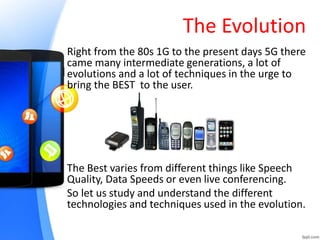
Right from the 80s 1G to the present days 5G there
came many intermediate generations, a lot of
evolutions and a lot of techniques in the urge to
bring the BEST to the user.
The Best varies from different things like Speech
Quality, Data Speeds or even live conferencing.
So let us study and understand the different
technologies and techniques used in the evolution.
Different Generations in
Mobile Networks
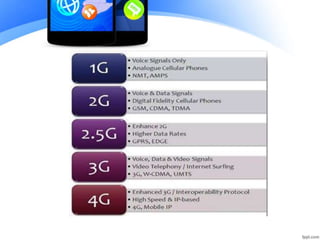
1G
• 1G as the name indicates is the first generation of the mobile telephone
technology.
• Developed in 1980's, 1G uses analog signals for its transmission.
• The technique used for handling the traffic in 1G is Frequency-Division Multiple
Access (FDMA).
What is FDMA ??
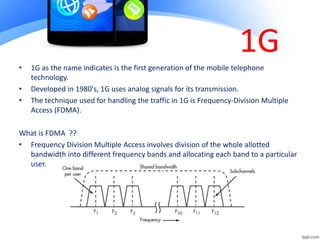
• Frequency Division Multiple Access involves division of the whole allotted
bandwidth into different frequency bands and allocating each band to a particular
user.
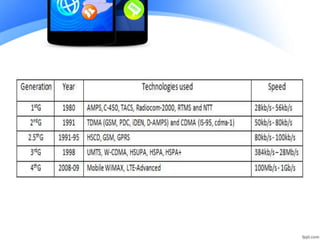
• The speed in 1G varies roughly between 28Kbps to 56Kbps.
1G was used in different ways in different countries.
Some of them are
• NMT (NordicMobile Telephone), used in Nordic countries, Eastern Europe and
Russia. Others include AMPS (Advanced Mobile Phone System) used in the United
States. TACS (Total Access Communications System) in the United Kingdom,
• C-Netz in West Germany,
• Radiocom 2000 in France, and
• RTMI in Italy.
Challenges faced in the 1G
• Insufficient Capacity
• Unreliable Handoff
• Highly UNSECURE.
Inspite of the Challenges we can still see some advantages of 1G over 2G. They
are
• Since 1G used analog signals, they have very less dependency on the location
and nearness to the tower.
• Even though the call is made far away from the tower, we can see only the
analog signal losing power unlike the 2G completely getting disconnected.
…..
2G
• 2G as it stands is the second generation wireless telephone technology.
• Introduced in 1991, this was one of the most popular mobile technologies.
• They were launched commercially on the GSM standard.
• As a development to 1G technology, the 2G used digital signals for its
transmission.
• The additional option available in 2G is the messaging facility.
• Different multiplexing techniques involved in the second generation
include Time Division Multiple Access (TDMA), Code Division Multiple
Access (CDMA) and sometimes Frequency Division Multiple Access
(FDMA).
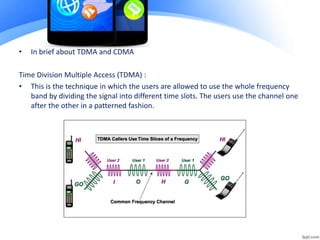
• In brief about TDMA and CDMA
Time Division Multiple Access (TDMA) :
• This is the technique in which the users are allowed to use the whole frequency
band by dividing the signal into different time slots. The users use the channel one
after the other in a patterned fashion.
Code Division Multiple Access (CDMA) :
• This is the technique in which each user is allotted a unique code which will be
encrypted along with the information sent. Here the whole frequency channel is
available to the users the whole time.
The speed in 2G varies between 50kbps to approximately 250 kbps.
The different technologies of 2G include
• GSM - GSM stands for Global System for Mobile Communications. This is a global
standard for mobile communications spreading in over 219 countries and
territories. We will learn more about GSM in the coming chapters.
Advantages of 2G :
• The main advantage of 2G over the 1G is the use of digital signals.
• The use of digital data service with 2g technology has helped mobile network
operators to provide the SMS or short message services to any mobile network at
any time over the cellular phones.
• Among the benefits of 2g technologies is that the lower power emissions have also
helped in dealing with health concerns.
• Improved privacy is another added advantage of 2g technology.
Disadvantages of 2G :
• The weaker digital signal will not be sufficient to reach a cell tower.
• Under unfavorable conditions, digital will have occasional dropouts, and may fail
completely if the conditions worsen.
• ………………………………
2.5G
• 2.5G, which stands for "second and a half generation," is a cellular wireless
technology developed in between its predecessor, 2G, and its successor, 3G.
• The term "second and a half generation" is used to describe 2G-systems that have
implemented a packet switched domain in addition to the circuit switched domain.
"2.5G" is an informal term, invented solely for marketing purposes, unlike "2G" or
"3G" which are officially defined standards based on those defined by the
International Telecommunication (ITU).
• 2.5G or GPRS could provide data rates from 56 kbit/s up to 115 kbit/s.
• It can be used for services such as Wireless Application Protocol (WAP) access,
Multimedia Messaging Service (MMS), and for Internet communication services
such as email and World Wide Web access. G
• 2.5G networks may support services such as WAP, MMS, SMS mobile games, and
search and directory.
3G
• 3G is the third generation of cellular technology.
• The research on the development in the very late 1980s by the International
Telecommunication Unit.
• Even though the research started in 1980s, the public availability started only in
the early 2000s.
• 3G was first introduced to the public in Japan by NTT DoCoMo in 2011.
• As the frequencies used by the 3G technology are quite different from 2G, the
infrastructure for the 3G is completely different from 2G.
• This led to the delay in the growth of 3G in different countries.
• Data Rates of 3G are quite more compared to 2G and 2.5G.
• The speed in 3G varies in between 2 Mbps to 28 Mbps for a stationary user and is
around 384 kbps in a moving vehicle.
• Many of the services provided by 3G technology include Mobile TV, Video
Conferencing, Global Positioning System (GPS) and many more.
• The technology used to handle traffic in 3G is W-CDMA
A brief about W-CDMA
• W-CDMA stands for Wideband Code Division Multiple Access. The technique uses
a unique code for each channel so that only the decoder who knows the code can
pick out the wanted signal and the rest of the signals will appear as noise to him.
Advantages :
• Faster Data connectivity
• Uninterrupted Video streaming on smartphones.
• Live video calls and video conferences.
•
Disadvantages :
• Much costlier than 2G.
• Completely advanced hardware required to be installed.
• Difference of 3G is shown only in smartphones which are not available to all the
people.
3.5G
• High-Speed Downlink Packet Access(HSDPA) is a mobile telephony protocol, also
called 3.5G (or "3½G"), which provides a smooth evolutionary path for UMTS-
based 3G networks allowing for higher data transfer speeds.
• HSDPA is a packet-based data service in W-CDMA downlink with data transmission
up to 8-10 Mbit/s (and 20 Mbit/s for MIMO systems) over a 5MHz bandwidth in
WCDMA downlink.
• HSDPA implementations includes Adaptive Modulation and Coding (AMC),
Multiple-Input Multiple-Output (MIMO), Hybrid Automatic Request (HARQ), fast
cell search, and advanced receiver design.
4G(LTE)
• 4G is the fourth generation of mobile technology.
• This was first commercially launched in 2010.
• 4G technology speeds targets peak data rates of almost 1 Gbps for stationary
objects and almost upto 100 Mbps for moving objects.
• The technology used in 4G wireless system is OFDMA.
A brief about OFDMA :
• OFDMA stands for Orthogonal Frequency Division Multiple Access.
• The technology works by splitting the signal into multiple smaller sub-sections that
are then transmitted simultaneously at different frequencies.
LTE :
• Long Term Evolution is an emerging technology for higher data rates. It is also
referred as 3.9 G or super 3G technology.
• LTE is developed as an improvement to Universal Mobile Telecommunication
System by 3G Generation Partnership Project (3GPP).
• LTE uses Orthogonal Frequency Division Multiple Access (OFDMA).
• The download rate in LTE is 150 Mbps and it utilizes the available spectrum in a
very sophisticated way.
Advantages of :
• Very High Speed, almost ten times compared to 3G.
• The expectation for the 4G technology is basically the high quality audio/video
streaming over end to end Internet Protocol.
• High speed rate and peak rates up to 1GB/s
• Bulk downloads in lesser time.
Disadvantages of 4G network
• Requires higher frequency bandwidth.
• Requires error correcting technology to work efficiently.
• Data charges are high.
Comparison of
Different Generations
Evolution From 1G to 5G.pptx

Evolution From 1G to 5G.pptx

  • 1.
  • 2.
    Contents 1. Mobile Network– The Evolution 2. Different Generations in Mobile Networks 3. Second Generation – 2G 4. Third Generation – 3G 5. Fourth Generation – 4G 6. Fifth Generation-5G
  • 3.
  • 4.
    The Evolution Right fromthe 80s 1G to the present days 5G there came many intermediate generations, a lot of evolutions and a lot of techniques in the urge to bring the BEST to the user. The Best varies from different things like Speech Quality, Data Speeds or even live conferencing. So let us study and understand the different technologies and techniques used in the evolution.
  • 5.
  • 6.
    1G • 1G asthe name indicates is the first generation of the mobile telephone technology. • Developed in 1980's, 1G uses analog signals for its transmission. • The technique used for handling the traffic in 1G is Frequency-Division Multiple Access (FDMA). What is FDMA ?? • Frequency Division Multiple Access involves division of the whole allotted bandwidth into different frequency bands and allocating each band to a particular user.
  • 7.
    • The speedin 1G varies roughly between 28Kbps to 56Kbps. 1G was used in different ways in different countries. Some of them are • NMT (NordicMobile Telephone), used in Nordic countries, Eastern Europe and Russia. Others include AMPS (Advanced Mobile Phone System) used in the United States. TACS (Total Access Communications System) in the United Kingdom, • C-Netz in West Germany, • Radiocom 2000 in France, and • RTMI in Italy. Challenges faced in the 1G • Insufficient Capacity • Unreliable Handoff • Highly UNSECURE.
  • 8.
    Inspite of theChallenges we can still see some advantages of 1G over 2G. They are • Since 1G used analog signals, they have very less dependency on the location and nearness to the tower. • Even though the call is made far away from the tower, we can see only the analog signal losing power unlike the 2G completely getting disconnected. …..
  • 9.
    2G • 2G asit stands is the second generation wireless telephone technology. • Introduced in 1991, this was one of the most popular mobile technologies. • They were launched commercially on the GSM standard. • As a development to 1G technology, the 2G used digital signals for its transmission. • The additional option available in 2G is the messaging facility. • Different multiplexing techniques involved in the second generation include Time Division Multiple Access (TDMA), Code Division Multiple Access (CDMA) and sometimes Frequency Division Multiple Access (FDMA).
  • 10.
    • In briefabout TDMA and CDMA Time Division Multiple Access (TDMA) : • This is the technique in which the users are allowed to use the whole frequency band by dividing the signal into different time slots. The users use the channel one after the other in a patterned fashion.
  • 11.
    Code Division MultipleAccess (CDMA) : • This is the technique in which each user is allotted a unique code which will be encrypted along with the information sent. Here the whole frequency channel is available to the users the whole time. The speed in 2G varies between 50kbps to approximately 250 kbps. The different technologies of 2G include • GSM - GSM stands for Global System for Mobile Communications. This is a global standard for mobile communications spreading in over 219 countries and territories. We will learn more about GSM in the coming chapters.
  • 12.
    Advantages of 2G: • The main advantage of 2G over the 1G is the use of digital signals. • The use of digital data service with 2g technology has helped mobile network operators to provide the SMS or short message services to any mobile network at any time over the cellular phones. • Among the benefits of 2g technologies is that the lower power emissions have also helped in dealing with health concerns. • Improved privacy is another added advantage of 2g technology. Disadvantages of 2G : • The weaker digital signal will not be sufficient to reach a cell tower. • Under unfavorable conditions, digital will have occasional dropouts, and may fail completely if the conditions worsen. • ………………………………
  • 13.
    2.5G • 2.5G, whichstands for "second and a half generation," is a cellular wireless technology developed in between its predecessor, 2G, and its successor, 3G. • The term "second and a half generation" is used to describe 2G-systems that have implemented a packet switched domain in addition to the circuit switched domain. "2.5G" is an informal term, invented solely for marketing purposes, unlike "2G" or "3G" which are officially defined standards based on those defined by the International Telecommunication (ITU). • 2.5G or GPRS could provide data rates from 56 kbit/s up to 115 kbit/s. • It can be used for services such as Wireless Application Protocol (WAP) access, Multimedia Messaging Service (MMS), and for Internet communication services such as email and World Wide Web access. G • 2.5G networks may support services such as WAP, MMS, SMS mobile games, and search and directory.
  • 14.
    3G • 3G isthe third generation of cellular technology. • The research on the development in the very late 1980s by the International Telecommunication Unit. • Even though the research started in 1980s, the public availability started only in the early 2000s. • 3G was first introduced to the public in Japan by NTT DoCoMo in 2011. • As the frequencies used by the 3G technology are quite different from 2G, the infrastructure for the 3G is completely different from 2G. • This led to the delay in the growth of 3G in different countries. • Data Rates of 3G are quite more compared to 2G and 2.5G. • The speed in 3G varies in between 2 Mbps to 28 Mbps for a stationary user and is around 384 kbps in a moving vehicle. • Many of the services provided by 3G technology include Mobile TV, Video Conferencing, Global Positioning System (GPS) and many more.
  • 15.
    • The technologyused to handle traffic in 3G is W-CDMA A brief about W-CDMA • W-CDMA stands for Wideband Code Division Multiple Access. The technique uses a unique code for each channel so that only the decoder who knows the code can pick out the wanted signal and the rest of the signals will appear as noise to him. Advantages : • Faster Data connectivity • Uninterrupted Video streaming on smartphones. • Live video calls and video conferences. • Disadvantages : • Much costlier than 2G. • Completely advanced hardware required to be installed. • Difference of 3G is shown only in smartphones which are not available to all the people.
  • 16.
    3.5G • High-Speed DownlinkPacket Access(HSDPA) is a mobile telephony protocol, also called 3.5G (or "3½G"), which provides a smooth evolutionary path for UMTS- based 3G networks allowing for higher data transfer speeds. • HSDPA is a packet-based data service in W-CDMA downlink with data transmission up to 8-10 Mbit/s (and 20 Mbit/s for MIMO systems) over a 5MHz bandwidth in WCDMA downlink. • HSDPA implementations includes Adaptive Modulation and Coding (AMC), Multiple-Input Multiple-Output (MIMO), Hybrid Automatic Request (HARQ), fast cell search, and advanced receiver design.
  • 17.
    4G(LTE) • 4G isthe fourth generation of mobile technology. • This was first commercially launched in 2010. • 4G technology speeds targets peak data rates of almost 1 Gbps for stationary objects and almost upto 100 Mbps for moving objects. • The technology used in 4G wireless system is OFDMA. A brief about OFDMA : • OFDMA stands for Orthogonal Frequency Division Multiple Access. • The technology works by splitting the signal into multiple smaller sub-sections that are then transmitted simultaneously at different frequencies.
  • 18.
    LTE : • LongTerm Evolution is an emerging technology for higher data rates. It is also referred as 3.9 G or super 3G technology. • LTE is developed as an improvement to Universal Mobile Telecommunication System by 3G Generation Partnership Project (3GPP). • LTE uses Orthogonal Frequency Division Multiple Access (OFDMA). • The download rate in LTE is 150 Mbps and it utilizes the available spectrum in a very sophisticated way.
  • 19.
    Advantages of : •Very High Speed, almost ten times compared to 3G. • The expectation for the 4G technology is basically the high quality audio/video streaming over end to end Internet Protocol. • High speed rate and peak rates up to 1GB/s • Bulk downloads in lesser time. Disadvantages of 4G network • Requires higher frequency bandwidth. • Requires error correcting technology to work efficiently. • Data charges are high.
  • 20.