The telecom industry in India is growing rapidly and is expected to triple in size by 2012, driven by rising demand. The government has actively supported the industry's growth through liberal policies beginning in 1994, opening the sector to private investment. This has provided significant opportunities for both domestic and foreign investors in manufacturing and infrastructure. Continued focus on expanding rural connectivity also presents substantial opportunities for further growth in the Indian telecom market.
Indian telecom industry rapidly growing with potential to be a global manufacturing hub; rising demand creates opportunities for domestic and foreign investors.
Discussion of Indian telecom policies including opportunities, regulatory policy, and investment projections; market expected to reach US $8 billion by 2012.
India's DTH market broader than developed nations; projected telecom subscriber base to exceed 500 million by 2010.
Telecom services expected 150% growth over 5 years; estimated US $22 billion investment opportunities across various telecom sectors.
Overview of regulatory bodies like DOT and TRAI; policies encouraging FDI and involvement of private players in the telecom sector.
Current budget proposes tax incentives and reductions in customs duties on telecom equipment to encourage growth and infrastructure investment.
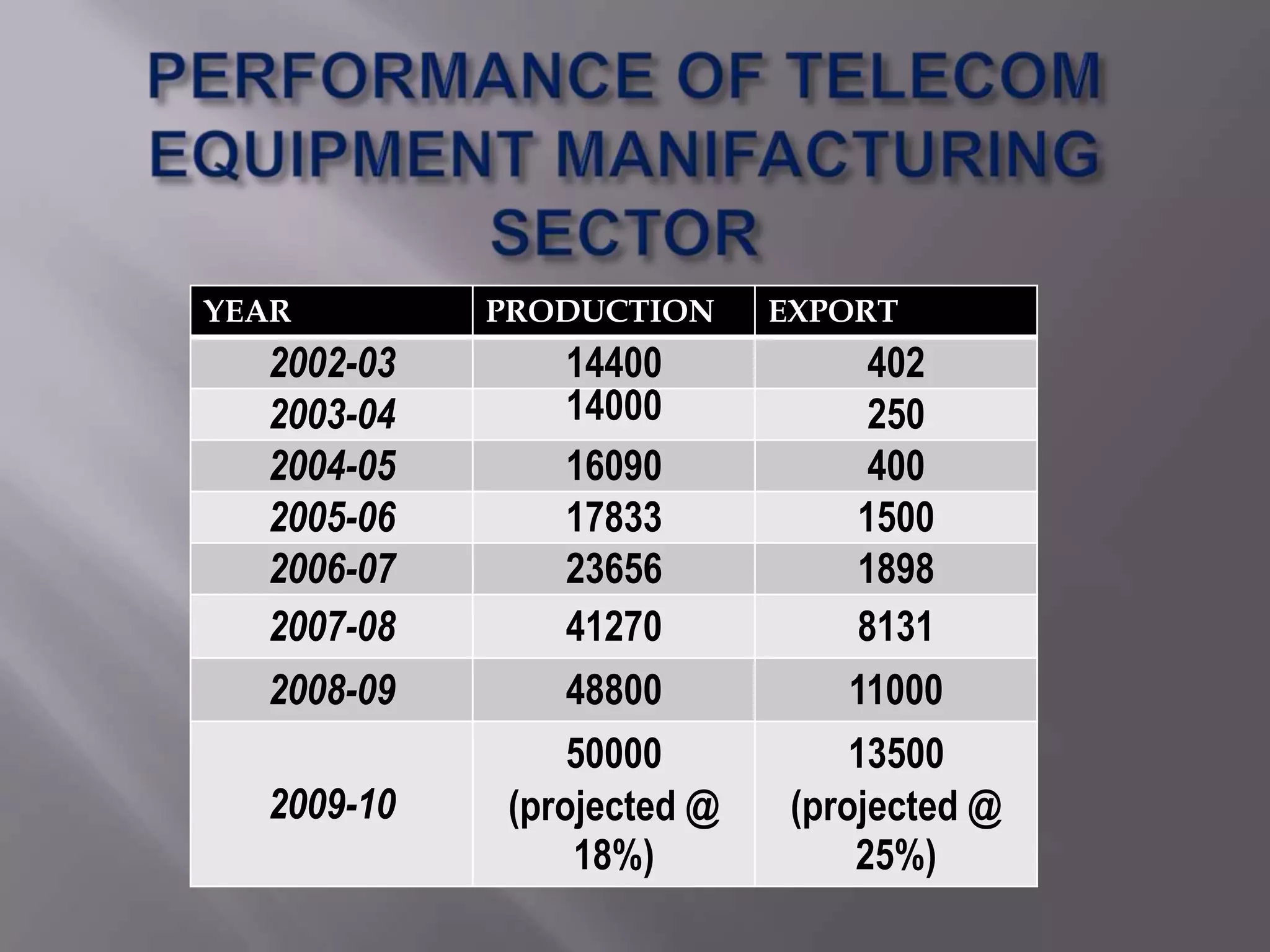
Historical production and export figures in telecom; India ranks 3rd globally in network size with a strong investment track record.
Indian telecom is the fastest growing sector, driven by liberal policies; demand for telecom services in rural areas recognized as a key growth area.
Conclusion summarizing the rapid growth of the Indian telecom sector.
Indian telecom industry is growing at a great
pace & India is expected to become a
manufacturing hub for telecom equipment.
Indian telecom equipment manufacturing
sector is set to become one of the largest
sectors globally by 2010.
3.
Due to rising demand for a wide range of
telecom equipment, particularly in the area of
mobile telecommunications, has provided
excellent opportunities to domestic and foreign
investors in the manufacturing sector.
4.
Next we are going to see about the contents of
this title “Indian telecom policies “they are,
Opportunities
Regulatory policy
Incentives to invest
Projection in the current budget
5.
The Indian telecom market is expected to
grow three fold by 2012 & market size over US
$ 8 billion. Moreover the government has set a
target of 20 million broadband connections by
2010.
The National Telecom Policy 1999 targets
tele-density at 15 per cent by 2010. This will
entail an investment of US $ 40- 50 billion over
the next 6-8 years.
6.
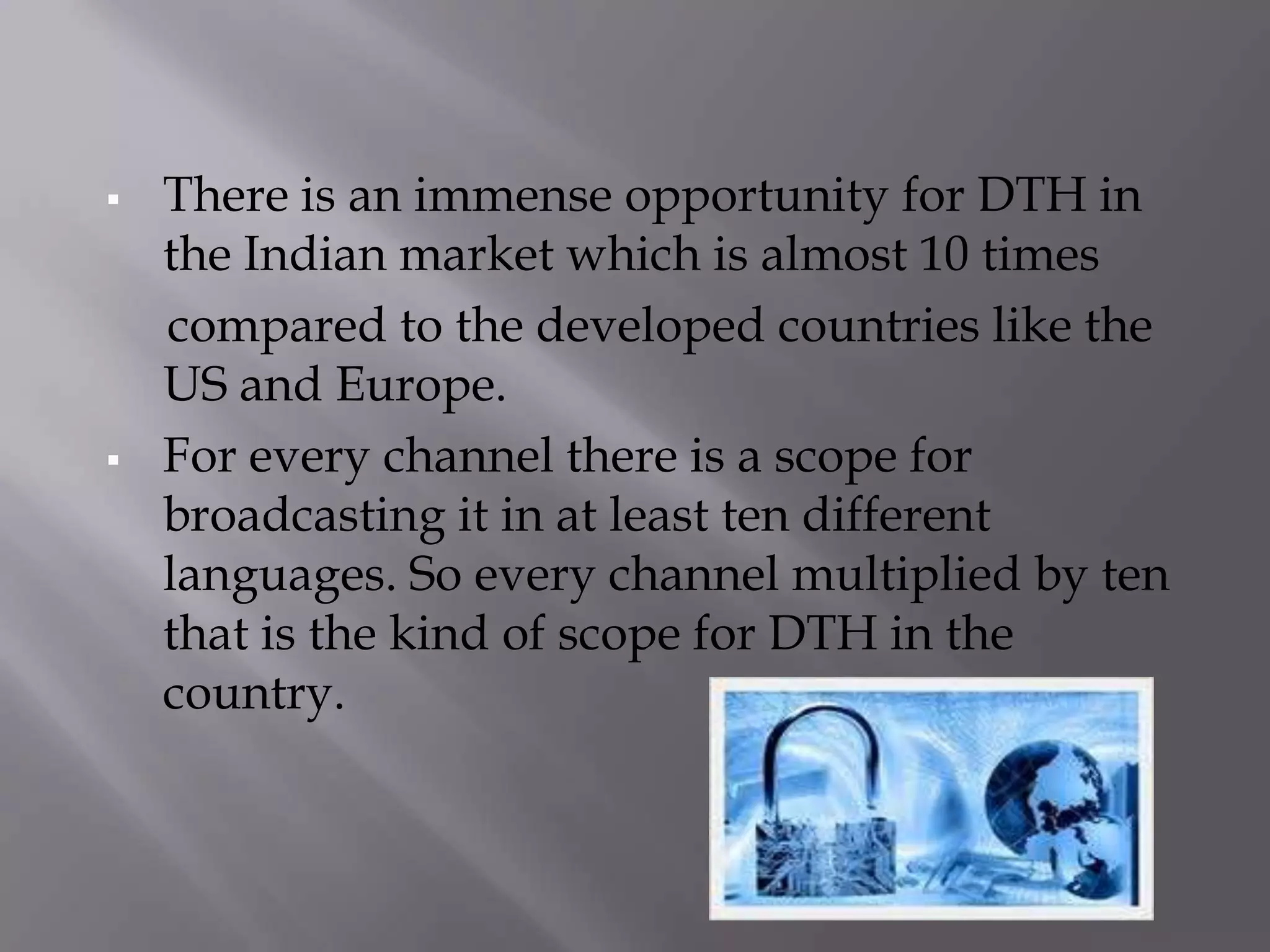
There is an immense opportunity for DTH in
the Indian market which is almost 10 times
compared to the developed countries like the
US and Europe.
For every channel there is a scope for
broadcasting it in at least ten different
languages. So every channel multiplied by ten
that is the kind of scope for DTH in the
country.
7.
India’s media players have all the ingredients
to develop a successful DTH industry. So
currently there is a lot of pent-up demand in
the Indian market for DTH.
It is expected that by the year 2010 there will be
over 500 million subscribers in the Indian
telecom market.
Cellular subscriber base is projected to grow at
a CAGR(Compounded Annual Growth Rate)
of 48 per cent & expected to reach 88 million in
2012.
8.
Over 150% growth in telecom services is
projected in 5 years. India will require large
investments in network infrastructure & India
expected to be fasted growing telecom market
in the world.
Since the project expected to reach 30-40% per
year 250 subscribers by 2009- 2010.Total
estimate of investment opportunity of USS 22
billion expected over the next five years.
9.
Investment opportunity of $22 billion across
many areas:
Telecom Devices and Software for Internet
Broadband and Direct To Home Services
Gateway exchange
Set top box
Modem
Mobile handsets and consumer premise
equipments
10.
Gaming devices
EPABX
Telecom Software
Telecom Services for voice and data via a
range of technologies.
With the rapid growth of the telecom
network, there are further opportunities to
expand the telecom infrastructure and research
and development.
11.
The Department of Telecommunications (DOT)
under the Ministry of Communications and
Information Technology is the concerned
authority for all matters relating to telecom.
The department is responsible for formulating
the developmental policies; granting licenses
for various telecom services;
promoting standardization, research and
development as well as private investment in
the sector.
12.
An independentregulatory body called as the
Telecom Regulatory Authority of India
(TRAI) was established in 1997, under the
Telecom Regulatory Authority of India Act,
1997
The Telecom Regulatory Authority of India
Act, 1997 was amended by the Telecom
Regulatory Authority of India (Amendment)
Act, 2000.
13.
By the Amendment Act, an Appellate
Tribunal known as the Telecom Disputes
Settlement and Appellate Tribunal(TDSAT) has
been set up to protect the interests of service
providers and consumers of the telecom sector.
74% to 100% FDI permitted for various
telecom services.
FIPB approval required for foreign investment
exceeding 49% in all telecom services.
14.
100% FDI permitted in telecom equipment
manufacturing on automatic approval basis.
Indian has a telecom policy viz. Telecom Policy
of 1994 aims to encourage private and foreign
investment.
Which has opened the doors of the sector for
private players and the process was given a
further boost by the telecom policy announced
in 1999 viz. NewTelecom Policy 1999.
15.
Other enactments which govern the telecom
sector are as follows: Indian Telegraph
Act, 1885
Indian Telegraph (Amendment) Rules, 2000
Indian Wireless Act, 1933
Cable Television Networks (Regulations)
Act,1995
Information Technology Act, 2000
Broadband Policy 2004
16.
Tax incentives under the current Budget
Customs duty on convergence products to be
reduced from 10% to 5%.
Exemption from excise duty for specified
inputs and raw materials for manufacture of
specified electronics/ IT hardware to lower the
network cost for telecom service providers.
17.
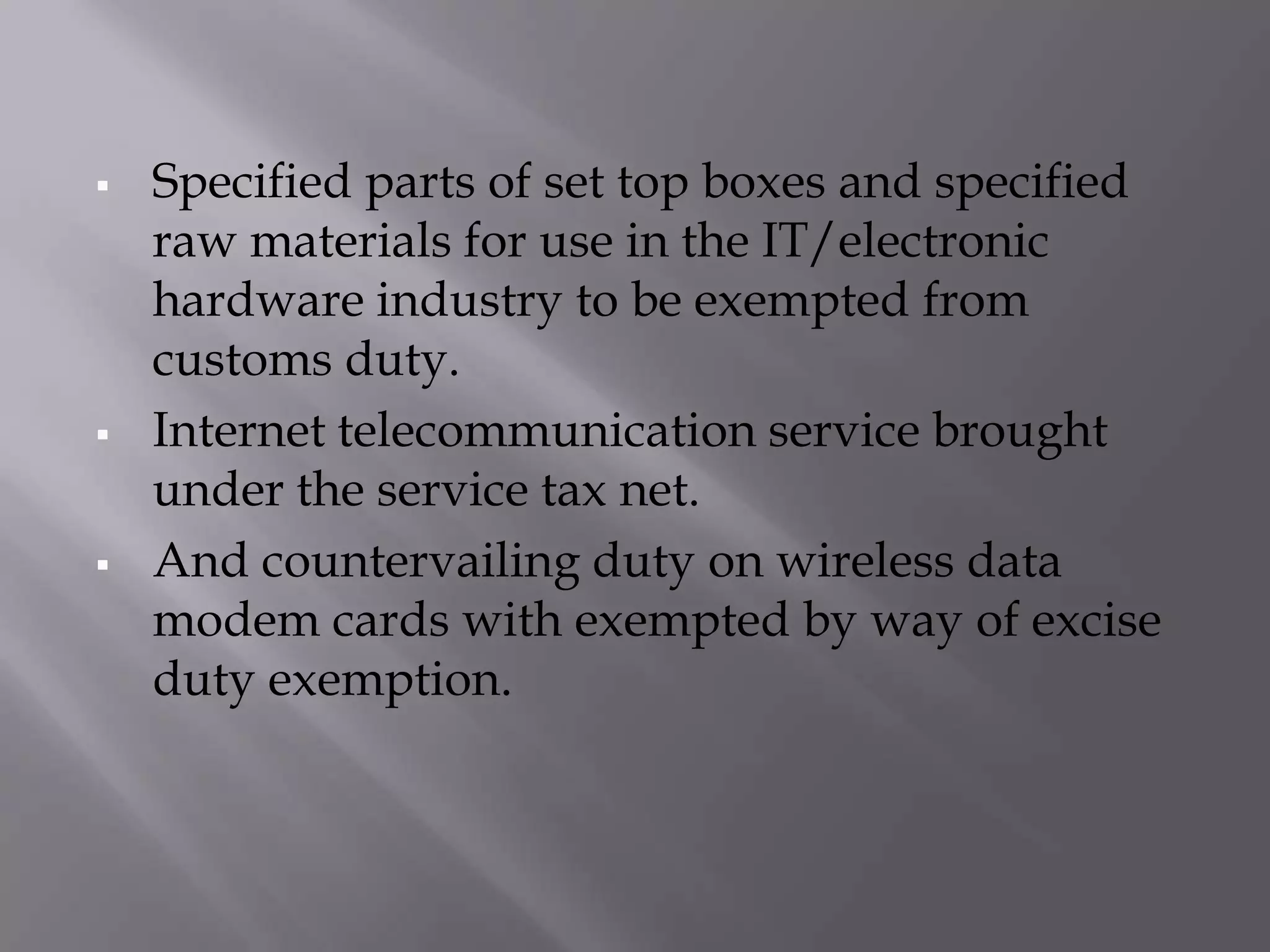
Specified parts of set top boxes and specified
raw materials for use in the IT/electronic
hardware industry to be exempted from
customs duty.
Internet telecommunication service brought
under the service tax net.
And countervailing duty on wireless data
modem cards with exempted by way of excise
duty exemption.
18.
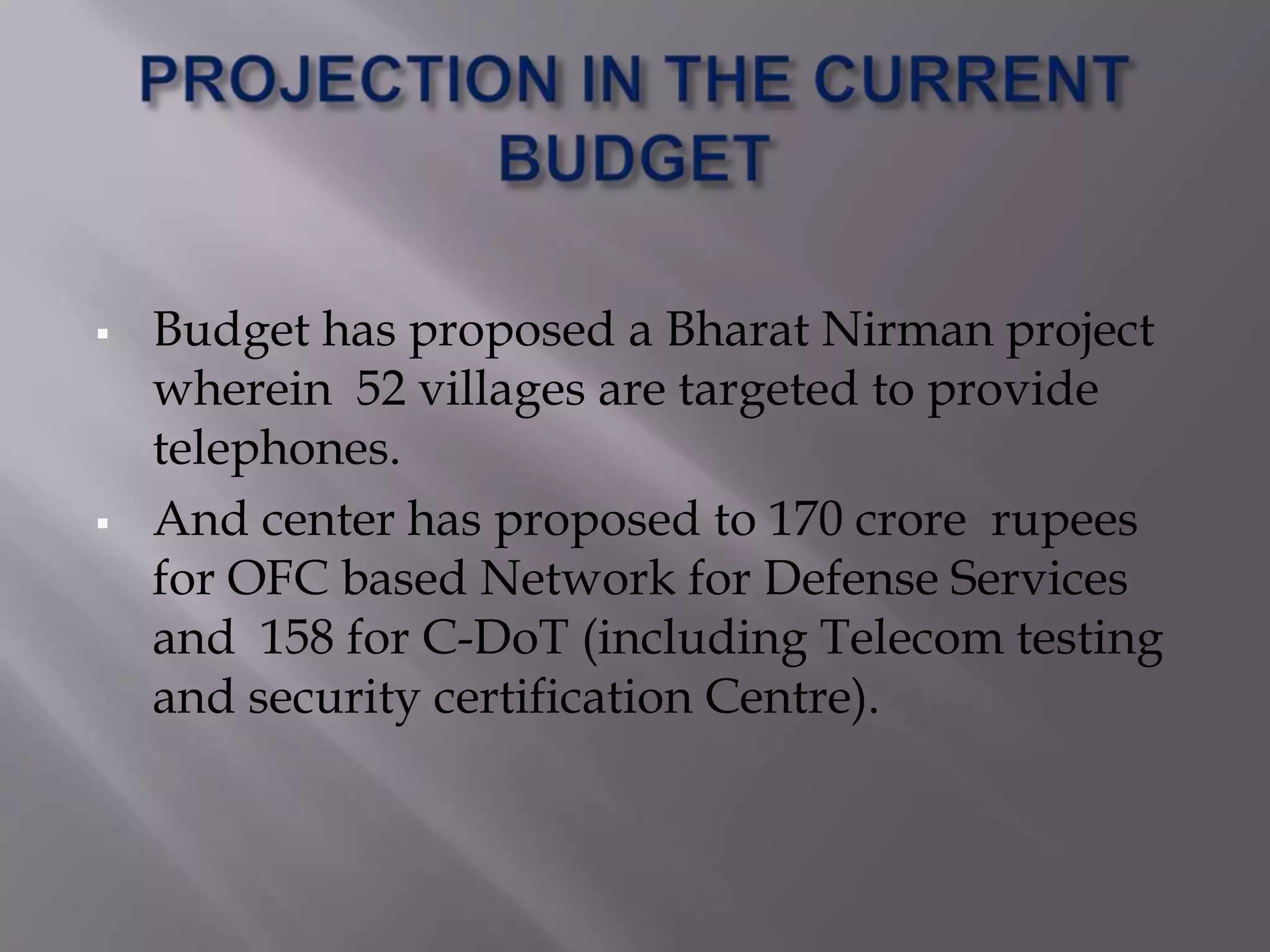
Budget has proposed a Bharat Nirman project
wherein 52 villages are targeted to provide
telephones.
And center has proposed to 170 crore rupees
for OFC based Network for Defense Services
and 158 for C-DoT (including Telecom testing
and security certification Centre).
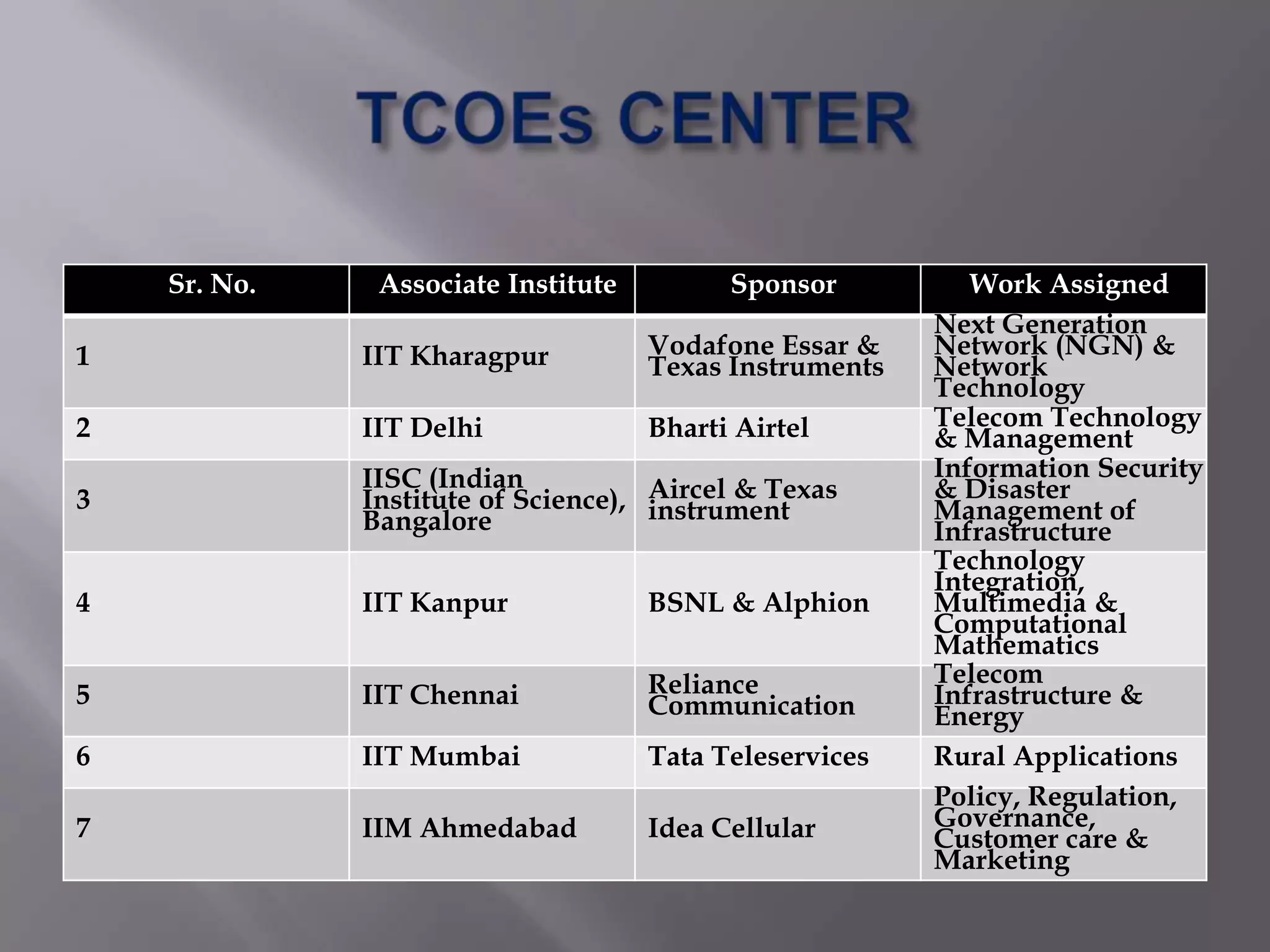
Sr. No. Associate Institute Sponsor Work Assigned
Next Generation
1 IIT Kharagpur Vodafone Essar & Network (NGN) &
Texas Instruments Network
Technology
2 IIT Delhi Bharti Airtel Telecom Technology
& Management
IISC (Indian Information Security
3 Institute of Science), Aircel & Texas
instrument
& Disaster
Management of
Bangalore Infrastructure
Technology
Integration,
4 IIT Kanpur BSNL & Alphion Multimedia &
Computational
Mathematics
Reliance Telecom
5 IIT Chennai Communication Infrastructure &
Energy
6 IIT Mumbai Tata Teleservices Rural Applications
Policy, Regulation,
7 IIM Ahmedabad Idea Cellular Governance,
Customer care &
Marketing
21.
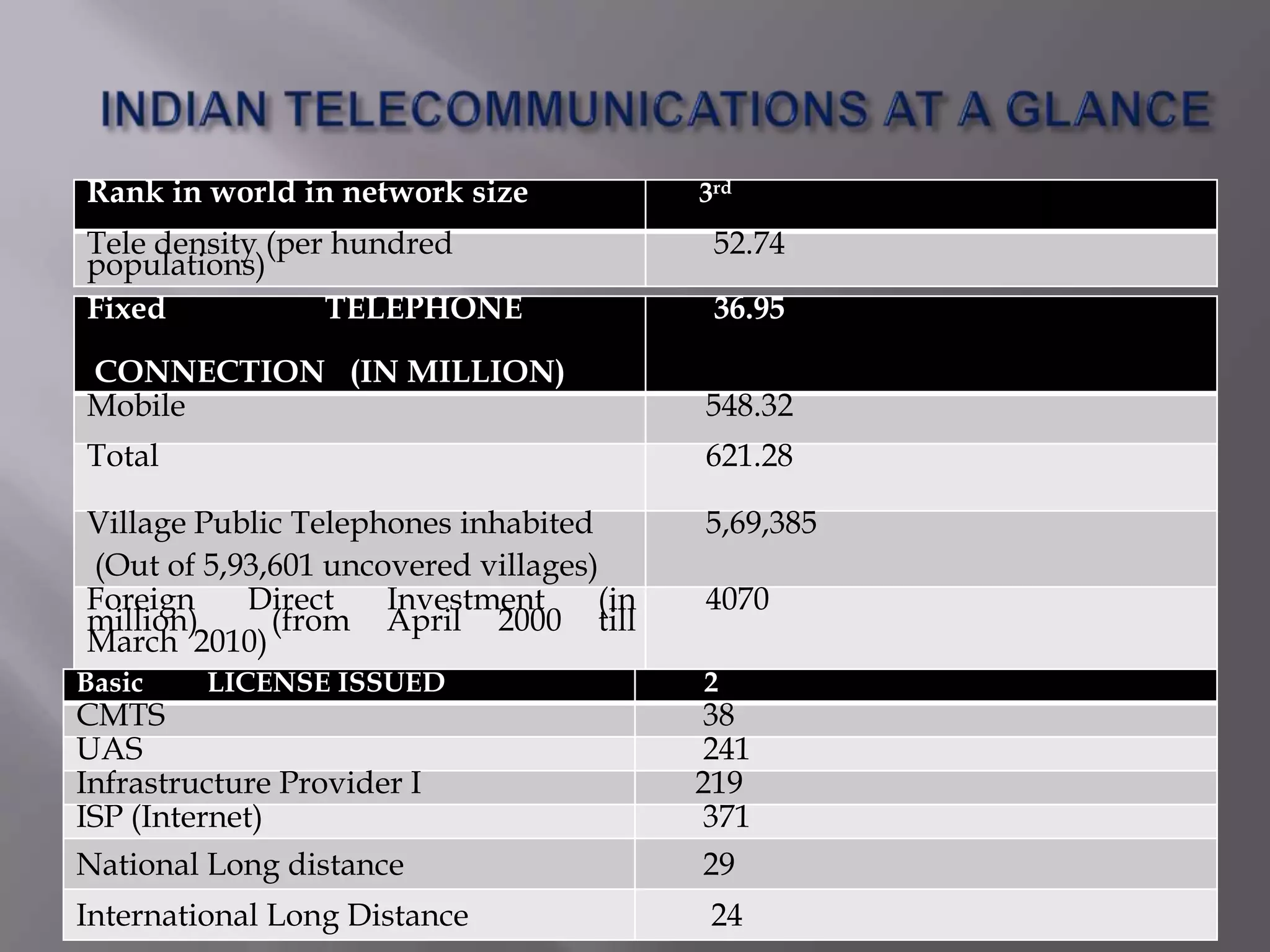
Rank in worldin network size 3rd
Tele density (per hundred 52.74
populations)
Fixed TELEPHONE 36.95
CONNECTION (IN MILLION)
Mobile 548.32
Total 621.28
Village Public Telephones inhabited 5,69,385
(Out of 5,93,601 uncovered villages)
Foreign Direct Investment (in 4070
million) (from April 2000 till
March 2010)
Basic LICENSE ISSUED 2
CMTS 38
UAS 241
Infrastructure Provider I 219
ISP (Internet) 371
National Long distance 29
International Long Distance 24
22.
Indian telecom is world’s fastest growing
telecom expected grow three fold by
2012.Tremendous strides in this industry have
been facilitated by the supportive and liberal
policies of the Government.
Especially the Telecom Policy of 1994 which
opened the doors of the sector for private
players.
23.
Rising demand for a wide range of telecom
equipment has provided excellent
opportunities for investors in the
manufacturing sector.
Provision of telecom services to the rural areas
in India has been recognized as another thrust
area by govt. which also helps for the
enormous opportunities in this sector.
24.
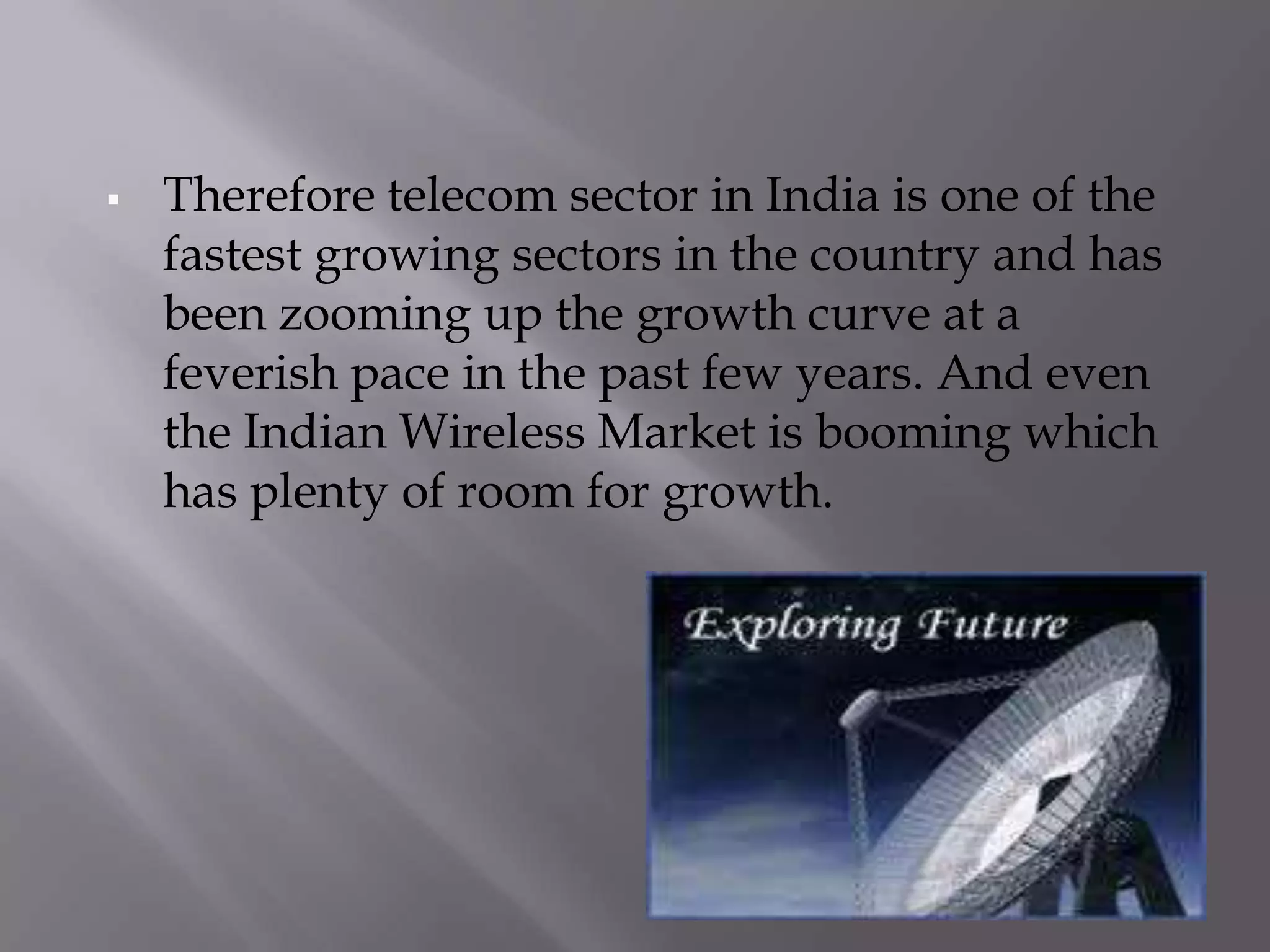
Therefore telecom sector in India is one of the
fastest growing sectors in the country and has
been zooming up the growth curve at a
feverish pace in the past few years. And even
the Indian Wireless Market is booming which
has plenty of room for growth.