The 7 C’s of Knowledge Leadership:
Innovating our Future
Artur Gonçalves
Sepideh Haeri
2


New economic world order
•  Mainly based on the flow of intellectual not
   financial, capital.
•  Profound changes everywhere in the way human
   talents are managed.
•  The effective leadership is not having the most
   knowledge, it is to know how to use it.
3


Innovation: the key to survival
•  Real value is created when connections are made
   among seemingly isolated elements
   (Innovation).
•  Innovation need several sub components, all of
   which rely greatly on proper knowledge
   leadership.
4


Seven domains to (re) consider for the
implication of knowledge management
•  (C1) – Context
•  (C2) – Competency
•  (C3) – Culture
•  (C4) – Communities
•  (C5) – Common Language
•  (C6) – Communications
•  (C7) - Coaching
5


Knowledge Leadership is a matter of CONTEXT
(Financial capital and Human capital orientations)


•  Both orientations are necessary to ensure
   optimal flexibility, adaptability and agility
•  However, new world economic order pushes
   towards going Human Capital orientation more
   and more.
•  Why? Tremendous speed of change in multiple
   interdependent variables that brings high levels
   of uncertainty.
6


Knowledge Leadership is a matter of CONTEXT Characteristics of
Financial Capital Orientation   (Traditional/Industrial)
•  Performance measures are static and financial, $$$ are
   the main asset.

•  Structure/culture is Competitive, based on market share
   and there is a distrust of boarders

•  Leadership concerns: Costs/expenses, profitability

•  Processes: Independent (isolated islands), Cause/effect
•  Technology : Information processing, data/information,
   things/warehouse
7


Knowledge Leadership is a matter of CONTEXT Characteristics of
Human Capital Orientation
(Knowledge, Innovation)

•  Performance measures are dynamic and comprehensive
   (measuring intangibles). Relationships are main assets.
•  Structure/culture is collaborating, value-adding and
   based on sets of alliances.
•  Leadership concerns: Revenue/Investment , Sustained
   Growth. (more insight into future)
•  Processes: Inter-dependent , value system
•  Technology : Knowledge processing, tacit/explicit
   knowledge, Flow/Process
8


Knowledge Leadership is a matter of CONTEXT
What today’s leaders must do?
•  Lead by example
•  Inspire passion for the work
•  Walk and talk
•  Ensure that teams are well prepared for decision making
   under fast changing, information flooding conditions of
   today’s world.
•  Help others stay focused and balanced as they establish
   priorities.
•  Convey context and meaning in ways that enable others
   to leverage their own talents.
9


Knowledge Leadership is a matter of
COMPETENCY
•  Innovation is believed to be the one competency needed
   to manage into the future.
•  It is the key to survival of any being that is going to be
   sustainable.
•  BUT ….

•  There are many Sub-Components
•  In fact innovation is a compound of several different
   competences. The individual competencies are %70
   generic and %30 field or industry or case dependent.
10


Knowledge Leadership is a matter of
COMPETENCY (2)
•  Competency Map:
    is an assessment tool that outlines the skills and
   behavior required to successfully undertake a
   position or role.
•  Banff Centre for management has conducted a
   research on the subject.
11


Knowledge Leadership is a matter of
COMPETENCY (3)
•  The research identified 35 competences organized in the
   following categories:
  ▫    Direction setting
  ▫    Change Leadership
  ▫    Critical Thinking
  ▫    Organizational development and diversity
  ▫    Personal/Organizational Balance
  ▫    Quality
  ▫    Knowledge and Innovation
•  Each indicates four levels of apptitude.
12


Knowledge Leadership is a matter of          COMPETENCY (4)
Leadership Training
•  It is almost impossible to be taught LEADERSHIP.
•  In fact it can be done in a 5 step LEARNING process:
  ▫  Step 1: Competency Profiling of the learner.
  ▫  Step 2: The Learning Contract (customized plan for
     individual).
  ▫  Step 3: The Learning Process (hands-on, interactive,
     feedback, re-focus, real environment and applications, knowledge
     circle).
  ▫  Step 4: Re-entry Planning (it is not as simple as teaching -
     takes a lot of listening exercise, identifying language, motivation
     and talents in others ready to be nurtured) .
  ▫  Step 5: Measurement of Impact : Successful
     DEMONSTRATION of the desired skills and learning
     competencies is ESSENTIAL.
13


Knowledge Leadership is a matter of
CULTURE
•  Corporate culture is very important.

•  Over the long term, culture does more to
   influence the impact of corporate leadership
   than any other factor.

•  Innovation is defined as the number-one
   advantage of the knowledge program, the main
   obstacle however is the development of
   knowledge sharing culture!
14


Knowledge Leadership is a matter of
CULTURE(2)
•     Two greatest obstacles to successful knowledge
      Leadership :
     1.  Lack of trust
     2.  Inadequate communications

     Specifically regarding values, mission and critical
        success factors.

     These 2 elements combined with lack of vision
        seem to be the root of management duress.
15


Knowledge Leadership is a matter of CULTURE(3)

•     Creating and sustaining a culture where knowledge is
      valued is one of the most difficult challenges in
      practice.
•     Appropriate culture are those that:
1.    Engender change, innovation, openness and trust
2.    People are recognized and rewarded for their
      knowledge contribution
3.    Flexible, networked organizational structures, multiple
      teams and a climate of intensive and purposeful
      networking.
4.    ….
16


Communities
•  Various disciplines started converging in responsibility
   and practice.
  ▫  Integrating core principles from the domains of others.
  ▫  Convergence of functional perspectives and common
     agendas are emerging.
  ▫  Growth of circles and networked organizations ( harness
     creativity and promote cross-fertilization).

•  (…)The need to know what each other knows ( Brown
   and Gray, 1995).
  ▫  Provides insights into how the entire operation may
     effectively led.
  ▫  Leaders, will not operate only based on competition.
  ▫  Collaborate and contribute to the success of one another.
17


Conversation and Common Language
 •  Innovation Language
    ▫  Language that does not focus on a particular function.
    ▫  Encompass industries, sectors , regions….universal scope

 •  Knowledge language with a glossary of terms ( Skandia and Ericsson in Sweden )
    ▫  On-line capability to add terms( more that 400)
          –  Appling heritage, purpose, mission and strategy of the enterprise
    ▫  Spheres of influence ( Once connections are made among internal and external constituents)
    ▫  Structured conversation and dialog
    ▫  Flow of meaning

–  Quality and level of conversations
    –     Network of conversations ( Ray Stata, Chairman of Analog Devices of Nortwood
           Massachusetts)
                 ▫  Common Language and shared vision

    ▫  Encourage
             –  Employers to become a community of inquirer’s not advocates,
             –  Managers to understand the knowledge, skills experiences of one another
18


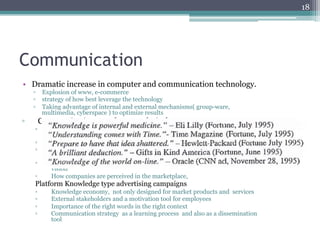
Communication
•  Dramatic increase in computer and communication technology.
     ▫  Explosion of www, e-commerce
     ▫  strategy of how best leverage the technology
     ▫  Taking advantage of internal and external mechanisms( group-ware,
        multimedia, cyberspace ) to optimize results
▫     Communication not always technical
     ▫     Apprise organization and stakeholder of priorities, changes in direction,
           success stories
     ▫     Simple but not simplistic communications
     ▫     Integrate plans with human capital ( knowledge of all stakeholders in the
           innovation process.)
     ▫     External messages must be consistent with internal culture, values and
           vision
     ▫     How companies are perceived in the marketplace,
     Platform Knowledge type advertising campaigns
     ▫     Knowledge economy, not only designed for market products and services
     ▫     External stakeholders and a motivation tool for employees
     ▫     Importance of the right words in the right context
     ▫     Communication strategy as a learning process and also as a dissemination
           tool
19


Coaching
•  Tow parties – Both responsible.
   ▫  Forward looking, change oriented, and developmental
   ▫  Enable client success, productivity, growth, stakeholder value

   ▫  More about ‘Being’ than ‘doing’
       –  Involves trust, support and shared values.

•  The coaching relationship enables people to work out issues and find answers through their
   own effective discovery process.

•  Successful leaders values others and have a need to ‘know what the other know’.

•  Ability to coach and be coached.
   ▫  Value of Mutual talent

•  Important to have others – motivate their own innovation process.
   ▫  Personal coaching success fact!
20


Measure Leadership
•  Principles have been around for decades
  –    Few organizations have implemented them
  –    Fewer have discovered a systematic way to measure the results

  –    In recent times, with the significant research being done, institutes began to
        comprehend,
             “the power of the intangible value of the enterprise.”
•  Measure what we can measure
  ▫  “ I’d rather be roughly right than precisely wrong!” (Leif Edvisson, Chief
     Knowledge Officer )

   ▫      Major research project
                     The intangibles agenda, as a priority!
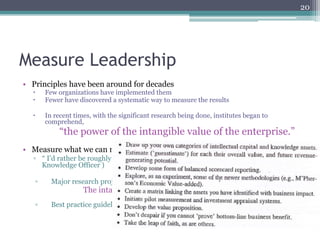
   ▫      Best practice guidelines( Skyrme and Amidon, 1999):
21


Measure Leadership
•  Large gap between management expectation and
   actual achievement of results
    –  Most important but the least understood

•  Traditional accounting mechanisms did not provide
   reliable ways in measuring the intangibles.

•  Investing executives
  ▫  Effective in understanding the past and present
  ▫  Not very effective in predicting the future directions
     that companies should take
22


A Knowledge Leadership Litmus Test
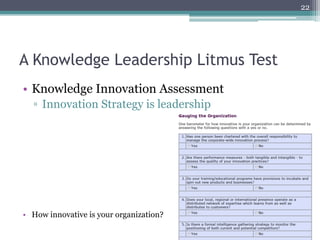
•  Knowledge Innovation Assessment
  ▫  Innovation Strategy is leadership


•  How innovative is your organization?
23


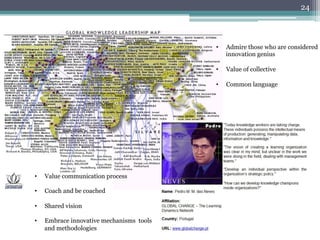
Global Knowledge Leadership map

•  ENTOVATION network invited to participate in
   the Global Knowledge Leadership Map.

•  Variety of disciplines, a wide range of functional
   responsibilities and representing 50 nations.

•  They are all playing a role in shaping our new
   economy.
24


                                           •    Admire those who are considered
                                                innovation genius

                                           •    Value of collective

                                           •    Common language


•    Value communication process

•    Coach and be coached

•    Shared vision

•    Embrace innovative mechanisms tools
     and methodologies

Group5 ppt

  • 1.
    The 7 C’sof Knowledge Leadership: Innovating our Future Artur Gonçalves Sepideh Haeri
  • 2.
    2 New economic worldorder •  Mainly based on the flow of intellectual not financial, capital. •  Profound changes everywhere in the way human talents are managed. •  The effective leadership is not having the most knowledge, it is to know how to use it.
  • 3.
    3 Innovation: the keyto survival •  Real value is created when connections are made among seemingly isolated elements (Innovation). •  Innovation need several sub components, all of which rely greatly on proper knowledge leadership.
  • 4.
    4 Seven domains to(re) consider for the implication of knowledge management •  (C1) – Context •  (C2) – Competency •  (C3) – Culture •  (C4) – Communities •  (C5) – Common Language •  (C6) – Communications •  (C7) - Coaching
  • 5.
    5 Knowledge Leadership isa matter of CONTEXT (Financial capital and Human capital orientations) •  Both orientations are necessary to ensure optimal flexibility, adaptability and agility •  However, new world economic order pushes towards going Human Capital orientation more and more. •  Why? Tremendous speed of change in multiple interdependent variables that brings high levels of uncertainty.
  • 6.
    6 Knowledge Leadership isa matter of CONTEXT Characteristics of Financial Capital Orientation (Traditional/Industrial) •  Performance measures are static and financial, $$$ are the main asset. •  Structure/culture is Competitive, based on market share and there is a distrust of boarders •  Leadership concerns: Costs/expenses, profitability •  Processes: Independent (isolated islands), Cause/effect •  Technology : Information processing, data/information, things/warehouse
  • 7.
    7 Knowledge Leadership isa matter of CONTEXT Characteristics of Human Capital Orientation (Knowledge, Innovation) •  Performance measures are dynamic and comprehensive (measuring intangibles). Relationships are main assets. •  Structure/culture is collaborating, value-adding and based on sets of alliances. •  Leadership concerns: Revenue/Investment , Sustained Growth. (more insight into future) •  Processes: Inter-dependent , value system •  Technology : Knowledge processing, tacit/explicit knowledge, Flow/Process
  • 8.
    8 Knowledge Leadership isa matter of CONTEXT What today’s leaders must do? •  Lead by example •  Inspire passion for the work •  Walk and talk •  Ensure that teams are well prepared for decision making under fast changing, information flooding conditions of today’s world. •  Help others stay focused and balanced as they establish priorities. •  Convey context and meaning in ways that enable others to leverage their own talents.
  • 9.
    9 Knowledge Leadership isa matter of COMPETENCY •  Innovation is believed to be the one competency needed to manage into the future. •  It is the key to survival of any being that is going to be sustainable. •  BUT …. •  There are many Sub-Components •  In fact innovation is a compound of several different competences. The individual competencies are %70 generic and %30 field or industry or case dependent.
  • 10.
    10 Knowledge Leadership isa matter of COMPETENCY (2) •  Competency Map: is an assessment tool that outlines the skills and behavior required to successfully undertake a position or role. •  Banff Centre for management has conducted a research on the subject.
  • 11.
    11 Knowledge Leadership isa matter of COMPETENCY (3) •  The research identified 35 competences organized in the following categories: ▫  Direction setting ▫  Change Leadership ▫  Critical Thinking ▫  Organizational development and diversity ▫  Personal/Organizational Balance ▫  Quality ▫  Knowledge and Innovation •  Each indicates four levels of apptitude.
  • 12.
    12 Knowledge Leadership isa matter of COMPETENCY (4) Leadership Training •  It is almost impossible to be taught LEADERSHIP. •  In fact it can be done in a 5 step LEARNING process: ▫  Step 1: Competency Profiling of the learner. ▫  Step 2: The Learning Contract (customized plan for individual). ▫  Step 3: The Learning Process (hands-on, interactive, feedback, re-focus, real environment and applications, knowledge circle). ▫  Step 4: Re-entry Planning (it is not as simple as teaching - takes a lot of listening exercise, identifying language, motivation and talents in others ready to be nurtured) . ▫  Step 5: Measurement of Impact : Successful DEMONSTRATION of the desired skills and learning competencies is ESSENTIAL.
  • 13.
    13 Knowledge Leadership isa matter of CULTURE •  Corporate culture is very important. •  Over the long term, culture does more to influence the impact of corporate leadership than any other factor. •  Innovation is defined as the number-one advantage of the knowledge program, the main obstacle however is the development of knowledge sharing culture!
  • 14.
    14 Knowledge Leadership isa matter of CULTURE(2) •  Two greatest obstacles to successful knowledge Leadership : 1.  Lack of trust 2.  Inadequate communications Specifically regarding values, mission and critical success factors. These 2 elements combined with lack of vision seem to be the root of management duress.
  • 15.
    15 Knowledge Leadership isa matter of CULTURE(3) •  Creating and sustaining a culture where knowledge is valued is one of the most difficult challenges in practice. •  Appropriate culture are those that: 1.  Engender change, innovation, openness and trust 2.  People are recognized and rewarded for their knowledge contribution 3.  Flexible, networked organizational structures, multiple teams and a climate of intensive and purposeful networking. 4.  ….
  • 16.
    16 Communities •  Various disciplinesstarted converging in responsibility and practice. ▫  Integrating core principles from the domains of others. ▫  Convergence of functional perspectives and common agendas are emerging. ▫  Growth of circles and networked organizations ( harness creativity and promote cross-fertilization). •  (…)The need to know what each other knows ( Brown and Gray, 1995). ▫  Provides insights into how the entire operation may effectively led. ▫  Leaders, will not operate only based on competition. ▫  Collaborate and contribute to the success of one another.
  • 17.
    17 Conversation and CommonLanguage •  Innovation Language ▫  Language that does not focus on a particular function. ▫  Encompass industries, sectors , regions….universal scope •  Knowledge language with a glossary of terms ( Skandia and Ericsson in Sweden ) ▫  On-line capability to add terms( more that 400) –  Appling heritage, purpose, mission and strategy of the enterprise ▫  Spheres of influence ( Once connections are made among internal and external constituents) ▫  Structured conversation and dialog ▫  Flow of meaning –  Quality and level of conversations –  Network of conversations ( Ray Stata, Chairman of Analog Devices of Nortwood Massachusetts) ▫  Common Language and shared vision ▫  Encourage –  Employers to become a community of inquirer’s not advocates, –  Managers to understand the knowledge, skills experiences of one another
  • 18.
    18 Communication •  Dramatic increasein computer and communication technology. ▫  Explosion of www, e-commerce ▫  strategy of how best leverage the technology ▫  Taking advantage of internal and external mechanisms( group-ware, multimedia, cyberspace ) to optimize results ▫  Communication not always technical ▫  Apprise organization and stakeholder of priorities, changes in direction, success stories ▫  Simple but not simplistic communications ▫  Integrate plans with human capital ( knowledge of all stakeholders in the innovation process.) ▫  External messages must be consistent with internal culture, values and vision ▫  How companies are perceived in the marketplace, Platform Knowledge type advertising campaigns ▫  Knowledge economy, not only designed for market products and services ▫  External stakeholders and a motivation tool for employees ▫  Importance of the right words in the right context ▫  Communication strategy as a learning process and also as a dissemination tool
  • 19.
    19 Coaching •  Tow parties– Both responsible. ▫  Forward looking, change oriented, and developmental ▫  Enable client success, productivity, growth, stakeholder value ▫  More about ‘Being’ than ‘doing’ –  Involves trust, support and shared values. •  The coaching relationship enables people to work out issues and find answers through their own effective discovery process. •  Successful leaders values others and have a need to ‘know what the other know’. •  Ability to coach and be coached. ▫  Value of Mutual talent •  Important to have others – motivate their own innovation process. ▫  Personal coaching success fact!
  • 20.
    20 Measure Leadership •  Principleshave been around for decades –  Few organizations have implemented them –  Fewer have discovered a systematic way to measure the results –  In recent times, with the significant research being done, institutes began to comprehend, “the power of the intangible value of the enterprise.” •  Measure what we can measure ▫  “ I’d rather be roughly right than precisely wrong!” (Leif Edvisson, Chief Knowledge Officer ) ▫  Major research project The intangibles agenda, as a priority! ▫  Best practice guidelines( Skyrme and Amidon, 1999):
  • 21.
    21 Measure Leadership •  Largegap between management expectation and actual achievement of results –  Most important but the least understood •  Traditional accounting mechanisms did not provide reliable ways in measuring the intangibles. •  Investing executives ▫  Effective in understanding the past and present ▫  Not very effective in predicting the future directions that companies should take
  • 22.
    22 A Knowledge LeadershipLitmus Test •  Knowledge Innovation Assessment ▫  Innovation Strategy is leadership •  How innovative is your organization?
  • 23.
    23 Global Knowledge Leadershipmap •  ENTOVATION network invited to participate in the Global Knowledge Leadership Map. •  Variety of disciplines, a wide range of functional responsibilities and representing 50 nations. •  They are all playing a role in shaping our new economy.
  • 24.
    24 •  Admire those who are considered innovation genius •  Value of collective •  Common language •  Value communication process •  Coach and be coached •  Shared vision •  Embrace innovative mechanisms tools and methodologies