WE CANNOT AFFORD NOT
SHARING OUR KNOWLEDGE
      AULIA BRAMANDITA
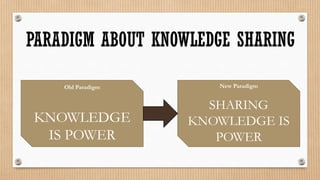
PARADIGM ABOUT KNOWLEDGE SHARING

    Old Paradigm       New Paradigm


                     SHARING
KNOWLEDGE          KNOWLEDGE IS
 IS POWER             POWER
IMPORTANCE OF
KNOWLEDGE SHARING
 Fact that it is essential to
  convince the corporate
culture that everyone could
 benefit from knowledge
          sharing
THE NEED OF KNOWLEDGE MANAGEMENT
• “Knowledge has become the key resource, for a nation’s military
  strength as well as for its economic strength… is fundamentally
  different from the traditional key resources of the economist – land,
  labor, and even capital…we need systematic work on the quality of
  knowledge and the productivity of knowledge… the performance
  capacity, if not the survival, of any organization in the knowledge
  society will come increasingly to depend on those two factors”
  [Drucker,1994]
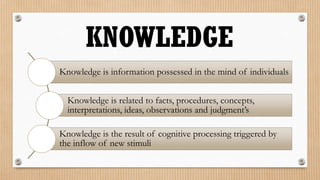
KNOWLEDGE
Knowledge is information possessed in the mind of individuals


  Knowledge is related to facts, procedures, concepts,
  interpretations, ideas, observations and judgment’s

Knowledge is the result of cognitive processing triggered by
the inflow of new stimuli
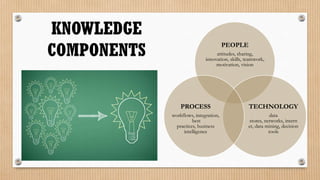
KNOWLEDGE
COMPONENTS                             PEOPLE
                                  attitudes, sharing,
                             innovation, skills, teamwork,
                                  motivation, vision


                 PROCESS                          TECHNOLOGY
             workflows, integration,                         data
                       best                       stores, networks, intern
               practices, business                et, data mining, decision
                  intelligence                              tools
• Intangible products - ideas, processes, information are taking a growing
  share of global trade
• Increasingly the only sustainable competitive advantage is continuous
  innovation (application of new knowledge)


• "Our problem as an organization is that we don't know what we know".
  Expertise learnt and applied in one part of the organization is not
  leveraged in another.
• Increasing turnover of staff. When someone leaves an organization
  their knowledge walks out of the door with them.
• The amount of time spent to experience and acquire
  knowledge has reduced sharply
• Strategic changing direction may lead to loss of knowledge


• Accelerating change - technology, business and social. As
  things change so does our knowledge base
• Reductions in human resources will create a need to replace
  informal knowledge with formal methods
WHY KNOWLEDGE SHARING ARE REQUIRED
 The amount of information and knowledge is growing vastly, due to the
 today’s growth of ICT.


 A necessary consequence of the increasing pool of knowledge is increased
  specialization. No one can keep with all new developments within this
 broad range of required competencies. Then, specialization is required.


 Consequence of the explosion of knowledge is that education no
 longer should be regarded as a phase life, but rather as a life-long
 experience.
MOTIVATING KNOWLEDGE SHARING
• Knowledge is a perishable. It is becoming short-lived. If we do not make use of
  our knowledge then it will loses its value.
• Even with the low level of knowledge sharing – if we do not make our
  knowledge productive than someone else with that same knowledge will do.
• By sharing our knowledge, we will gain more then we will lose. Sharing
  knowledge is a synergistic process – we get more out than we give in.
• To get most things done in an organization today requires a collaborative effort.
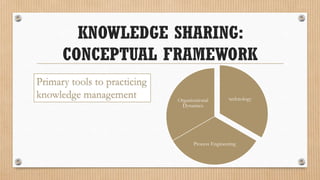
KNOWLEDGE SHARING:
      CONCEPTUAL FRAMEWORK
Primary tools to practicing
knowledge management          Organizational        technology
                               Dynamics


                                     Process Engineering
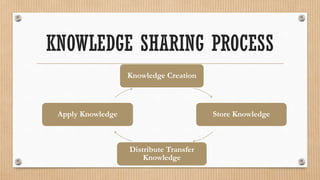
KNOWLEDGE SHARING PROCESS
                   Knowledge Creation


 Apply Knowledge                         Store Knowledge


                   Distribute Transfer
                       Knowledge
THE ROLE OF TECHNOLOGY (1/2)
• Some people believe that we do not need technology to implement Knowledge
  Management. For some level, they might be right - Knowledge Management is
  basically about people. Yet, there is no way that we can share knowledge
  effectively within an organization without technology.
• Technology plays an important role and crucial part of changing the corporate
  culture to knowledge sharing. In lot ways, it is technology that made knowledge
  sharing take place.
• If well implemented and if people are trained and educated about its
  use, knowledge sharing technology is definitely useful.
THE ROLE OF TECHNOLOGY (2/2)
• Accommodates knowledge sharing process and
 communication
• Allows sharing the knowledge to multiple persons
 simultaneously
• Offers a variety of services to the sharing process
• Integrates organization systems and networks
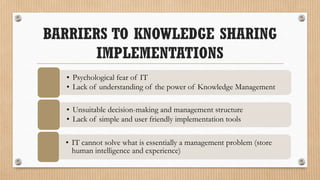
BARRIERS TO KNOWLEDGE SHARING
       IMPLEMENTATIONS
  • Psychological fear of IT
  • Lack of understanding of the power of Knowledge Management

  • Unsuitable decision-making and management structure
  • Lack of simple and user friendly implementation tools

  • IT cannot solve what is essentially a management problem (store
    human intelligence and experience)
ISSUES ON KNOWLEDGE SHARING
• “Effective KM is not about making a choice between
 “software vs. wetware, classroom vs. hands-on, formal vs.
 informal, technical vs. social…uses all the options available
 to motivated employees to put knowledge to work …[and]
 depends on recognizing that all of these options basically
 need each other” [Stewart, 2002].
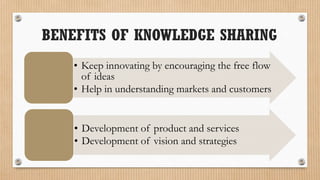
BENEFITS OF KNOWLEDGE SHARING
   • Keep innovating by encouraging the free flow
     of ideas
   • Help in understanding markets and customers


   • Development of product and services
   • Development of vision and strategies
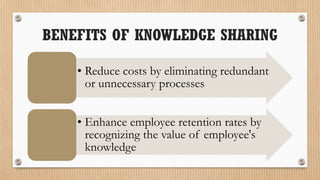
BENEFITS OF KNOWLEDGE SHARING

    • Reduce costs by eliminating redundant
      or unnecessary processes


    • Enhance employee retention rates by
      recognizing the value of employee's
      knowledge
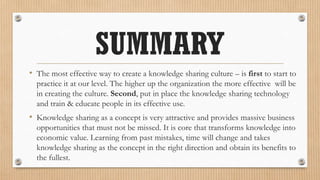
SUMMARY
• The most effective way to create a knowledge sharing culture – is first to start to
  practice it at our level. The higher up the organization the more effective will be
  in creating the culture. Second, put in place the knowledge sharing technology
  and train & educate people in its effective use.
• Knowledge sharing as a concept is very attractive and provides massive business
  opportunities that must not be missed. It is core that transforms knowledge into
  economic value. Learning from past mistakes, time will change and takes
  knowledge sharing as the concept in the right direction and obtain its benefits to
  the fullest.
“ An investment in knowledge
     pays the best interest                  ”
                         Benjamin Franklin


           THANK YOU !

We cannot afford not sharing our knowledge

  • 1.
    WE CANNOT AFFORDNOT SHARING OUR KNOWLEDGE AULIA BRAMANDITA
  • 2.
    PARADIGM ABOUT KNOWLEDGESHARING Old Paradigm New Paradigm SHARING KNOWLEDGE KNOWLEDGE IS IS POWER POWER
  • 3.
    IMPORTANCE OF KNOWLEDGE SHARING Fact that it is essential to convince the corporate culture that everyone could benefit from knowledge sharing
  • 4.
    THE NEED OFKNOWLEDGE MANAGEMENT • “Knowledge has become the key resource, for a nation’s military strength as well as for its economic strength… is fundamentally different from the traditional key resources of the economist – land, labor, and even capital…we need systematic work on the quality of knowledge and the productivity of knowledge… the performance capacity, if not the survival, of any organization in the knowledge society will come increasingly to depend on those two factors” [Drucker,1994]
  • 5.
    KNOWLEDGE Knowledge is informationpossessed in the mind of individuals Knowledge is related to facts, procedures, concepts, interpretations, ideas, observations and judgment’s Knowledge is the result of cognitive processing triggered by the inflow of new stimuli
  • 6.
    KNOWLEDGE COMPONENTS PEOPLE attitudes, sharing, innovation, skills, teamwork, motivation, vision PROCESS TECHNOLOGY workflows, integration, data best stores, networks, intern practices, business et, data mining, decision intelligence tools
  • 7.
    • Intangible products- ideas, processes, information are taking a growing share of global trade • Increasingly the only sustainable competitive advantage is continuous innovation (application of new knowledge) • "Our problem as an organization is that we don't know what we know". Expertise learnt and applied in one part of the organization is not leveraged in another. • Increasing turnover of staff. When someone leaves an organization their knowledge walks out of the door with them.
  • 8.
    • The amountof time spent to experience and acquire knowledge has reduced sharply • Strategic changing direction may lead to loss of knowledge • Accelerating change - technology, business and social. As things change so does our knowledge base • Reductions in human resources will create a need to replace informal knowledge with formal methods
  • 9.
    WHY KNOWLEDGE SHARINGARE REQUIRED The amount of information and knowledge is growing vastly, due to the today’s growth of ICT. A necessary consequence of the increasing pool of knowledge is increased specialization. No one can keep with all new developments within this broad range of required competencies. Then, specialization is required. Consequence of the explosion of knowledge is that education no longer should be regarded as a phase life, but rather as a life-long experience.
  • 10.
    MOTIVATING KNOWLEDGE SHARING •Knowledge is a perishable. It is becoming short-lived. If we do not make use of our knowledge then it will loses its value. • Even with the low level of knowledge sharing – if we do not make our knowledge productive than someone else with that same knowledge will do. • By sharing our knowledge, we will gain more then we will lose. Sharing knowledge is a synergistic process – we get more out than we give in. • To get most things done in an organization today requires a collaborative effort.
  • 11.
    KNOWLEDGE SHARING: CONCEPTUAL FRAMEWORK Primary tools to practicing knowledge management Organizational technology Dynamics Process Engineering
  • 12.
    KNOWLEDGE SHARING PROCESS Knowledge Creation Apply Knowledge Store Knowledge Distribute Transfer Knowledge
  • 13.
    THE ROLE OFTECHNOLOGY (1/2) • Some people believe that we do not need technology to implement Knowledge Management. For some level, they might be right - Knowledge Management is basically about people. Yet, there is no way that we can share knowledge effectively within an organization without technology. • Technology plays an important role and crucial part of changing the corporate culture to knowledge sharing. In lot ways, it is technology that made knowledge sharing take place. • If well implemented and if people are trained and educated about its use, knowledge sharing technology is definitely useful.
  • 14.
    THE ROLE OFTECHNOLOGY (2/2) • Accommodates knowledge sharing process and communication • Allows sharing the knowledge to multiple persons simultaneously • Offers a variety of services to the sharing process • Integrates organization systems and networks
  • 15.
    BARRIERS TO KNOWLEDGESHARING IMPLEMENTATIONS • Psychological fear of IT • Lack of understanding of the power of Knowledge Management • Unsuitable decision-making and management structure • Lack of simple and user friendly implementation tools • IT cannot solve what is essentially a management problem (store human intelligence and experience)
  • 16.
    ISSUES ON KNOWLEDGESHARING • “Effective KM is not about making a choice between “software vs. wetware, classroom vs. hands-on, formal vs. informal, technical vs. social…uses all the options available to motivated employees to put knowledge to work …[and] depends on recognizing that all of these options basically need each other” [Stewart, 2002].
  • 17.
    BENEFITS OF KNOWLEDGESHARING • Keep innovating by encouraging the free flow of ideas • Help in understanding markets and customers • Development of product and services • Development of vision and strategies
  • 18.
    BENEFITS OF KNOWLEDGESHARING • Reduce costs by eliminating redundant or unnecessary processes • Enhance employee retention rates by recognizing the value of employee's knowledge
  • 19.
    SUMMARY • The mosteffective way to create a knowledge sharing culture – is first to start to practice it at our level. The higher up the organization the more effective will be in creating the culture. Second, put in place the knowledge sharing technology and train & educate people in its effective use. • Knowledge sharing as a concept is very attractive and provides massive business opportunities that must not be missed. It is core that transforms knowledge into economic value. Learning from past mistakes, time will change and takes knowledge sharing as the concept in the right direction and obtain its benefits to the fullest.
  • 20.
    “ An investmentin knowledge pays the best interest ” Benjamin Franklin THANK YOU !