Information & Knowledge
      Management - Class 2

Knowledge Management vs Knowledge Engineering

              Marielba Zacarias
              Prof. Auxiliar DEEI
         FCT I, Gab 2.69, Ext. 7749
               mzacaria@ualg.pt
         http://w3.ualg.pt/~mzacaria
Summary


Knowledge Managment
Knowledge Engineering
Knowledge
    Management
in Organizational and
Management Sciences
Types of knowledge
“The Tacit Dimension”, M. Polanyi, 1966
Tacit
  Individual knowledge embedded in
  experience and involves opinions,
  instincts, judgements and values
Explicit
  Knowledge shared via oral or written
  means (for some, information)
Types of Knowledge
Empirical:                   Conceptual:
Tacit knowledge from         Explicit knowledge
experience                   articulated through language,
                             symbols and images
Skill & “know-how”,
Atention, love and trust     Designs, models, concepts about
Energy, passion and stress   artifacts
Routines:                    Sistemic:
Tacit knowledge routinized   Explícit knowledge
through work practices       standardized, distributed and
                             packaged
Know-how about daily         Documents, Specifications,
operations, organizational   manuals, data bases, patents
routines and culture         and licences
Knowledge creation
  process (SECI)
Knowledge Chain
internal awareness
  know core skills and competences
internal responsiveness
  explore and exploit them in value actions
external responsiveness
  capacity to satisfy market needs
external awareness
ability of perceiving how the market values product and
services
Chain dynamics
                 Internal   Internal

  Awareness


Responsiveness
Wrong chain
internal awareness               external responsiveness

  extensive use of graphics,       no feedback loops with
  management through               clients, few predictive efforts
  memos, no knowledge
  sharing, static procedures     external awareness
  and policies. Focus on
  product lines
                                      slow distribution
                                      channels, standard
internal responsiveness               products, long
                                      innovation cycles,
  new ideas drowned by                excessive focus on the
  hierarchical and excessively        internal rate of return
  departamentalized structures
Right Chain
internal awareness               external responsiveness

  awareness of strenghts and       reduction of filters to access
  weaknesses, experiences are      the market and capacity of
  openly communicated, focus       creating partnerships with
  on compentencies and skills      clients and competitors,
                                   proactive thinking and
  not on products
                                   behavior

internal responsiveness          external awareness
  ability of organizing
  competencies based on               focus on service client
  internl awareness and market        and using knowledge as
  needs                               a value-creating product
KM Processes
             (Frapaiolo)
Intermediation
 link knowledge-person
 from provider to consumer
Externalization
 link knowledge-knowledge
 store in repository
 organize within classification system
KM Processes II
             (Frapaiolo)
Internalization
  link knowledge-query
  extraction & filtering by consumer

Cognition
  link knowledge-process
  application of knowledge in organizational
  activity
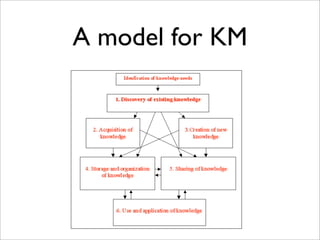
A model for KM
Another model

                                  KM Influences

                                  Govern


                                                                              Learning
 Recognition of   Triggers          KME,                     Achievement of
Knowledge need                Knowledge Activities

                                                                              Projection

                             Available for   processing in

                             Knowledge Resources
Another model
                  Competition
                  Fashion
                  Markets            KM Influences
                  Technology
                  Time               Govern
                  GEPSE climate

                                                                                 Learning
 Recognition of      Triggers           KME,                    Achievement of
Knowledge need                    Knowledge Activities

                                                                                 Projection

                                Available for   processing in

                                  Knowledge Resources
KM Activities 1
          External Sources


             Acquiring


Using


                 Internalizing
KM Activities 1
          External Sources
                                 Identifying knowledge in the
                                 environment and transforming
                                 it into a representation for
                                 usage and/or internalization
             Acquiring
                                             Identifying
                                             Capturing
Using                                        Organizing
                                             Transferring


                 Internalizing
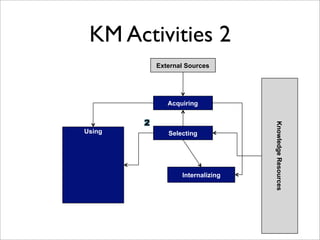
KM Activities 2
        External Sources


           Acquiring


                               Knowledge Resources
Using      Selecting


               Internalizing
KM Activities 2
        External Sources       Participants’ knowledge
                               Artifacts
                               Culture
                               Strategy
                               …
           Acquiring


                                            Knowledge Resources
Using      Selecting


               Internalizing
KM Activities 2
                                                External Sources       Participants’ knowledge
                                                                       Artifacts
                                                                       Culture
                                                                       Strategy
               Identifying knowledge within                            …
                 the organization’s KR and
               providing it in an appropriate      Acquiring
                representation to an activity
                        that needs it


                                                                                    Knowledge Resources
Identifying            Using                       Selecting
Capturing
Organizing
Transferring

                                                       Internalizing
KM Activities 3
         External Sources


            Acquiring


                                Knowledge Resources
Using       Selecting


                Internalizing
KM Activities 3
                 External Sources


                     Acquiring


                                                   Knowledge Resources
    Using            Selecting


                         Internalizing


              Incorporating knowledge into the
              organization. Culminating activity
                  in organizational learning
Assessing
Targeting
Structuring
Delivering
KM Activities 3
                   External Sources


                      Acquiring


                                          Knowledge Resources
     Using            Selecting

  Generating


                          Internalizing

 Externalizing


External Targets
KM Activities 3
                                                 External Sources
        Generating

Applying existing knowledge to
  generate new (or not new)
          knowledge                                 Acquiring

       Monitoring


                                                                        Knowledge Resources
       Evaluating                   Using           Selecting
       Producing
       Transferring               Generating


                                                        Internalizing

                                 Externalizing


                            External Targets
KM Activities 3
                                                  External Sources
         Generating

Applying existing knowledge to
  generate new (or not new)
          knowledge                                  Acquiring

        Monitoring


                                                                         Knowledge Resources
        Evaluating                  Using            Selecting
        Producing
        Transferring              Generating


      Externalizing                                      Internalizing

                                 Externalizing
  Making some knowledge
available in an outward form

      Targeting
      Producing                External Targets
      Transferring
Knowledge Management
Activities that we do not do in IM

socialize            synthesize

internalize          design

externalize          learn

combine              sharing

“sensemaking”        tomar decisões

create
Knowledge
    Management
in Computer Science
Knowledge Management
             (Laudon & Laudon)
Capture, Codification and Discovery
  Expert Systems, Neuronal networks, fuzzy logic, data
  mining, genetic algorithms, intelligent agents
Creation
  CAD, Virtual Reality, Investment workstations
Sharing
  Tools supporting individual and collaborative work (e-
  mail, groupware, intranets)
Distribution
  word processing, worksheets, publishing tools
CommonKADS

Methodology to carry out structured
knowledge Management, Knowledge
Analysis and Knowledge-intensive
system development
Product from Artificial Intelligence
CommonKADS
     Premises

Knowledge is a valuable asset
Knowledge engineering lies at the heart
of development, distribution and
maintenance of knowledge assets
Knowledge in
   CommonKADS
Data, information and knowledge
slightly different meanings
Data is uninterpreted signals
Information is data with meaning
Data and information that people bring
about to practical use in action
Knowledge Engineering
 Discipline devoted to the analysis,
 design and implementation of
 knowledge systems
 knowledge systems =
  expert systems, knowledge-based
  systems, knowledge-intensive
  information systems
First Architecture of
Knowledge Systems

      Reasoning
      Mechanism


       Domain
      Knowledge
      (facts, rules)
Knowledge Engineering
     Principles
 Constructing different aspect models of human
 knowledge
   Modeling activity
 First concentrate on the conceptual structure of
 knowledge, leave programming details for later
 Knowledge has a stable structure analyzable through
 knowledge types and roles
 Knowledge Project must be managed in a controlled
 “spiral” way (iterative and incremental)
CommonKADS
        Model Suite
organization
                 task model              agent model
   model


          knowledge            communication
            model                 model


                      design
                      model
Organizational & Task
      Models
Mayor features of an organization to
discover problems and opportunities,
feasibility and impact of knowledge
systems
Task layout. Inputs and outputs, pre-
conditions, performance criteria, needed
resources and competences
Agent & Knowledge
      Models
Human and automated agents.
Competences, authority and constraints
to act. Communication links among
agents.
Knowledge Types and Structures in a
language understandable by humans.
Vehicle of communication with experts
and users about problem-solving aspects
Knowledge
    Representation
Semantic Networks, Frames
Conceptual maps
Class diagrams
Topic Maps
Graphs
Rules, Scripts....
Communication and
  Design Models
Communicative transactions
 Language-Action Perspective modeling
 approaches
Technical specifications in terms of
architecture, implementation platform
and software modules
 based on the previous models
CommonKADS
      roles
Knowledge provider/expert
Knowledge engineer/analyst
Knowledge-system developer
Knowledge user
Project Manager
Knowledge Manager
 architecture + management issues

Gic2012 aula2-ingles

  • 1.
    Information & Knowledge Management - Class 2 Knowledge Management vs Knowledge Engineering Marielba Zacarias Prof. Auxiliar DEEI FCT I, Gab 2.69, Ext. 7749 mzacaria@ualg.pt http://w3.ualg.pt/~mzacaria
  • 2.
  • 3.
    Knowledge Management in Organizational and Management Sciences
  • 4.
    Types of knowledge “TheTacit Dimension”, M. Polanyi, 1966 Tacit Individual knowledge embedded in experience and involves opinions, instincts, judgements and values Explicit Knowledge shared via oral or written means (for some, information)
  • 5.
    Types of Knowledge Empirical: Conceptual: Tacit knowledge from Explicit knowledge experience articulated through language, symbols and images Skill & “know-how”, Atention, love and trust Designs, models, concepts about Energy, passion and stress artifacts Routines: Sistemic: Tacit knowledge routinized Explícit knowledge through work practices standardized, distributed and packaged Know-how about daily Documents, Specifications, operations, organizational manuals, data bases, patents routines and culture and licences
  • 6.
    Knowledge creation process (SECI)
  • 7.
    Knowledge Chain internal awareness know core skills and competences internal responsiveness explore and exploit them in value actions external responsiveness capacity to satisfy market needs external awareness ability of perceiving how the market values product and services
  • 8.
    Chain dynamics Internal Internal Awareness Responsiveness
  • 9.
    Wrong chain internal awareness external responsiveness extensive use of graphics, no feedback loops with management through clients, few predictive efforts memos, no knowledge sharing, static procedures external awareness and policies. Focus on product lines slow distribution channels, standard internal responsiveness products, long innovation cycles, new ideas drowned by excessive focus on the hierarchical and excessively internal rate of return departamentalized structures
  • 10.
    Right Chain internal awareness external responsiveness awareness of strenghts and reduction of filters to access weaknesses, experiences are the market and capacity of openly communicated, focus creating partnerships with on compentencies and skills clients and competitors, proactive thinking and not on products behavior internal responsiveness external awareness ability of organizing competencies based on focus on service client internl awareness and market and using knowledge as needs a value-creating product
  • 11.
    KM Processes (Frapaiolo) Intermediation link knowledge-person from provider to consumer Externalization link knowledge-knowledge store in repository organize within classification system
  • 12.
    KM Processes II (Frapaiolo) Internalization link knowledge-query extraction & filtering by consumer Cognition link knowledge-process application of knowledge in organizational activity
  • 13.
  • 14.
    Another model KM Influences Govern Learning Recognition of Triggers KME, Achievement of Knowledge need Knowledge Activities Projection Available for processing in Knowledge Resources
  • 15.
    Another model Competition Fashion Markets KM Influences Technology Time Govern GEPSE climate Learning Recognition of Triggers KME, Achievement of Knowledge need Knowledge Activities Projection Available for processing in Knowledge Resources
  • 16.
    KM Activities 1 External Sources Acquiring Using Internalizing
  • 17.
    KM Activities 1 External Sources Identifying knowledge in the environment and transforming it into a representation for usage and/or internalization Acquiring Identifying Capturing Using Organizing Transferring Internalizing
  • 18.
    KM Activities 2 External Sources Acquiring Knowledge Resources Using Selecting Internalizing
  • 19.
    KM Activities 2 External Sources Participants’ knowledge Artifacts Culture Strategy … Acquiring Knowledge Resources Using Selecting Internalizing
  • 20.
    KM Activities 2 External Sources Participants’ knowledge Artifacts Culture Strategy Identifying knowledge within … the organization’s KR and providing it in an appropriate Acquiring representation to an activity that needs it Knowledge Resources Identifying Using Selecting Capturing Organizing Transferring Internalizing
  • 21.
    KM Activities 3 External Sources Acquiring Knowledge Resources Using Selecting Internalizing
  • 22.
    KM Activities 3 External Sources Acquiring Knowledge Resources Using Selecting Internalizing Incorporating knowledge into the organization. Culminating activity in organizational learning Assessing Targeting Structuring Delivering
  • 23.
    KM Activities 3 External Sources Acquiring Knowledge Resources Using Selecting Generating Internalizing Externalizing External Targets
  • 24.
    KM Activities 3 External Sources Generating Applying existing knowledge to generate new (or not new) knowledge Acquiring Monitoring Knowledge Resources Evaluating Using Selecting Producing Transferring Generating Internalizing Externalizing External Targets
  • 25.
    KM Activities 3 External Sources Generating Applying existing knowledge to generate new (or not new) knowledge Acquiring Monitoring Knowledge Resources Evaluating Using Selecting Producing Transferring Generating Externalizing Internalizing Externalizing Making some knowledge available in an outward form Targeting Producing External Targets Transferring
  • 26.
    Knowledge Management Activities thatwe do not do in IM socialize synthesize internalize design externalize learn combine sharing “sensemaking” tomar decisões create
  • 27.
    Knowledge Management in Computer Science
  • 28.
    Knowledge Management (Laudon & Laudon) Capture, Codification and Discovery Expert Systems, Neuronal networks, fuzzy logic, data mining, genetic algorithms, intelligent agents Creation CAD, Virtual Reality, Investment workstations Sharing Tools supporting individual and collaborative work (e- mail, groupware, intranets) Distribution word processing, worksheets, publishing tools
  • 29.
    CommonKADS Methodology to carryout structured knowledge Management, Knowledge Analysis and Knowledge-intensive system development Product from Artificial Intelligence
  • 30.
    CommonKADS Premises Knowledge is a valuable asset Knowledge engineering lies at the heart of development, distribution and maintenance of knowledge assets
  • 31.
    Knowledge in CommonKADS Data, information and knowledge slightly different meanings Data is uninterpreted signals Information is data with meaning Data and information that people bring about to practical use in action
  • 32.
    Knowledge Engineering Disciplinedevoted to the analysis, design and implementation of knowledge systems knowledge systems = expert systems, knowledge-based systems, knowledge-intensive information systems
  • 33.
    First Architecture of KnowledgeSystems Reasoning Mechanism Domain Knowledge (facts, rules)
  • 34.
    Knowledge Engineering Principles Constructing different aspect models of human knowledge Modeling activity First concentrate on the conceptual structure of knowledge, leave programming details for later Knowledge has a stable structure analyzable through knowledge types and roles Knowledge Project must be managed in a controlled “spiral” way (iterative and incremental)
  • 35.
    CommonKADS Model Suite organization task model agent model model knowledge communication model model design model
  • 36.
    Organizational & Task Models Mayor features of an organization to discover problems and opportunities, feasibility and impact of knowledge systems Task layout. Inputs and outputs, pre- conditions, performance criteria, needed resources and competences
  • 37.
    Agent & Knowledge Models Human and automated agents. Competences, authority and constraints to act. Communication links among agents. Knowledge Types and Structures in a language understandable by humans. Vehicle of communication with experts and users about problem-solving aspects
  • 38.
    Knowledge Representation Semantic Networks, Frames Conceptual maps Class diagrams Topic Maps Graphs Rules, Scripts....
  • 39.
    Communication and Design Models Communicative transactions Language-Action Perspective modeling approaches Technical specifications in terms of architecture, implementation platform and software modules based on the previous models
  • 40.
    CommonKADS roles Knowledge provider/expert Knowledge engineer/analyst Knowledge-system developer Knowledge user Project Manager Knowledge Manager architecture + management issues