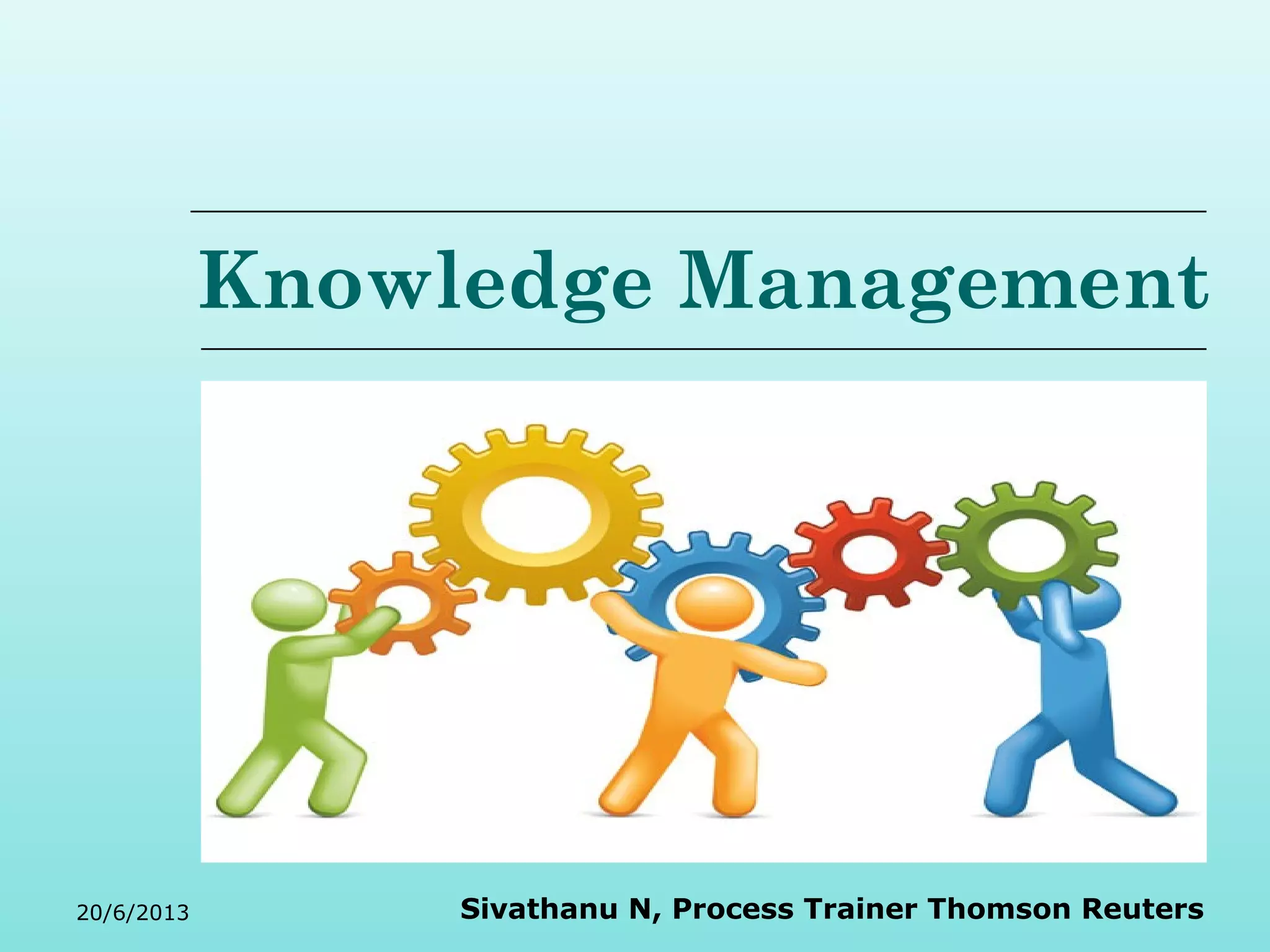
Knowledge Management 
20/6/2013 Sivathanu N, Process Trainer Thomson Reuters
A G E N D A 
WWhhaatt i sis K Knnoowwleleddggee?? 
TTyyppeess o off K Knnoowwleleddggee 
What is Knowledge 
Management? 
What is Knowledge 
Management? 
The Essence of Knowledge 
Management 
The Essence of Knowledge 
Management 
Why Knowledge 
Management? 
Why Knowledge 
Management? 
What does leveraging 
"collective knowledge" 
involve? 
What does leveraging 
"collective knowledge" 
involve? 
The role of HR & Training 
team in institutionalizing 
KM in an organization 
The role of HR & Training 
team in institutionalizing 
KM in an organization 
HR processes and practices 
impact the knowledge 
sharing in a firm 
HR processes and practices 
impact the knowledge 
sharing in a firm 
How do we create a 
knowledge sharing culture? 
How do we create a 
knowledge sharing culture? 
20/6/2013 
Sivathanu N, Process Trainer 
Thomson Reuters
20/6/2013 
Sivathanu N, Process Trainer 
Thomson Reuters
20/6/2013 
Sivathanu N, Process Trainer 
Thomson Reuters
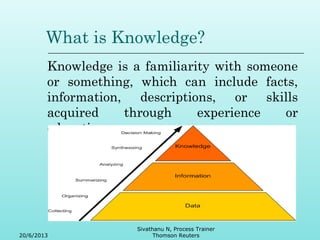
What is Knowledge? 
Knowledge is a familiarity with someone 
or something, which can include facts, 
information, descriptions, or skills 
acquired through experience or 
education. 
20/6/2013 
Sivathanu N, Process Trainer 
Thomson Reuters
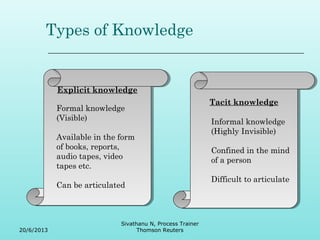
Types of Knowledge 
EExxpplliicciitt k knnoowwlleeddggee 
Tacit knowledge 
Tacit knowledge 
Formal knowledge 
(Visible) 
Available in the form 
of books, reports, 
audio tapes, video 
tapes etc. 
Can be articulated 
Informal knowledge 
(Highly Invisible) 
Confined in the mind 
of a person 
Difficult to articulate 
20/6/2013 
Sivathanu N, Process Trainer 
Thomson Reuters
20/6/2013 
Sivathanu N, Process Trainer 
Thomson Reuters
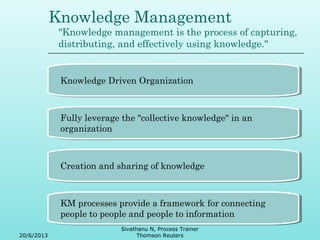
Knowledge Management 
"Knowledge management is the process of capturing, 
distributing, and effectively using knowledge." 
Knowledge Knowledge DDrriivveenn O Orrggaanniizzaattiioonn 
Fully leverage the "collective knowledge" in an 
organization 
Fully leverage the "collective knowledge" in an 
organization 
CCrreeaattiioonn a anndd s shhaarriinngg o off k knnoowwlleeddggee 
KM processes provide a framework for connecting 
people to people and people to information 
KM processes provide a framework for connecting 
people to people and people to information 
20/6/2013 
Sivathanu N, Process Trainer 
Thomson Reuters
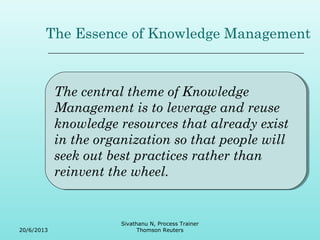
The Essence of Knowledge Management 
The central theme of Knowledge 
Management is to leverage and reuse 
knowledge resources that already exist 
in the organization so that people will 
seek out best practices rather than 
reinvent the wheel. 
The central theme of Knowledge 
Management is to leverage and reuse 
knowledge resources that already exist 
in the organization so that people will 
seek out best practices rather than 
reinvent the wheel. 
20/6/2013 
Sivathanu N, Process Trainer 
Thomson Reuters
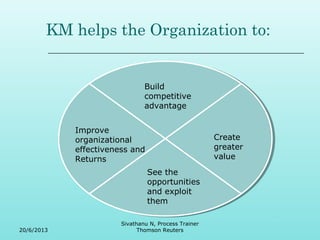
KM helps the Organization to: 
Build 
competitive 
advantage 
Improve 
organizational 
effectiveness and 
Returns 
Create 
greater 
value 
See the 
opportunities 
and exploit 
them 
20/6/2013 
Sivathanu N, Process Trainer 
Thomson Reuters
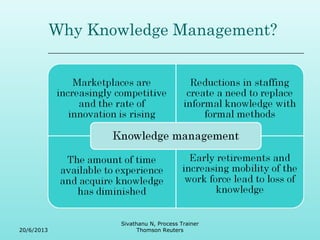
Why Knowledge Management? 
20/6/2013 
Sivathanu N, Process Trainer 
Thomson Reuters
What does leveraging "collective 
knowledge" involve? 
 Working in collaborative teams, capturing and sharing 
knowledge and delivering business excellence. 
 Developing and sharing "best practices." 
 Faster replication of innovations through faster movement 
of knowledge through the organization. 
 Acquisition and sharing of "new knowledge." 
 Creating an environment that is comfortable to the idea of 
openness, knowledge sharing, risk of failure as well as 
rewards for success. 
 Managing organizational learning. 
20/6/2013 
Sivathanu N, Process Trainer 
Thomson Reuters
The role of HR in institutionalizing 
KM in an organization 
 Focus on strengthening collaborative team effort to 
leverage collective knowledge of the enterprise. 
 Corporate Education. 
 Performance Management and nurturing (sharing, doing 
and caring) culture. 
 Talent management. 
 Recruitment, training, skill and competency development. 
 New HRM roles are those of human capital steward, 
knowledge facilitator, relationship builder, and rapid 
deployment specialist. 
20/6/2013 
Sivathanu N, Process Trainer 
Thomson Reuters
How do HR processes and practices 
impact the knowledge sharing in a firm? 
 Job rotations 
 Networked organization 
 Training 
 Knowledge communities (Teams) 
 E- Learning 
 Culture change 
20/6/2013 
Sivathanu N, Process Trainer 
Thomson Reuters
Some of the steps that HR could take 
for cultural change : 
 Performance Development Planning (PDP); 
 Learning from experience 
 Team commitment 
 Developing others 
 Develop a mechanism to communicate effectively. 
 Collaborative effort and knowledge. 
 Make KM part of the Company training modules. 
 Hold visible knowledge sharing events. 
20/6/2013 
Sivathanu N, Process Trainer 
Thomson Reuters
Conclusion: 
 Transformation into knowledge driven organization 
 HR & Training Team has a key role to play in 
nurturing and strengthening knowledge management 
through "learning initiatives" and "culture change 
initiatives.“ 
 HR & Training Team is best placed to play the role of 
an effective facilitator, and give positive reinforcements 
for Knowledge Management . 
 Knowledge management has already been embraced as 
a source of solutions to the problems of today’s business. 
20/6/2013 
Sivathanu N, Process Trainer 
Thomson Reuters

Knowledge Management

  • 1.
    Knowledge Management 20/6/2013Sivathanu N, Process Trainer Thomson Reuters
  • 2.
    A G EN D A WWhhaatt i sis K Knnoowwleleddggee?? TTyyppeess o off K Knnoowwleleddggee What is Knowledge Management? What is Knowledge Management? The Essence of Knowledge Management The Essence of Knowledge Management Why Knowledge Management? Why Knowledge Management? What does leveraging "collective knowledge" involve? What does leveraging "collective knowledge" involve? The role of HR & Training team in institutionalizing KM in an organization The role of HR & Training team in institutionalizing KM in an organization HR processes and practices impact the knowledge sharing in a firm HR processes and practices impact the knowledge sharing in a firm How do we create a knowledge sharing culture? How do we create a knowledge sharing culture? 20/6/2013 Sivathanu N, Process Trainer Thomson Reuters
  • 3.
    20/6/2013 Sivathanu N,Process Trainer Thomson Reuters
  • 4.
    20/6/2013 Sivathanu N,Process Trainer Thomson Reuters
  • 5.
    What is Knowledge? Knowledge is a familiarity with someone or something, which can include facts, information, descriptions, or skills acquired through experience or education. 20/6/2013 Sivathanu N, Process Trainer Thomson Reuters
  • 6.
    Types of Knowledge EExxpplliicciitt k knnoowwlleeddggee Tacit knowledge Tacit knowledge Formal knowledge (Visible) Available in the form of books, reports, audio tapes, video tapes etc. Can be articulated Informal knowledge (Highly Invisible) Confined in the mind of a person Difficult to articulate 20/6/2013 Sivathanu N, Process Trainer Thomson Reuters
  • 7.
    20/6/2013 Sivathanu N,Process Trainer Thomson Reuters
  • 8.
    Knowledge Management "Knowledgemanagement is the process of capturing, distributing, and effectively using knowledge." Knowledge Knowledge DDrriivveenn O Orrggaanniizzaattiioonn Fully leverage the "collective knowledge" in an organization Fully leverage the "collective knowledge" in an organization CCrreeaattiioonn a anndd s shhaarriinngg o off k knnoowwlleeddggee KM processes provide a framework for connecting people to people and people to information KM processes provide a framework for connecting people to people and people to information 20/6/2013 Sivathanu N, Process Trainer Thomson Reuters
  • 9.
    The Essence ofKnowledge Management The central theme of Knowledge Management is to leverage and reuse knowledge resources that already exist in the organization so that people will seek out best practices rather than reinvent the wheel. The central theme of Knowledge Management is to leverage and reuse knowledge resources that already exist in the organization so that people will seek out best practices rather than reinvent the wheel. 20/6/2013 Sivathanu N, Process Trainer Thomson Reuters
  • 10.
    KM helps theOrganization to: Build competitive advantage Improve organizational effectiveness and Returns Create greater value See the opportunities and exploit them 20/6/2013 Sivathanu N, Process Trainer Thomson Reuters
  • 11.
    Why Knowledge Management? 20/6/2013 Sivathanu N, Process Trainer Thomson Reuters
  • 12.
    What does leveraging"collective knowledge" involve?  Working in collaborative teams, capturing and sharing knowledge and delivering business excellence.  Developing and sharing "best practices."  Faster replication of innovations through faster movement of knowledge through the organization.  Acquisition and sharing of "new knowledge."  Creating an environment that is comfortable to the idea of openness, knowledge sharing, risk of failure as well as rewards for success.  Managing organizational learning. 20/6/2013 Sivathanu N, Process Trainer Thomson Reuters
  • 13.
    The role ofHR in institutionalizing KM in an organization  Focus on strengthening collaborative team effort to leverage collective knowledge of the enterprise.  Corporate Education.  Performance Management and nurturing (sharing, doing and caring) culture.  Talent management.  Recruitment, training, skill and competency development.  New HRM roles are those of human capital steward, knowledge facilitator, relationship builder, and rapid deployment specialist. 20/6/2013 Sivathanu N, Process Trainer Thomson Reuters
  • 14.
    How do HRprocesses and practices impact the knowledge sharing in a firm?  Job rotations  Networked organization  Training  Knowledge communities (Teams)  E- Learning  Culture change 20/6/2013 Sivathanu N, Process Trainer Thomson Reuters
  • 15.
    Some of thesteps that HR could take for cultural change :  Performance Development Planning (PDP);  Learning from experience  Team commitment  Developing others  Develop a mechanism to communicate effectively.  Collaborative effort and knowledge.  Make KM part of the Company training modules.  Hold visible knowledge sharing events. 20/6/2013 Sivathanu N, Process Trainer Thomson Reuters
  • 16.
    Conclusion:  Transformationinto knowledge driven organization  HR & Training Team has a key role to play in nurturing and strengthening knowledge management through "learning initiatives" and "culture change initiatives.“  HR & Training Team is best placed to play the role of an effective facilitator, and give positive reinforcements for Knowledge Management .  Knowledge management has already been embraced as a source of solutions to the problems of today’s business. 20/6/2013 Sivathanu N, Process Trainer Thomson Reuters

Editor's Notes

  • #6 So, in summary the following associations can reasonably be made: Information relates to description, definition, or perspective (what, who, when, where). Knowledge comprises strategy, practice, method, or approach (how). Wisdom embodies principle, insight, moral, or archetype (why). Now that I have categories I can get hold of, maybe I can figure out what can be managed. An Example This example uses a bank savings account to show how data, information, knowledge, and wisdom relate to principal, interest rate, and interest. Data: The numbers 100 or 5%, completely out of context, are just pieces of data. Interest, principal, and interest rate, out of context, are not much more than data as each has multiple meanings which are context dependent. Information: If I establish a bank savings account as the basis for context, then interest, principal, and interest rate become meaningful in that context with specific interpretations. Principal is the amount of money, $100, in the savings account. Interest rate, 5%, is the factor used by the bank to compute interest on the principal. Knowledge: If I put $100 in my savings account, and the bank pays 5% interest yearly, then at the end of one year the bank will compute the interest of $5 and add it to my principal and I will have $105 in the bank. This pattern represents knowledge, which, when I understand it, allows me to understand how the pattern will evolve over time and the results it will produce. In understanding the pattern, I know, and what I know is knowledge. If I deposit more money in my account, I will earn more interest, while if I withdraw money from my account, I will earn less interest.
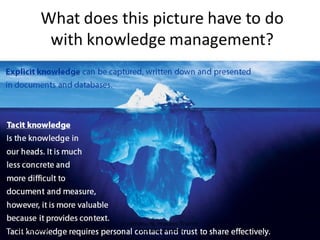
  • #7 two kinds of knowledge parallel Michael Polanyi’s often-quoted distinction between explicit knowledge (sometimes referred to as formal knowledge), which can be articulated in language and transmitted among individuals, and tacit knowledge (also, informal knowledge), personal knowledge rooted in individual experience and involving personal belief, perspective, and values. (Polanyi, Michael. The Tacit Dimension. London: Routledge & Kegan Paul. See also Karl E. Sveiby’s online description, "Tacit Knowledge." In traditional perceptions of the role of knowledge in business organizations, tacit knowledge is often viewed as the real key to getting things done and creating new value. Not explicit knowledge. Thus we often encounter an emphasis on the "learning organization" and other approaches that stress internalization of information (through experience and action) and generation of new knowledge through managed interaction Tacit knowledge can be shared and exchanged.
  • #9 I associate the cause of my indirection with the many companies I have been associated with in the past. These companies had pursued TQM or reengineering, not in support of what they were trying to accomplish, but as ends in themselves because they simply didn't know what they were really trying to accomplish. And, since they didn't know what they were really trying to accomplish, the misdirection was actually a relief, and pursued with a passion­­it just didn't get them anywhere in particular. According to Mike Davidson[dav96], and I agree with him, what's really important is: Mission: What are we trying to accomplish? Competition: How do we gain a competitive edge? Performance: How do we deliver the results? Change: How do we cope with change? As such, knowledge management, and everything else for that matter, is important only to the extent that it enhances an organization's ability and capacity to deal with, and develop in, these four dimensions.
  • #10 Knowledge Management is a process that, continuously and systematically, transfers knowledge from individuals and teams, who generate them, to the brain of the organisation for the benefit of the entire organisation. It is the systematic, explicit, and deliberate building, renewal, and application of knowledge to maximize an enterprise's knowledge-related effectiveness and returns from its knowledge assets.
  • #11 Companies derive the benefits from knowledge management. These benefits include:   Companies discover the opportunities provided by the environment and exploit them with the help of knowledge created and developed. Companies can reduce the threats created by the environment Derive more value and competencies from the intellectual property. Increase productivity, profit etc. Learn continuously and retain competencies Ability to change and to become agent Getting maximum from the people and information technology.
  • #12 Changes in strategic direction may result in the loss of knowledge in a specific area. To these paraphrases of Ms. Macintosh’s observations we would add: Most of our work is information based. Organizations compete on the basis of knowledge. Products and services are increasingly complex, endowing them with a significant information component. The need for life-long learning is an inescapable reality.In brief, knowledge and information have become the medium in which business problems occur. As a result, managing knowledge represents the primary opportunity for achieving substantial savings, significant improvements in human performance, and competitive advantage.It’s not just a Fortune 500 business problem. Small companies need formal approaches to knowledge management even more, because they don’t have the market leverage, inertia, and resources that big companies do. They have to be much more flexible, more responsive, and more "right" (make better decisions) — because even small mistakes can be fatal to them.
  • #13 KM provides an enabling framework to leverage "collective knowledge." When KM becomes "the way we work," it helps us deliver on strategic priorities and business goals - growth, innovation, speed of response, quality of response, faster time to market, strengthen organizational learning, protect functional and operational excellence in a dis-aggregated organizational structure.
  • #14 Focus on strengthening collaborative team effort to leverage collective knowledge of the enterprise. HR has a pivotal role to play in the KM movement. Key HR processes - Corporate Education, Performance Management and nurturing (sharing, doing and caring) culture, have a very significant role in the development of the knowledge-based enterprise. These new HRM roles are those of human capital steward, knowledge facilitator, relationship builder, and rapid deployment specialist
  • #16 Performance Development Planning (PDP):In HUL, our PDP incorporates "knowledge - Development & Sharing” as one of the key competencies to be monitored and developed. Some of the key competencies linked to knowledge development and sharing are: 1. Learning from experience 2. Developing others 3. Team commitment Develop a mechanism to communicate effectively what knowledge-related behaviour is expected from the employees. Share with all employees, success stories of collaborative effort and knowledge. Make KM part of the Company training modules. Hold visible knowledge sharing events like " Knowledge Fairs."