GlobalThink
      101
              A Primer for
International Human Resources Management
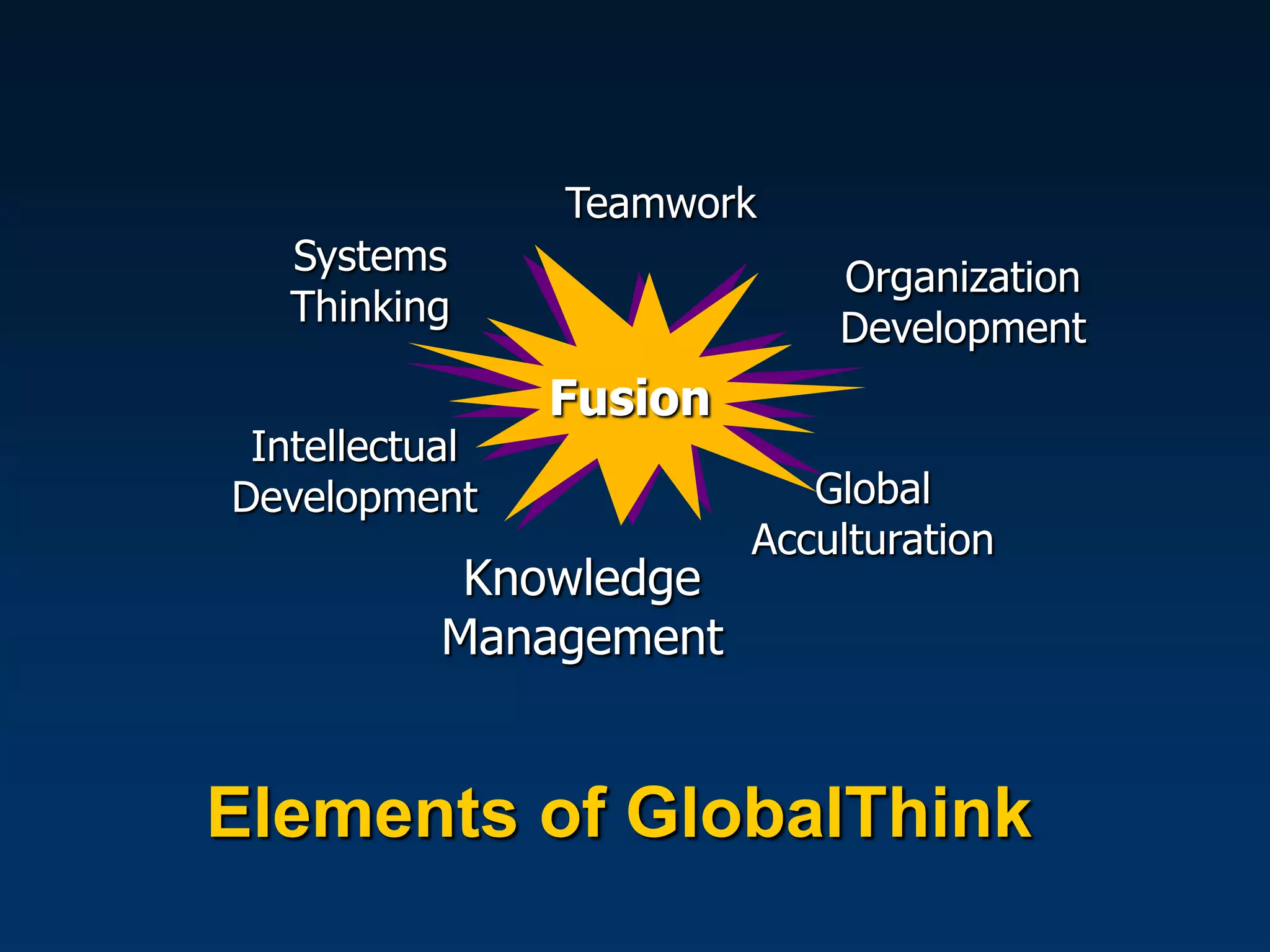
Teamwork
   Systems                   Organization
   Thinking                  Development
                Fusion
 Intellectual
Development                 Global
                         Acculturation
            Knowledge
           Management


Elements of GlobalThink
The New
              Occupy Wall Street
  Global          Social Media
(Dis)Order   Post Digital Revolution
         Global Knowledge Economy
                  Arab Spring
        Age of Networked Intelligence
          Global Economic Dominos
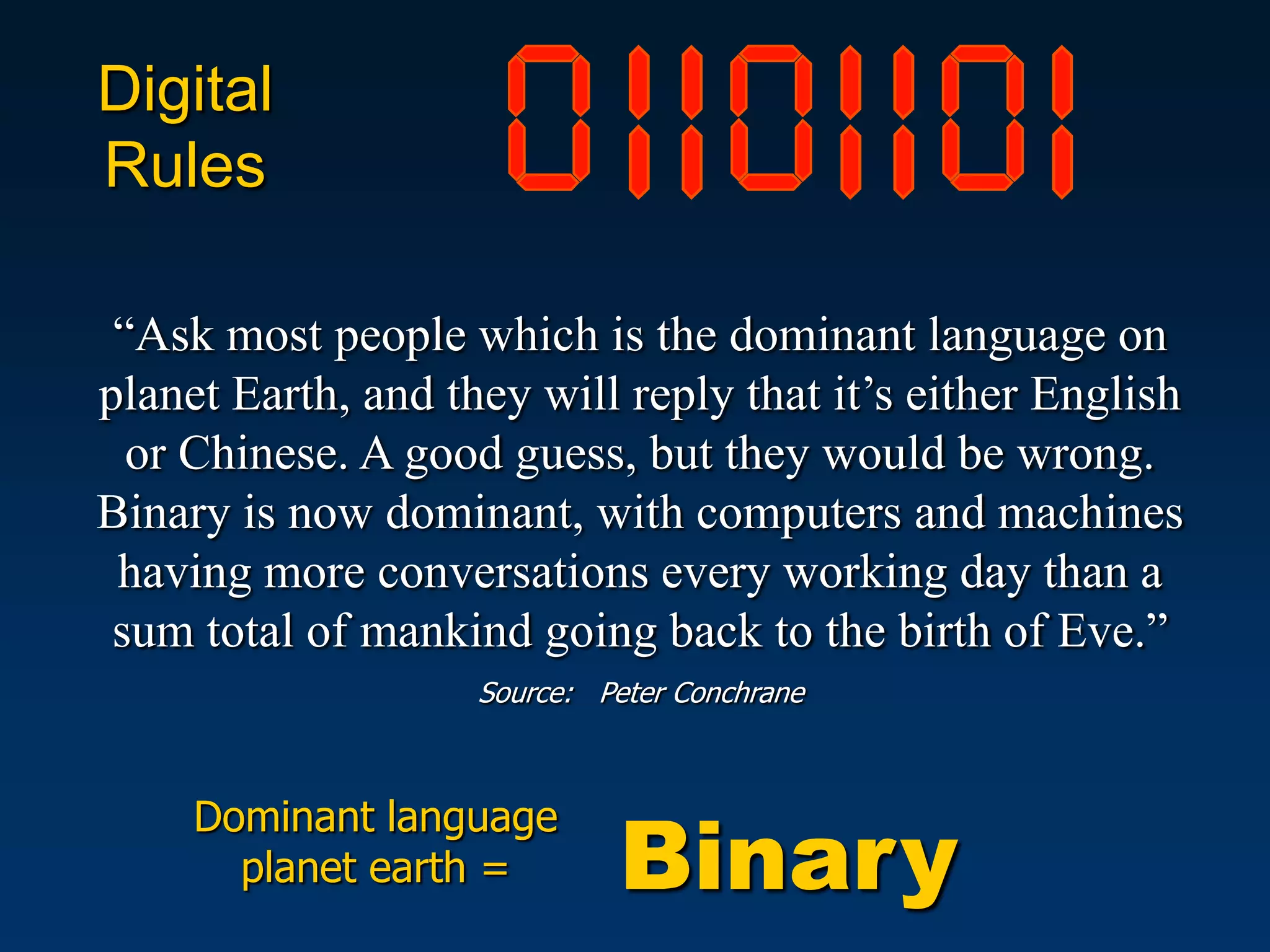
Digital
Rules

 “Ask most people which is the dominant language on
planet Earth, and they will reply that it’s either English
  or Chinese. A good guess, but they would be wrong.
Binary is now dominant, with computers and machines
 having more conversations every working day than a
 sum total of mankind going back to the birth of Eve.”
                    Source: Peter Conchrane


                              Binary
     Dominant language
       planet earth =
Technology = Key
                   enabler of
                  globalization


Globalization and technology are
 mutually reinforcing drivers of
             change.
Multinational enterprises
 are transforming into
     global learning
     organizations.
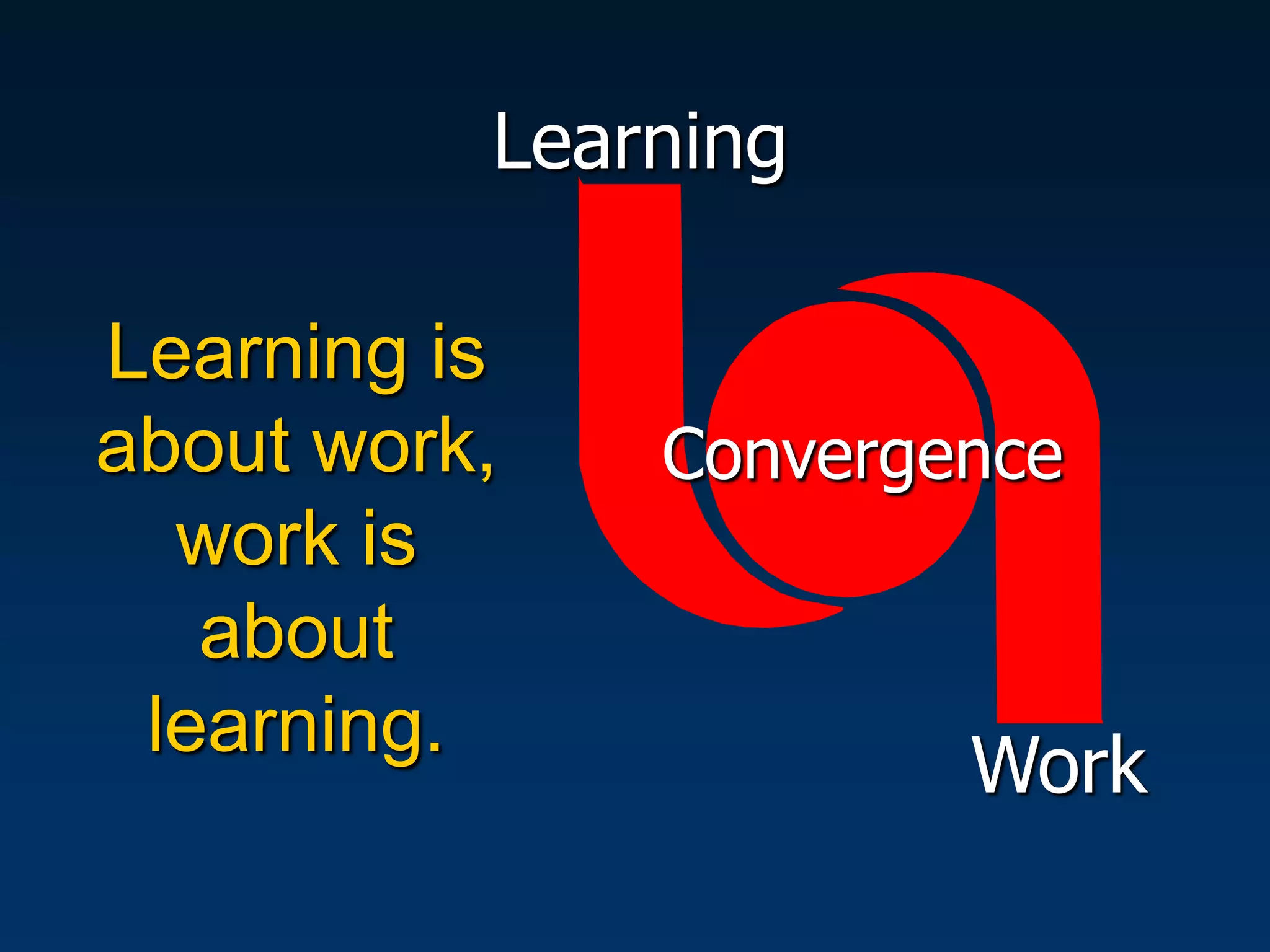
Learning

Learning is
about work,   Convergence
  work is
   about
 learning.
                      Work
Learning is integral to work - a
  by-product of work rather
   than something done in
            isolation

   -   say like most
        training
Characteristics of the
    Global L.O.
•   Global free flow of knowledge
•   Systems thinking
•   Thinking “outside the cubicle”
•   Learning = key strategic global asset
•   Self-directed lifelong learning
Global Free Flow of Knowledge


    Ability to rapidly develop and access
             information globally –
 The key enabler of global performance
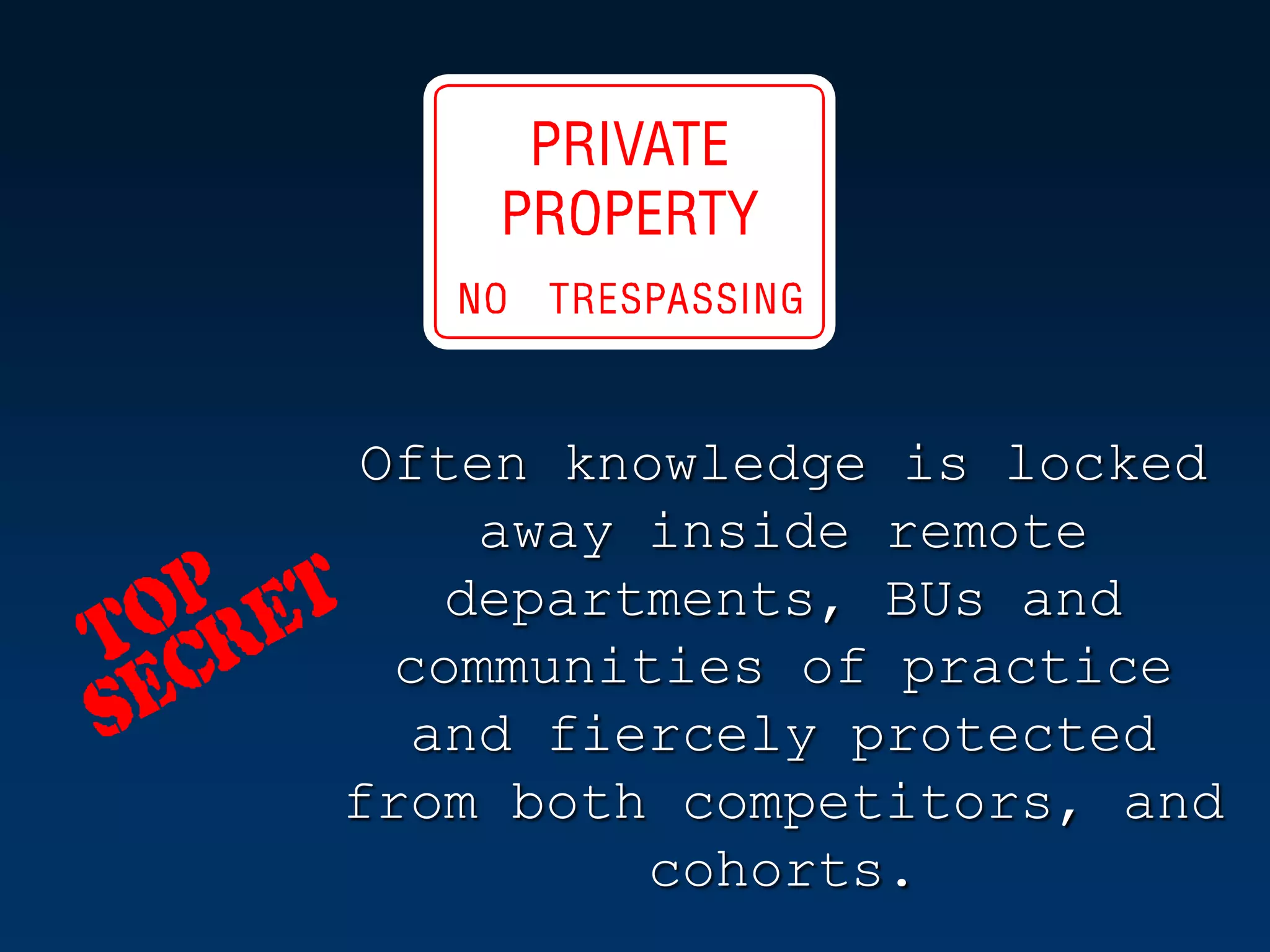
Often knowledge is locked
     away inside remote
    departments, BUs and
  communities of practice
   and fiercely protected
from both competitors, and
          cohorts.
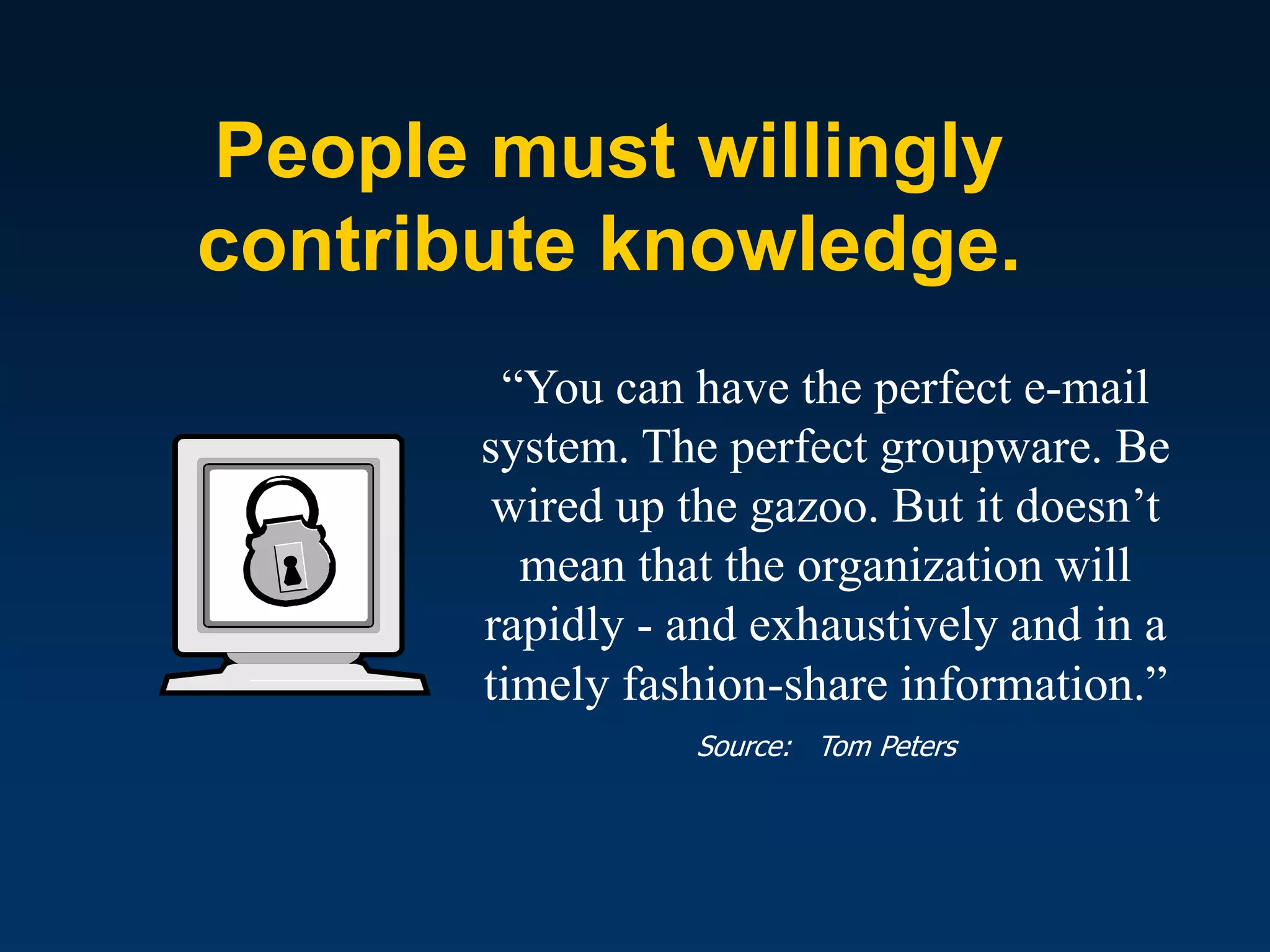
People must willingly
contribute knowledge.
        “You can have the perfect e-mail
       system. The perfect groupware. Be
        wired up the gazoo. But it doesn’t
         mean that the organization will
       rapidly - and exhaustively and in a
       timely fashion-share information.”
                 Source: Tom Peters
I get it!
    Knowledge is not neat or simple.
       It is a complex mixture of various
        elements; it is fluid and formally
     structured and comes in at least two
                     flavors.
Knowledge = Information in Context + Understanding
Knowledge                              Data


“It is all to easy to confuse data with with knowledge
    and information with information technology.”
                   Source: Peter Drucker
Knowledge originates
and resides in people’s
        minds.

In the post digital revolution,
 global organizations are more
dependent on people than ever.


     Knowledge = transient asset
Knowledge Management
             (Kind of) Defined
“KM is a lofty concept - debated by academics and even doubted by some
         analysts - and one that few businesses have mastered.”
                        Source: InformationWeek


     KM = A term used to describe the evolving
        practice of accelerating learning and
    performance by connecting and coordinating
      organizational intellectual resources and
               information technology.
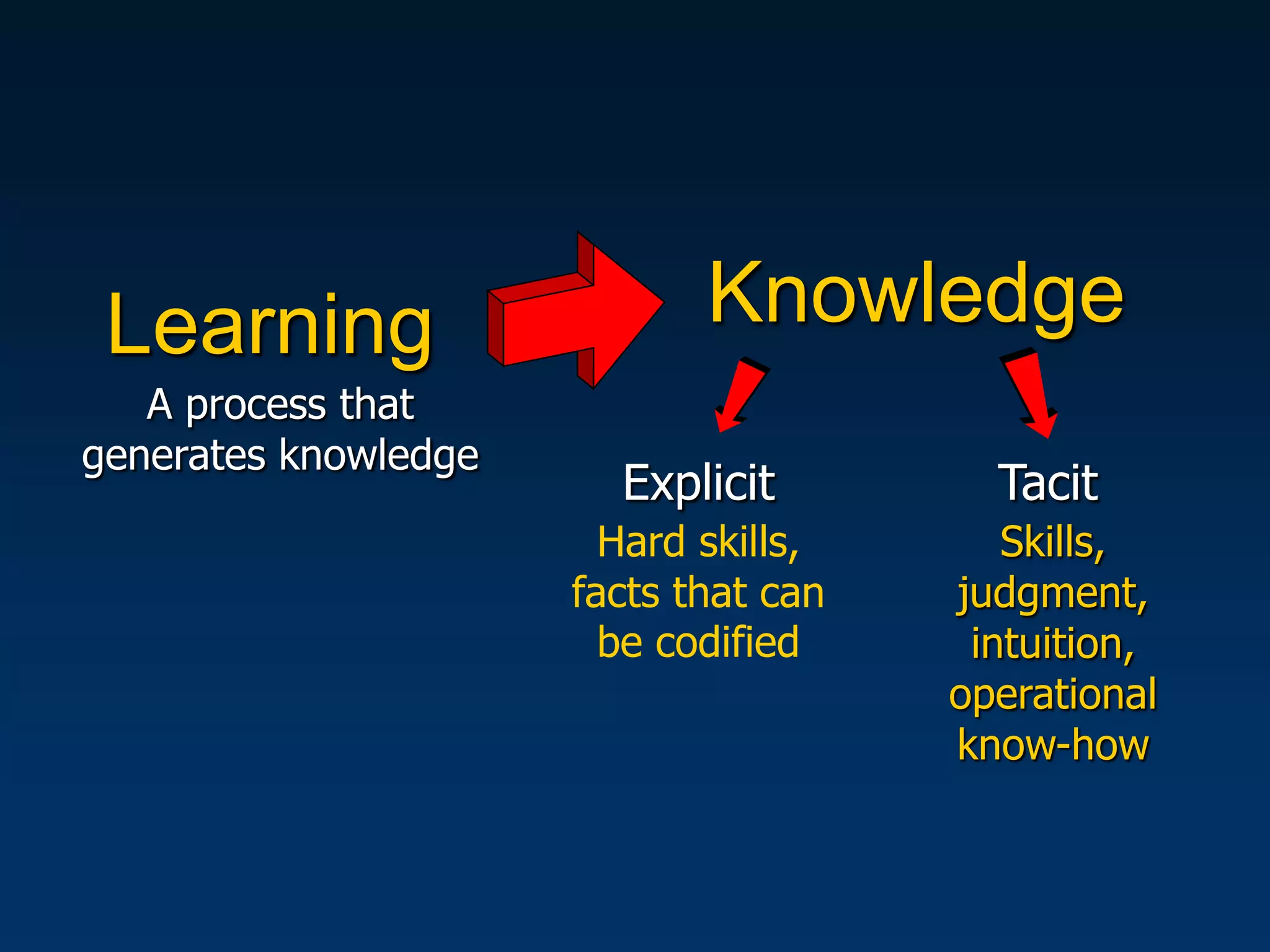
Learning                    Knowledge
   A process that
generates knowledge
                        Explicit         Tacit
                        Hard skills,      Skills,
                      facts that can   judgment,
                        be codified     intuition,
                                       operational
                                       know-how
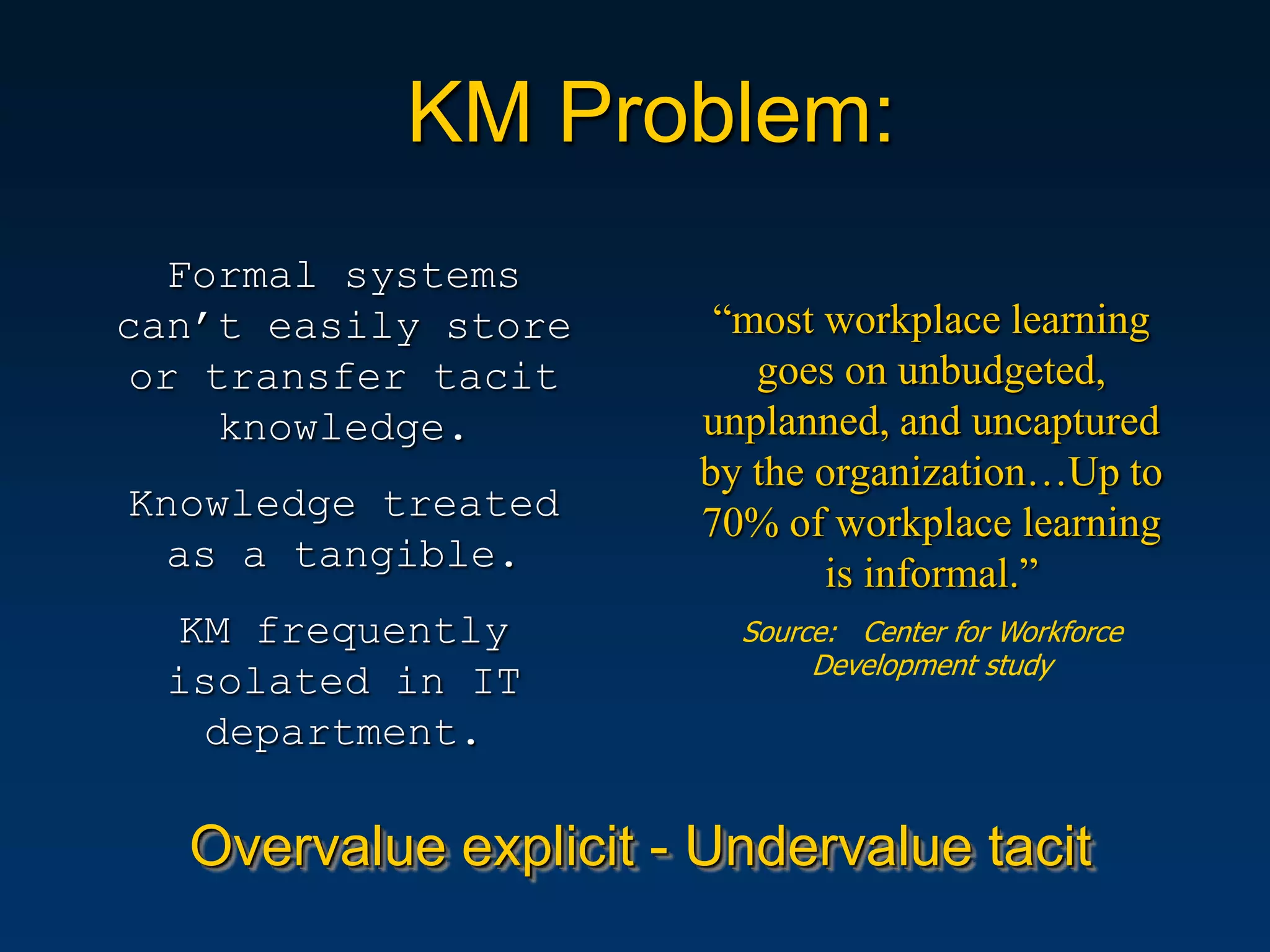
KM Problem:
  Formal systems
can’t easily store     “most workplace learning
or transfer tacit        goes on unbudgeted,
    knowledge.        unplanned, and uncaptured
                      by the organization…Up to
Knowledge treated     70% of workplace learning
 as a tangible.              is informal.”
  KM frequently         Source: Center for Workforce
                             Development study
  isolated in IT
   department.

  Overvalue explicit - Undervalue tacit
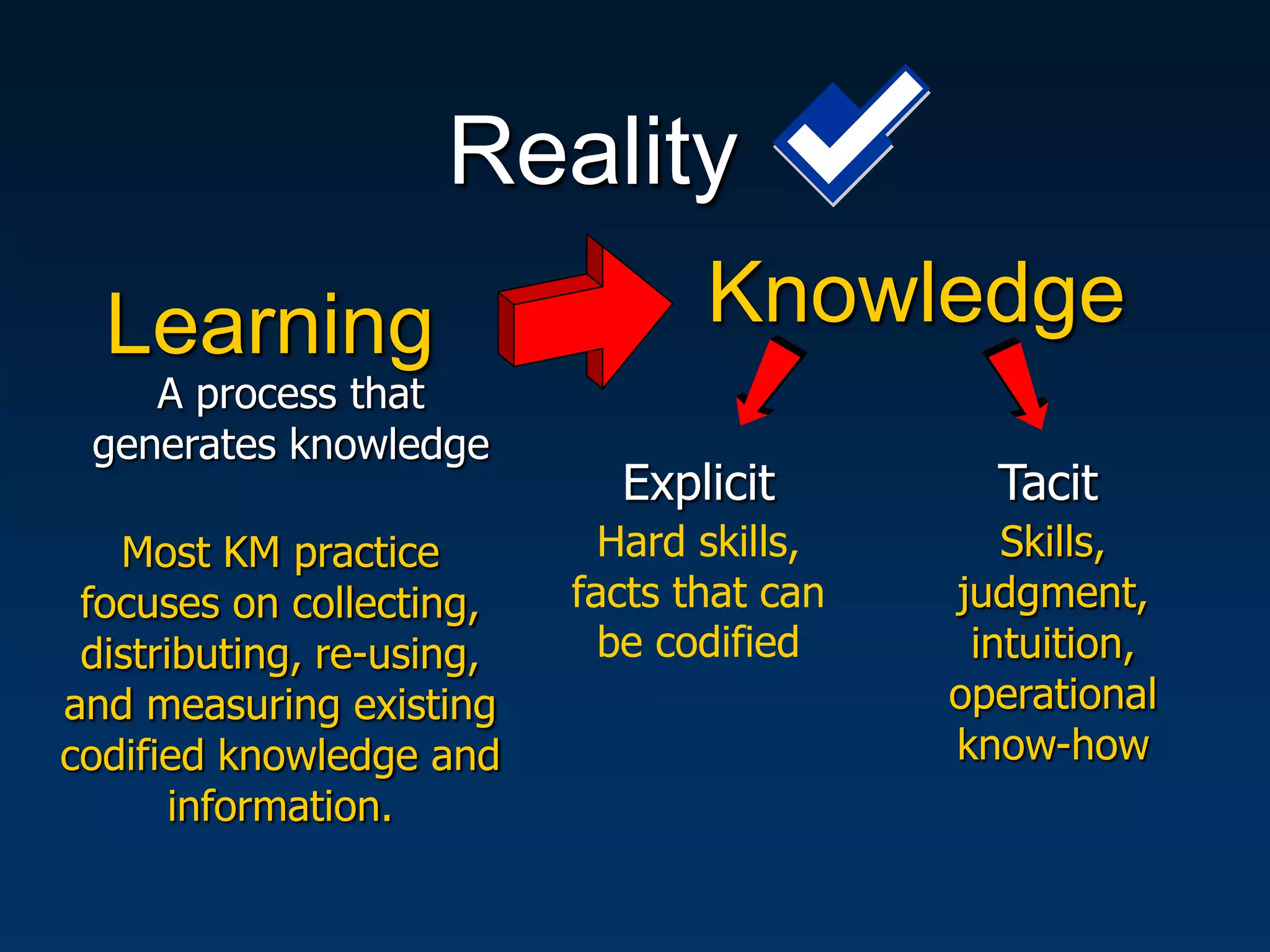
Reality
  Learning                        Knowledge
    A process that
 generates knowledge
                             Explicit         Tacit
   Most KM practice          Hard skills,      Skills,
 focuses on collecting,    facts that can   judgment,
 distributing, re-using,     be codified     intuition,
and measuring existing                      operational
codified knowledge and                      know-how
       information.
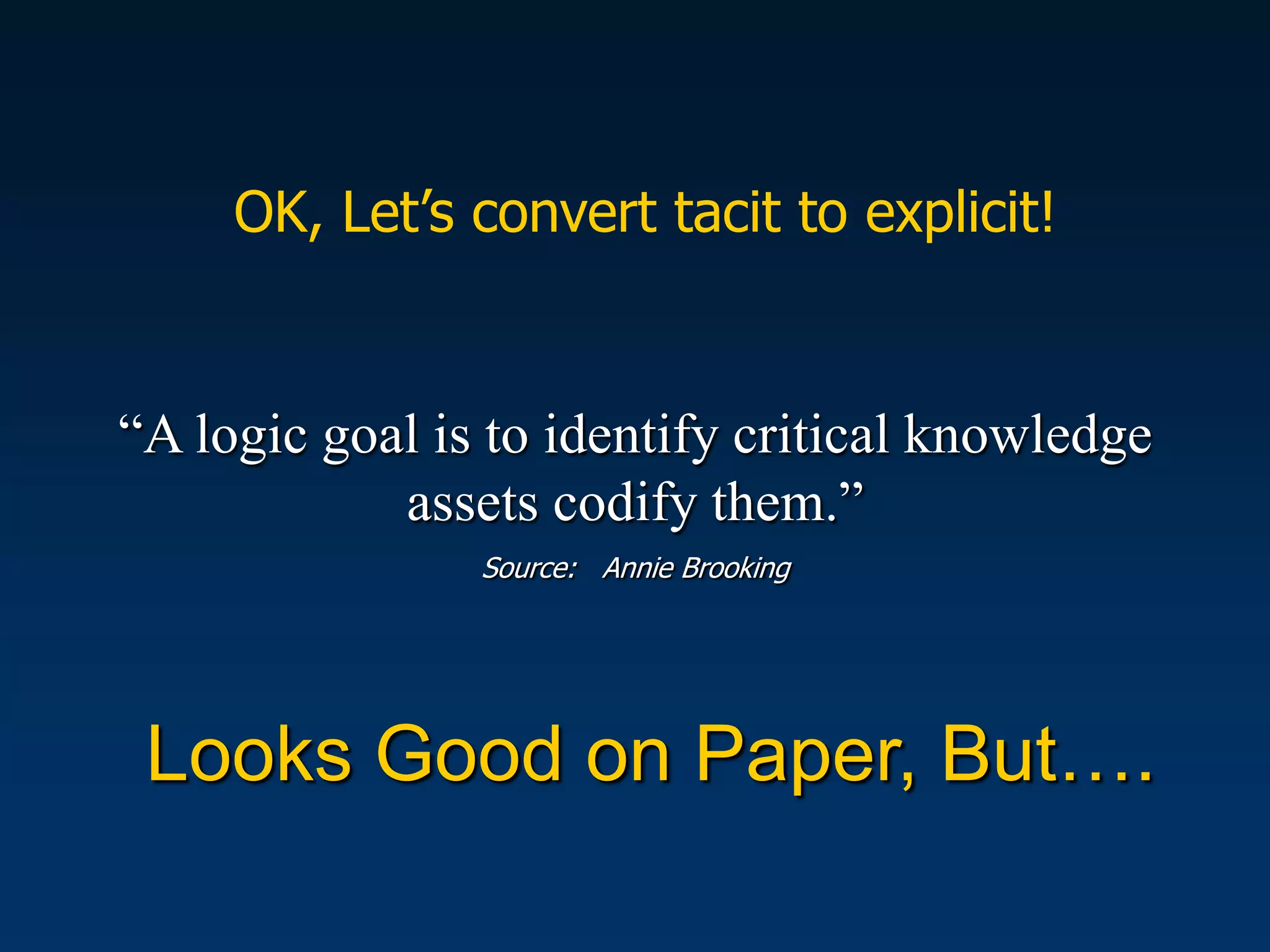
OK, Let’s convert tacit to explicit!


“A logic goal is to identify critical knowledge
            assets codify them.”
                Source: Annie Brooking


 Looks Good on Paper, But….
The KM Fix
      The crux of the KM issue is not
  information, information technology, or
                knowledge.
 It’s really about how you get busy people
               to support KM.

  The answer has much more to do with
motivation and leadership than bits and
                bytes.
The Hard Part
           Emotional Engagement


   Knowing                Doing
    Knowledge &
  information are
vitally important,         Motivation
but ultimately it’s
 performance that     Acknowledge emotion
      counts.
“Organizations learn only through individuals
who learn. Individual learning does not guarantee
   organizational learning. But without it no
        organizational learning occurs.”
                  Source: Pete Senge


       It’s Personal
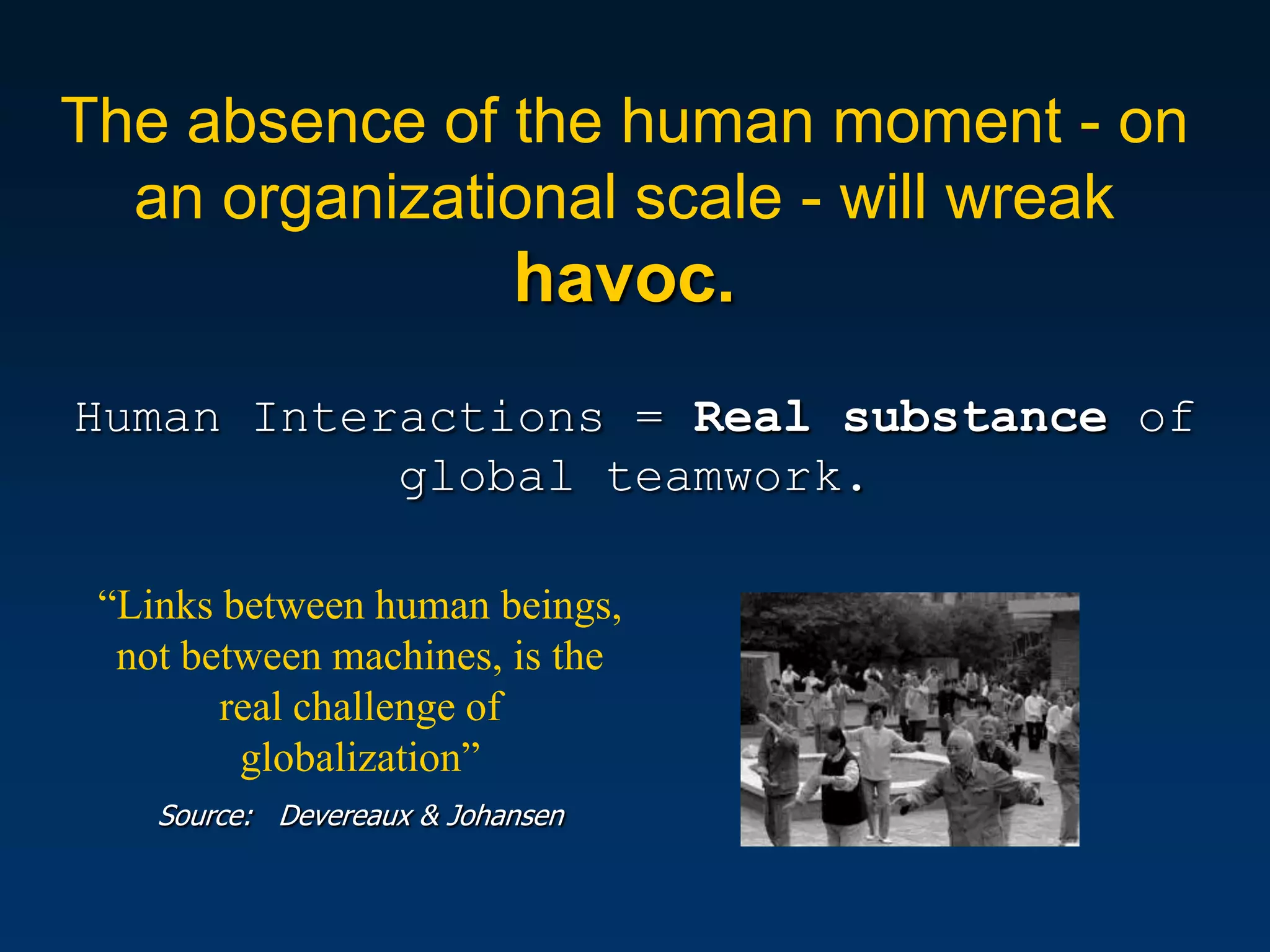
The absence of the human moment - on
  an organizational scale - will wreak
                            havoc.
Human Interactions = Real substance of
           global teamwork.

 “Links between human beings,
  not between machines, is the
        real challenge of
         globalization”
    Source: Devereaux & Johansen
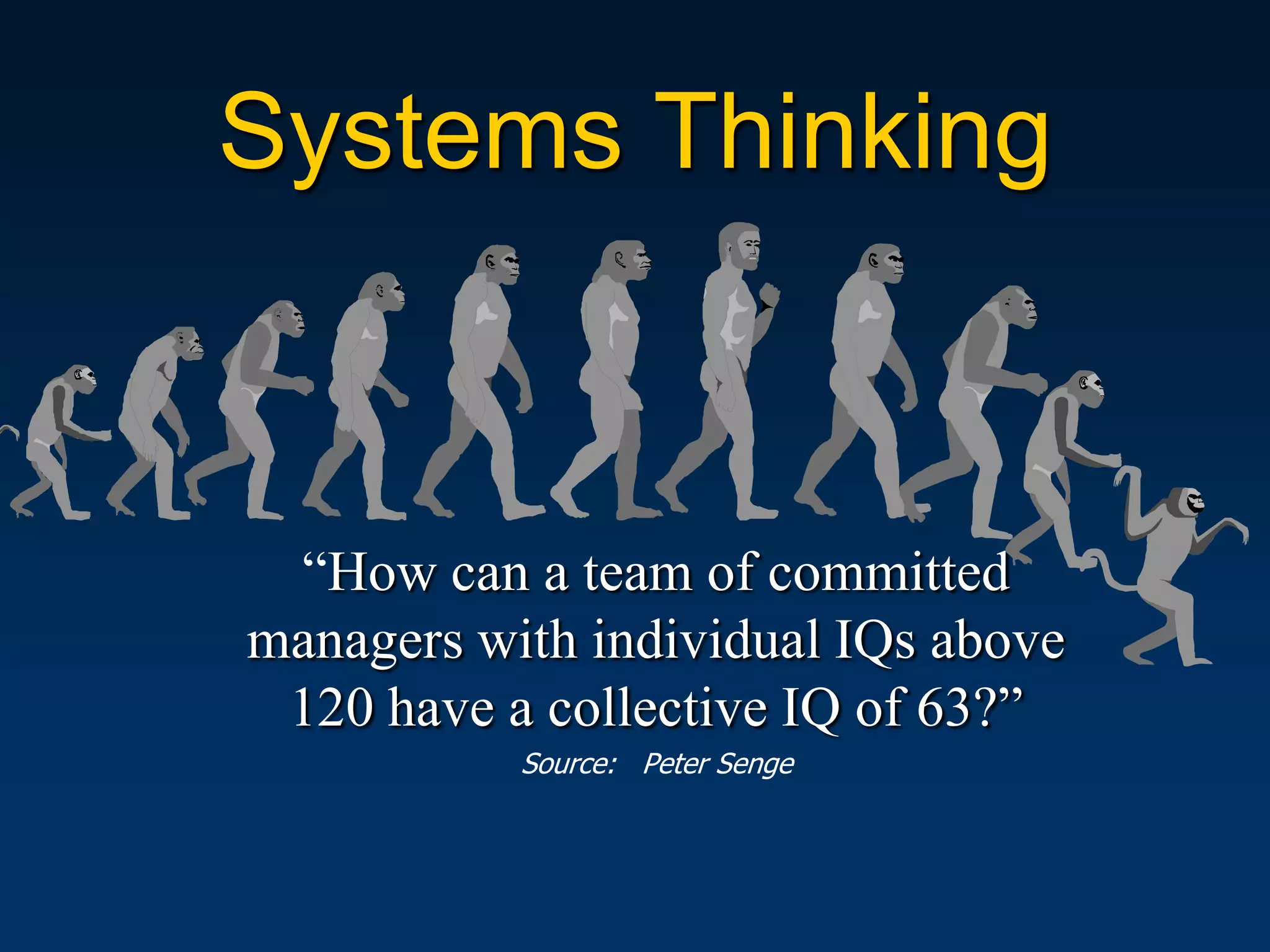
Systems Thinking


 “How can a team of committed
managers with individual IQs above
 120 have a collective IQ of 63?”
           Source: Peter Senge
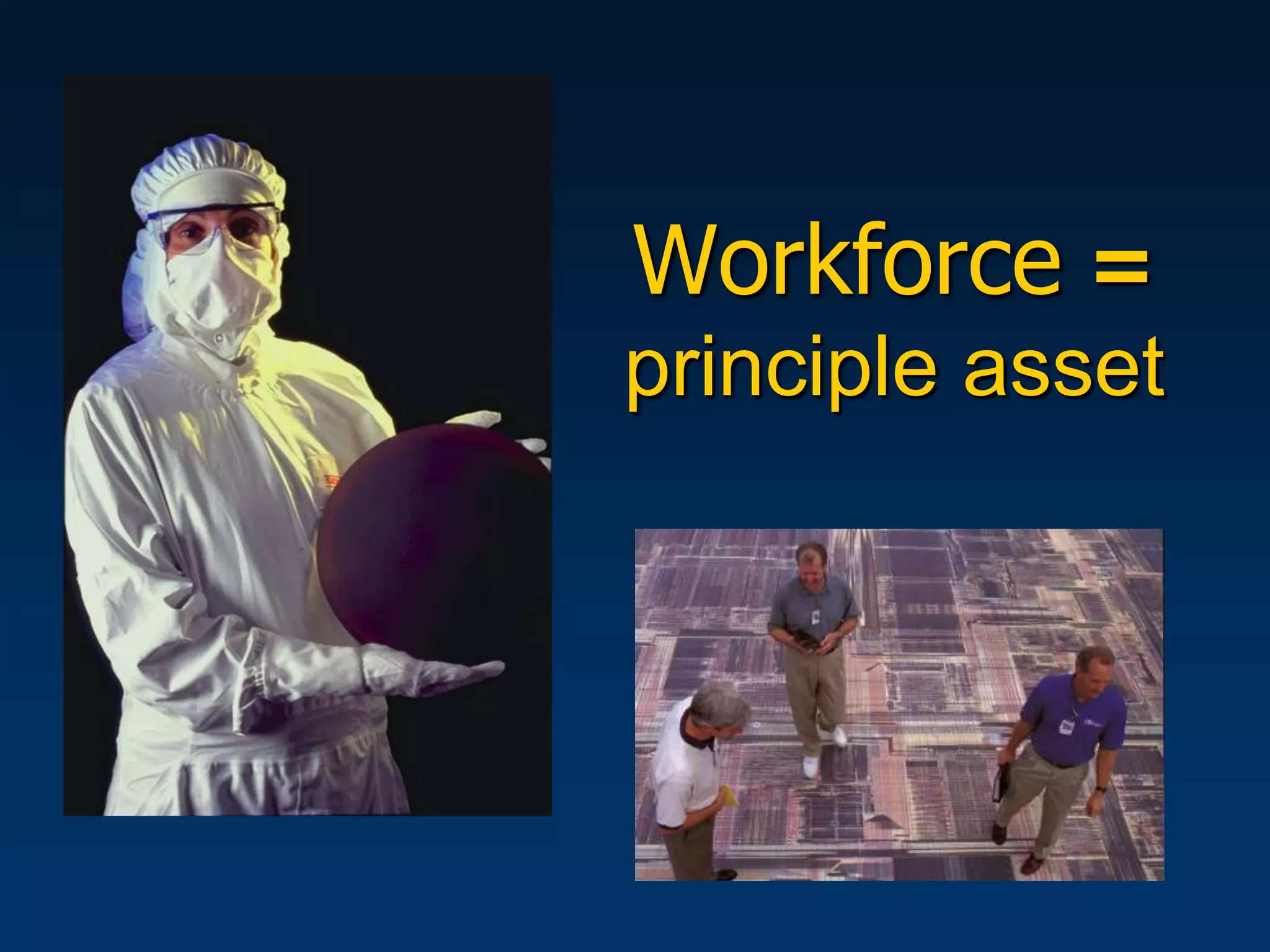
Workforce =
principle asset
Global organizations have a need for
    not only scientists, computer
  wizards, and engineers, but for a
highly-skilled workforce as a whole.


          This means
        everyone!
GlobalThink: The Skills Sets
•   Technical competency
•   Flexible, self-directed team player
•   Ability to cope with ambiguity
•   Strong communications skills
•   Ability to stay current - maintain work skills
•   Ability to deal with change
•   Sense of responsibility
•   Ability to appreciate a diverse multicultural
    workplace
Changing Nature of Work
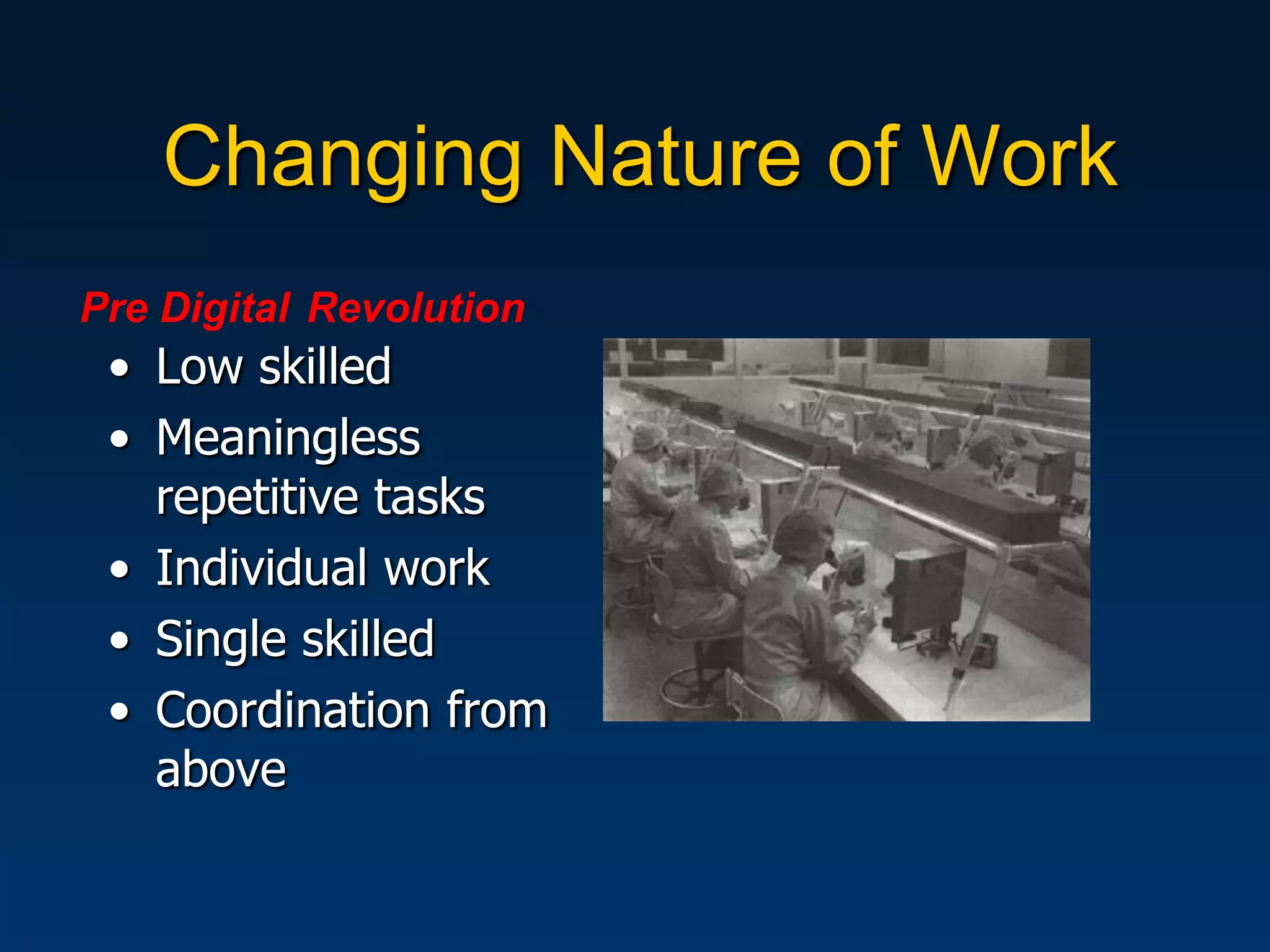
Pre Digital Revolution
 • Low skilled
 • Meaningless
   repetitive tasks
 • Individual work
 • Single skilled
 • Coordination from
   above
Changing Nature of Work
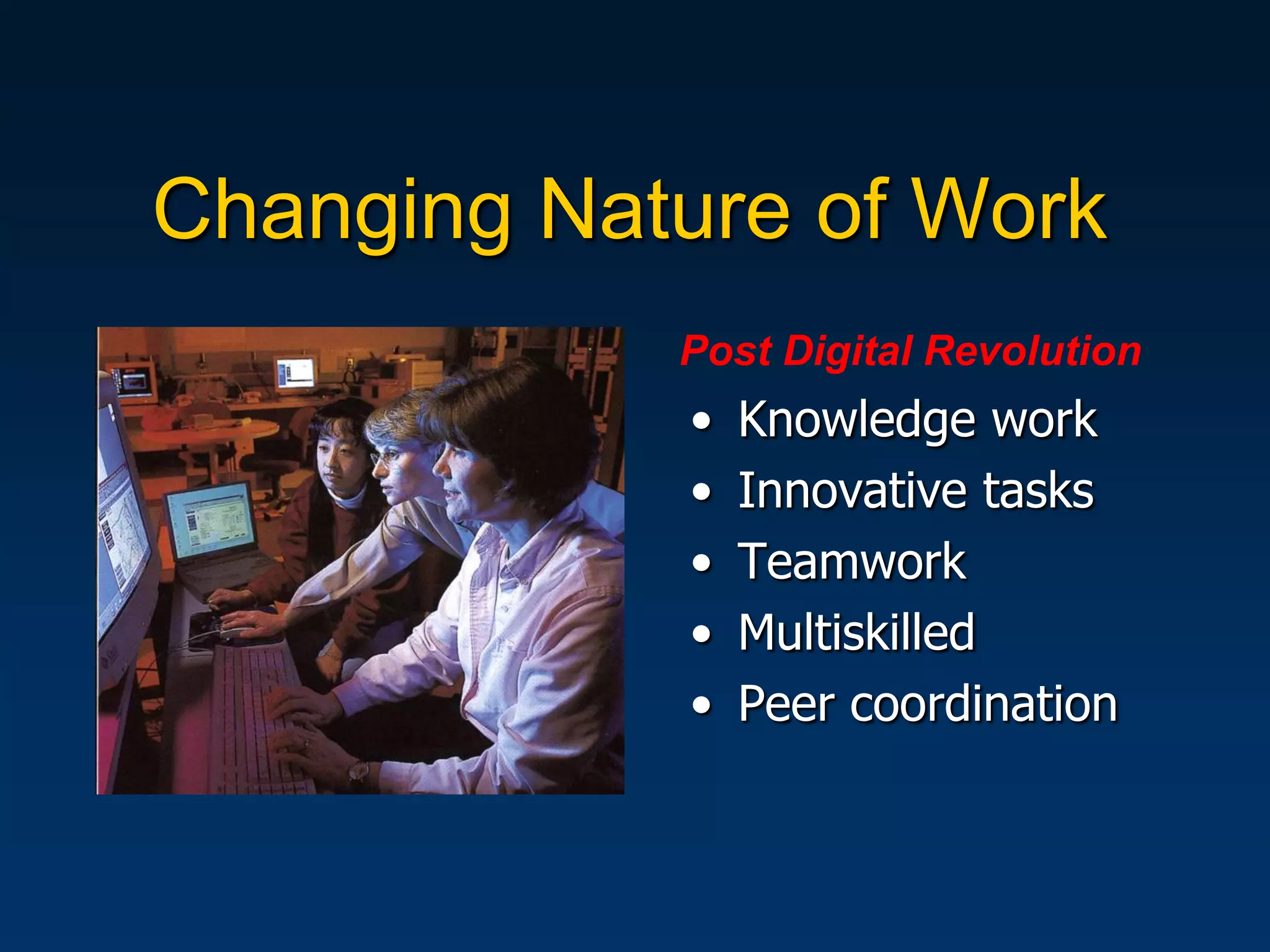
            Post Digital Revolution
            •   Knowledge work
            •   Innovative tasks
            •   Teamwork
            •   Multiskilled
            •   Peer coordination
Multicultural Intelligence

      Globalization demands that
individuals develop cultural literacy --
a sense of comfort that enables them
  to be effective anywhere, anytime,
             with anyone.
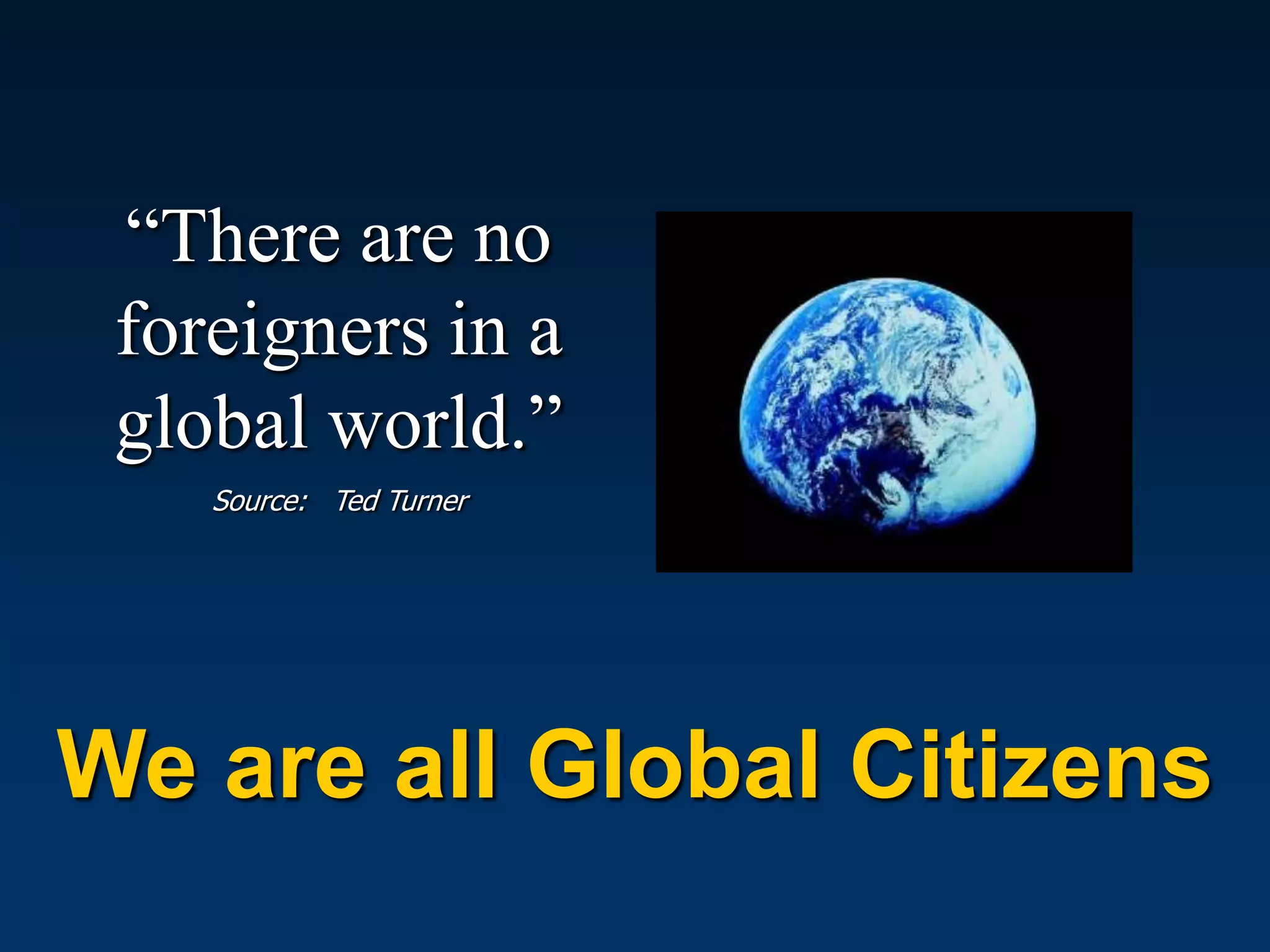
“There are no
 foreigners in a
 global world.”
    Source: Ted Turner


We are all Global Citizens
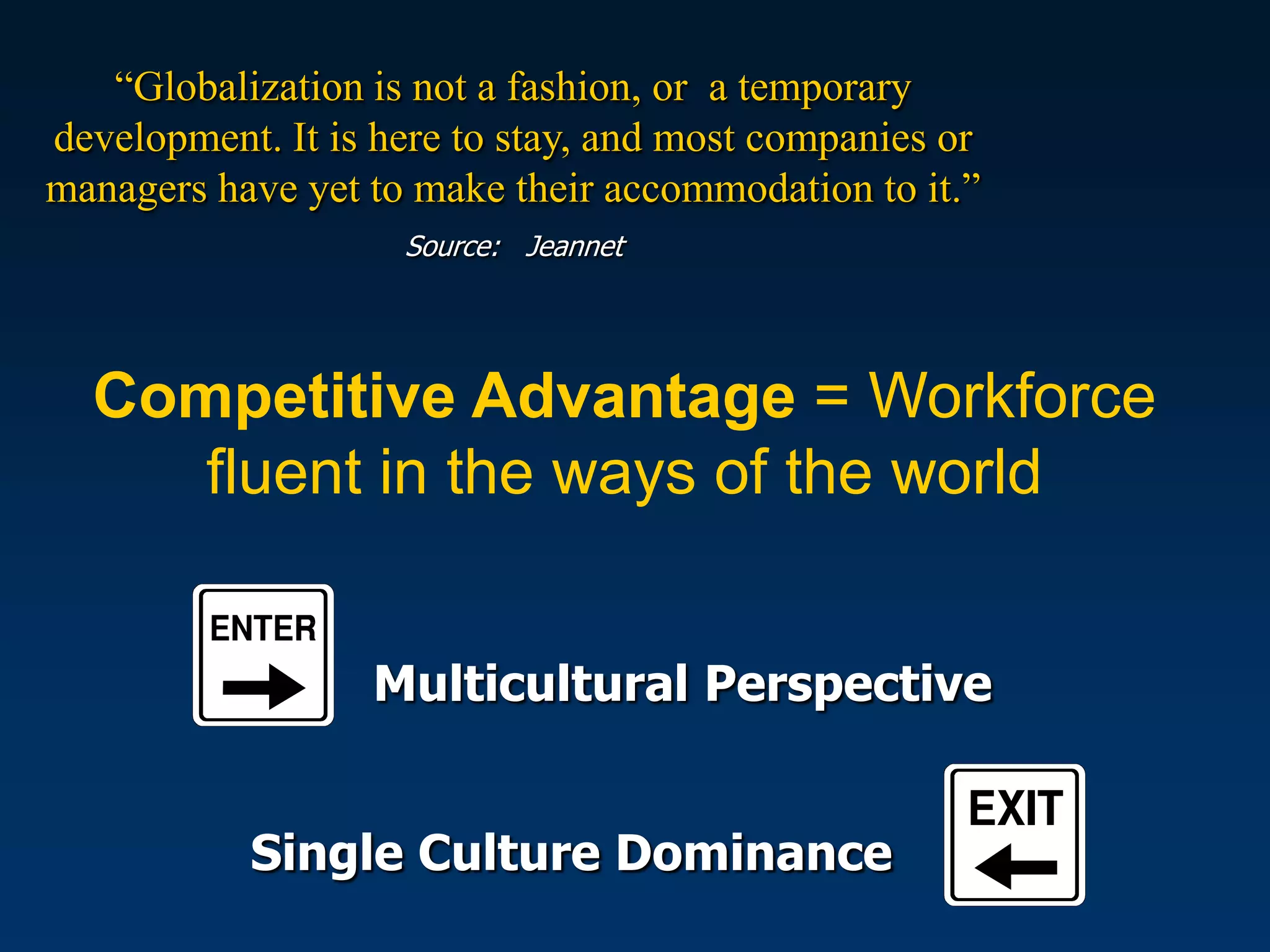
“Globalization is not a fashion, or a temporary
development. It is here to stay, and most companies or
managers have yet to make their accommodation to it.”
                    Source: Jeannet


  Competitive Advantage = Workforce
     fluent in the ways of the world


                  Multicultural Perspective


           Single Culture Dominance
Born in the USA

Ethnocentricity?
 Organizations tend to develop
  policies and strategies that
concentrate on nationals of the
      headquarters country.
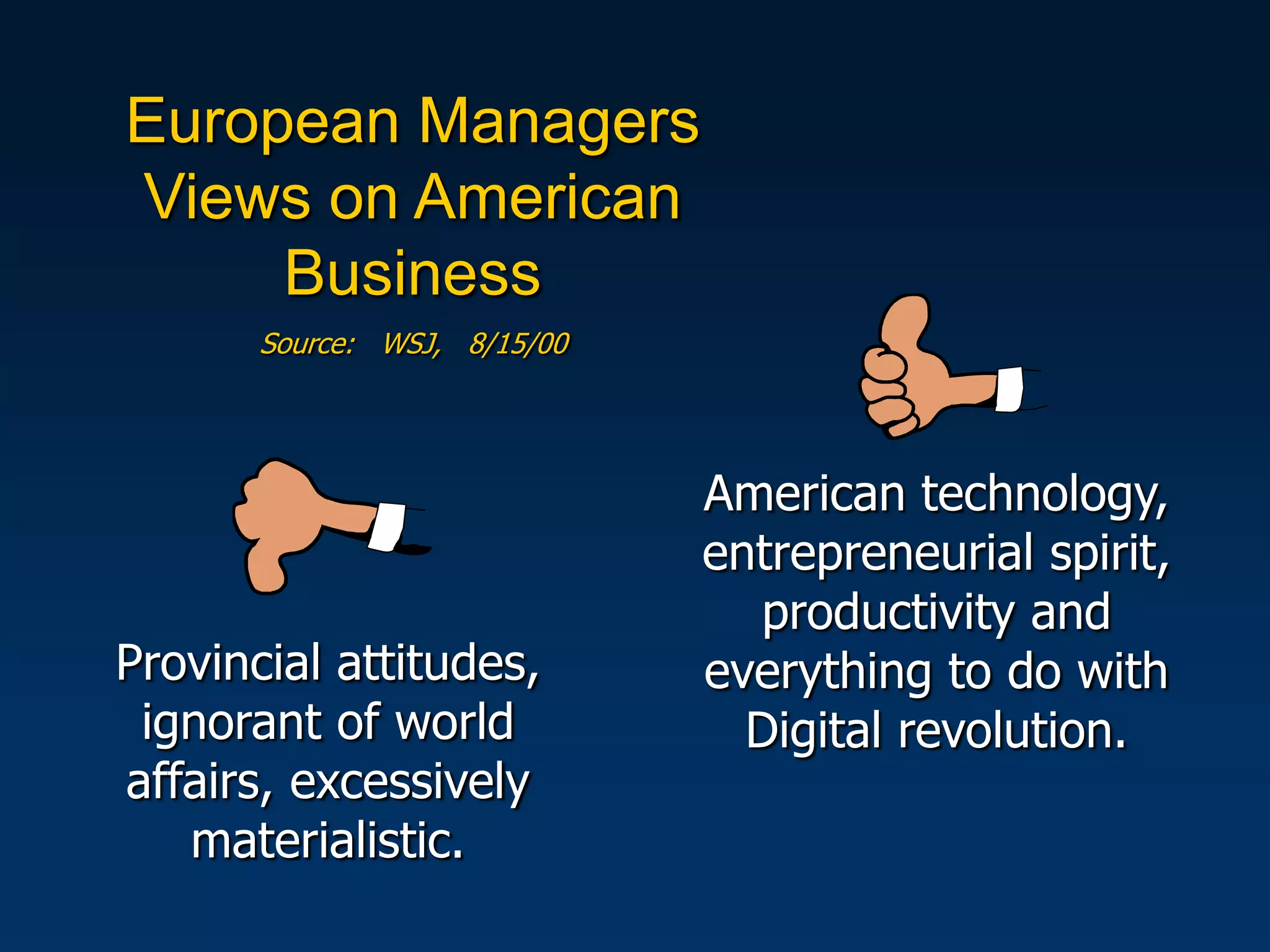
European Managers
Views on American
     Business
       Source: WSJ, 8/15/00


                              American technology,
                              entrepreneurial spirit,
                                productivity and
Provincial attitudes,         everything to do with
 ignorant of world              Digital revolution.
affairs, excessively
   materialistic.
Get a Global
 Mindset
     Your First Steps

Declare global citizenship.
Accept equality of all cultures represented by
stakeholders.
Recognize that our own cultural provincialities
are invisible to you (and maybe us).
“Most multinational
companies now do a
     good job of
   globalizing the
supply chains for all
 their essential raw
 materials -- except
 human resources”
    Source: Quelch & Bloom
While operations, sales, and marketing have
generally made significant progress to go
global………   HR is lagging behind


Missing in action:

 Global human resources
Global HR
Essentials
Develop, nurture, and reward global diversity.

Globally connect all HR activities.

Build global awareness at all levels - in all HR groups and
locations. No exceptions.

Create an Global HR mission statement.
The only real core competency
  is growing talent globally


 The right talent in the right
   places at the right times.

Ihrmglobalthink3

  • 1.
    GlobalThink 101 A Primer for International Human Resources Management
  • 2.
    Teamwork Systems Organization Thinking Development Fusion Intellectual Development Global Acculturation Knowledge Management Elements of GlobalThink
  • 3.
    The New Occupy Wall Street Global Social Media (Dis)Order Post Digital Revolution Global Knowledge Economy Arab Spring Age of Networked Intelligence Global Economic Dominos
  • 4.
    Digital Rules “Ask mostpeople which is the dominant language on planet Earth, and they will reply that it’s either English or Chinese. A good guess, but they would be wrong. Binary is now dominant, with computers and machines having more conversations every working day than a sum total of mankind going back to the birth of Eve.” Source: Peter Conchrane Binary Dominant language planet earth =
  • 5.
    Technology = Key enabler of globalization Globalization and technology are mutually reinforcing drivers of change.
  • 6.
    Multinational enterprises aretransforming into global learning organizations.
  • 7.
    Learning Learning is about work, Convergence work is about learning. Work
  • 8.
    Learning is integralto work - a by-product of work rather than something done in isolation - say like most training
  • 9.
    Characteristics of the Global L.O. • Global free flow of knowledge • Systems thinking • Thinking “outside the cubicle” • Learning = key strategic global asset • Self-directed lifelong learning
  • 10.
    Global Free Flowof Knowledge Ability to rapidly develop and access information globally – The key enabler of global performance
  • 11.
    Often knowledge islocked away inside remote departments, BUs and communities of practice and fiercely protected from both competitors, and cohorts.
  • 12.
    People must willingly contributeknowledge. “You can have the perfect e-mail system. The perfect groupware. Be wired up the gazoo. But it doesn’t mean that the organization will rapidly - and exhaustively and in a timely fashion-share information.” Source: Tom Peters
  • 13.
    I get it! Knowledge is not neat or simple. It is a complex mixture of various elements; it is fluid and formally structured and comes in at least two flavors. Knowledge = Information in Context + Understanding
  • 14.
    Knowledge Data “It is all to easy to confuse data with with knowledge and information with information technology.” Source: Peter Drucker
  • 15.
    Knowledge originates and residesin people’s minds. In the post digital revolution, global organizations are more dependent on people than ever. Knowledge = transient asset
  • 16.
    Knowledge Management (Kind of) Defined “KM is a lofty concept - debated by academics and even doubted by some analysts - and one that few businesses have mastered.” Source: InformationWeek KM = A term used to describe the evolving practice of accelerating learning and performance by connecting and coordinating organizational intellectual resources and information technology.
  • 17.
    Learning Knowledge A process that generates knowledge Explicit Tacit Hard skills, Skills, facts that can judgment, be codified intuition, operational know-how
  • 18.
    KM Problem: Formal systems can’t easily store “most workplace learning or transfer tacit goes on unbudgeted, knowledge. unplanned, and uncaptured by the organization…Up to Knowledge treated 70% of workplace learning as a tangible. is informal.” KM frequently Source: Center for Workforce Development study isolated in IT department. Overvalue explicit - Undervalue tacit
  • 19.
    Reality Learning Knowledge A process that generates knowledge Explicit Tacit Most KM practice Hard skills, Skills, focuses on collecting, facts that can judgment, distributing, re-using, be codified intuition, and measuring existing operational codified knowledge and know-how information.
  • 20.
    OK, Let’s converttacit to explicit! “A logic goal is to identify critical knowledge assets codify them.” Source: Annie Brooking Looks Good on Paper, But….
  • 21.
    The KM Fix The crux of the KM issue is not information, information technology, or knowledge. It’s really about how you get busy people to support KM. The answer has much more to do with motivation and leadership than bits and bytes.
  • 22.
    The Hard Part Emotional Engagement Knowing Doing Knowledge & information are vitally important, Motivation but ultimately it’s performance that Acknowledge emotion counts.
  • 23.
    “Organizations learn onlythrough individuals who learn. Individual learning does not guarantee organizational learning. But without it no organizational learning occurs.” Source: Pete Senge It’s Personal
  • 24.
    The absence ofthe human moment - on an organizational scale - will wreak havoc. Human Interactions = Real substance of global teamwork. “Links between human beings, not between machines, is the real challenge of globalization” Source: Devereaux & Johansen
  • 25.
    Systems Thinking “Howcan a team of committed managers with individual IQs above 120 have a collective IQ of 63?” Source: Peter Senge
  • 26.
  • 27.
    Global organizations havea need for not only scientists, computer wizards, and engineers, but for a highly-skilled workforce as a whole. This means everyone!
  • 28.
    GlobalThink: The SkillsSets • Technical competency • Flexible, self-directed team player • Ability to cope with ambiguity • Strong communications skills • Ability to stay current - maintain work skills • Ability to deal with change • Sense of responsibility • Ability to appreciate a diverse multicultural workplace
  • 29.
    Changing Nature ofWork Pre Digital Revolution • Low skilled • Meaningless repetitive tasks • Individual work • Single skilled • Coordination from above
  • 30.
    Changing Nature ofWork Post Digital Revolution • Knowledge work • Innovative tasks • Teamwork • Multiskilled • Peer coordination
  • 31.
    Multicultural Intelligence Globalization demands that individuals develop cultural literacy -- a sense of comfort that enables them to be effective anywhere, anytime, with anyone.
  • 32.
    “There are no foreigners in a global world.” Source: Ted Turner We are all Global Citizens
  • 33.
    “Globalization is nota fashion, or a temporary development. It is here to stay, and most companies or managers have yet to make their accommodation to it.” Source: Jeannet Competitive Advantage = Workforce fluent in the ways of the world Multicultural Perspective Single Culture Dominance
  • 34.
    Born in theUSA Ethnocentricity? Organizations tend to develop policies and strategies that concentrate on nationals of the headquarters country.
  • 35.
    European Managers Views onAmerican Business Source: WSJ, 8/15/00 American technology, entrepreneurial spirit, productivity and Provincial attitudes, everything to do with ignorant of world Digital revolution. affairs, excessively materialistic.
  • 36.
    Get a Global Mindset Your First Steps Declare global citizenship. Accept equality of all cultures represented by stakeholders. Recognize that our own cultural provincialities are invisible to you (and maybe us).
  • 37.
    “Most multinational companies nowdo a good job of globalizing the supply chains for all their essential raw materials -- except human resources” Source: Quelch & Bloom
  • 38.
    While operations, sales,and marketing have generally made significant progress to go global……… HR is lagging behind Missing in action: Global human resources
  • 39.
    Global HR Essentials Develop, nurture,and reward global diversity. Globally connect all HR activities. Build global awareness at all levels - in all HR groups and locations. No exceptions. Create an Global HR mission statement.
  • 40.
    The only realcore competency is growing talent globally The right talent in the right places at the right times.