DRIVERS OF KNOWLEDGE
MANAGEMENT
LECTURE -9
Knowledge Management
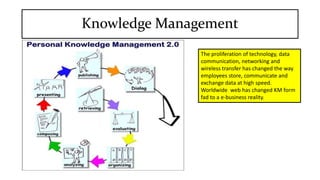
The proliferation of technology, data
communication, networking and
wireless transfer has changed the way
employees store, communicate and
exchange data at high speed.
Worldwide web has changed KM form
fad to a e-business reality.
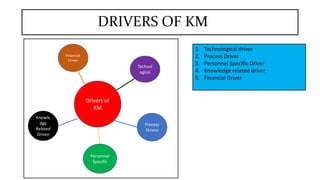
DRIVERS OF KM
Drivers of
KM
Financial
Driver
Personnel
Specific
Process
Driven
Technol
ogical
Knowle
dge
Related
Driven
1. Technological driver
2. Process Driver
3. Personnel Specific Driver
4. Knowledge related driver
5. Financial Driver
KEY CHALLENGES OF KM
• 1. Biggest challenges KM vendors face is convincing Corporates and
employees.
• 2. How knowledge can be captured , processed, and acted upon.
• 3. Addressing areas of collaborations
• 4. Continuing researching KM to expand current capabilities
• 5. How to deal with tacit Knowledge.
COMMON TOOLS FOR KM
• 1. Internet and Intranet
• 2.Internet installation
• 3. Developing videoconferencing system
• 4. Sharing best practices through the organization.
• Creating Knowledge centre
• 6. Creating Working Knowledge Team from all departments.
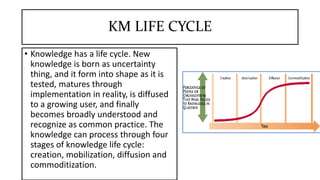
KM LIFE CYCLE
• Knowledge has a life cycle. New
knowledge is born as uncertainty
thing, and it form into shape as it is
tested, matures through
implementation in reality, is diffused
to a growing user, and finally
becomes broadly understood and
recognize as common practice. The
knowledge can process through four
stages of knowledge life cycle:
creation, mobilization, diffusion and
commoditization.
Creation
• 1.
• In this initial state of knowledge formation, people cannot define or
understand completely the idea or emerging knowledge, even for the
person who proposes it due to the perplexing nature of knowledge
creation. Knowledge creation with respect to its commercial viability
can be tested at the early stage of the life-cycle. A nurturing business
environment that is open to new ideas and adaptable to changes is
necessitated for creativity and experimentation. In order to create
that culture, adjustments must be made in the following areas:

Drivers of knowledge management l 9

  • 1.
  • 2.
    Knowledge Management The proliferationof technology, data communication, networking and wireless transfer has changed the way employees store, communicate and exchange data at high speed. Worldwide web has changed KM form fad to a e-business reality.
  • 3.
    DRIVERS OF KM Driversof KM Financial Driver Personnel Specific Process Driven Technol ogical Knowle dge Related Driven 1. Technological driver 2. Process Driver 3. Personnel Specific Driver 4. Knowledge related driver 5. Financial Driver
  • 4.
    KEY CHALLENGES OFKM • 1. Biggest challenges KM vendors face is convincing Corporates and employees. • 2. How knowledge can be captured , processed, and acted upon. • 3. Addressing areas of collaborations • 4. Continuing researching KM to expand current capabilities • 5. How to deal with tacit Knowledge.
  • 5.
    COMMON TOOLS FORKM • 1. Internet and Intranet • 2.Internet installation • 3. Developing videoconferencing system • 4. Sharing best practices through the organization. • Creating Knowledge centre • 6. Creating Working Knowledge Team from all departments.
  • 6.
    KM LIFE CYCLE •Knowledge has a life cycle. New knowledge is born as uncertainty thing, and it form into shape as it is tested, matures through implementation in reality, is diffused to a growing user, and finally becomes broadly understood and recognize as common practice. The knowledge can process through four stages of knowledge life cycle: creation, mobilization, diffusion and commoditization.
  • 9.
    Creation • 1. • Inthis initial state of knowledge formation, people cannot define or understand completely the idea or emerging knowledge, even for the person who proposes it due to the perplexing nature of knowledge creation. Knowledge creation with respect to its commercial viability can be tested at the early stage of the life-cycle. A nurturing business environment that is open to new ideas and adaptable to changes is necessitated for creativity and experimentation. In order to create that culture, adjustments must be made in the following areas: