CHAPTER 1
KNOWLEDGE
MANAGEMENT
Presented By:
Apoorva Rashmi
KNOWLEDGE MANAGEMENT CONCEPT
 Knowledge Management is a process of
identifying, capturing, organizing and disseminating
the intellectual assets of that are critical to the
organization’s long term performance
TYPES OF KNOWLEDGE
 Tacit Knowledge
 Knowledge which draws on the accumulated experience and
learning of a person and which is hard to reproduce or share
with others
 Explicit Knowledge
 Knowledge which can be shared with others-it can be
documented, categorized and transmitted to others and
illustrated to others
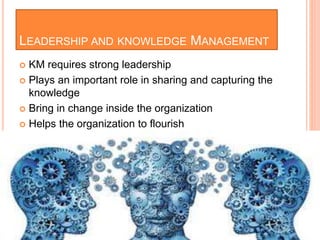
LEADERSHIP AND KNOWLEDGE MANAGEMENT
 KM requires strong leadership
 Plays an important role in sharing and capturing the
knowledge
 Bring in change inside the organization
 Helps the organization to flourish
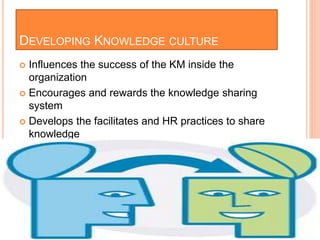
DEVELOPING KNOWLEDGE CULTURE
 Influences the success of the KM inside the
organization
 Encourages and rewards the knowledge sharing
system
 Develops the facilitates and HR practices to share
knowledge
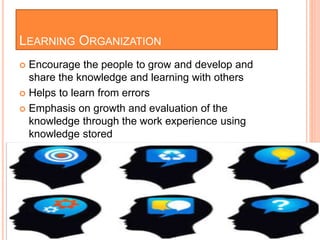
LEARNING ORGANIZATION
 Encourage the people to grow and develop and
share the knowledge and learning with others
 Helps to learn from errors
 Emphasis on growth and evaluation of the
knowledge through the work experience using
knowledge stored
DEVELOPMENTAL ORGANIZATION
 Paved way for the more advanced growth and the
evolution that might happen in KM
 Systems and values are reshaped to reflect the
changing environment
 Enhance the elements of the corporate activity,
reshapes the core business and its positioning and
the placement in the external market
APPLYING KNOWLEDGE TO THE WORKFORCE
PRACTICE
 Make the employees embrace the KM principles
inside the organization
 Build strong and supportive systems to encourage
the knowledge inside the organization
 Knowledge based practices are the result of the
cultural, leadership, systematic process which
operate inside the organization
KNOWLEDGE SYSTEMS
 It involves building the infrastructure necessary for
the capturing and sharing of the knowledge
 Includes wide variety of professionals namely
 technologists
 Librarians
 systems managers
 database managers &
 human resource specialists
 It may pose challenges to the traditional
organizations
 But once KM system is developed it acts as an
asset in long run
KNOWLEDGE SERVICE
 KM is a difficult process
 Takes lot of input, time & process to convert ideas
into reality
 Transition process should be well planned out
 It needs cohesive & integrated system to smooth
transition from phase to phase
 Empower the workers in the application of the
knowledge
STRATEGIC KNOWLEDGE LEADERSHIP
 Knowledge leader: is a person who sets a new
direction for the KM and drives it forward
 Roles of Strategic Knowledge leadership:
 Developing the big picture
 Actively promoting good knowledge management
process
 Managing the overall KM programme
 Catalyst for connection, coordination and collaboration
 Conceptual abilities
 Involvement
 inquisitive
THANK
YOU

Knowledge Management

  • 1.
  • 2.
    KNOWLEDGE MANAGEMENT CONCEPT Knowledge Management is a process of identifying, capturing, organizing and disseminating the intellectual assets of that are critical to the organization’s long term performance
  • 3.
    TYPES OF KNOWLEDGE Tacit Knowledge  Knowledge which draws on the accumulated experience and learning of a person and which is hard to reproduce or share with others  Explicit Knowledge  Knowledge which can be shared with others-it can be documented, categorized and transmitted to others and illustrated to others
  • 4.
    LEADERSHIP AND KNOWLEDGEMANAGEMENT  KM requires strong leadership  Plays an important role in sharing and capturing the knowledge  Bring in change inside the organization  Helps the organization to flourish
  • 5.
    DEVELOPING KNOWLEDGE CULTURE Influences the success of the KM inside the organization  Encourages and rewards the knowledge sharing system  Develops the facilitates and HR practices to share knowledge
  • 6.
    LEARNING ORGANIZATION  Encouragethe people to grow and develop and share the knowledge and learning with others  Helps to learn from errors  Emphasis on growth and evaluation of the knowledge through the work experience using knowledge stored
  • 7.
    DEVELOPMENTAL ORGANIZATION  Pavedway for the more advanced growth and the evolution that might happen in KM  Systems and values are reshaped to reflect the changing environment  Enhance the elements of the corporate activity, reshapes the core business and its positioning and the placement in the external market
  • 8.
    APPLYING KNOWLEDGE TOTHE WORKFORCE PRACTICE  Make the employees embrace the KM principles inside the organization  Build strong and supportive systems to encourage the knowledge inside the organization  Knowledge based practices are the result of the cultural, leadership, systematic process which operate inside the organization
  • 9.
    KNOWLEDGE SYSTEMS  Itinvolves building the infrastructure necessary for the capturing and sharing of the knowledge  Includes wide variety of professionals namely  technologists  Librarians  systems managers  database managers &  human resource specialists  It may pose challenges to the traditional organizations  But once KM system is developed it acts as an asset in long run
  • 10.
    KNOWLEDGE SERVICE  KMis a difficult process  Takes lot of input, time & process to convert ideas into reality  Transition process should be well planned out  It needs cohesive & integrated system to smooth transition from phase to phase  Empower the workers in the application of the knowledge
  • 11.
    STRATEGIC KNOWLEDGE LEADERSHIP Knowledge leader: is a person who sets a new direction for the KM and drives it forward  Roles of Strategic Knowledge leadership:  Developing the big picture  Actively promoting good knowledge management process  Managing the overall KM programme  Catalyst for connection, coordination and collaboration  Conceptual abilities  Involvement  inquisitive
  • 12.