Krishan Bheenick
Senior Programme Coordinator
Knowledge Management
Overview of CTA’s
approach to Knowledge
Management
including the Knowledge
Ecosystems Approach
GFRAS/AFAAS/MEAS/GIZ
East Africa EAS Policy Dialogue
Kampala Uganda, 16-18 June 2015
Your reflections so far today…
Agricultural Innovation Systems – definition, concept
RAS in an AIS – role; functions; linkages; exchanges, KM
AFAAS has prioritised Knowledge Management as a priority
in its strategic direction...
So what is Knowledge
Management?
Exercise 1: Speed dating…to find KM?
Speed dating of 5 minutes (one round) (5 min)
Q1. Introduce yourself (Job/ function)
Q2. Which knowledge did you recently share in a network?
Q3. How would you describe knowledge management; and
what would be your definition?
In groups of 6, write the definition of knowledge
management in 10 words or less (5 min)
Share with the others ( 10 min)
Exercise 1: Speed dating…to find KM?
Did you share knowledge or information?
Where was the knowledge stored?
Are there several definitions? And perspectives?
What is Knowledge Management?
• Proposed definition:
KM is the discipline of enabling individuals, teams and
entire organisations to collectively and systematically
create, harvest, share and apply knowledge, in order to
better achieve their objectives, improve their practices and
learn from what they do.
Knowledge = Fn (Information * Skills, Experience, Attitude)
Why KM is important
• Improves the ability of individuals and organisations to
solve problems better, adapt, evolve to meet changing
requirements, and survive disruptive changes
• KM approaches can help communities to generate,
access, share and employ knowledge to get their
collective voices heard
• KM is also ultimately linked to longer-term
development goals which seek to empower
communities in developing and transition countries to
participate effectively in development processes
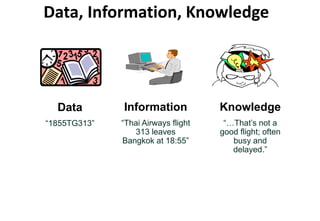
Data, Information, Knowledge
Data
“1855TG313”
Information
“Thai Airways flight
313 leaves
Bangkok at 18:55”
Knowledge
“…That’s not a
good flight; often
busy and
delayed.”
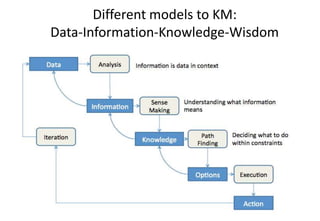
Different models to KM:
Data-Information-Knowledge-Wisdom
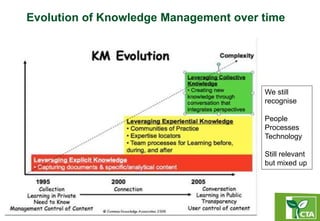
Evolution of Knowledge Management over time
We still
recognise
People
Processes
Technology
Still relevant
but mixed up
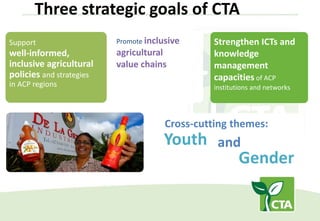
Cross-cutting themes:
Three strategic goals of CTA
Promote inclusive
agricultural
value chains
Support
well-informed,
inclusive agricultural
policies and strategies
in ACP regions
Strengthen ICTs and
knowledge
management
capacities of ACP
institutions and networks
Youth and
Gender
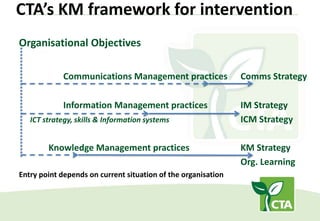
CTA’s KM framework for intervention
Organisational Objectives
Communications Management practices Comms Strategy
Information Management practices IM Strategy
ICT strategy, skills & Information systems ICM Strategy
Knowledge Management practices KM Strategy
Org. Learning
Entry point depends on current situation of the organisation
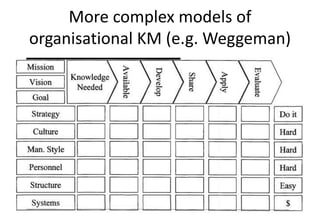
More complex models of
organisational KM (e.g. Weggeman)
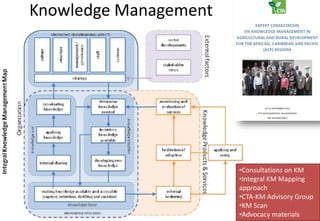
Knowledge Management
•Consultations on KM
•Integral KM Mapping
approach
•CTA-KM Advisory Group
•KM Scan
•Advocacy materials
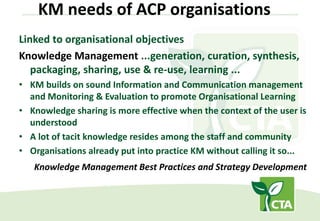
KM needs of ACP organisations
Linked to organisational objectives
Knowledge Management ...generation, curation, synthesis,
packaging, sharing, use & re-use, learning ...
• KM builds on sound Information and Communication management
and Monitoring & Evaluation to promote Organisational Learning
• Knowledge sharing is more effective when the context of the user is
understood
• A lot of tacit knowledge resides among the staff and community
• Organisations already put into practice KM without calling it so...
Knowledge Management Best Practices and Strategy Development
KM demands from partners
Europe
EC looking for KM
support to
delegations
International Organisations
GODAN looking for KM support showing data use with
Farmers Organsations
CGIAR interested in comparing KM scan approaches
Caribbean
IICA applying KM
scan methodology
on Value Chains
Pacific
SPC KM Strategy &
roll out to countries;
Implementing KM
platforms
Eastern Africa
-EAFF -Request for
KM support
-ASARECA KI-Hub &
Think Tank
Farmers Org KM
Southern Africa
-CCARDESA IKM
system
-Southern Af
Beans Research
Network
Org & Net KM
West Africa
SAKSS
KM around data for
policy making in
CAADP
Central Africa
-CORAF KM
Directorate
-CORAF-ReGICA
Networking
KM
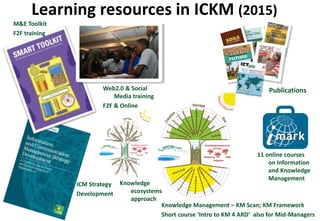
Learning resources in ICKM (2015)
ICM Strategy
Development
M&E Toolkit
F2F training
PublicationsWeb2.0 & Social
Media training
F2F & Online
Knowledge Management – KM Scan; KM Framework
Short course ‘Intro to KM 4 ARD’ also for Mid-Managers
11 online courses
on Information
and Knowledge
Management
Knowledge
ecosystems
approach
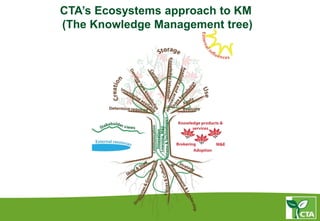
CTA’s Ecosystems approach to KM
(The Knowledge Management tree)
Exercise 2: How do we assess KM in RAS?
Multiple perspectives of RAS:
(a) Country level RAS organisation e.g. Public sector
Extension Institution
(b) Country level Network – e.g. Country Forum
(c) Regional level Network – e.g. RESCAR-AOC,
AFAAS, RELASER etc.
CHOOSE ONE PERSPECTIVE
(3 groups)
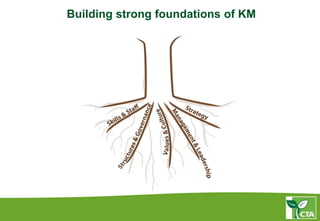
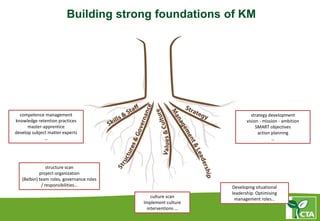
Building strong foundations of KM
culture scan
Implement culture
interventions …
structure scan
project-organization
(Belbin) team roles, governance roles
/ responsibilities… Developing situational
leadership. Optimising
management roles…
competence management
knowledge retention practices
master-apprentice
develop subject matter experts
…
strategy development
vision - mission - ambition
SMART objectives
action planning
…
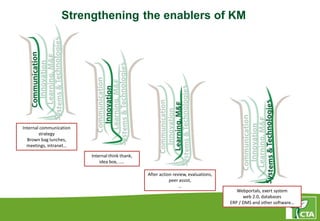
Strengthening the enablers of KM
Internal communication
strategy
Brown bag lunches,
meetings, intranet…
Internal think thank,
idea box, ..…
After action review, evaluations,
peer assist,
…
Webportals, exert system
web 2.0, databases
ERP / DMS and other software…
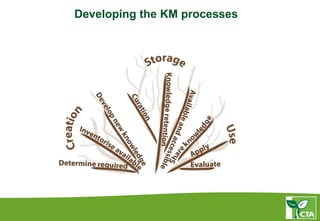
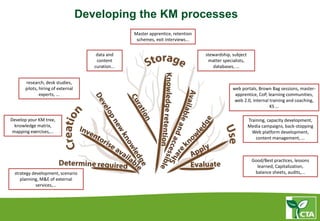
Developing the KM processes
research, desk studies,
pilots, hiring of external
experts, ...
Develop your KM tree,
knowledge matrix,
mapping exercises,...
strategy development, scenario
planning, M&E of external
services,...
data and
content
curation...
stewardship, subject
matter specialists,
databases, ...
Master apprentice, retention
schemes, exit interviews...
web portals, Brown Bag sessions, master-
apprentice, CoP, learning communities,
web 2.0, internal training and coaching,
KS ...
Training, capacity development,
Media campaigns, back-stopping
Web platform development,
content management, ...
Good/Best practices, lessons
learned, Capitalization,
balance sheets, audits,...
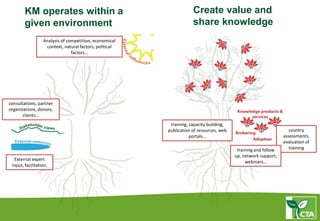
KM operates within a
given environment
Analysis of competition, economical
context, natural factors, political
factors…
consultations, partner
organizations, donors,
clients…
External expert
input, facilitation,
Create value and
share knowledge
training, capacity building,
publication of resources, web
portals...
country
assessments,
evaluation of
trainingtraining and follow
up, network support,
webinars...
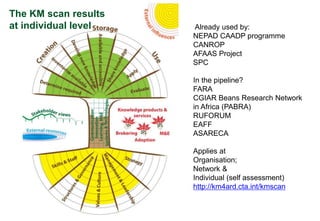
The KM scan results
at individual level Already used by:
NEPAD CAADP programme
CANROP
AFAAS Project
SPC
In the pipeline?
FARA
CGIAR Beans Research Network
in Africa (PABRA)
RUFORUM
EAFF
ASARECA
Applies at
Organisation;
Network &
Individual (self assessment)
http://km4ard.cta.int/kmscan
Feedback session- what are we learning?
• Knowledge Ecosystems approach as a framework
for systematic analysis, making sense and
prioritising?
• Reducing complexity following analysis to define
action (AFAAS experience with CIKM Strategy)
• Do you always need to start with a KM strategy?
• Would you recommend the approach and
associated methods and tools.
Gallery walk of the KM trees
• A walk in the forest of trees constituting the
Knowledge Ecosystem of RAS at different levels?
• 5 minutes explanation by each group
• Optional: Pitch to a decision maker (2 minutes)
– What's your point about KM?
– What's in it for me?
– What do you want me to do?
• Try out the individual KM scan at km4ard.cta.int/kmscan
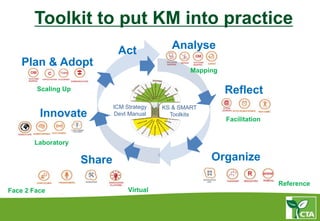
Organize
Reflect
Facilitation
Act
Share
Face 2 Face
Plan & Adopt
Scaling Up
Mapping
Laboratory
Innovate
Toolkit to put KM into practice
Virtual
Reference
ICM Strategy
Devt Manual
KS & SMART
Toolkits
Analyse
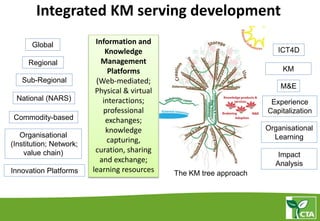
Integrated KM serving development
Regional
Sub-Regional
National (NARS)
Organisational
(Institution; Network;
value chain)
Innovation Platforms
Commodity-based
Information and
Knowledge
Management
Platforms
(Web-mediated;
Physical & virtual
interactions;
professional
exchanges;
knowledge
capturing,
curation, sharing
and exchange;
learning resources The KM tree approach
ICT4D
KM
M&E
Organisational
Learning
Impact
Analysis
Experience
Capitalization
Global
P
E
R
F
E
C
T
T
E
A
M
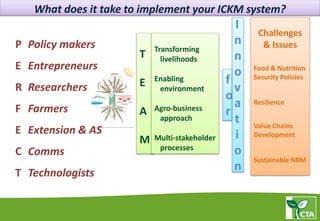
Policy makers
Entrepreneurs
Researchers
Farmers
Extension & AS
Comms
Technologists
Transforming
livelihoods
Enabling
environment
Agro-business
approach
Multi-stakeholder
processes
Challenges
& Issues
Food & Nutrition
Security Policies
Resilience
Value Chains
Development
Sustainable NRM
I
n
n
o
v
a
t
i
o
n
f
o
r
What does it take to implement your ICKM system?
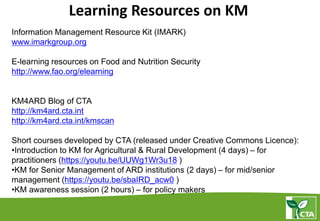
Learning Resources on KM
Information Management Resource Kit (IMARK)
www.imarkgroup.org
E-learning resources on Food and Nutrition Security
http://www.fao.org/elearning
KM4ARD Blog of CTA
http://km4ard.cta.int
http://km4ard.cta.int/kmscan
Short courses developed by CTA (released under Creative Commons Licence):
•Introduction to KM for Agricultural & Rural Development (4 days) – for
practitioners (https://youtu.be/UUWg1Wr3u18 )
•KM for Senior Management of ARD institutions (2 days) – for mid/senior
management (https://youtu.be/sbaIRD_acw0 )
•KM awareness session (2 hours) – for policy makers
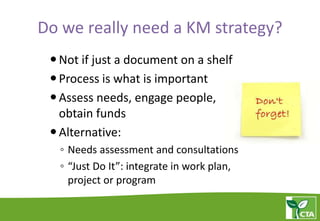
Do we really need a KM strategy?
Not if just a document on a shelf
Process is what is important
Assess needs, engage people,
obtain funds
Alternative:
◦ Needs assessment and consultations
◦ “Just Do It”: integrate in work plan,
project or program
Linking KM to institutional goals
• Use most recent organisational strategy or
strategic planning
• Use organisational objectives or goals
• Look for those that can be supported by creating,
sharing and applying knowledge
• Align the KM objectives to the strategic
objectives
Focusing your KM interventions
KM is broad, where will you focus your
energy, resources, etc. ?
What will bring maximum impact? for e.g:
◦ Internal vs external focus
◦ Collect vs connect focus
Identify the key knowledge needs within
the organisation and provide a plan for
addressing these
Structure of a KM strategy document
• KM definition
• Vision statement
• Strategic objectives
• Activities or initiatives associated
with each objectives
• Annex: Implementation plan
• Annex: M&E plan

KNOWLEDGE MANAGEMENT BY CTA

  • 1.
    Krishan Bheenick Senior ProgrammeCoordinator Knowledge Management Overview of CTA’s approach to Knowledge Management including the Knowledge Ecosystems Approach GFRAS/AFAAS/MEAS/GIZ East Africa EAS Policy Dialogue Kampala Uganda, 16-18 June 2015
  • 2.
    Your reflections sofar today… Agricultural Innovation Systems – definition, concept RAS in an AIS – role; functions; linkages; exchanges, KM AFAAS has prioritised Knowledge Management as a priority in its strategic direction... So what is Knowledge Management?
  • 3.
    Exercise 1: Speeddating…to find KM? Speed dating of 5 minutes (one round) (5 min) Q1. Introduce yourself (Job/ function) Q2. Which knowledge did you recently share in a network? Q3. How would you describe knowledge management; and what would be your definition? In groups of 6, write the definition of knowledge management in 10 words or less (5 min) Share with the others ( 10 min)
  • 4.
    Exercise 1: Speeddating…to find KM? Did you share knowledge or information? Where was the knowledge stored? Are there several definitions? And perspectives?
  • 5.
    What is KnowledgeManagement? • Proposed definition: KM is the discipline of enabling individuals, teams and entire organisations to collectively and systematically create, harvest, share and apply knowledge, in order to better achieve their objectives, improve their practices and learn from what they do. Knowledge = Fn (Information * Skills, Experience, Attitude)
  • 6.
    Why KM isimportant • Improves the ability of individuals and organisations to solve problems better, adapt, evolve to meet changing requirements, and survive disruptive changes • KM approaches can help communities to generate, access, share and employ knowledge to get their collective voices heard • KM is also ultimately linked to longer-term development goals which seek to empower communities in developing and transition countries to participate effectively in development processes
  • 7.
    Data, Information, Knowledge Data “1855TG313” Information “ThaiAirways flight 313 leaves Bangkok at 18:55” Knowledge “…That’s not a good flight; often busy and delayed.”
  • 8.
    Different models toKM: Data-Information-Knowledge-Wisdom
  • 9.
    Evolution of KnowledgeManagement over time We still recognise People Processes Technology Still relevant but mixed up
  • 10.
    Cross-cutting themes: Three strategicgoals of CTA Promote inclusive agricultural value chains Support well-informed, inclusive agricultural policies and strategies in ACP regions Strengthen ICTs and knowledge management capacities of ACP institutions and networks Youth and Gender
  • 11.
    CTA’s KM frameworkfor intervention Organisational Objectives Communications Management practices Comms Strategy Information Management practices IM Strategy ICT strategy, skills & Information systems ICM Strategy Knowledge Management practices KM Strategy Org. Learning Entry point depends on current situation of the organisation
  • 12.
    More complex modelsof organisational KM (e.g. Weggeman)
  • 13.
    Knowledge Management •Consultations onKM •Integral KM Mapping approach •CTA-KM Advisory Group •KM Scan •Advocacy materials
  • 14.
    KM needs ofACP organisations Linked to organisational objectives Knowledge Management ...generation, curation, synthesis, packaging, sharing, use & re-use, learning ... • KM builds on sound Information and Communication management and Monitoring & Evaluation to promote Organisational Learning • Knowledge sharing is more effective when the context of the user is understood • A lot of tacit knowledge resides among the staff and community • Organisations already put into practice KM without calling it so... Knowledge Management Best Practices and Strategy Development
  • 15.
    KM demands frompartners Europe EC looking for KM support to delegations International Organisations GODAN looking for KM support showing data use with Farmers Organsations CGIAR interested in comparing KM scan approaches Caribbean IICA applying KM scan methodology on Value Chains Pacific SPC KM Strategy & roll out to countries; Implementing KM platforms Eastern Africa -EAFF -Request for KM support -ASARECA KI-Hub & Think Tank Farmers Org KM Southern Africa -CCARDESA IKM system -Southern Af Beans Research Network Org & Net KM West Africa SAKSS KM around data for policy making in CAADP Central Africa -CORAF KM Directorate -CORAF-ReGICA Networking KM
  • 16.
    Learning resources inICKM (2015) ICM Strategy Development M&E Toolkit F2F training PublicationsWeb2.0 & Social Media training F2F & Online Knowledge Management – KM Scan; KM Framework Short course ‘Intro to KM 4 ARD’ also for Mid-Managers 11 online courses on Information and Knowledge Management Knowledge ecosystems approach
  • 17.
    CTA’s Ecosystems approachto KM (The Knowledge Management tree)
  • 18.
    Exercise 2: Howdo we assess KM in RAS? Multiple perspectives of RAS: (a) Country level RAS organisation e.g. Public sector Extension Institution (b) Country level Network – e.g. Country Forum (c) Regional level Network – e.g. RESCAR-AOC, AFAAS, RELASER etc. CHOOSE ONE PERSPECTIVE (3 groups)
  • 19.
  • 20.
    Building strong foundationsof KM culture scan Implement culture interventions … structure scan project-organization (Belbin) team roles, governance roles / responsibilities… Developing situational leadership. Optimising management roles… competence management knowledge retention practices master-apprentice develop subject matter experts … strategy development vision - mission - ambition SMART objectives action planning …
  • 21.
    Strengthening the enablersof KM Internal communication strategy Brown bag lunches, meetings, intranet… Internal think thank, idea box, ..… After action review, evaluations, peer assist, … Webportals, exert system web 2.0, databases ERP / DMS and other software…
  • 22.
  • 23.
    Developing the KMprocesses research, desk studies, pilots, hiring of external experts, ... Develop your KM tree, knowledge matrix, mapping exercises,... strategy development, scenario planning, M&E of external services,... data and content curation... stewardship, subject matter specialists, databases, ... Master apprentice, retention schemes, exit interviews... web portals, Brown Bag sessions, master- apprentice, CoP, learning communities, web 2.0, internal training and coaching, KS ... Training, capacity development, Media campaigns, back-stopping Web platform development, content management, ... Good/Best practices, lessons learned, Capitalization, balance sheets, audits,...
  • 24.
    KM operates withina given environment Analysis of competition, economical context, natural factors, political factors… consultations, partner organizations, donors, clients… External expert input, facilitation, Create value and share knowledge training, capacity building, publication of resources, web portals... country assessments, evaluation of trainingtraining and follow up, network support, webinars...
  • 25.
    The KM scanresults at individual level Already used by: NEPAD CAADP programme CANROP AFAAS Project SPC In the pipeline? FARA CGIAR Beans Research Network in Africa (PABRA) RUFORUM EAFF ASARECA Applies at Organisation; Network & Individual (self assessment) http://km4ard.cta.int/kmscan
  • 26.
    Feedback session- whatare we learning? • Knowledge Ecosystems approach as a framework for systematic analysis, making sense and prioritising? • Reducing complexity following analysis to define action (AFAAS experience with CIKM Strategy) • Do you always need to start with a KM strategy? • Would you recommend the approach and associated methods and tools.
  • 27.
    Gallery walk ofthe KM trees • A walk in the forest of trees constituting the Knowledge Ecosystem of RAS at different levels? • 5 minutes explanation by each group • Optional: Pitch to a decision maker (2 minutes) – What's your point about KM? – What's in it for me? – What do you want me to do? • Try out the individual KM scan at km4ard.cta.int/kmscan
  • 28.
    Organize Reflect Facilitation Act Share Face 2 Face Plan& Adopt Scaling Up Mapping Laboratory Innovate Toolkit to put KM into practice Virtual Reference ICM Strategy Devt Manual KS & SMART Toolkits Analyse
  • 29.
    Integrated KM servingdevelopment Regional Sub-Regional National (NARS) Organisational (Institution; Network; value chain) Innovation Platforms Commodity-based Information and Knowledge Management Platforms (Web-mediated; Physical & virtual interactions; professional exchanges; knowledge capturing, curation, sharing and exchange; learning resources The KM tree approach ICT4D KM M&E Organisational Learning Impact Analysis Experience Capitalization Global
  • 30.
    P E R F E C T T E A M Policy makers Entrepreneurs Researchers Farmers Extension &AS Comms Technologists Transforming livelihoods Enabling environment Agro-business approach Multi-stakeholder processes Challenges & Issues Food & Nutrition Security Policies Resilience Value Chains Development Sustainable NRM I n n o v a t i o n f o r What does it take to implement your ICKM system?
  • 31.
    Learning Resources onKM Information Management Resource Kit (IMARK) www.imarkgroup.org E-learning resources on Food and Nutrition Security http://www.fao.org/elearning KM4ARD Blog of CTA http://km4ard.cta.int http://km4ard.cta.int/kmscan Short courses developed by CTA (released under Creative Commons Licence): •Introduction to KM for Agricultural & Rural Development (4 days) – for practitioners (https://youtu.be/UUWg1Wr3u18 ) •KM for Senior Management of ARD institutions (2 days) – for mid/senior management (https://youtu.be/sbaIRD_acw0 ) •KM awareness session (2 hours) – for policy makers
  • 32.
    Do we reallyneed a KM strategy? Not if just a document on a shelf Process is what is important Assess needs, engage people, obtain funds Alternative: ◦ Needs assessment and consultations ◦ “Just Do It”: integrate in work plan, project or program
  • 33.
    Linking KM toinstitutional goals • Use most recent organisational strategy or strategic planning • Use organisational objectives or goals • Look for those that can be supported by creating, sharing and applying knowledge • Align the KM objectives to the strategic objectives
  • 34.
    Focusing your KMinterventions KM is broad, where will you focus your energy, resources, etc. ? What will bring maximum impact? for e.g: ◦ Internal vs external focus ◦ Collect vs connect focus Identify the key knowledge needs within the organisation and provide a plan for addressing these
  • 35.
    Structure of aKM strategy document • KM definition • Vision statement • Strategic objectives • Activities or initiatives associated with each objectives • Annex: Implementation plan • Annex: M&E plan

Editor's Notes

  • #6 Trainers notes This is the proposed definition for this course but it isn’t the only definition. Make sure that you mention this. It is a purposely broad definition to try to encapsulate what we will cover in the course.
  • #7 Trainers notes Mention that there are the three different levels: people often think of KM more at the level of the first bullet point but it can have a much bigger impact.
  • #8 7
  • #12 Any ICKM strategy has to be linked with the organisation’s objectives. Some Comms, Information and Knowledge Management practices already exist in the workplace.
  • #31 PARTNERSHIPS
  • #33 Trainers notes Link from last slide: … so now that you know what is the content of a KM strategy document, the question you may have is, do we really need one? Alternative: example for “Just Do It”: in 2006, FAO did not want to launch into a KM strategy process right away but wanted to focus on three knowledge areas, which they called “pillars” (Knowledge Networks, Best Practices and Ask FAO). Their idea was to work on the low hanging fruit, get some focused work done and results before launching into a KM strategy process.
  • #34 Trainers notes Link from last slide: … this was a strategic decision at FAO based on the organisational objectives at the time. The linkage is what is most important, KM cannot be done in a vacuum. KM initiatives need to support an organisation’ strategic objectives.
  • #35 Trainers notes Link from last slide: … so why would you want a KM strategy? For one thing, it helps to focus your KM interventions KM is broad…: for e.g internal vs external: some organisations start with a “getting the house in order” focus. Collect vs connect: some organisations focus more on capturing explicit knowledge, while others create more spaces for tacit knowledge exchange, for e.g. in communities of practice, where practitioners share their expertise. Identify the key…: emphasize that the end goal is to have a stronger organisation.
  • #36 Trainers notes Link from last slide: … so what does a KM strategy document look like? KM strategy documents encompass different content but usually have a similar format that includes these elements. KM definition: YOUR own KM definition, the one that better represents your context and your work.